Apply for Drip or Sprinkler Irrigation in Khyber Pakhtunkhwa Under KPIAIP
Apply for a subsidised drip or sprinkler system in Khyber Pakhtunkhwa: the OFWM form, the 3 documents, the farmer's share, the rules, and the December 2026 end.
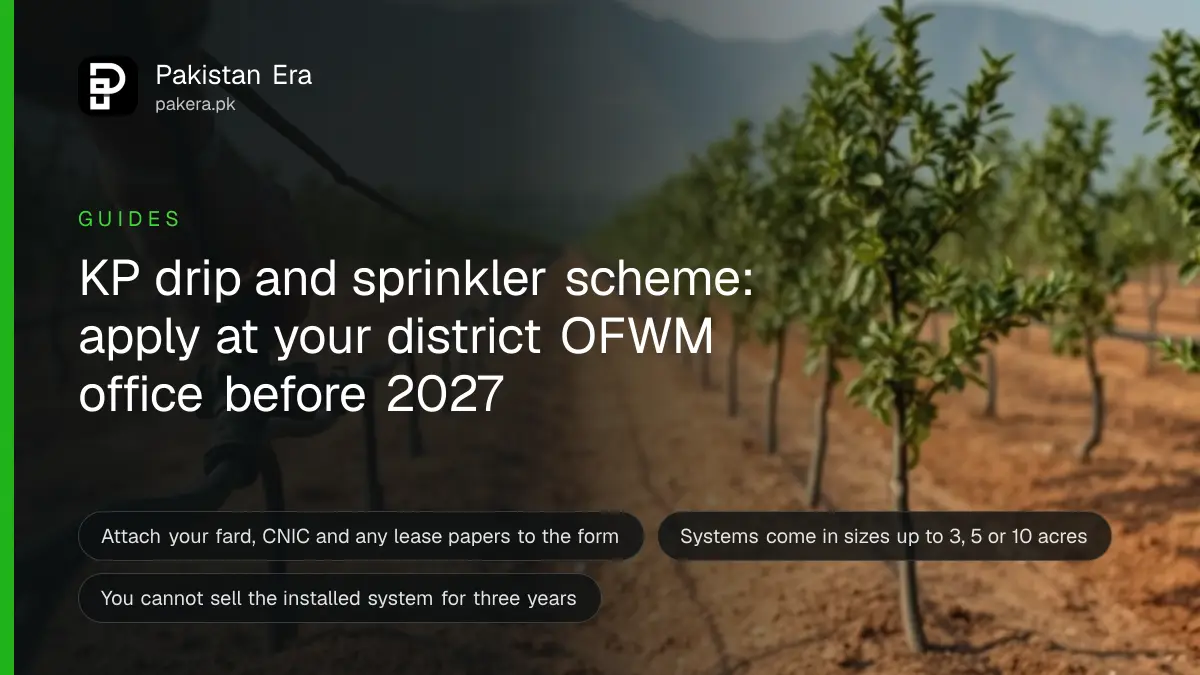
Farmers in Khyber Pakhtunkhwa apply for a subsidised drip or sprinkler system on a one-page form at their district On-Farm Water Management (OFWM) office. Attach a copy of your fard, your CNIC and any lease papers. The World Bank project paying for it is due to close on 31 December 2026.
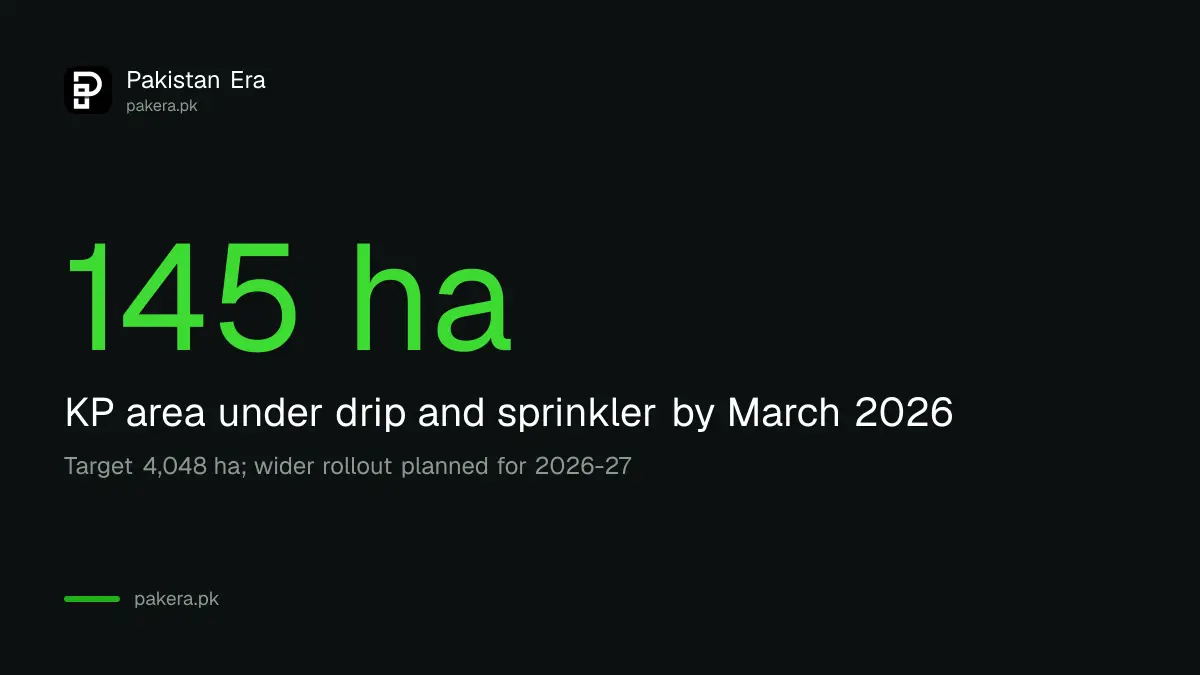
The scheme runs under the Khyber Pakhtunkhwa Irrigated Agriculture Improvement Project, known as KPIAIP. The World Bank's April 2026 progress report, with figures to March, shows drip and sprinkler systems covering only 145 hectares, against a target of 4,048. That gap is the reason to apply now. The report says the wider rollout will start in 2026-27.
We read the OFWM application form, its notification of approved supply companies and its 2025-26 rate lists on 3 October 2026. We also read the project's financing and project agreements and its two latest World Bank reports. We did not apply, because a farm is needed to do so.
What the KP drip and sprinkler scheme gives you
The scheme pays part of the cost of installing a high efficiency irrigation system, called HEIS, on your farm. You pay the rest. A drip system waters each plant through pipes, and a sprinkler sprays water over the field. Both use far less water than flooding.
The financing agreement with the World Bank lists three sizes of system: up to 3 acres, up to 5 acres and up to 10 acres. OFWM's rate lists for 2025-26 also cover solar pumping, hose reel and centre pivot systems, plus fruit plants and vegetable farming for the land you convert.
| Item | What the official papers say |
|---|---|
| Project | KPIAIP, World Bank credit 6456-PK |
| Run by | Directorate General OFWM, Agriculture Department KP |
| System sizes | Up to 3, 5 or 10 acres |
| Who pays | Shared between the project and the farmer, by agreement |
| Installed by | One of 26 pre-identified supply companies |
| Project closing date | 31 December 2026, after a one year extension |
Here is the catch. Neither the OFWM website nor the project documents publish the farmer's share as a percentage. The project agreement says the split is written into a three-way agreement between OFWM, the supply company and you. Ask the district office for the figure for your system before you sign anything.
Who can apply in Khyber Pakhtunkhwa
Any farmer with land and a water source can apply, whether the land is owned, leased or farmed on a share basis. The form asks for your total acres, your water source and your crops. You must also say you are ready to pay your share.
The form gives three choices for how you hold the land: your own, on lease, or as a sharecropper. It gives three choices for water: a tubewell, a canal or a well. If your tubewell has no power yet, the form asks about electricity and solar separately, and a tubewell electricity connection takes time, so start that early.
Drip suits orchards and vegetables best. Our honest view is that a farmer growing only wheat on flat canal land will see less benefit than an orchard owner on a slope.
How to apply for a drip or sprinkler system in KP
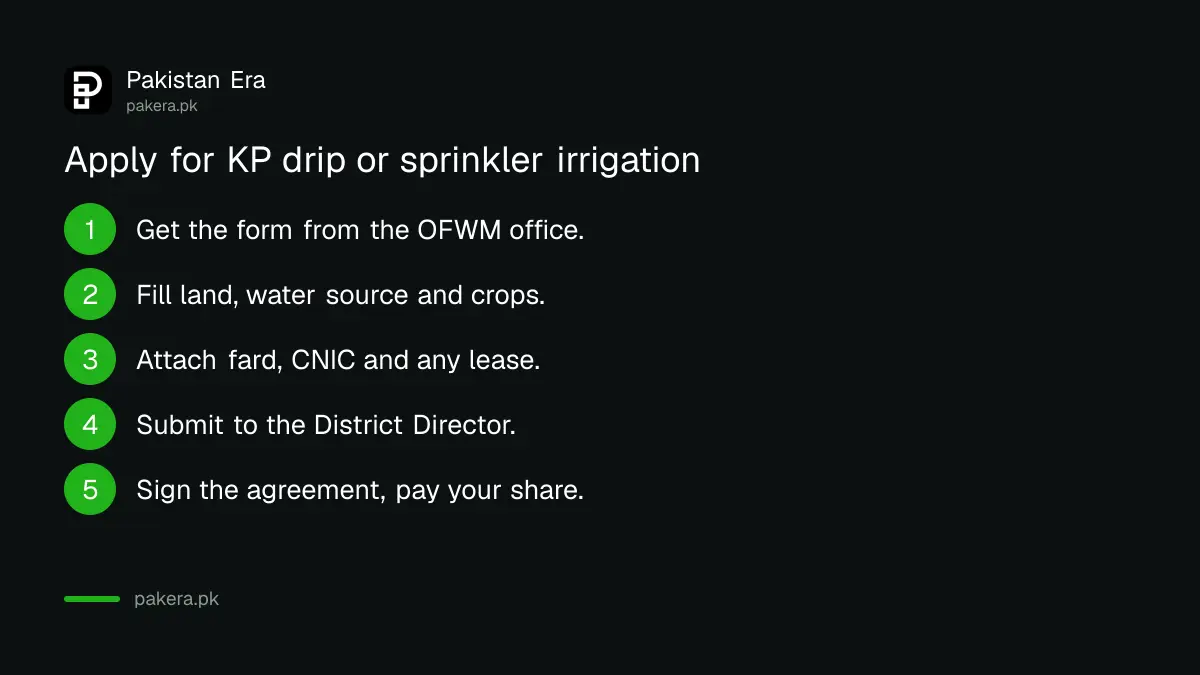
Write to the District Director or District Officer of OFWM on the department's application form. Fill in your land, water and crop details, sign or thumb print it, and attach three documents. The office then checks your farm before any agreement.
- Get the HEIS application form from your district OFWM office, or download it from the Downloads page of ofwm.kp.gov.pk. It is in Urdu.
- Fill in your name, father's or husband's name, farm address, tehsil, district and phone number.
- Give your total acres and how you hold them, the water source, any motor or diesel engine horsepower, your crops, and electricity or solar details.
- Sign or add your thumb print, write your CNIC number, and attach the documents listed below.
- Submit it to the District Director or District Officer OFWM. After the survey, you sign the three-way agreement and pay your share.
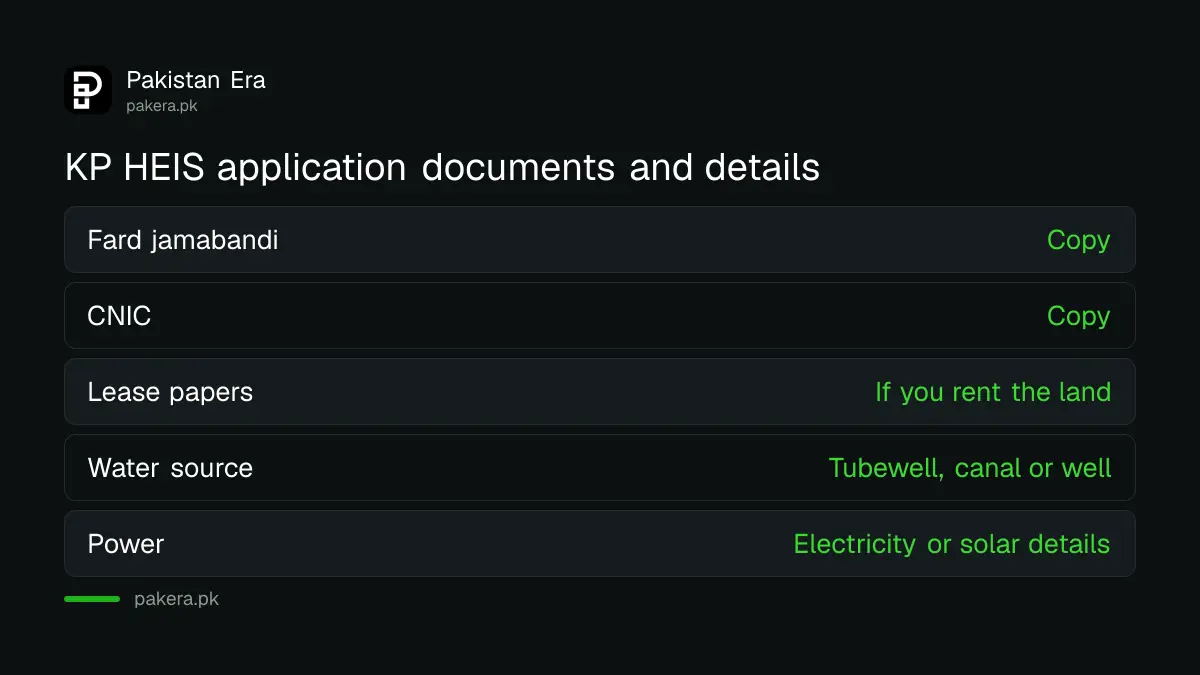
Documents to attach
- A copy of the fard jamabandi, the land ownership record. You can get a KP fard online before you go.
- A copy of your computerised CNIC.
- Lease papers, if you farm rented land.
Rules you accept when the system is installed
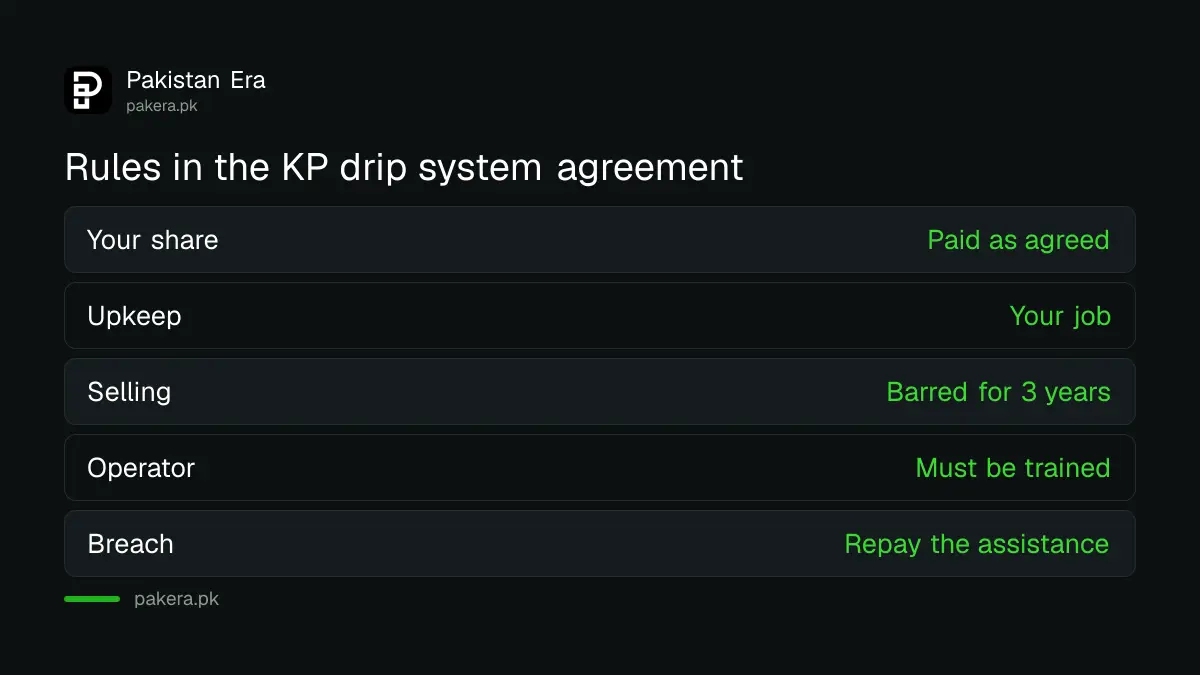
Once installed, the system is yours to run and repair. You cannot sell, transfer or hand it over for three years. If you break the agreement, you must pay back the help you received. Your operator must also be trained.
These duties come from the project agreement between the World Bank and the KP government. They bind every farmer who takes a system:
- Pay your share as set out in your agreement.
- Run and maintain the system yourself after installation.
- Keep it for three years. No sale, transfer or handover in any form.
- Train the operator through the supply company or OFWM.
- Repay the assistance if you break the agreement's terms.
The supply company is not your free choice from the open market. OFWM pre-identified 26 firms in a notification dated 3 December 2025, renewable each year on performance. Each firm must certify that it will supply certified plants and seedlings.
Why the KP scheme has been slow, and what changes now
Drip and sprinkler work slowed while the project's PC-1 budget document was revised. The World Bank says activities paused in June 2025 when the rupee budget ceiling was reached. It extended the project to 31 December 2026, mainly to finish HEIS work.
The World Bank's December 2025 restructuring paper says the PC-1 revision began in September 2024. Its April 2026 progress report says HEIS has moved slowly because of the PC-1 revision, and that larger scale installation starts in 2026-27.
The same project has done much better on other parts. It has lined 13,100 watercourses for about 210,000 farming families and built 4,136 water storage tanks. So the money and the offices exist. Drip is simply the part that lagged. Farmers in Punjab can compare Punjab's drip subsidy, which runs on its own rules.
Common questions
How much subsidy does KP give on drip irrigation?
OFWM KP has not published a percentage. The project agreement says the cost split is set in a three-way agreement between OFWM, the supply company and the farmer. Ask your district office for the exact figure.
Where do I get the KP drip irrigation application form?
From your district OFWM office, or the Downloads page of ofwm.kp.gov.pk, where it is listed as "Application for HEIS installation". The form is in Urdu.
Can a tenant farmer apply for drip irrigation in KP?
Yes. The form accepts land held on lease or on a share basis. Attach your lease papers with the fard and CNIC copies.
Can I sell my drip system later?
Not for three years after installation. Selling, transferring or handing it over breaks the agreement, and you would have to repay the assistance.
What is the OFWM KP phone number?
The Directorate General in Peshawar lists 091-9224307-8 and dgofwm@gmail.com. District offices have their own numbers, such as Peshawar 091-9218249, Mardan 0937-9230278 and Swat 0946-9240166.
When does the KPIAIP project end?
The World Bank extended its closing date by one year to 31 December 2026. Apply well before then, because survey and installation take time.
How we verified this
What we checked, where we read it, and what we could not confirm.
Last checked on 3 October 2026. The application form, its fields and the three attachments are read in the "Application for HEIS installation" form on the OFWM Khyber Pakhtunkhwa downloads page, which also carries the notification of 26 pre-identified supply companies dated 3 December 2025. The 2025-26 proposed rate lists are on OFWM's HEIS Rates page, and the office phone numbers are on its contacts page. The three system sizes and the three-way cost sharing agreement are read in the World Bank financing agreement for credit 6456-PK, and the farmer's duties, including the three year bar on sale, in the project agreement with the KP government. The pause, the PC-1 revision and the 31 December 2026 closing date are read in the World Bank's December 2025 restructuring paper. The 145 hectares against 4,048, the 13,100 watercourses, the 4,136 tanks and the 2026-27 rollout are read in the World Bank progress report of April 2026. The farmer's share as a percentage is not published in any of these.
About the author

Senior Writer, Public Services and Technology
Shahid joined us in 2024 as an author. He is a senior contributor to Pakistan's leading technology websites. He writes detailed articles, mostly covering his expertise in the latest tech, mobiles, apps, gadgets, and step-by-step guides. His ideology is to help people understand the latest trends and explain complex methods through very easy-to-understand guides.