Get 75% Subsidy on Drip or Sprinkler Irrigation in Punjab
Punjab pays 75% of a drip or sprinkler system up to 7.5 acres and 60% to 12.5 acres. Costs, papers, where to apply, and why the solar tubewell scheme is closed.
Punjab pays 75% of the cost of a drip or sprinkler irrigation system on the first 7.5 acres, and 60% on the next 5 acres, up to 12.5 acres. Apply at your tehsil or district On-Farm Water Management (OFWM) office with your fard and CNIC. The solar tubewell scheme many farmers ask about has ended.
We read the Punjab Agriculture Department's subsidy page and its Water Management FAQs on agripunjab.gov.pk on 2 October 2026. The answer to the solar tubewell question is printed there in plain Urdu: the scheme is over, though the department hopes to offer it again. What is open now is solar power for a drip or sprinkler system, at the same 75% subsidy.
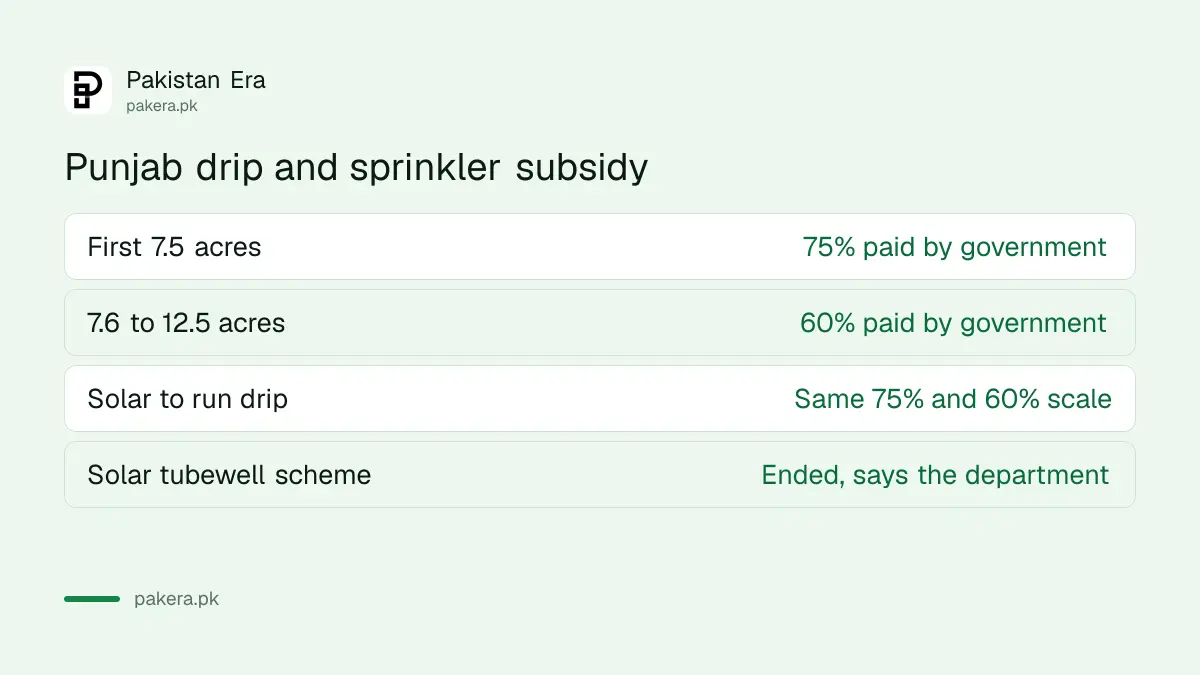
The drip and sprinkler subsidy in Punjab
Under the Punjab Resilient and Inclusive Agriculture Transformation project, known as PRIAT, the government pays 75% of a high efficiency irrigation system for up to 7.5 acres and 60% for the next 5 acres. The farmer pays the rest. It is open across the whole of Punjab.
High efficiency irrigation, or HEIS, means drip, bubbler, sprinkler and rain-gun systems. Drip puts water slowly at the root of each plant through small emitters on plastic pipes. A sprinkler sprays it over the field. The department says its studies on sugarcane, citrus, potato, wheat and gram found about 50% water saving and 20% to 100% higher yields.
| What is subsidised | Government share | Where |
|---|---|---|
| Drip or sprinkler system, first 7.5 acres | 75% | All Punjab (PRIAT) |
| Drip or sprinkler system, 7.6 to 12.5 acres | 60% | All Punjab (PRIAT) |
| Solar system to run the drip or sprinkler | 75% up to 7.5 acres, 60% above | All Punjab (PRIAT) |
| Water storage pond, if the design needs one | 70%, up to Rs 900,000 | As per site design |
| Solar coupled drip or sprinkler | 70%, up to Rs 385,000 an acre | Attock, Chakwal, Jhelum, Rawalpindi |
The department's own example is a 12.5 acre farm. It gets 75% on the first 7.5 acres and 60% on the remaining 5. Its PRIAT project runs from 2022-23 to 2026-27, so the current terms may change after June 2027.
What a drip system costs the farmer
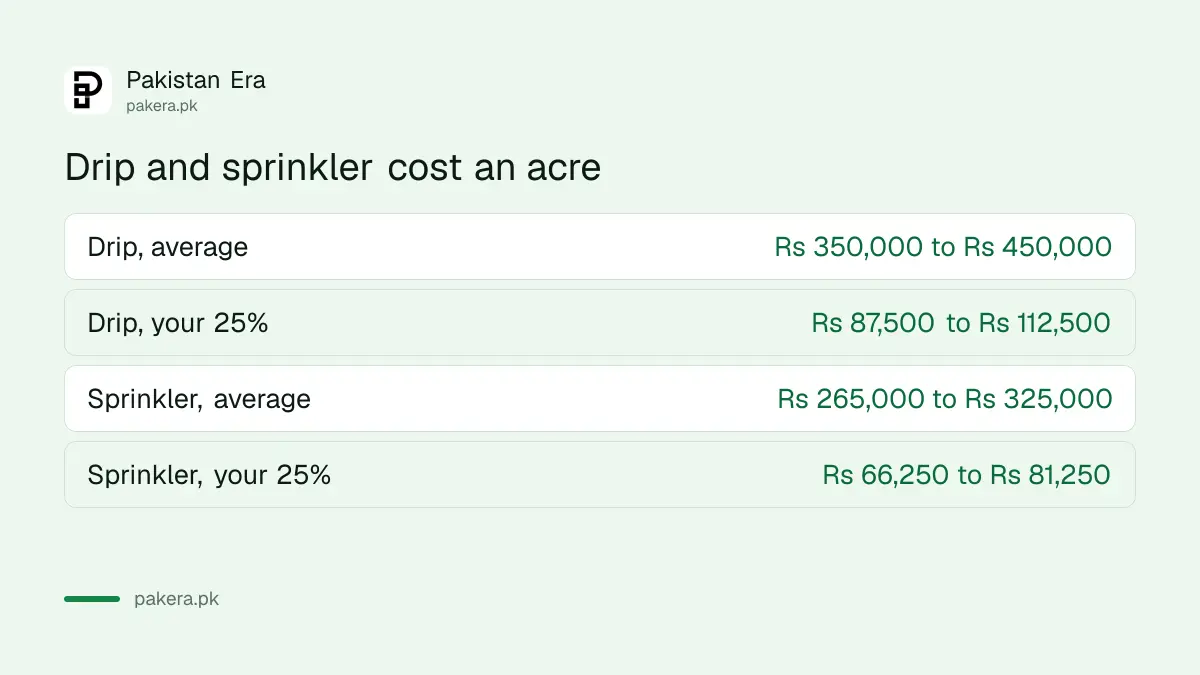
The department puts the average cost of drip at Rs 350,000 to Rs 450,000 an acre on a five acre scheme, and sprinkler at Rs 265,000 to Rs 325,000 an acre. At 75% subsidy, your share on drip is roughly Rs 87,500 to Rs 112,500 an acre.
That share is our arithmetic on the department's averages. Your real quote depends on the crop, the design and the size of the farm. Orchards and vegetables suit drip best, the department says. Sprinkler costs less per acre.
| System | Average cost an acre | Your 25% share, about |
|---|---|---|
| Drip, five acre scheme | Rs 350,000 to Rs 450,000 | Rs 87,500 to Rs 112,500 |
| Sprinkler | Rs 265,000 to Rs 325,000 | Rs 66,250 to Rs 81,250 |
A soil and water test before the design is worth the small cost. Drip emitters clog in salty or sandy water if the filter is wrong, and the company designs the filter around your water.
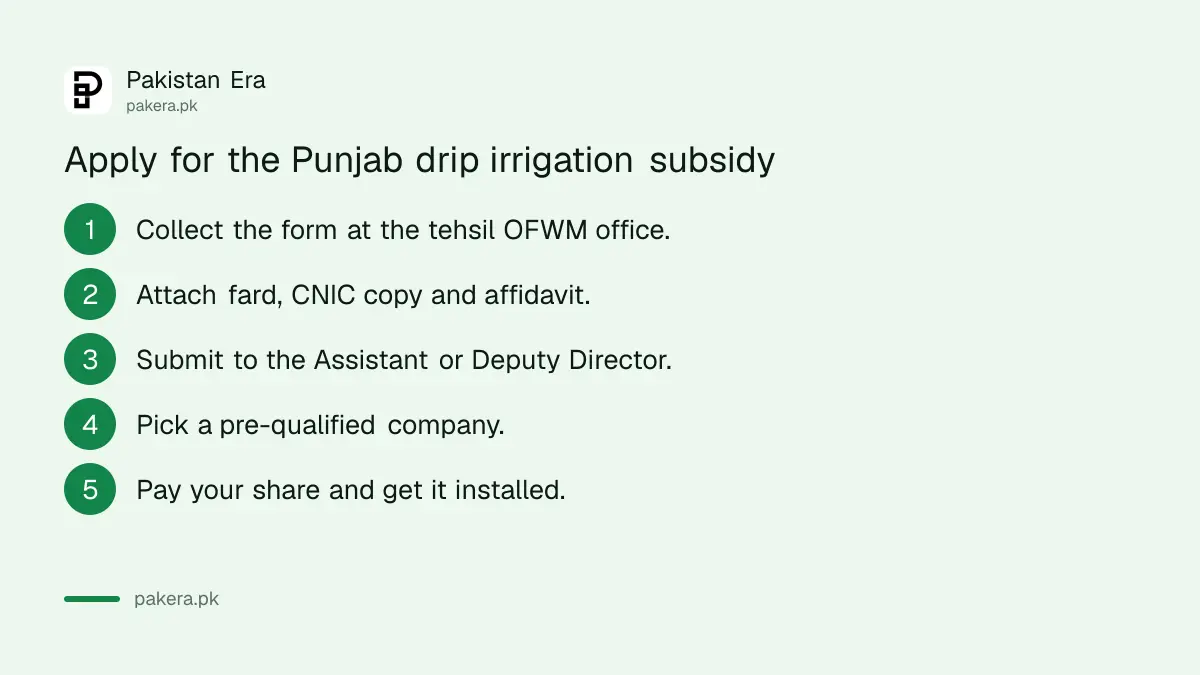
How to apply for the drip irrigation subsidy
Get the form from any OFWM office at tehsil, district, division or province level, or download it from the OFWM website. Submit it with your papers to the Assistant Director Agriculture (OFWM) at the tehsil or the Deputy Director Agriculture (OFWM) at the district. Applications are taken first come, first served.
- Visit the tehsil OFWM office and collect the application form. Ask which projects are open in your district.
- Prepare your papers. The department lists a Fard Jamabandi, a valid CNIC copy and an affidavit on stamp paper accepting the project's terms. You can get a fard of your land from an Arazi Record Centre.
- Submit the form to the Assistant Director (tehsil) or Deputy Director (district) of OFWM.
- Choose a company from the department's list of pre-qualified supply and service companies. The company designs and installs the system on a turn-key basis.
- Pay your share, which is the cost left after the subsidy, as the office directs.
- Use the free support. The company must give engineering and farming support for two years after installation.
The department's procedure has a pre-qualified company doing the installation. Check that a company is on its list before you pay anyone anything.
The Punjab solar tubewell scheme has ended
The Agriculture Department's FAQ answers "Is a solar system being given for tubewells?" with "No". It says the scheme for electric and diesel tubewells has ended, though it is hoped solar systems will be offered next year. The department now gives solar subsidy only to run drip or sprinkler systems.
That earlier scheme was the Chief Minister's Programme for Solarization of Agriculture Tubewells. The Agriculture Department South Punjab's page described it as 7,000 tubewells, Rs 9,887.42 million, from 2024-25 to 2025-26, with winners picked by ballot against district quotas.
So if someone offers to "register" you for a solar tubewell for a fee, walk away. There is no open scheme to register for. The household free solar panel scheme is a separate programme for homes, not tubewells.
The solar route that is open needs a drip or sprinkler system first. The FAQ says installing high efficiency irrigation is a pre-requisite for the solar subsidy.
Other water saving help from OFWM
The same wing helps line watercourses and buy laser land levellers. For watercourse lining, the government gives the materials and technical help, and farmers pay for labour. For a laser leveller, it gives a one-time Rs 600,000 a unit, or Rs 700,000 in Pothohar.
- Watercourse improvement: government supplies bricks or concrete segments; farmers do the digging, filling and mason work through their Water Users' Association.
- Laser land leveller: Rs 600,000 a unit under the Chief Minister's Programme for Water Efficient Agriculture, 2025-27 to 2027-28; Rs 700,000 under the Pothohar project.
These sit beside the department's other schemes for Punjab farmers, such as the Kissan Card.
Common questions
How much subsidy does Punjab give on drip irrigation?
75% of the cost for up to 7.5 acres and 60% for 7.6 to 12.5 acres, under the PRIAT project, across all of Punjab.
Is the Punjab solar tubewell scheme open?
No. The Agriculture Department's FAQ says it has ended. Solar is subsidised only to run a drip or sprinkler system.
Where do I get the drip irrigation form?
From any OFWM office at tehsil, district, division or province level, or from the OFWM website. Submit it at the tehsil or district office.
Is there a last date to apply?
The department says applications are being received and systems are provided first come, first served. No closing date is given.
Can I choose my own company to install drip?
Only from the department's list of pre-qualified supply and service companies. They install on a turn-key basis and support you for two years.
Which crops suit drip irrigation?
Orchards and vegetables suit it best, the department says. Cotton, maize and sugarcane can also be grown on drip.
How we verified this
What we checked, where we read it, and what we could not confirm.
Last checked on 2 October 2026. We read the Punjab Agriculture Department's Water Management subsidies page for the PRIAT sliding scale, the Pothohar solar rate, watercourse cost sharing and laser leveller amounts, and its Water Management FAQs for the end of the solar tubewell scheme, the solar subsidy for drip, the papers, the offices, the costs, the pond subsidy and the two year support. We read the Agriculture Department South Punjab's page on the tubewell solarization programme for its size, budget and dates. The farmer's share figures are our arithmetic. We did not apply ourselves, and we could not open ofwm.agripunjab.gov.pk, which loaded only a blank page for us.
About the author

Public Services and Education Journalist
Fajr Riaz is a journalist and content writer at Pakistan Era, based in Lahore. She covers the questions people meet in everyday life in Pakistan: how a public service works, what a change in the rules means, and where to find a reliable answer.