Get Your Soil Tested in Punjab at One of 36 Government Labs
Get your soil tested in Punjab at a government lab. We list the 8 divisional labs, how to take a sample, what the report shows and the 7 to 10 day wait.

To get your soil tested in Punjab, take a mixed soil sample from your field to the government Soil and Water Testing Lab in your district. Punjab's Agriculture Department runs 36 of these labs, 8 at division level and 28 at district level. The lab tests the sample and gives you a report with a fertiliser recommendation, usually in 7 to 10 working days.
Most farmers buy DAP and urea by habit, the same number of bags every season. A soil test tells you what your land actually needs. A 50 kg bag of DAP averaged Rs 16,055 in July 2026, so guessing is expensive. We read the Agriculture Department's own service page and the Soil Fertility Research Institute's notices to set out how the soil test works, where the labs are and what we could not confirm.
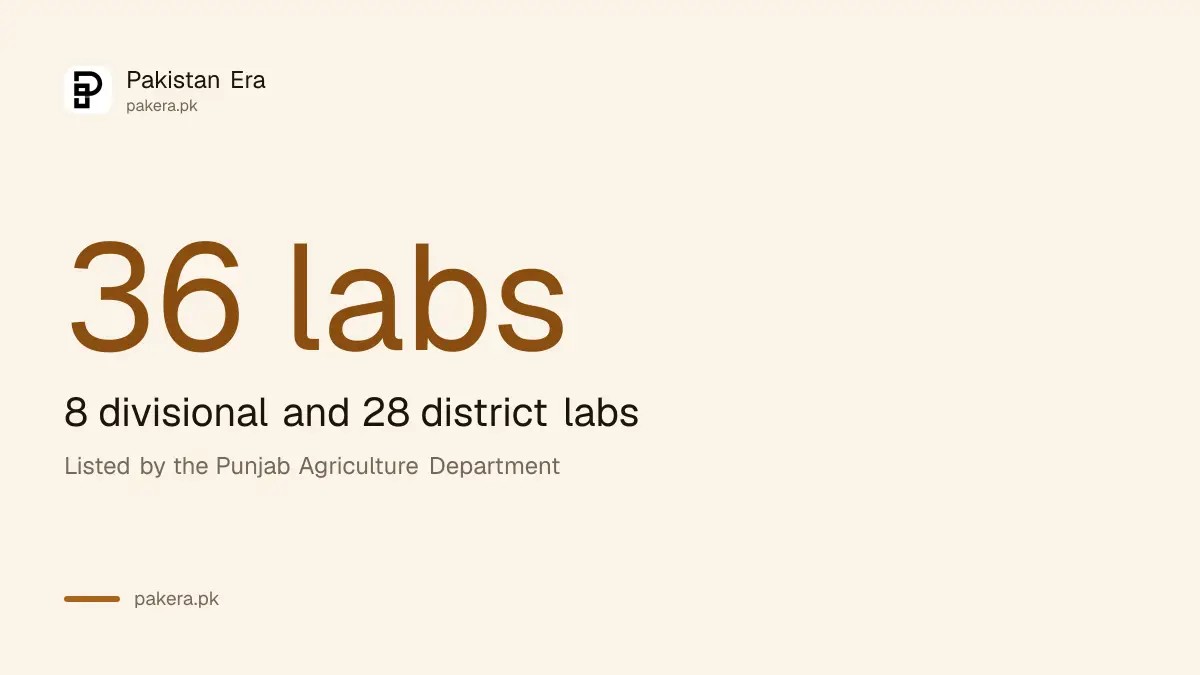
Punjab runs 36 government soil testing labs
Punjab has 8 divisional labs and 28 district labs that test soil and water for farmers. The divisional labs, under the Soil Fertility Research Institute, also test fertiliser and plant samples. Every district lab gives soil and irrigation water reports with fertiliser advice.
The Agriculture Department's research services page lists each lab with its address, landline, mobile number and email. The Soil Fertility Research Institute says there is one lab in each district. The eight divisional labs are in these cities:
| Divisional lab | Where it is | Landline |
|---|---|---|
| Lahore | Thokar Niaz Baig | 042-99233587 |
| Faisalabad | Ayub Agricultural Research Institute, Jhang Road | 041-9201805 |
| Rawalpindi | Data Ganj Bakhsh, Murree Road | 051-4251546 |
| Sargodha | Behind City Police, Suleman Pura | 048-3740081 |
| Gujranwala | Opposite Gulshan-e-Iqbal Park | 055-9200216 |
| Multan | Old Shujabad Road | 061-4423568 |
| Bahawalpur | Government Agriculture Research Station | 062-9255218 |
| Dera Ghazi Khan | Near Dar-ul-Aman, Jail Road, Model Bazar | 064-2468222 |
The 28 district labs cover the other districts, from Attock and Bhakkar to Okara, Sahiwal, Rahim Yar Khan and Vehari. Many sit in the district complex or the agriculture office compound. The department's page gives each one's mobile number, so call before you travel.
How to take a soil sample from your field
A good sample comes from many spots across one field, mixed together. Take it before you plough and before you add any fertiliser. Keep each field separate. If you are unsure how deep to dig for your crop, the lab will tell you on the phone.
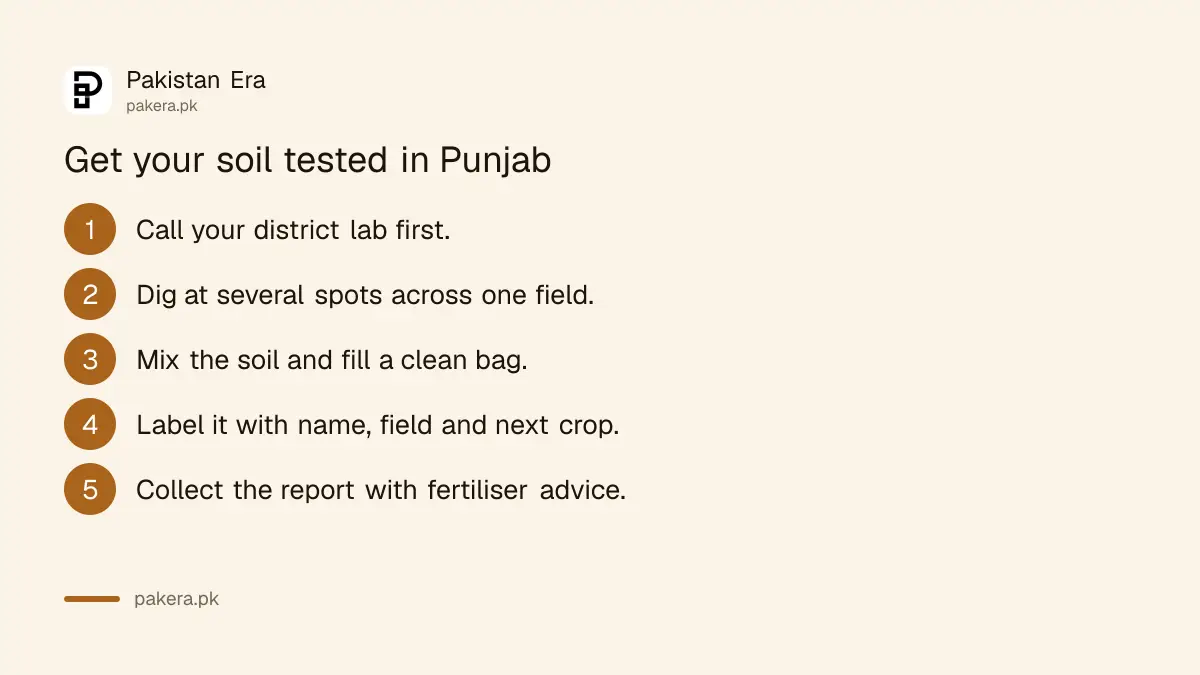
The department's page says lab staff can also come and take the sample from your field if you ask. That is the safer choice the first time. If you do it yourself, the steps are simple:
- Pick one field at a time. A field that gets different water or had a different crop needs its own sample.
- Dig at several points across the field. Walk in a zigzag. Avoid the edges, the water channel, old manure heaps and the spot where the tractor turns.
- Mix the soil in a clean bucket. Remove stones, roots and stubble.
- Put about half a kilo in a clean cloth or plastic bag. Never use an old fertiliser bag, because leftover fertiliser will spoil the result.
- Label it. Write your name, mobile number, village, khasra or field name, and the crop you plan to sow next.
- Take it to the lab. Carry your CNIC in case the lab asks for it. Ask when the report will be ready and how they will contact you.
Sowing season is the busiest time at every lab. The best window for wheat sowing in Punjab on irrigated land is 1 to 20 November, so send the sample in early October to get the report before you buy fertiliser.
What the soil test report tells you
The report gives your soil's fertility status, its pH level and any salt problem, then a fertiliser recommendation for your crop. The Soil Fertility Research Institute says the lab evaluates soil fertility, pH and problems caused by excess salts or fertiliser.
In plain words, the report answers three questions. Is the soil short of nitrogen, phosphorus or potash? Is it too alkaline, which locks phosphorus away from the crop? And is salt building up? Many Punjab soils have high pH and low phosphorus, which the institute lists among the common soil problems in Pakistan.
A soil test does not diagnose every problem. The institute says poor growth can also come from disease, insects, water, compaction or weather. If the soil comes back fine, look at those next. The same labs also test tubewell and canal water for irrigation, which matters if your water tastes salty or leaves a white crust on the soil.
The fee and how long the report takes
The Soil Fertility Research Institute says a report usually takes seven to ten working days. Farmers pay the government's advisory test rate, but we could not find that farmer rate published anywhere online. Call your lab and ask before you go.
We read the institute's test rates notification. It lists commercial rates for industry, exporters and students. A covering note from the institute's director says advisory test fees for farmers "will continue to be charged at the existing Government Rates", without stating the amount. So any figure you see quoted elsewhere is not one we could confirm at source.
One practical point: ask the lab to write the recommendation in bags per acre. A report in kilograms of nutrient is harder to use at the dealer's counter. Then buy only what the report says, from a licensed dealer, and keep the receipt. The dealers that accept the Kisan Card are listed by the department.

More help with your soil and fertiliser
Your local Agriculture Officer (Extension) at the markaz can explain the report and match it to the department's crop plan. The Agriculture Department's helpline is 0800-17000. Plant clinics in local markets also give advice on crop problems.
The Soil Fertility Research Institute also offers a fertiliser calculator app called Khad Hisab, listed on its website. The extension wing runs village training sessions, and your Field Assistant tells farmers a day before one is held. If you also want to know what DAP and urea cost before you buy, that is worth checking the same week.
Common questions
Is soil testing free in Punjab?
Not always. Farmers pay the government's advisory rate, which is kept low, but we could not find the amount published online. Call your district lab to ask.
How long does a soil test take in Punjab?
Usually seven to ten working days, according to the Soil Fertility Research Institute. Call your lab to ask about the current wait.
Can someone from the lab collect the sample from my field?
Yes. The Agriculture Department says lab staff can collect the sample from your field on request. Call the lab to arrange it.
Where is the soil testing lab in my district?
Punjab has 28 district labs and 8 divisional labs. The Agriculture Department's research services page lists every lab with its phone number and email.
Can I test my tubewell water at the same lab?
Yes. The same labs test irrigation water for farmers. Take a clean bottle of water from the running tubewell and label it the same way.
How often should I test my soil?
Ask your lab, since it depends on your crops and water. Testing before a major crop, or when yields fall for no clear reason, is a sensible rule.
How we verified this
What we checked, where we read it, and what we could not confirm.
Last checked on 1 October 2026. We read the Punjab Agriculture Department's research services page on agripunjab.gov.pk, which lists 8 divisional and 28 district soil and water testing labs with their contacts, and says farmers can submit samples or ask staff to collect them. We read the Soil Fertility Research Institute's services page and FAQ on sfri.punjab.gov.pk for the 36 labs, what the test covers and the seven to ten working day turnaround. We read the institute's test rates notification, a scanned PDF, page by page: it confirms farmer advisory tests are charged at existing government rates but does not state the amount, so we have not given one. The sampling steps are ordinary practice; the lab's own instructions take priority.
About the author

Senior Writer, Public Services and Technology
Shahid joined us in 2024 as an author. He is a senior contributor to Pakistan's leading technology websites. He writes detailed articles, mostly covering his expertise in the latest tech, mobiles, apps, gadgets, and step-by-step guides. His ideology is to help people understand the latest trends and explain complex methods through very easy-to-understand guides.