Standard Chartered Credit Card Charges 2026 in Pakistan: Annual Fee for All 6 Cards, 46% Markup, Late Fee and Cash Advance (Full List)
Standard Chartered credit card annual fees run from Rs 9,000 to Rs 30,000 in 2026. See all 6 cards, the 46% markup, late fee, cash advance and foreign spread.
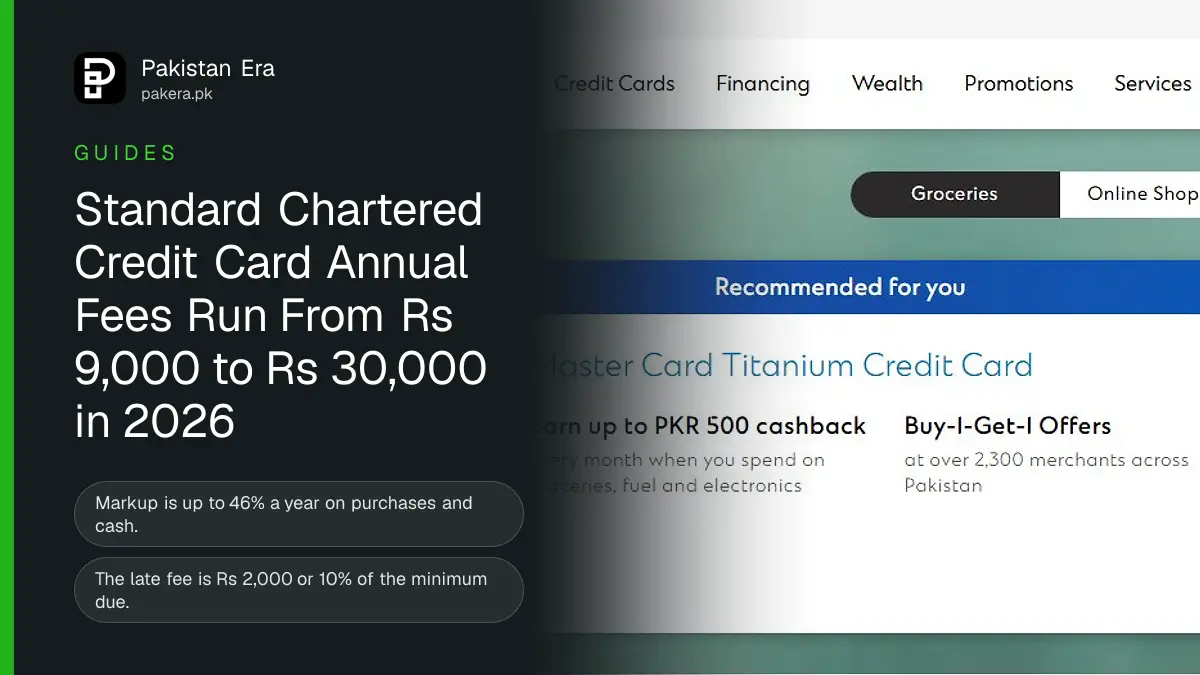
Standard Chartered Pakistan credit cards cost Rs 9,000 to Rs 30,000 a year in annual fees, from the Easy Credit card to World Elite, under the bank's schedule of charges for July to December 2026. Markup is up to 46% a year, the late fee is Rs 2,000 or 10% of the minimum due, and foreign spending carries up to 6% extra.
We downloaded Standard Chartered's conventional schedule of charges for the second half of 2026 from the bank's own site on 12 November 2026 and read the two credit card pages line by line. We also opened the bank's credit cards page to see which cards it is selling now. Below is every annual fee, every penalty, and the sums that show what each charge costs in practice.
Standard Chartered credit card annual fees run from Rs 9,000 to Rs 30,000
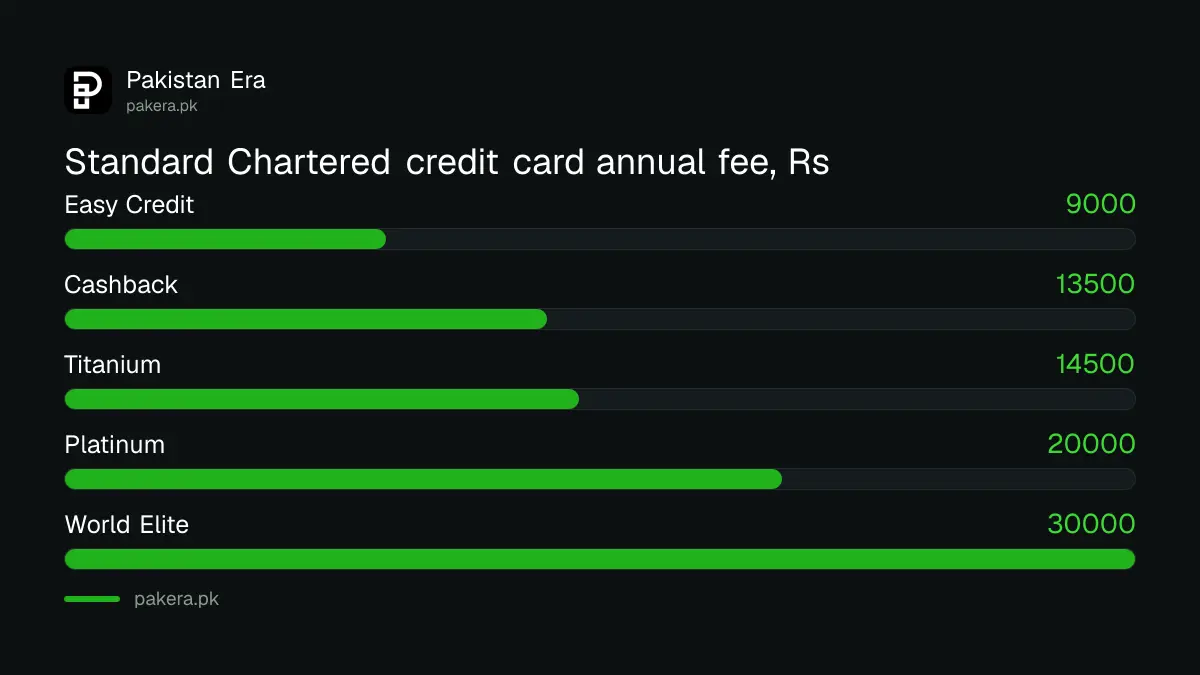
Standard Chartered lists six Mastercard credit cards in its July to December 2026 schedule. The cheapest annual fee is Rs 9,000 for Easy Credit and the dearest is Rs 30,000 for World Elite. A supplementary card for a family member costs Rs 1,000 to Rs 15,000 a year.
| Card | Annual fee | Supplementary card |
|---|---|---|
| Mastercard Easy Credit | Rs 9,000 (flat) | Rs 1,000 |
| Mastercard Cashback | Rs 13,500 | Rs 5,000 |
| Mastercard Titanium | Rs 14,500 | Rs 7,000 |
| Mastercard Platinum | Rs 20,000 | Rs 9,000 |
| Mastercard World | Rs 26,000 | Rs 11,000 |
| Mastercard World Elite | Rs 30,000 | Rs 15,000 |
The schedule says government taxes may apply on top of these charges. So the amount on your statement can be higher than the figure in the table.
Priority Banking clients who meet the bank's balance rules get the annual and joining fee waived on every card except World and Easy Credit, the schedule says. For everyone else, the full fee applies.
Markup is up to 46% a year on purchases and cash
The schedule sets the service fee, or markup, at up to 46% a year on both shopping and cash withdrawals, for every card. The schedule does not spell out the free period, but on credit cards markup is normally charged on the amount left unpaid after the due date. Confirm the rule for your card with the bank.
At 46% a year, Rs 100,000 left unpaid for one month costs about Rs 3,833 in markup. Leave it for a full year and it is about Rs 46,000. The schedule adds that discounts on rates "may be offered during special promotions", but it gives no lower figure.
Corporate cards have their annual fee waived and carry a flat 46% markup, the same page says.
Late fee, cash advance and other penalties
The late payment fee is Rs 2,000 or 10% of the minimum amount due, whichever is higher. A cash withdrawal costs Rs 1,200 or 3% of the amount, whichever is higher, plus any charge from the ATM's own bank.
| Charge | Standard Chartered fee |
|---|---|
| Late payment | Rs 2,000 or 10% of minimum due, whichever is higher |
| Cash advance | Rs 1,200 or 3%, whichever is higher, plus acquiring bank charges |
| Direct debit failure | Rs 1,200 each time |
| Cheque return | Rs 1,000 each time |
| Card replacement | Rs 1,500 per card |
| Card conversion | Rs 1,500 per card |
| Dispute arbitration | US$500 or equivalent, not charged if you win |
| Instalment plan early closure | Rs 1,000 or 5% of remaining balance, whichever is higher |
| Credit Protector (optional) | 0.35% of outstanding a month |
| Credit Cover Plus (optional) | 0.69% of outstanding a month |
When the late fee goes above Rs 2,000
The 10% rule takes over once your minimum due is above Rs 20,000. For example, a minimum due of Rs 30,000 paid late costs Rs 3,000, not Rs 2,000. The late fee is on top of the markup.
When the cash advance fee goes above Rs 1,200
The 3% rule takes over for a cash withdrawal above Rs 40,000. Taking Rs 10,000 in cash still costs Rs 1,200, which is 12% of the amount. That makes small cash withdrawals the most expensive way to use the card.
Foreign spending carries up to 6% extra
Every purchase settled in foreign currency, or made through a foreign merchant, counts as a foreign transaction. The schedule adds a spread of Re 1 per US dollar and up to 6% of the amount. QR payments also carry up to 6%.
So a US$100 online purchase could cost up to US$6 more than the card network rate, plus the Re 1 per dollar spread. The schedule also warns that the conversion rate is taken when the charge settles, which can be days after you buy. Our guide to foreign transaction fees on Pakistani cards compares this with other banks and wallets.
The Re 1 spread does not apply to transactions a foreign merchant bills in rupees, the schedule notes. Those are called DCC, dynamic currency conversion, and they often have their own markup built in by the merchant.
Instalment plans can cost up to 20% of the amount
Standard Chartered's Asaan Instalment Plan lets you split a purchase into monthly payments. The schedule allows booking charges of up to 20% of the booked amount, and service charges up to the card's markup rate. Closing a plan early costs Rs 1,000 or 5% of what is left.
The schedule gives maximums, not the exact rate on each plan. Ask for the total cost in rupees before you agree, and compare it with other banks in our credit card instalment plans comparison.
Here is how to keep the charges down:
- Pay the full statement balance by the due date.
- Set up a direct debit, but keep enough in the account. A failed debit costs Rs 1,200.
- Avoid cash withdrawals on the card. Even Rs 5,000 costs Rs 1,200.
- Check whether Priority Banking would waive your annual fee.
- Read your statement each month. Our guide to credit card statement rights explains what the bank must show.
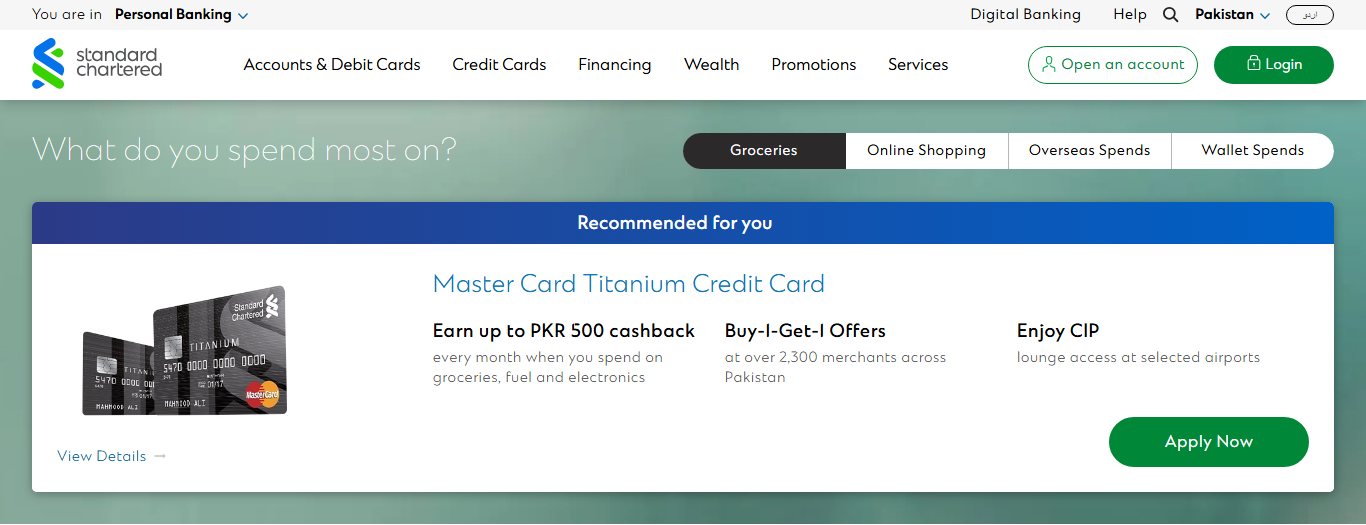
The credit cards page also shows a Saadiq Mastercard Platinum card, which is Islamic. Its charges are not in the conventional schedule we read, so they are not in this guide. For card activation and bill payment, see our Standard Chartered credit card guide.
Frequently asked questions
What is the annual fee of the Standard Chartered Titanium credit card?
The Mastercard Titanium annual fee is Rs 14,500, and a supplementary card costs Rs 7,000 a year, in the July to December 2026 schedule.
What is the Standard Chartered credit card late payment fee?
It is Rs 2,000 or 10% of the minimum amount due, whichever is higher.
What markup does Standard Chartered charge on credit cards?
Up to 46% a year on unpaid purchases and cash, according to the schedule of charges.
How much does a cash withdrawal on a Standard Chartered credit card cost?
Rs 1,200 or 3% of the amount, whichever is higher, plus any fee from the ATM's bank.
Which Standard Chartered credit card is cheapest?
Mastercard Easy Credit, at a flat Rs 9,000 a year, with a Rs 1,000 supplementary card.
Last checked: 12 November 2026, in Standard Chartered Pakistan's conventional schedule of charges for July to December 2026 and its credit cards page.
About the author

Senior Writer, Public Services and Technology
Shahid joined us in 2024 as an author. He is a senior contributor to Pakistan's leading technology websites. He writes detailed articles, mostly covering his expertise in the latest tech, mobiles, apps, gadgets, and step-by-step guides. His ideology is to help people understand the latest trends and explain complex methods through very easy-to-understand guides.