Credit Card Bill Rights in Pakistan: Statement 15 Working Days Before Due Date
SBP rules give credit card holders a statement 15 working days before the due date, a holiday due date rule and late fee protection. See how to use them.
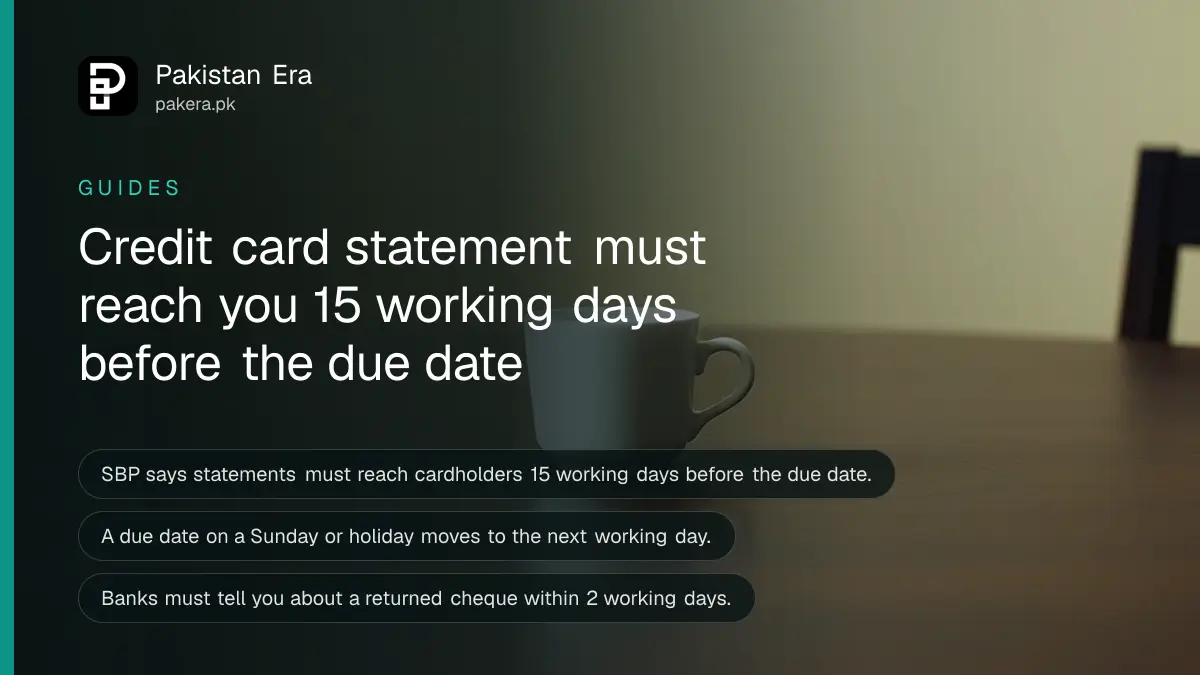
Short answer: SBP rules say your bank must send the credit card statement at least 15 working days before the due date. A due date on a Sunday or public holiday moves to the next working day. A bank cannot charge a late fee if it failed to tell you about a returned cheque within 2 working days.
The statement arrives late, the due date falls on a holiday, and a late payment fee shows up anyway. Most cardholders pay the fee and move on. SBP's rules give you more room than that.
We read the State Bank of Pakistan's Business Conduct and Fair Treatment of Consumers Regulatory Framework on 11 October 2026. This guide lists the credit card rights in it, shows which ones save you money, and says what to do if your bank ignores them.
The statement must arrive 15 working days before the due date
Section 2.5.2 of the framework says banks must provide the credit card statement at monthly intervals at least 15 working days before the due date. An e-statement must come with a free SMS alert that shows the amount due, the minimum payment and the due date.
If you ask for a duplicate copy, the bank must give it, paper or electronic, within 2 working days. The monthly statement must break down the total amount due, the minimum payment and the due date. It must also state the annual mark-up rate and amount, and the modes of payment with the days each takes to clear.
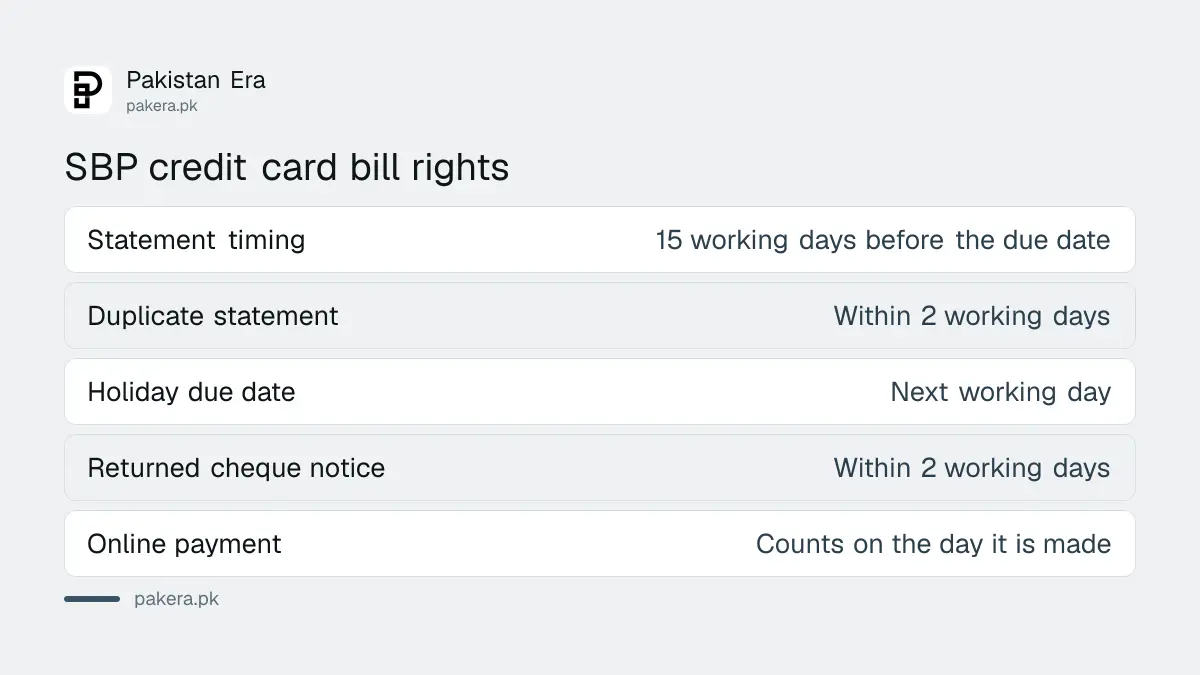
| Right | What SBP says | Section |
|---|---|---|
| Statement timing | Monthly, at least 15 working days before the due date | 2.5.2 |
| SMS for e-statement | Free alert with amount due, minimum and due date | 2.5.2 |
| Duplicate statement | Within 2 working days of your request | 2.5.2 |
| Due date on Sunday or holiday | Next working day becomes the due date | 3.2.2.2 |
| Returned cheque notice | Within 2 working days, or no late fee | 3.2.2.2 |
| Online repayment | Counted as paid on the date of the transaction | 3.2.2.2 |
| Annual fee reversal | Automatic once the spending condition is met, with SMS | 3.2.2.2 |
A due date on a holiday moves to the next working day
The framework says banks shall try to ensure the due date does not fall on a Sunday or public holiday. If it does, the first working day is the new due date. If you paid on that working day, a late payment fee should not apply.
The framework's wording is that banks "shall try to ensure". It then states the fallback, which is firm. Pay on the first working day and keep proof of the time of payment. Raise any late fee as a complaint and quote section 3.2.2.2, point 8.
Pay by any channel, and online payment counts at once
Banks must let you pay a card bill through internet banking, mobile banking, ATMs, branchless banking agents and the counter of any bank. The framework says an online repayment is treated as paid on the date the transaction is executed, not on the date the bank posts it.
Take a screenshot with the transaction time. If the bank posts the payment a day later and charges a late fee, the screenshot is your evidence. It also helps if you later have to argue a fee or dispute a card charge.
Fees not in your agreement need prior notice
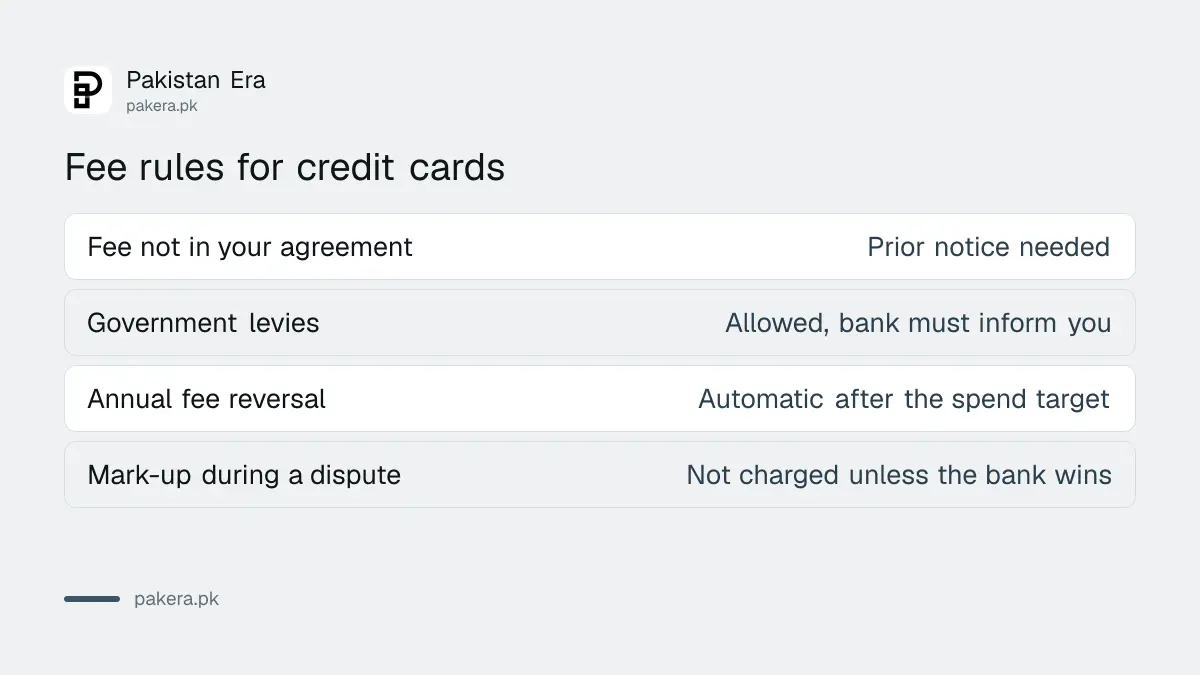
Section 3.2.2.2 says banks shall not charge any fee that was not listed in the user guide, application form or schedule of charges given at sale, unless they notify you first. Government levies, such as excise duty, are the exception, and the bank must still tell you about them.
Banks must also get your verifiable consent before offering you a new service. Mark-up is charged on the outstanding amount after your payment is deducted. The bank must also name a specific small amount below which an unpaid balance is not treated as partial payment, so mark-up does not apply to it. For comparing fees before you apply, see credit cards in Pakistan compared by fees.
What to do if the bank breaks these rules
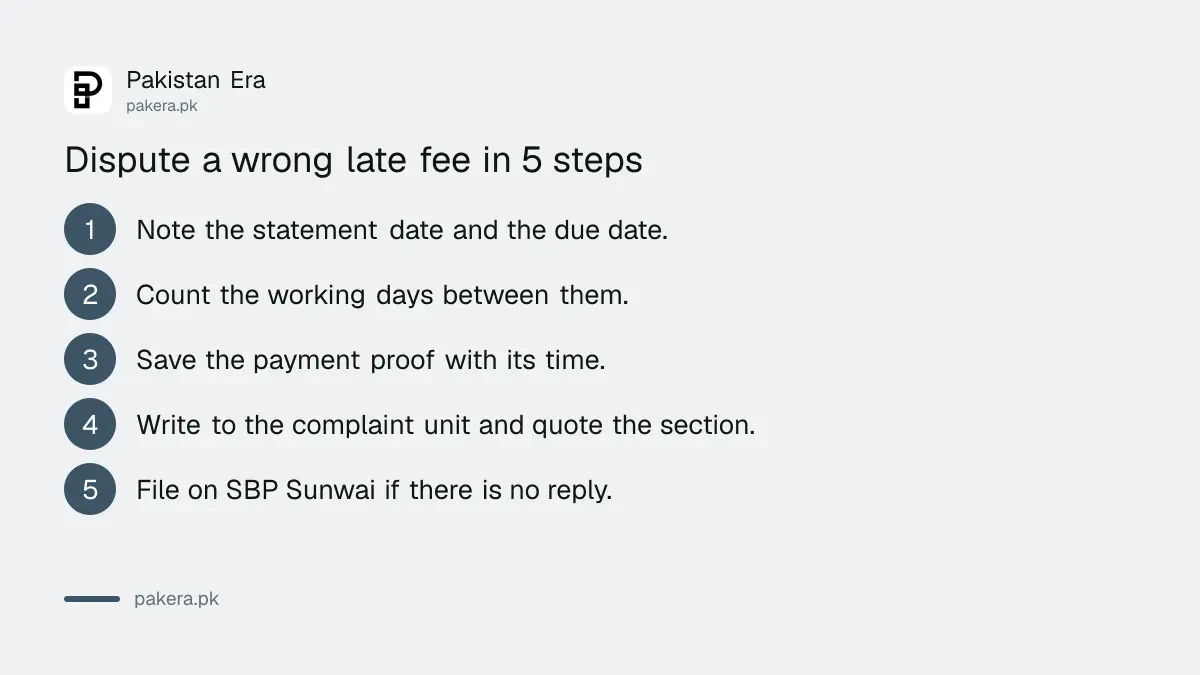
Gather the statement, the payment proof and any SMS. Write to the bank's complaint unit, quote the section, and ask for the fee to be reversed. If the bank does not reply, file on SBP Sunwai.
- Download the statement and note the date it reached you, and the due date.
- Count the working days between the two. If it is under 15, the bank missed the rule.
- Save the payment proof with the date and time.
- Write to the complaint unit, quote the section, and ask for a tracking number.
- If there is no answer in the time SBP allows, file on the SBP Sunwai complaint portal.
A disputed transaction has its own clock. SBP says banks must resolve a card dispute within 45 working days for a transaction made in Pakistan, and may not charge mark-up on the disputed amount while it investigates. The bank may also not start recovery on a reported disputed transaction until the investigation is done.
Common questions
How many days before the due date must my credit card statement reach me?
At least 15 working days, according to section 2.5.2 of SBP's framework. If your statement reached you later, the bank has not met the rule and you can complain about the late fee.
What if my due date falls on a Sunday?
The first working day after it becomes the new due date. Pay by then and you should not be charged a late fee.
Does an online payment count on the day I make it?
Yes. The framework says online repayments are considered paid and final on the date the transaction is executed. Keep the confirmation with its time.
My cheque bounced and the bank charged a late fee. Is that allowed?
Only if the bank told you about the returned cheque within 2 working days. SBP says banks shall not charge late payment fees if they fail to inform you in time, provided you submitted the cheque within the time the bank set.
Must the bank refund my annual fee if I meet the spend target?
Yes, without a request. SBP says banks must reverse the annual fee and associated charges when you meet the spending condition and inform you by SMS or email. Banks must disclose in advance any amount that stays deducted.
Can the bank ask me to repay while I dispute a charge?
It should not start recovery on a reported disputed transaction until its investigation is complete. The bank must also not charge mark-up on the disputed amount during that period, unless the dispute is settled in its favour.
How we verified this
What we checked, where we read it, and what we could not confirm.
We read SBP's BPRD Circular No. 04 of 2025 and the framework, sections 2.5.2, 3.2.2.2 and 5.1.1.5, on sbp.org.pk on 11 October 2026. We did not test any bank's own statements. Check your bank's schedule of charges and your agreement for specific amounts.
About the author

Technology Journalist & Multimedia Producer
Ahmad Ali is a technology journalist and multimedia producer at Pakistan Era, joining the team in October 2026. He covers consumer technology and digital life for Pakistani readers, combining research with hands-on product testing.