Get a Tubewell Electricity Connection in Pakistan: Rs 15,000 Deposit, 30 Days
Apply for an agricultural tubewell electricity connection: the papers, the Rs 15,000 NEPRA deposit, when you need a transformer and the 30 day deadline.
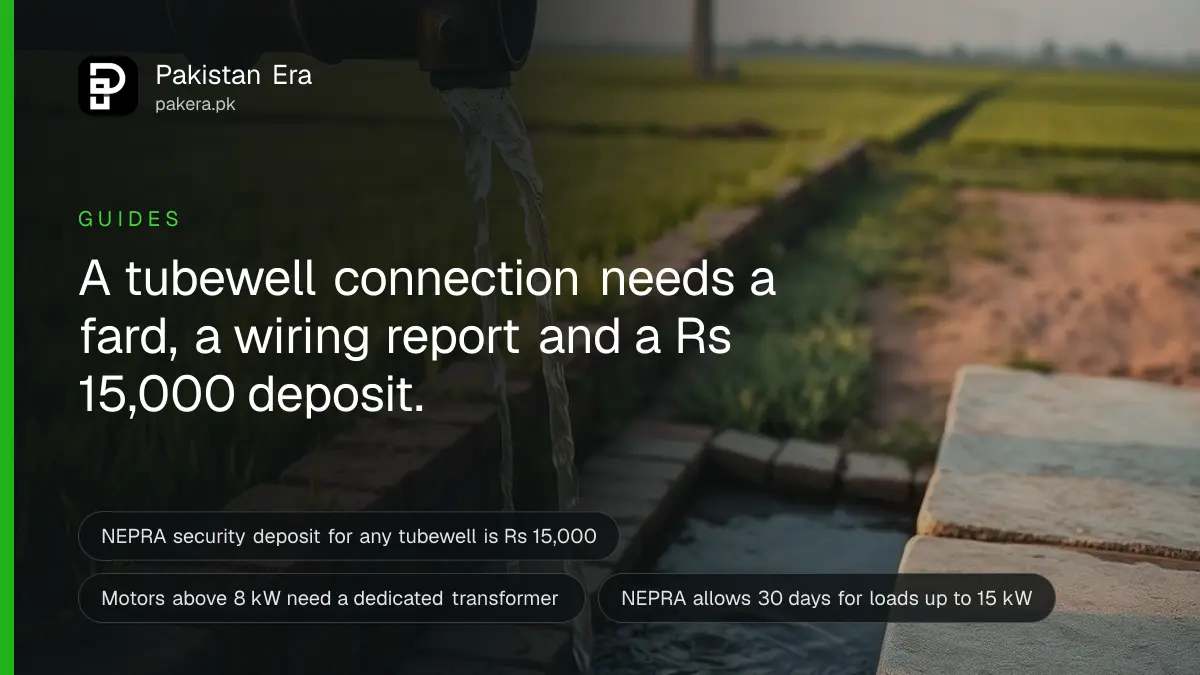
To get a tubewell electricity connection in Pakistan, apply to your electricity company (DISCO) with proof that you own the land, a wiring test report and an affidavit. The security deposit for an agricultural tubewell is a flat Rs 15,000, and NEPRA gives the company 30 days for a load up to 15 kW.
Those two figures come from NEPRA's Consumer Service Manual, revised on 26 November 2025, which every company from LESCO to QESCO must follow. We read the scanned manual page by page. The cost that really varies is the line and transformer, and that depends on how far your bore is from the nearest pole.

Where to apply for a tubewell connection
Apply to the electricity company that serves your village. Most companies take applications online on the ENC portal run by PITC, and every company also accepts forms at its sub-division office. You get a tracking ID either way, which you will need later.
The ENC portal at enc.com.pk handles new connections for LESCO, GEPCO, PESCO, HESCO, SEPCO, QESCO, TESCO and HAZECO. We opened it on 2 October 2026 and its notice board sends IESCO users to iesco.enc.com.pk and FESCO users to fesco.enc.com.pk. MEPCO users are told to use the MEPCO Smart App or PowerSmart App, or a customer facilitation centre.
On the form, tick "Agriculture" as the type of connection. That puts you on the agricultural tubewell tariff, which NEPRA calls Tariff D. The portal also offers an "Undertaking, No Mis Use of Tariff" form, and a tubewell meter used for a house or a shop can be treated as tariff misuse.
The process is the same as for any new electricity connection, with two differences: the deposit is fixed, and a larger motor needs its own transformer.
Papers you need for an agricultural connection
You need proof that you own or lawfully use the land, attested copies of your CNIC and a witness's CNIC, an affidavit on Rs 50 stamp paper, and a wiring test report. A tenant also needs the owner's no objection certificate and the owner's CNIC copy.
- Ownership proof. For farmland this is normally your fard. You can get a fard of your land in Punjab from an Arazi Record Centre.
- Affidavit on Rs 50 stamp paper. It states that no connection existed at the spot before, that you will pay any old dues found later, and that you are not a defaulter on any other connection in any company.
- Tenant's NOC. If you lease the land, the owner gives a no objection certificate and an affidavit that he will pay if you default.
- Wiring test report. It must come from the Electric Inspector or a wiring contractor he has authorised.
- CNIC copies. Attested copies for you and one witness.
What a tubewell connection costs
You pay two demand notices. One is the security deposit, fixed by NEPRA at Rs 15,000 lump sum for any agricultural tubewell. The other is the capital cost of poles, wire, meter and transformer, which the company estimates for your site.
| Item | Amount or rule | Source |
|---|---|---|
| Security deposit, agricultural tubewell | Rs 15,000 lump sum | NEPRA manual, Annexure IV |
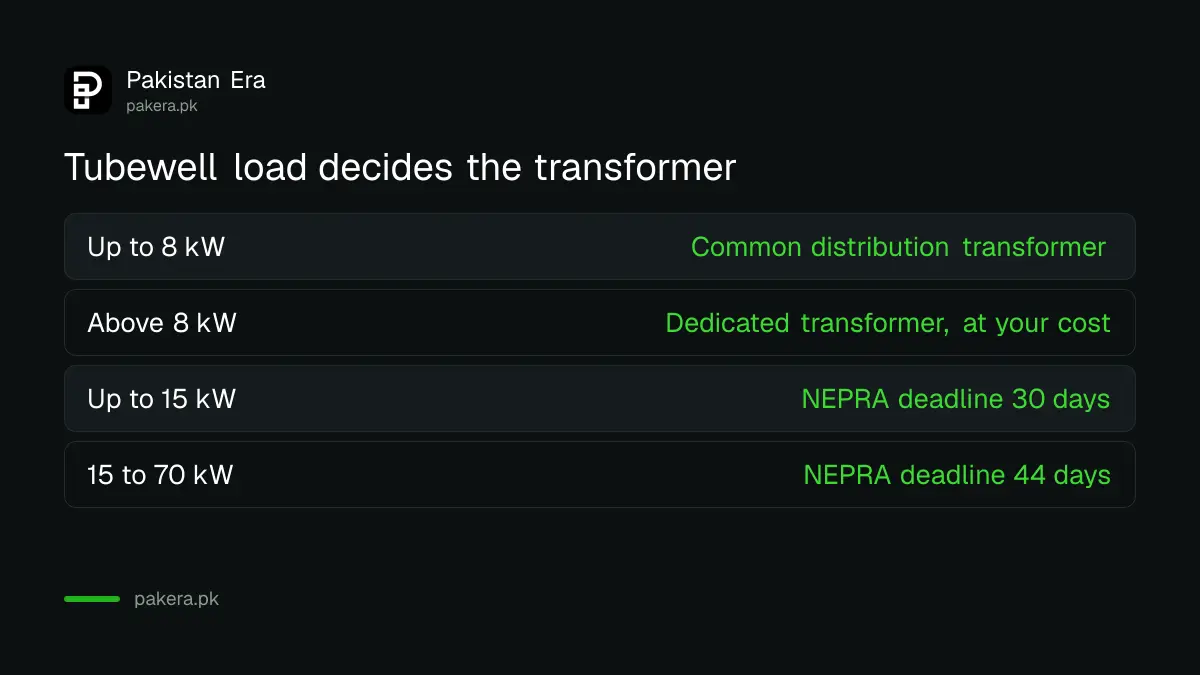
| Motor load up to 8 kW | Shares the common transformer | NEPRA manual, page 19 |
| Motor load above 8 kW | Needs a dedicated transformer | NEPRA manual, page 19 |
| Capital cost (line, poles, meter) | Site estimate on your demand notice | Your DISCO |
| Time to pay a demand notice | 30 days, plus 30 more on request | NEPRA manual, clause 5.1.2 |
The transformer line matters most. A 10 kW or 15 kW motor is common on a deep bore, and above 8 kW you pay for a dedicated transformer. That can cost far more than the deposit, so ask the sub-division for the estimate before you buy the motor.
Where there is no common network near your land, the manual says the company can still connect you on a "cost deposit" basis, meaning you pay for the line. If the company later turns that line into a shared one, the cost of the transformer and low tension line is to be paid back to you.
The Rs 15,000 is refundable. The manual says the company must return it within 30 days of a request after permanent disconnection, as long as you owe nothing.
Steps from application to a working meter
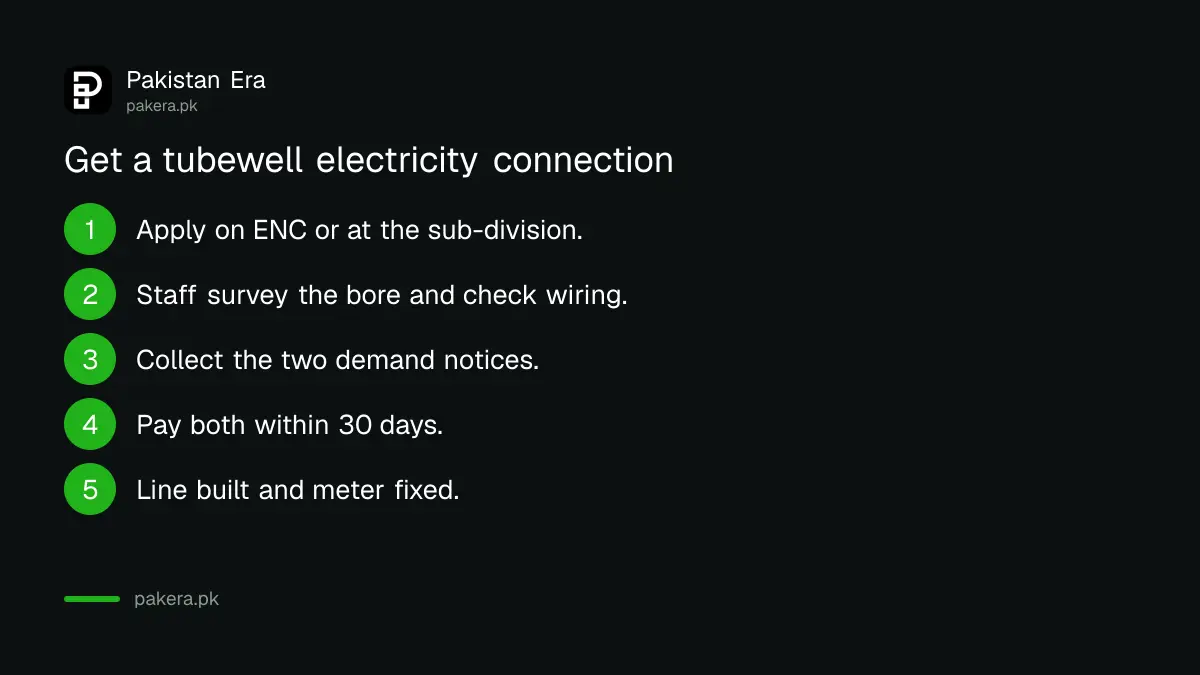
The company registers your form, surveys the site and checks the wiring report, then issues demand notices. You pay at the bank or online. The company then issues a work order, installs the line and fixes the meter. NEPRA allows 30 days in all for loads up to 15 kW.
- Apply on the ENC portal or at the sub-division, with the papers above. Note your tracking ID.
- Site survey. Staff visit the bore, check the wiring test report and confirm the load. NEPRA allows 4 days.
- Demand notices. The cost estimate is made and the notices issued. NEPRA allows 6 more days.
- Pay both notices in full by the due date. Ask in writing for the extra 30 days at least 3 days before the due date if you need it.
- Work order and line. Material is issued and the work done, in 11 days.
- Meter installed. NEPRA allows 9 days for the meter.
Those four stages add up to 30 days for Category 1, which is any load up to 15 kW at 400 volts. A load above 15 kW and up to 70 kW is Category 2, with 44 days. The manual says a company that misses the deadline must give you written reasons for each day of delay, with a copy to NEPRA.
Mistakes that delay or block a tubewell meter
Most delays come from unpaid dues on the land, a missing wiring test report, or a load that needs a transformer nobody budgeted for. A connection taken by a hook or with a tampered meter is theft and can be cut and charged.
- Old dues on the spot. The affidavit makes you liable for any earlier connection at the same place. Ask the sub-division to check before you apply.
- Understating the motor. If you declare 7 kW and run 11 kW, the company can demand a load extension later. Our note on how to extend electricity load explains that process.
- Running the pump off a neighbour's meter or a direct hook. That is how farmers end up in an FIR. Anyone can report electricity theft, and companies act on it.
Common questions
How much is the security deposit for a tubewell connection?
Rs 15,000 lump sum for any agricultural tubewell, including scarp and lift pumps. NEPRA's revised Consumer Service Manual of 26 November 2025 sets this in Annexure IV.
How long does a tubewell connection take?
NEPRA allows 30 days for a load up to 15 kW and 44 days for 15 to 70 kW. The clock covers registration, demand notice, work and meter.
Do I need my own transformer for a tubewell?
Only if the load is above 8 kW. Up to 8 kW, an agricultural connection runs from the common distribution transformer.
Can I apply for a tubewell connection online?
Yes, for most companies, on enc.com.pk. IESCO and FESCO use their own ENC sites, and MEPCO uses its app or a facilitation centre.
Can a tenant farmer get a tubewell connection?
Yes. A tenant needs the owner's no objection certificate, the owner's ownership proof and CNIC copy, and the owner's affidavit that he will cover any default.
What if the company misses the 30 days?
It must give you written reasons for each day of delay, with a copy to NEPRA. If that does not happen, complain to the company and then to NEPRA.
How we verified this
What we checked, where we read it, and what we could not confirm.
Last checked on 2 October 2026. We read NEPRA's Consumer Service Manual, revised 2025, a scanned PDF, page by page: the dedicated transformer table for agriculture (page 19), security deposit rules in Chapter 5 (page 39), the time frame table in Annexure III (page 93) and the security deposit rates in Annexure IV (page 96). The document list and the affidavit wording are from the manual's Chapter 2 and Annexure I. We opened enc.com.pk and read its notice board and download list. The capital cost of a line or transformer is site specific and no company publishes a fixed figure, so we have not given one. We did not apply for a connection ourselves.
About the author

Public Services and Education Journalist
Fajr Riaz is a journalist and content writer at Pakistan Era, based in Lahore. She covers the questions people meet in everyday life in Pakistan: how a public service works, what a change in the rules means, and where to find a reliable answer.