How to Report Electricity Theft or Meter Tampering in Pakistan
Report a kunda connection or meter tampering on the PITC complaint portal or 118. The PPC punishments, what the company must do next and how to attach proof.
To report electricity theft in Pakistan, log a complaint on the PITC complaint portal at ccms.pitc.com.pk, choose "Non-Line Complaints" and then "Electricity Theft", and attach a photo or short video. You can also call the 118 helpline. The company, not you, files the criminal case: the law lets a court act only on a complaint from a company officer of Grade 17 or above.
Most people see it before they report it. A hooked wire, the kunda, runs from the pole to a shop. A neighbour's meter has a broken seal. Or a man at the door offers to "set" your meter for a fee. We read the theft chapter of the Pakistan Penal Code and NEPRA's rules for every company, and checked the official complaint form, so this is what each step actually does.
Electricity theft is a crime under the Pakistan Penal Code
Theft of electricity has its own chapter in the Pakistan Penal Code, sections 462G to 462P. It covers hooking into lines, tampering with meters, reconnecting a cut supply without consent, and using a cheaper tariff for a costlier use.
The punishments depend on who does it. We read them on the Pakistan Code website, which publishes the law for the Ministry of Law and Justice.
| Section | Who it covers | Maximum punishment |
|---|---|---|
| 462I | Anyone hooking into distribution lines | 3 years, or fine up to Rs 3 million, or both |
| 462J | Home consumer tampering with a meter | 2 years, or fine up to Rs 1 million, or both |
| 462K | Shop, office or factory tampering | 3 years, or fine up to Rs 6 million, or both |
| 462L | Farm or tube well tampering | 2 years, or fine up to Rs 2.5 million, or both |
| 462M | Damaging lines, meters or equipment | Up to 7 years and a fine of at least Rs 3 million |
On top of that, section 462N makes the offender pay the financial loss caused to the company. It is recoverable as arrears of land revenue, the same way unpaid land tax is collected.
Report it on the PITC complaint portal in five steps
PITC, the power ministry's IT company, runs one complaint system for nine companies: LESCO, IESCO, FESCO, GEPCO, MEPCO, PESCO, HESCO, SEPCO and QESCO. We opened the form on 1 October 2026 and read its list of complaint types. "Electricity Theft" is one of them.
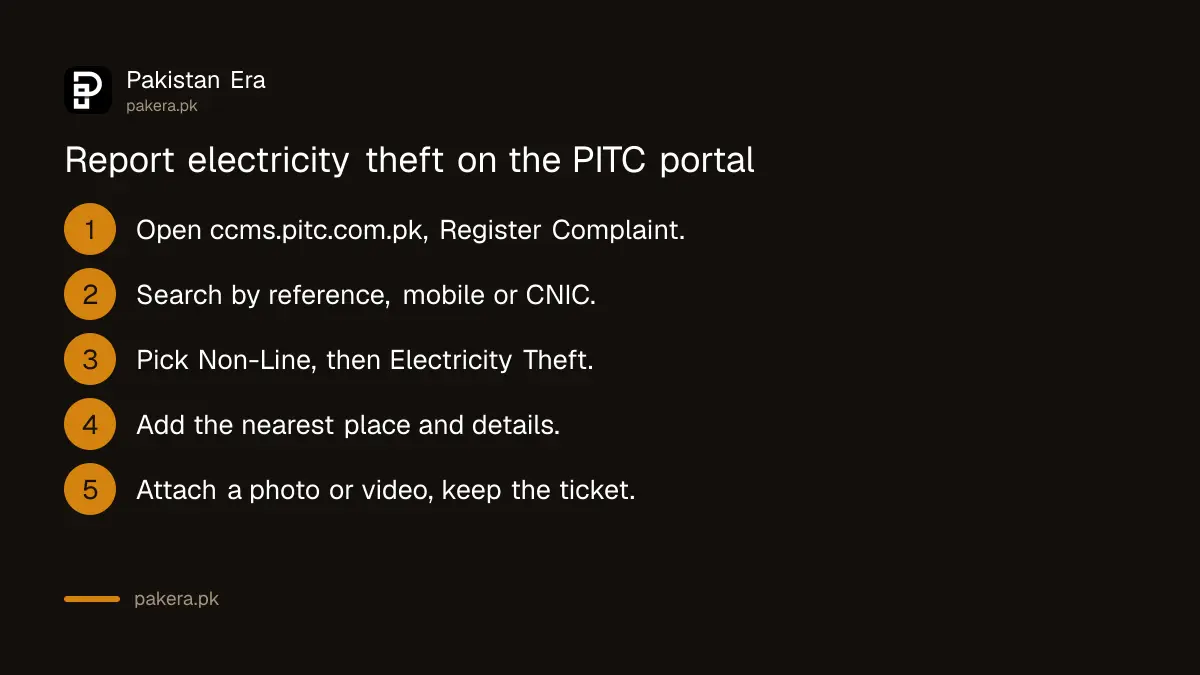
- Open the form. Go to ccms.pitc.com.pk and choose "Register Complaint".
- Identify yourself. Search by your own 14 digit reference number, your mobile number or your CNIC. The form uses your account to route the complaint to the right office.
- Pick the category. Choose "Non-Line Complaints", then "Electricity Theft". For stolen wires or meters, pick "Installed Transformer/Meter/Wire Theft". For a whole area taking supply illegally, pick "Bulk Distribution Theft".
- Describe the place. Fill in "Nearest Place" and the details: the street, the pole, what you saw and when. Do not guess at names.
- Attach proof. The form takes a photo, audio or MP4 video up to 2 MB. Then solve the small sum and press "Register Complaint". Keep the ticket number and use "Track by Ticket".
TESCO, HAZECO and K-Electric customers use their own company's channels. In Karachi, the steps for K-Electric complaints on 118 apply.
What a theft report starts
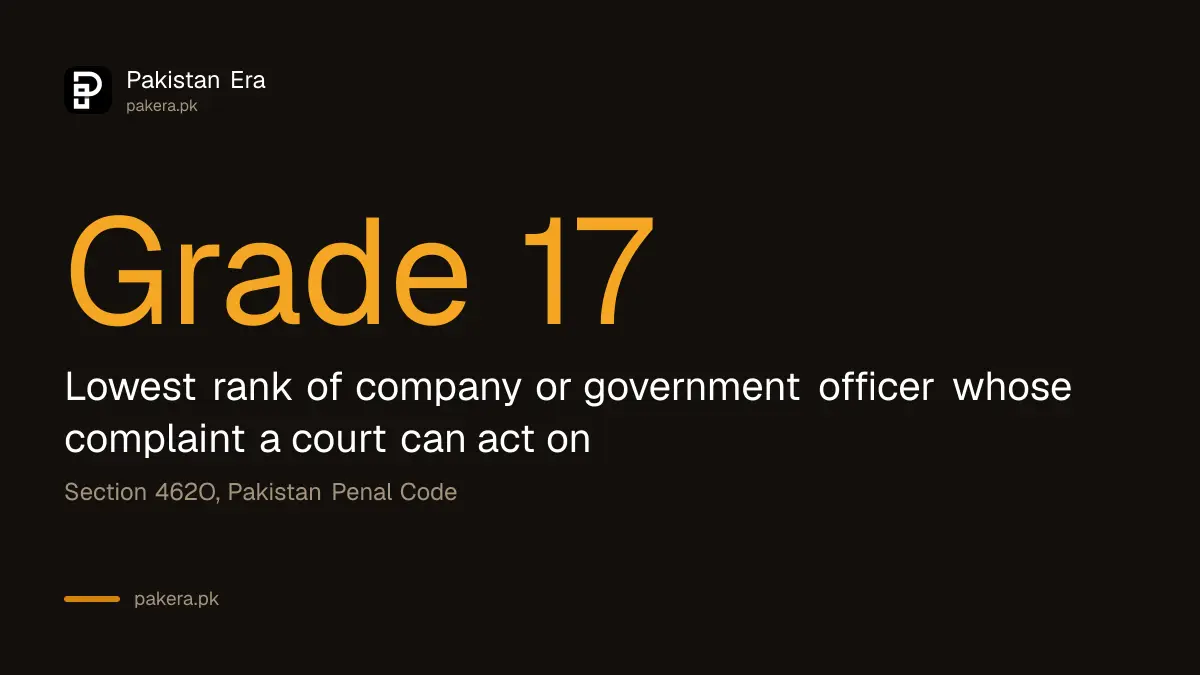
A citizen cannot take a theft case straight to court. Section 462O says the Electricity Utilities Court can take up these offences only on a written complaint, with reasons and full details, from an authorised officer of the government or the company, not below Grade 17.
NEPRA's Consumer Service Manual, revised in November 2025, sets out what the company then does. For direct theft, the supply is disconnected at once under an officer's supervision. The removed wire or equipment is kept as case property for the trial. Photos or videos are recorded as evidence. An officer of Grade 17 or above informs the police in writing.
The company also bills the loss. Clause 9.1.3 allows a detection bill of up to 12 months for someone with no connection, and up to 6 months for a registered consumer. If a detection bill ever lands on you wrongly, the steps to dispute an electricity detection bill are different, and you have a right to a hearing.
Signs of meter tampering NEPRA lists
Clause 9.2.1 of the manual lists the signs that make a company investigate a registered consumer. Knowing them helps you describe what you saw, and check your own meter is clean.
- A broken, missing or fake seal or terminal cover.
- Holes in the meter body, or a broken or smoky glass.
- A meter hanging loose, tilted or running in reverse.
- A dead, burnt or washed out display, or stuck digits.
- A shunt or chemical inside the meter, or a repasted body.
When these turn up, the company should secure the meter in front of the consumer, install a check meter, and serve a notice giving 7 days to reply. Only then does a detection bill follow.
Refuse and report anyone offering to fix your meter
An offer to slow your meter or cut your bill for cash is not a service. Section 462J makes it an offence for a home consumer to tamper with a meter, use a tampered meter, or abet any of those acts. So the person who pays for a "setting" is exposed too, and the fine for a household runs up to Rs 1 million.
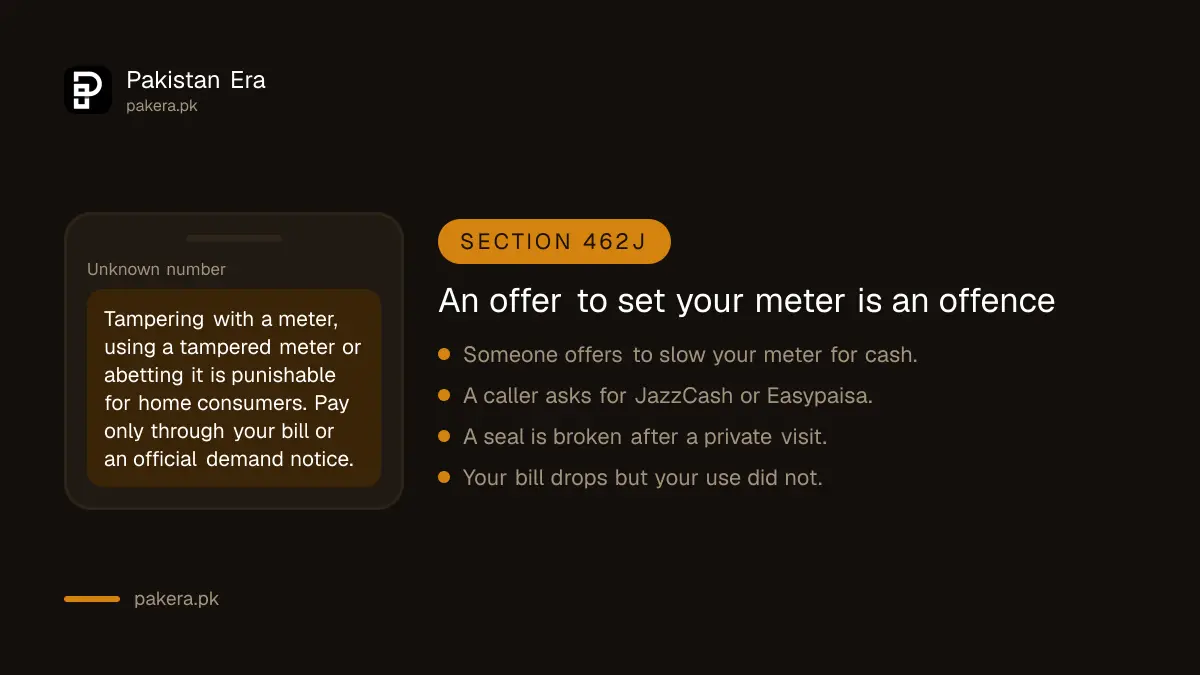
If the offer comes from someone claiming to be company staff, use the "Bribery/Corruption" type on the same portal. The portal itself warns never to send money for bills, meters, repairs, fine cancellation or bill adjustment to any person through Easypaisa, JazzCash or a direct bank transfer, and to report such calls to the 118 helpline. Payments go only through your bill or an official demand notice.
One safety point. Never touch or pull a hooked wire yourself. If a wire is down or sparking, choose "Live Fallen Wire" or "Meter Sparking/Wire Loose" under Line Complaints instead, which are treated as faults.
Common questions
Where do I report electricity theft in Pakistan?
On ccms.pitc.com.pk under Non-Line Complaints, Electricity Theft, or on the 118 helpline. K-Electric, TESCO and HAZECO customers use their own company's channels.
Can I report electricity theft without giving my name?
Not on the portal. It needs a reference number, mobile number or CNIC to register a complaint. We found no anonymous option on the form.
Can I file a police case for electricity theft myself?
No. Section 462O lets the court act only on a complaint from a company or government officer of Grade 17 or above. You report; the company files.
What is the punishment for meter tampering at home?
Up to 2 years in prison, a fine of up to Rs 1 million, or both, under section 462J. The loss to the company is recovered as well.
Can I attach a video to my theft complaint?
Yes. The portal accepts JPEG, PNG, GIF, MP3 and MP4 files up to 2 MB.
What if someone asks me to pay by JazzCash to fix my bill?
Do not pay. The portal warns against any such transfer to an individual. Report the call to 118.
How we verified this
What we checked, where we read it, and what we could not confirm.
Last checked on 1 October 2026. We read Chapter XVII-B of the Pakistan Penal Code, sections 462G to 462P, on the Pakistan Code website. We read Chapter 9 of NEPRA's revised Consumer Service Manual of November 2025. We opened the PITC complaint form and its published list of complaint types, file limits and scam warning. We did not file a theft report, so we cannot say how quickly offices act on one.
About the author

Tax, Bills and Technology Writer
Ali Akhtar is a young and curious voice here at Pakistan Era. He is currently pursuing his A-Levels and has a growing interest in Pakistan’s changing industrial landscape and educational trends. Ali likes to write in a way that helps him explain and explore the world around him. His writing reflects the perspective of the new generation navigating the evolving trends of Pakistan where technology, youth innovation, and shifting opportunities are reshaping the country’s future.