How to Complain Against a Federal Tender in Pakistan: GRC and PPRA Appeal
Complain against a federal tender in Pakistan: the GRC deadlines under the 2026 procurement rules, how to write the complaint, and the 10 day PPRA appeal.
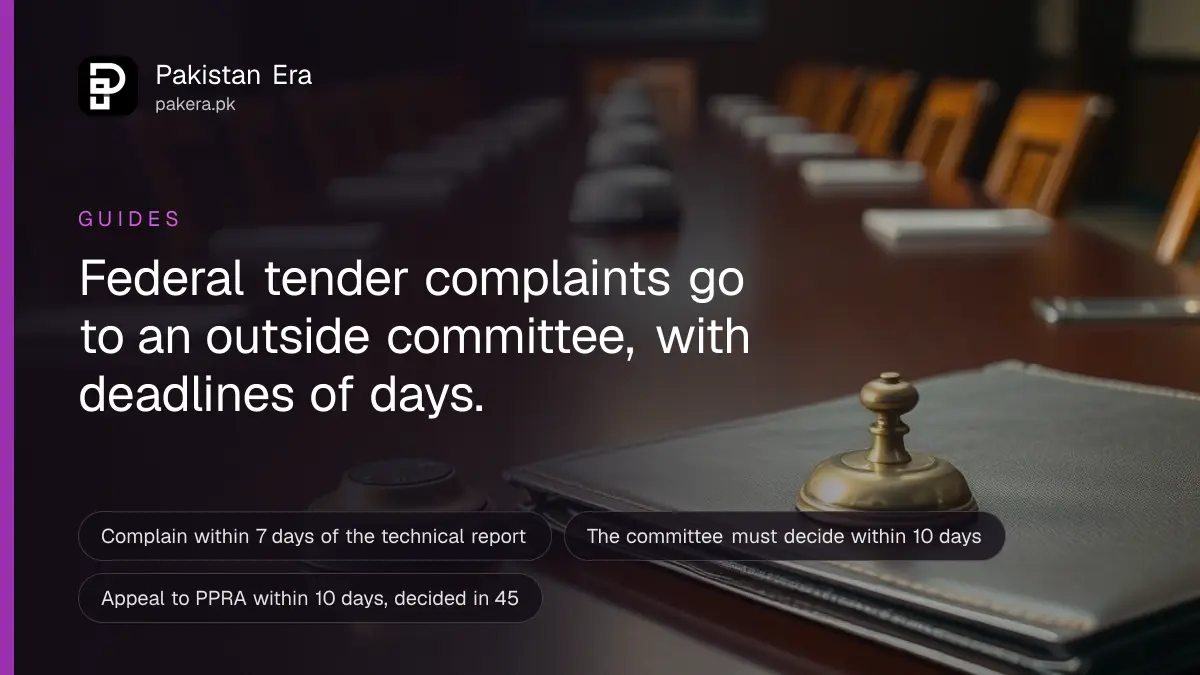
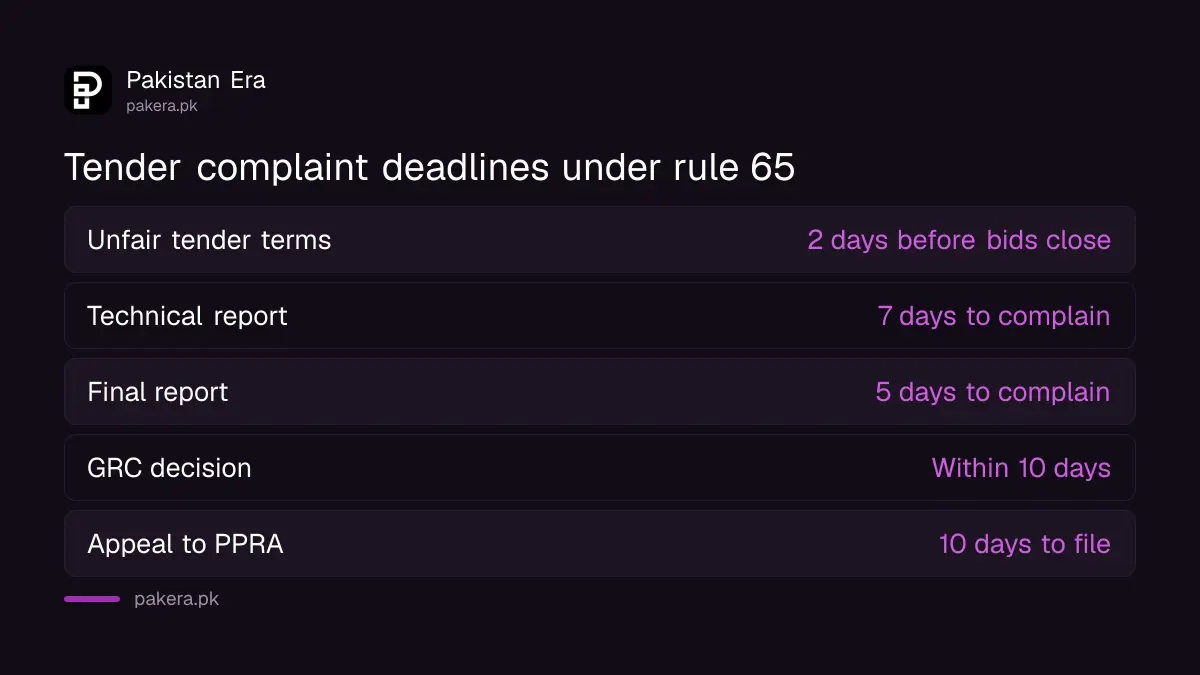
If you think a federal tender in Pakistan is unfair, you file a written complaint with the tender's Grievance Redressal Committee (GRC). Before bidding, the deadline is two days before bids close. After bidding, it is 7 days from the technical evaluation report or 5 days from the final one. The GRC must decide within 10 days.
If the GRC rules against you, you can appeal to PPRA's Appellate Committee within 10 days. These time limits come from rule 65 of the Public Procurement Rules, 2026, which took effect on 28 September 2026. We read the Gazette text that PPRA published on its announcements page.
The windows are short and they do not stretch. A supplier who waits a week to "see what happens" can lose the right to complain at all.
The Grievance Redressal Committee hears tender complaints first
Every federal procuring agency must set up a Grievance Redressal Committee, or GRC, to hear complaints from bidders before a contract takes effect. Under rule 65, its members must come completely from outside the agency running the tender, and their number must be odd.
Members come from another procuring agency, or from a pool of experts that PPRA keeps on EPADS, the federal online tender system. The point is that nobody from the buying department sits in judgement on its own tender.
PPRA publishes GRC notifications on its EPMS grievances page. On 2 October 2026 that page listed 36 entries, the latest dated 1 October 2026, for buyers such as CDA, the Board of Investment and the Petroleum Division.
Complain about the tender terms before you bid
If the bidding documents are unfair, you need not bid first. Rule 65(2) lets any party file a written complaint up to two days before the bid deadline against the eligibility rules, the evaluation criteria or any other term that breaks the procurement framework.
Typical examples are an experience rule that only one firm in Pakistan could meet, or a specification copied from one brand's catalogue. Rule 21(2) separately says an agency cannot set eligibility criteria beyond what the ordinance, rules and regulations allow.
Count the two days carefully. If bids close on a Thursday, a complaint filed on Wednesday is already late. File earlier, and keep proof of the date you sent it.
You can also ask questions before you complain. Rule 38 lets a bidder request a clarification on EPADS up to three days before the deadline, and the agency must reply within two days. Sometimes a clear answer fixes the problem. If it does not, you still have time to complain.
Complain about the evaluation within 7 days or 5 days
After bids are opened, rule 65(3) gives a bidder 7 days from the announcement of the technical evaluation report, and 5 days after the final evaluation report is issued. It must be in writing and name the act you dispute.
There is a trap in rule 65(5). If you wait for the final report, you cannot then object to the technical evaluation. So if your technical bid was wrongly rejected, complain within 7 days of that report. Do not wait for the prices to be opened. The one exception is a single stage, one envelope tender, where the whole final report can be challenged.
Some urgent buying uses even shorter windows. For gallop tendering, the rules allow no more than two days for filing and deciding a grievance after the final report. Schedule I sets a grievance period of one day for fertiliser, grains, sugar, petroleum products and coal, and three hours for LNG and LPG.
| Stage | Your deadline | Who decides, and how fast |
|---|---|---|
| Unfair tender terms | 2 days before bids close | GRC |
| Technical evaluation report | 7 days after it is announced | GRC, within 10 days |
| Final evaluation report | 5 days after it is issued | GRC, within 10 days |
| GRC decision, or no decision | 10 days to appeal | PPRA Appellate Committee, within 45 days |
| Dispute after contract signing | As set in the contract | Arbitration or other dispute resolution |
How to write and file the complaint
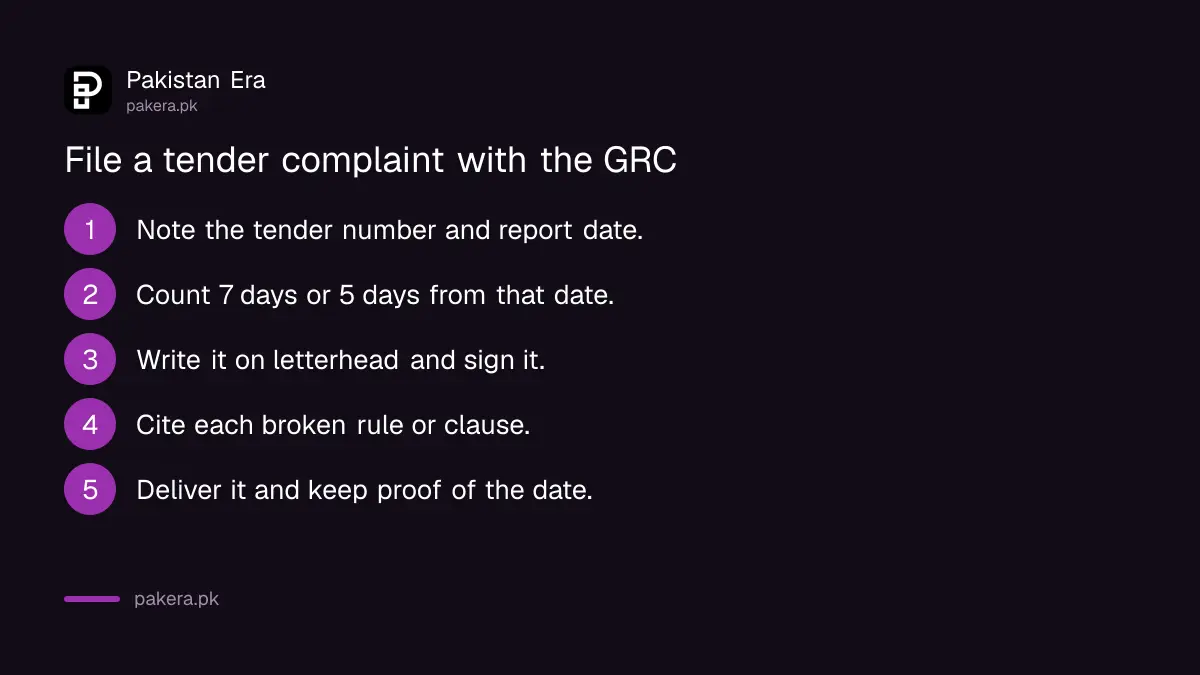
A good complaint is short, dated and specific. Name the tender number shown on EPADS, the procuring agency, the rule or tender clause you say was broken, and the remedy you want. Attach your evidence and keep a dated copy.
- Find the tender number and the date of the report you are challenging.
- Count your deadline from that date: 7 days for a technical report, 5 days for a final one.
- Write the complaint on your letterhead, signed by an authorised person.
- List each problem with the clause or rule it breaks.
- Say what you want: re-evaluation, a corrected document or cancellation.
- Deliver it in writing to the procuring agency's GRC and keep proof of delivery.
Rule 65(4) lets the GRC pause the tender while it decides a complaint against an evaluation report. Ask for that pause in your complaint if a contract is about to be signed.
Appeal to the PPRA Appellate Committee within 10 days
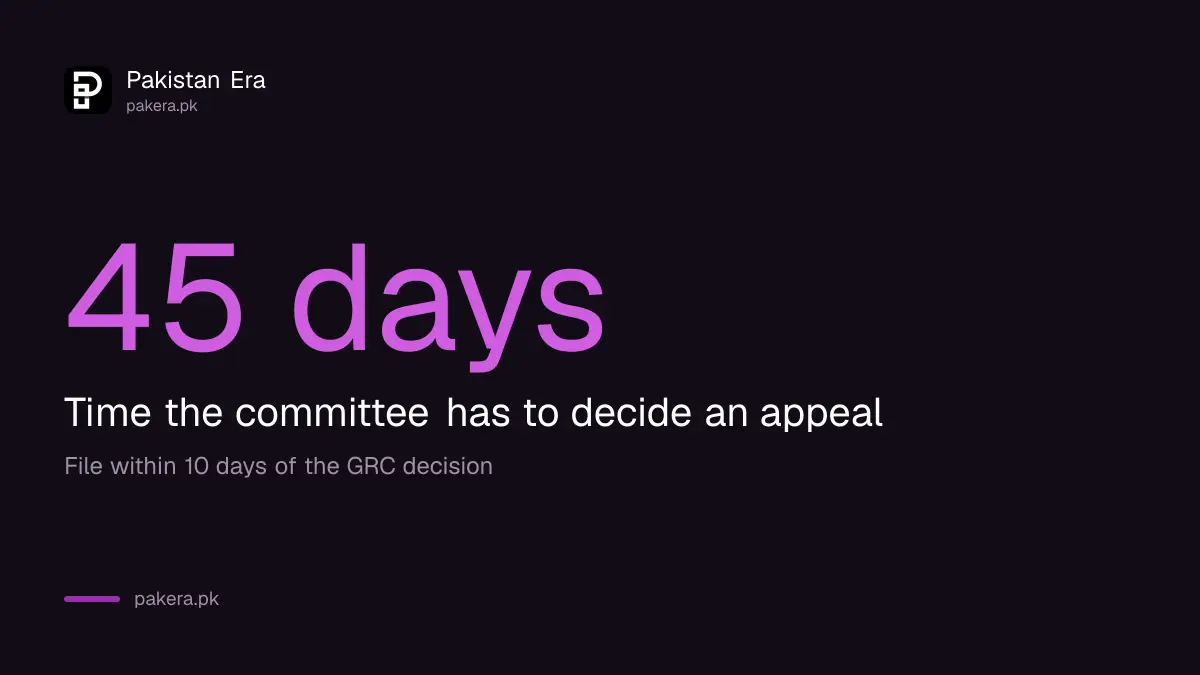
If the GRC rules against you, or fails to decide within 10 days, rule 65(7) lets you appeal to the Appellate Committee of PPRA within 10 days. You must deposit a prescribed fee. The committee decides within 45 days, and its decision is final.
The committee can suspend the award of the contract while the appeal is pending. It has an odd number of members, including one from outside PPRA.
We could not find the appeal fee amount on the PPRA pages we read on 2 October 2026. The rules say only "the prescribed fee" and "the procedure determined by the Authority". Call PPRA before you file, so a wrong payment does not cost you the 10 days.
Once a contract is in force, the GRC route closes. Rule 66 sends disputes between the agency and the contractor to alternate dispute resolution, and then to arbitration under the laws of Pakistan unless the contract says otherwise. Separately, rule 67 lets PPRA or the agency declare a "mis-procurement" when a complaint shows a material breach of the rules.
Keep your tax and records ready before you complain
A complaint is stronger when your own file is clean. Agencies check eligibility under rule 21, so keep your registration, tax and past-work papers current. If you complain while missing a required document, the committee may simply confirm your rejection.
Check that your NTN shows correctly using FBR's NTN verification, and that you appear when you check your filer status. If your goods need it, your sales tax registration should be active as well.
Common questions
How many days do I have to complain about a federal tender result?
Seven days from the announcement of the technical evaluation report, and five days after the final evaluation report, under rule 65(3) of the 2026 rules.
Can I complain before I submit a bid?
Yes. Any party can complain about the eligibility rules, evaluation criteria or other terms up to two days before the bid deadline.
How long does the GRC take to decide?
The rules give it 10 days from receiving the complaint. If it fails to decide, you can appeal to PPRA.
Is there a fee to appeal to PPRA?
Yes, the rules require a prescribed fee for an appeal. We could not find the amount published on PPRA's website, so confirm it with PPRA first.
Can the tender be stopped while my complaint is heard?
It can. The GRC may suspend proceedings on a complaint against an evaluation report, and the Appellate Committee may suspend the contract award during an appeal.
Do these rules apply to provincial tenders?
No. They cover federal procuring agencies. Punjab, Sindh, Khyber Pakhtunkhwa and Balochistan have their own procurement rules.
How we verified this
What we checked, where we read it, and what we could not confirm.
Last checked on 2 October 2026. We read the Public Procurement Rules, 2026 (S.R.O. 1658(I)/2026, Gazette of Pakistan Extraordinary, 28 September 2026) as published by PPRA, in particular rules 21, 38, 65, 66, 67 and 68, the gallop tendering rule and Schedule I. We opened PPRA's public grievances page on its EPMS site, which listed 36 GRC notifications. The amount of the appeal fee was not on the PPRA pages we read. Tenders started before 28 September 2026 still follow the 2004 rules under rule 68, so check which rules your tender falls under.
About the author

Tax, Bills and Technology Writer
Ali Akhtar is a young and curious voice here at Pakistan Era. He is currently pursuing his A-Levels and has a growing interest in Pakistan’s changing industrial landscape and educational trends. Ali likes to write in a way that helps him explain and explore the world around him. His writing reflects the perspective of the new generation navigating the evolving trends of Pakistan where technology, youth innovation, and shifting opportunities are reshaping the country’s future.