ATM Kept Your Card in Pakistan? SBP Says Collect It Within 5 Working Days
SBP says an ATM that captures your card must tell you in Urdu and English to collect it within 5 working days. See the steps and the white label ATM fee rule.
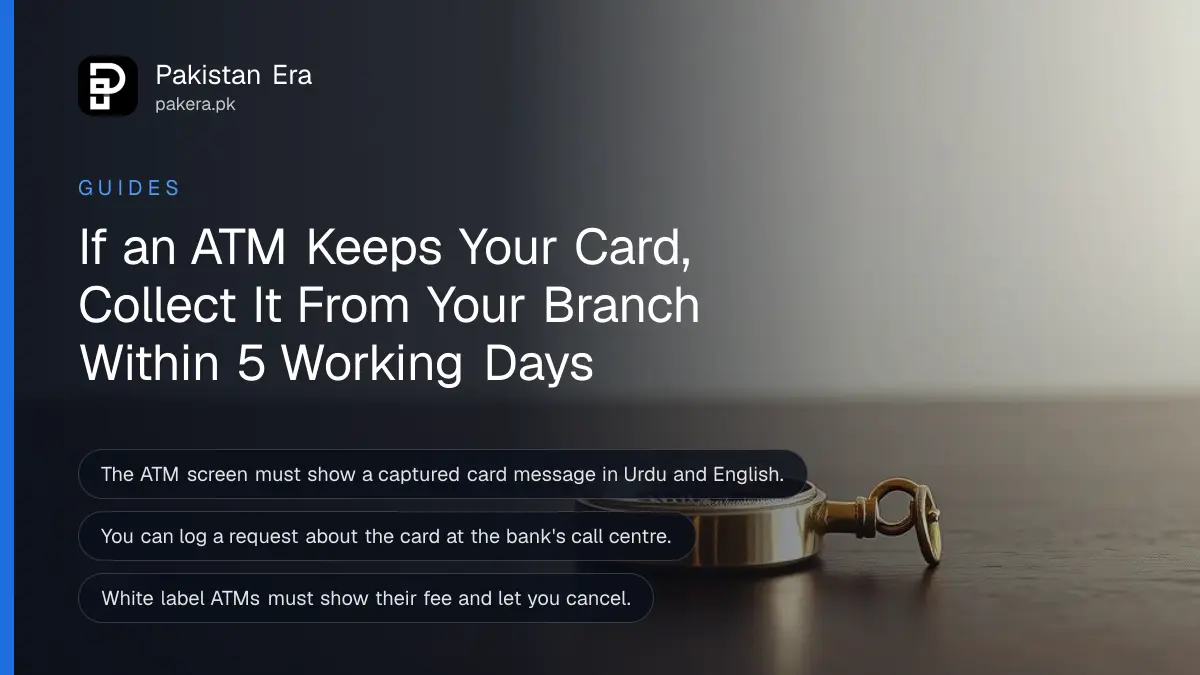
When an ATM keeps your card, SBP says the screen must tell you in Urdu and English that the card has been captured, that you can collect it from your branch within five working days, and that you can log a request at the bank's call centre. If an ATM shows a fee, you must be able to cancel before you pay.
An ATM that swallows your card is stressful, especially at night. The screen message is your first piece of evidence, so read it and note the time. We read the rules in SBP's Business Conduct and Fair Treatment of Consumers Regulatory Framework on 14 October 2026. It is part of BPRD Circular No. 04 of 2025, and section 3.2.2.1 covers ATM and debit cards.
The screen must say the card is captured and where to collect it
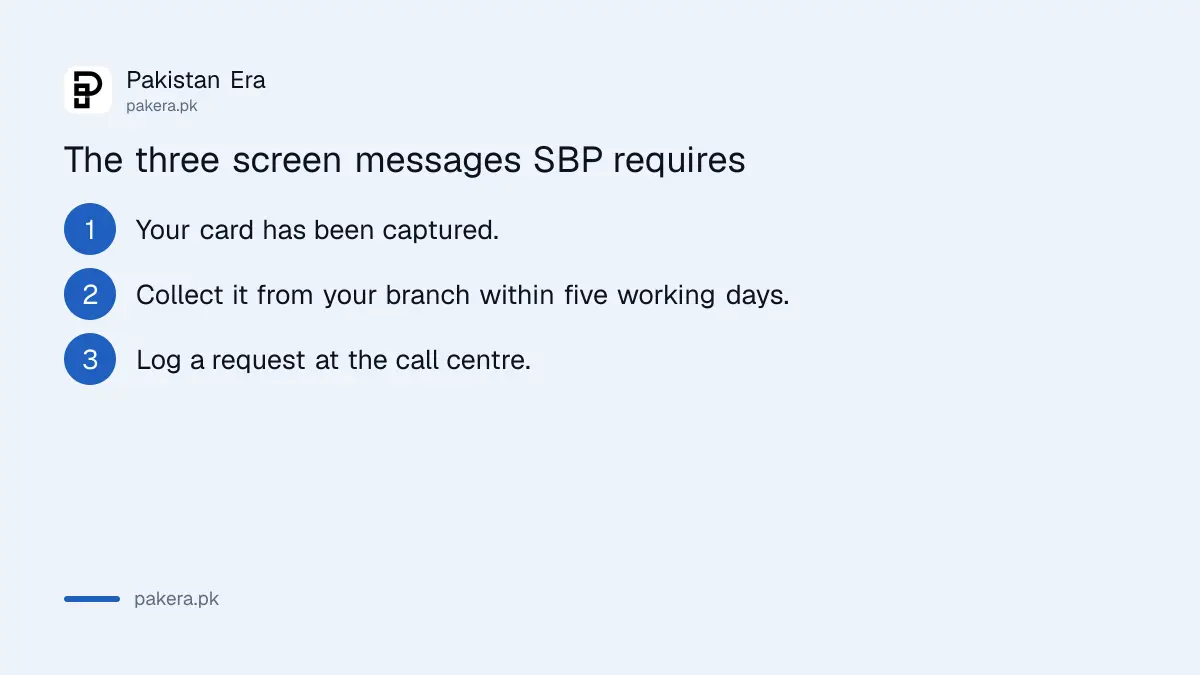
If a card is captured, SBP says the ATM shall show three messages in Urdu and English. The first says your card has been captured. The second says the card can be collected from your branch within five working days. The third says a request for the captured card can be logged at the call centre.
Take a photo of the screen if you can, or write down the ATM location, the time and the message. If the machine shows no message at all, note that too. It is a lapse you can report.
Protect your account first, then ask for the card
A captured card is usually not a theft, but you cannot be sure at the moment it happens. The framework says banks must let you enable and disable your card on mobile banking or internet banking, including for ATM, POS and online use. If your app has that switch, use it right away.
If you cannot reach your app, call the bank. SBP says a "card lost, stolen or block" request must be the first option on the call centre menu. Our guide on blocking a lost card explains the one minute answer rule. And the guide on how to block an ATM card lists the usual routes.
| Step | What to do | Why |
|---|---|---|
| At the machine | Read the message, note the time and place | Proof of what the ATM said |
| Within minutes | Disable the card in your app or call the bank | Stops any use while it is in the machine |
| Same day | Log a request at the call centre | SBP lists this as a route on the screen |
| Within five working days | Collect the card from your branch | The window the ATM screen must show |
What to do after your card is captured
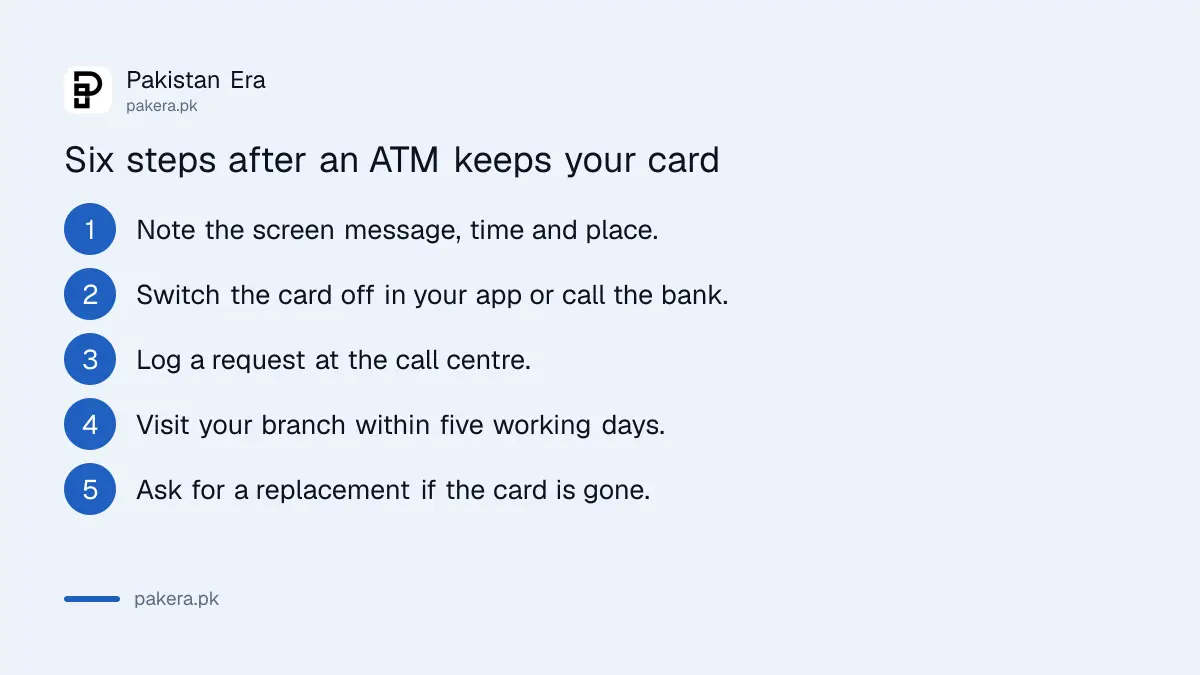
- Read the screen message and write down the time and the ATM location.
- Switch the card off in your banking app, or call the bank and ask to block it.
- Log a request about the captured card at the call centre and keep the reference number.
- Visit your branch within five working days and ask for the card.
- If the card is missing or damaged, ask the branch for a replacement and its charge in writing.
- Check your account statement for any transaction you did not make.
The framework does not say what happens if you miss the five working days, or whether the bank can charge a fee for returning the card. Ask your branch for its own rule on both.
White label ATMs must show the fee and let you cancel
Some ATMs belong to a company that is not a bank. SBP calls these white label ATM operators. They may charge reasonable transaction fees, either to you or to your bank if the bank is willing to absorb it. But the charge must be displayed on the ATM screen before you go further, in Urdu and English, and you must be able to cancel the transaction if you do not accept it.
So never press "continue" on a fee screen without reading it. Pressing cancel is allowed and costs you nothing under the framework. For other ATM charges, the guide on the inter-bank ATM withdrawal fee has the amounts reported when the 1Link rate changed.
Money gone without cash is a separate claim
Capture of a card and a failed cash withdrawal are not the same problem. If the ATM took money from your account and gave no cash, follow the refund steps in the guide on getting your money back when an ATM gives no cash. SBP's framework says ATM complaints follow instructions from its payment systems department rather than the usual complaint timelines.
If the bank gives no reply, the bank's complaint unit is the first stop. After 45 days without an answer, SBP's consumer page says you can go to the Banking Mohtasib Pakistan. For urgent matters such as an ATM problem, the same page says you can lodge the complaint with SBP.
Common questions about a captured ATM card in Pakistan
How long do I have to collect a captured card?
The ATM screen must say you can collect it from your branch within five working days, per SBP's framework. After that, the framework gives no rule, so ask your branch.
Can I get the card back at the ATM location?
No. The message tells you to collect it from your branch. You can also log a request about the captured card at the bank's call centre.
Should I block a captured card?
It is a safe step if you are unsure why it was captured. Use your banking app to disable the card, or call the bank. You can ask for a replacement at the branch afterwards.
Can a white label ATM charge me a fee?
Yes, a reasonable fee, but it must be displayed on screen in Urdu and English before you proceed. You can cancel the transaction if you do not accept the charge.
Where do I complain about an ATM problem?
Start with your bank. SBP's consumer page says urgent matters such as an ATM issue can also go to SBP, and unresolved complaints to the Banking Mohtasib after 45 days.
How we verified this
What we checked, where we read it, and what we could not confirm.
Last checked 14 October 2026. The captured card messages and the white label ATM rule are in section 3.2.2.1, points 4 and 5, of SBP's Business Conduct and Fair Treatment of Consumers Regulatory Framework. The card enable and disable rule is in section 3.2.2, and the call centre menu rule is in section 5.3.2. Escalation steps are from SBP's consumer protection page. We have not tested what any bank's ATM displays. Machines may show shorter text than the framework lists.
About the author

Senior Writer, Public Services and Technology
Shahid joined us in 2024 as an author. He is a senior contributor to Pakistan's leading technology websites. He writes detailed articles, mostly covering his expertise in the latest tech, mobiles, apps, gadgets, and step-by-step guides. His ideology is to help people understand the latest trends and explain complex methods through very easy-to-understand guides.