Auto Policy 2026-31 Clears Its Committee, But Not the Cabinet
The Dar-led steering committee has agreed the EV, hybrid, tax and localisation framework. It still needs the ministry and then the cabinet.
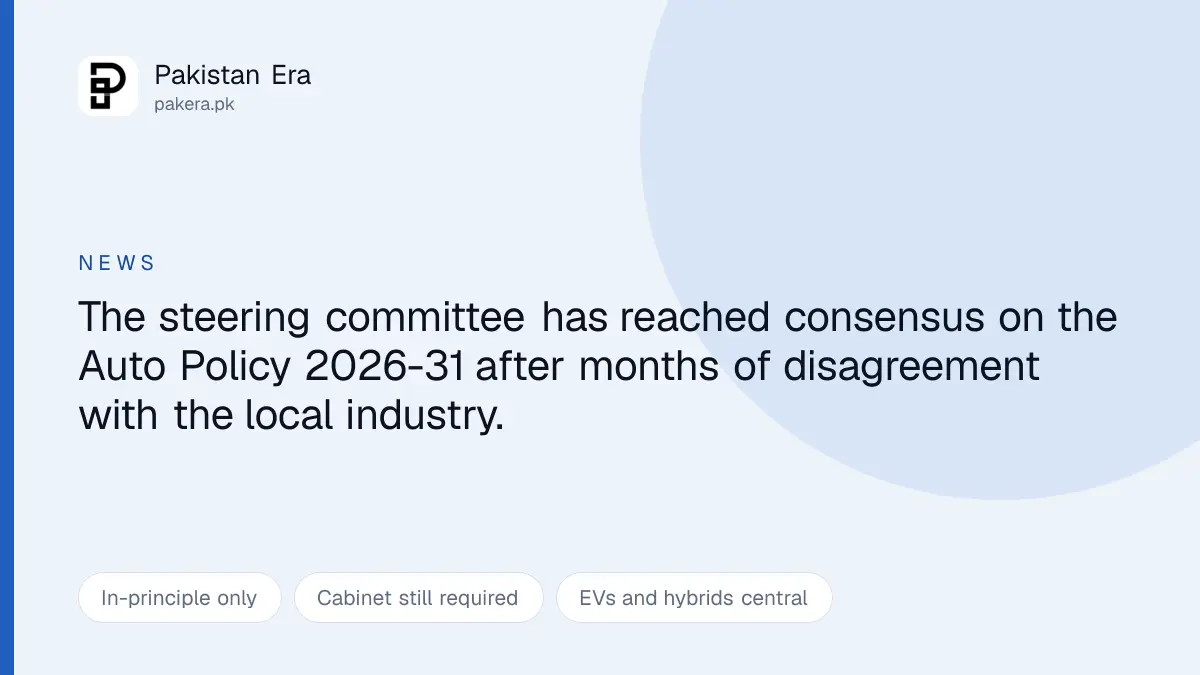
Pakistan's new Auto Policy 2026-31 has cleared its steering committee. After months of deadlock with the local car industry, a consensus exists.
Before anyone changes a buying decision: nothing has been approved. This is the first of several stages, and no duty, tax or incentive has moved.
Where it has actually reached
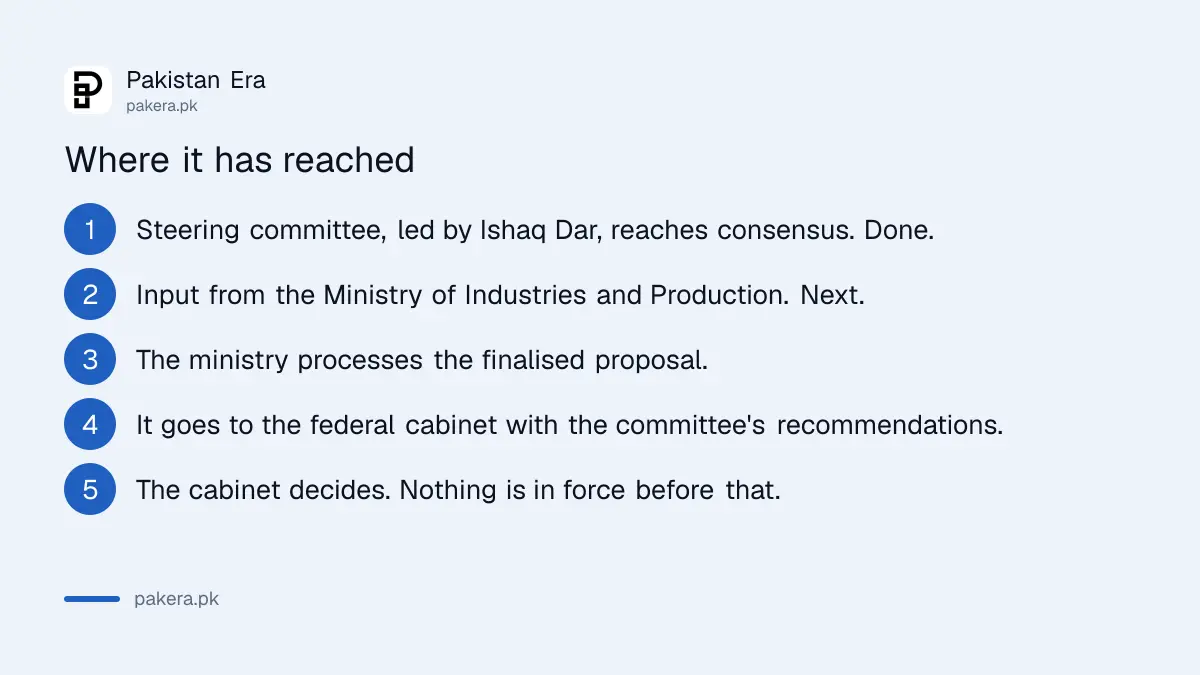
- The steering committee, led by Ishaq Dar, reaches consensus. This is what happened.
- Input is incorporated from the Ministry of Industries and Production. Next.
- The ministry processes the finalised proposal.
- It goes to the federal cabinet with the committee's recommendations.
- The cabinet decides. Nothing is in force before this.
Officials involved in the process describe the committee stage as the breakthrough, which it is, given how long this has been stuck. It is not the finish line.
What the policy is trying to do
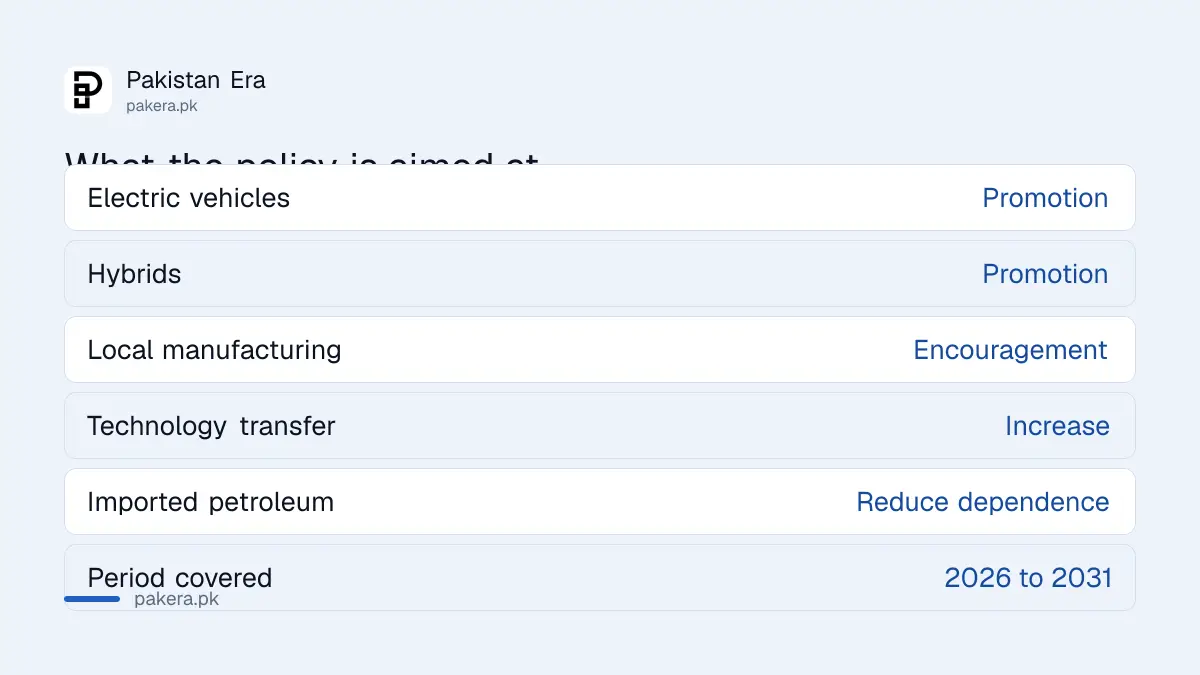
| Aim | Direction |
|---|---|
| Electric vehicles | Promote |
| Hybrid vehicles | Promote |
| Local manufacturing | Encourage |
| Technology transfer | Increase |
| Imported petroleum | Reduce dependence on |
That last aim explains why the finance side is so involved. Pakistan's fuel import bill is a balance of payments problem as much as a transport one, so moving vehicles off petrol is fiscal policy wearing an industrial hat.
Why it took this long
The policy has been delayed repeatedly since the FY27 budget talks, and the reporting is specific about the sticking points.
Disagreements with the local automobile industry centred on four things: the framework for electric vehicles, the treatment of hybrids, taxation, and localisation.
Those are not small technical details, they are the whole argument. Localisation rules decide how much of a car must be made here to qualify for favourable treatment, which decides whether an assembler's existing investment is protected or undercut. Tax treatment decides which technology wins. An industry built around one set of assumptions has an obvious interest in how fast the next set arrives.
We are describing the dispute as reported rather than taking a side in it, and we are not naming which companies objected.
If you are waiting to buy
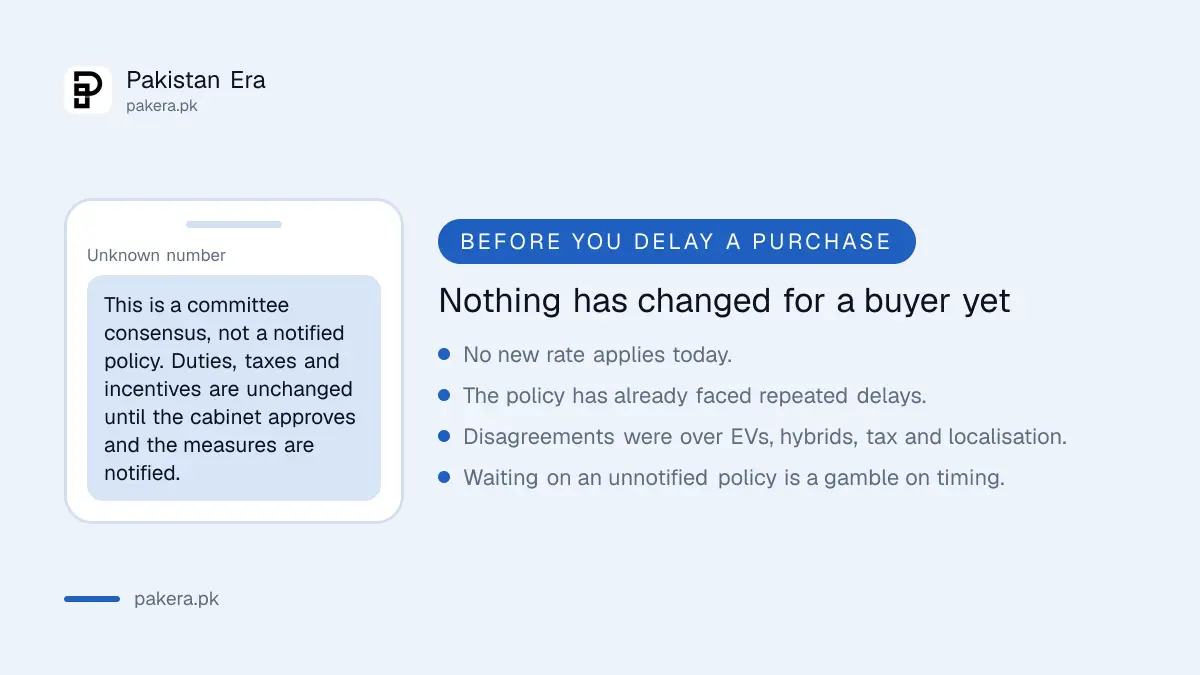
This is the only genuinely actionable question, so here is the honest answer.
Nothing has changed today. Current duties, taxes and incentives apply exactly as they did yesterday. A committee consensus is not a notified measure.
If you are holding off on a purchase to catch a future incentive, understand what you are betting on. This policy has already missed its own timelines more than once, it still needs a ministry stage and a cabinet decision, and no date has been announced for either. Waiting might save you money. It might also mean waiting through another year of price rises.
We are not going to tell you which way that goes, because nobody knows and the policy text is not public.
What we are not publishing
No duty rates, no tax figures, no incentive amounts, no localisation percentages.
The policy text has not been released, the reporting is sourced to officials rather than to a document, and a number attached to an unapproved policy is the most damaging thing we could print. Somebody would plan a purchase around it.
When the cabinet decides and the measures are notified, the figures become real and we will cover them then.
Why a five year auto policy matters more here than elsewhere
In most countries a car buyer never reads an industrial policy. In Pakistan it is worth knowing what one contains, for a specific reason.
Vehicle prices here are shaped far more by policy than by manufacturing. Duty structures, localisation requirements and tax treatment move the sticker price by amounts that dwarf anything happening on a production line. A policy change can alter what a car costs more than a model change does.
The five year framing matters too. Assemblers make investment decisions against a policy horizon, and a long delay in publishing one freezes those decisions. That is part of why this has been contentious: the industry is not only arguing about the contents, it has been waiting on the certainty.
For a buyer, the practical read is that the eventual policy will probably shift relative prices between petrol, hybrid and electric vehicles rather than making cars broadly cheaper. Which of those gets favoured is the argument that has taken months.
Where this sits against the current rules
While the new framework waits, the existing position is what applies.
Hybrids currently carry their own tax treatment, which we set out in the 25 per cent hybrid tax. Whether that treatment has actually shifted buyer behaviour is a separate question, and the sales picture is in why hybrid sales stalled.
The wider fuel cost argument behind the policy's petroleum aim is in why petrol prices do not fall with oil.
Questions readers are asking
Has the new auto policy been approved?
No. A steering committee has reached consensus. It still needs to go through the Ministry of Industries and Production and then to the federal cabinet.
What does it cover?
Promoting electric and hybrid vehicles, encouraging local manufacturing, increasing technology transfer and reducing dependence on imported petroleum, over 2026 to 2031.
Do car taxes change now?
No. Current duties, taxes and incentives are unchanged until the cabinet approves and measures are notified.
Why was it delayed?
Disagreements with the local automobile industry over the framework for EVs and hybrids, taxation and localisation, following the FY27 budget talks.
Should I wait to buy a car?
That is a bet on timing. The policy has missed its own deadlines before and no cabinet date has been announced. Nothing about today's news changes a price.
When will it take effect?
No date has been announced. It needs a ministry stage and a cabinet decision first.
Will EVs get cheaper?
The policy aims to promote them, but no rates or incentives have been published, so any specific figure circulating is speculation.
About the author

Tax, Bills and Technology Writer
Ali Akhtar is a young and curious voice here at Pakistan Era. He is currently pursuing his A-Levels and has a growing interest in Pakistan’s changing industrial landscape and educational trends. Ali likes to write in a way that helps him explain and explore the world around him. His writing reflects the perspective of the new generation navigating the evolving trends of Pakistan where technology, youth innovation, and shifting opportunities are reshaping the country’s future.