Building Under or Near Power Lines in Pakistan: Why You Can Be Refused an Electricity Connection
NEPRA bars building under or near power lines in Pakistan and lets the company refuse a connection on low clearance. See the rules and 5 checks before you buy.
In Pakistan, NEPRA's rules say you may not build or extend a house under or close to electricity lines, and the company may refuse a connection where the clearance is low. It can send a notice for illegal construction. The manual then makes the local civic authority responsible for demolition.
A plot with a line running over it can look like a bargain. The owner builds anyway, adds a balcony, and finds that the company will not give a meter. We read the safety chapter of NEPRA's Consumer Service Manual, the rulebook that every electricity company follows, to see exactly what it says. The manual gives no clearance in metres, which is the first thing buyers should know.
You may not build or extend near live lines
Clause 12.3.7 of the manual states that no consumer can construct or extend a building under or near the transmission or distribution lines, or in close proximity to them. It is one of the consumer's safety duties, listed beside wiring and earthing.
The word "extend" matters. A house that was safe when built can become unsafe when a floor or a balcony is added. The manual specifically names the "hazardous extension of balconies at the upper stories of houses in mohallas" that comes within close reach of lines.
Metal and chemical kite string, tied animals and loose stay wires are on the same list of dangers. All of them are in clause 12.4.
The company can refuse a connection on safety grounds
Clause 12.4.7 says a connection may not be granted where safety hazards are seen and the horizontal or vertical clearance of supply lines is low. The reason it gives is to discourage people from building under lines, to avoid accidents.
So the site visit that comes with every application matters. Annexure III of the manual includes a site survey as part of the first step for every connection category. If the surveyor finds a low line over your plot, the application can stop there.
The manual does not list a minimum distance. We could not find a metre figure in it, so we do not give one. Ask the company's sub division office to state the clearance in writing before you design the house.
Notices and demolition follow illegal construction
Clause 12.2.6 says the company will issue a notice to the person concerned in case of illegal construction or extension of a building under or near distribution or transmission lines, for violation of safety standards.
Clause 12.4.9 explains what comes next. If safety standards are not met, or a notice is already issued, the local building department or civic authority is responsible for demolishing the illegally built or extended structure. It acts after it receives the information from the company.
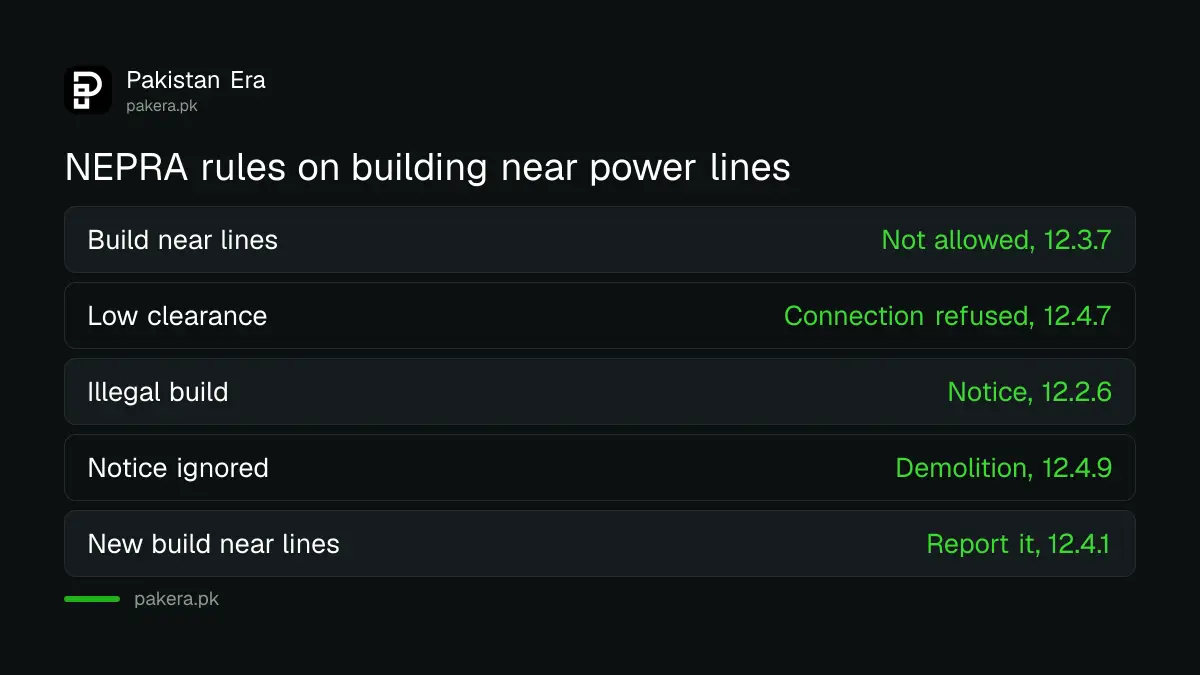
| Situation | What the manual says | Clause |
|---|---|---|
| Building under or near lines | Not allowed for any consumer | 12.3.7 |
| Low clearance at a new site | Connection may not be granted | 12.4.7 |
| Illegal construction found | Company issues a notice | 12.2.6 |
| Notice ignored | Civic authority responsible for demolition | 12.4.9 |
| New building near lines | Report it to the company | 12.4.1 |
The last row is also a right for neighbours. Clause 12.4.1 lists new roads, buildings or structures near or under lines as a hazard to report to the company at once.
Check the plot before you pay

- Look up from the plot. Stand on the plot and look for wires over it or near the boundary.
- Look at neighbouring houses. If balconies there are close to a line, expect the same rule for yours.
- Ask the sub division office in writing whether the plot has a clearance problem and what clearance it needs.
- Add the line to your sale terms. A seller who knows about the line should say so in the agreement.
- Plan the building line so the upper floors and balconies stay clear.
Our guide to documents and demand notice rules for a new electricity connection shows where the site survey comes in the process. If you need to move the line, shifting an electricity meter, pole or connection sets out the rules and charges.
If you already live under a line
If your house already stands close to a line, do not wait for a notice. Report it to the company's complaint centre and ask for a safety inspection. Never touch the line, and do not tie anything to a pole or stay wire. Keep children and animals away from the area.
The manual says a consumer is responsible for the right of way, in clause 14.5. That means that if a line must be shifted for your project, you should expect to deal with the cost and access. Our guide to reporting a fallen wire or sparking pole has the helplines to call for an emergency.
If the company disconnects you or sends a notice you think is wrong, respond in writing and keep a copy. If the reply does not settle it, how to complain to NEPRA about a wrong electricity bill covers the complaint route.
Common questions
How far must a house be from an electricity line in Pakistan?
NEPRA's manual does not give a distance. It says no building under or near lines. Ask your company's sub division to state the clearance for your plot in writing.
Can I get a meter for a house under a power line?
Not if the clearance is low. Clause 12.4.7 says a connection may not be granted where safety hazards are observed and the line clearance is low.
Who demolishes an illegal building near lines?
Under clause 12.4.9, the local building department or civic authority is responsible for demolishing it, after the company gives it the information.
Can I add a balcony on the first floor next to a line?
The manual warns against hazardous balcony extensions close to lines. Do not build one without written confirmation of the clearance from the company.
Does the company send a notice before action?
Yes. Clause 12.2.6 says the company issues a notice in case of illegal construction or extension near lines.
How do I report a new building near a line?
Tell the company's complaint centre. The manual lists new buildings and roads near lines as a hazard to report immediately.
How we verified this
What we checked, where we read it, and what we could not confirm.
Last checked 11 October 2026. We read Chapters 12 and 14 and Annexure III of NEPRA's Consumer Service Manual, as on 26 November 2025, in a copy published by a distribution company. The manual states no clearance distance, and we did not find one in the text. We did not check any local building bylaw. Confirm your plot with your sub division and on nepra.org.pk.
About the author

Global Affairs & Political Economy Writer
Muhammad Hatim is a book lover who started writing because he enjoys it. At Pakistan Era he writes about international relations, geopolitics and the global economy, with a particular interest in South Asia and the forces behind current events.