Shift an Electricity Meter, Pole or Connection in Pakistan: Rules and Charges
Shift an electricity meter for Rs 500, or move a pole or connection, under NEPRA rules. Who pays, the 7 day survey and the papers your SDO office will ask for.
To shift an electricity meter within your own house in Pakistan, apply to your SDO office with the reason. NEPRA's rules give the company seven days to survey the new spot, and the shifting charge is Rs 500 for a single phase meter or Rs 1,000 for three phase, plus any extra cable. Moving a pole or a whole connection costs more.
The usual trigger is building work. A family adds a room, rebuilds a boundary wall or opens a new gate, and the meter or the pole is in the way. We read the rules that NEPRA, the power regulator, sets for every distribution company, and they split this job into three different requests with three different price tags.
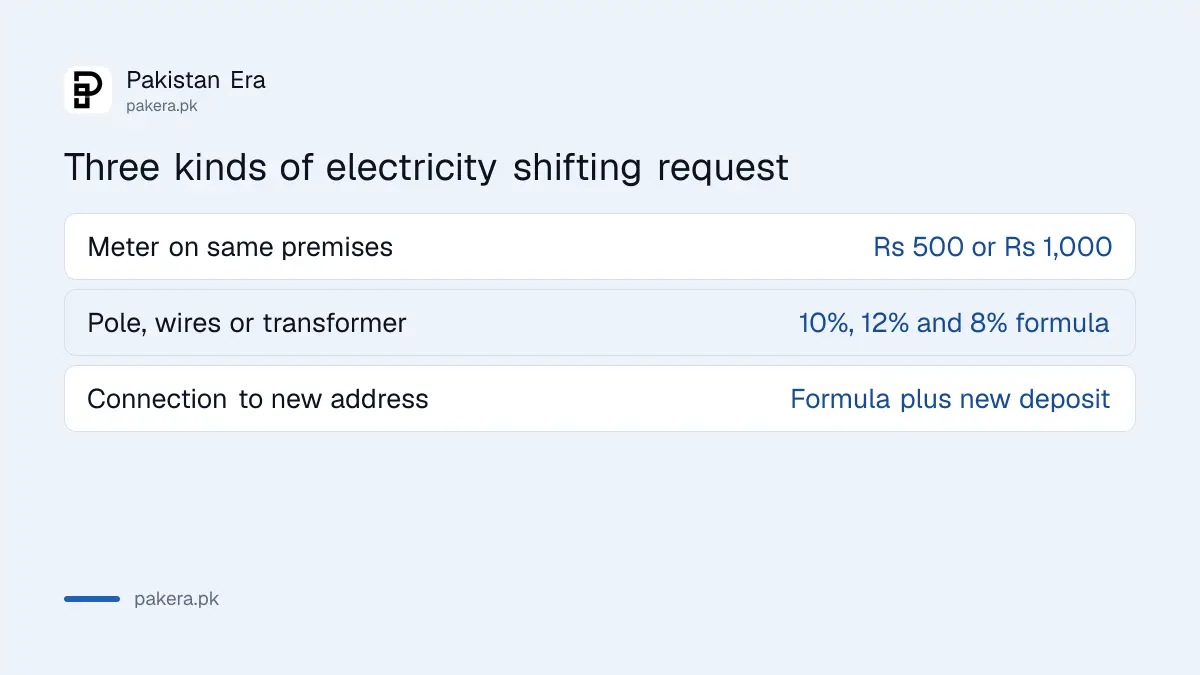
Electricity meter shifting comes in three types
NEPRA's Consumer Service Manual treats a meter move, a pole move and a connection move as separate cases. Pick the right one before you visit the office, because the forms and charges differ.
| What you want to move | NEPRA clause | What you pay |
|---|---|---|
| Meter to another spot on the same premises | 4.2.8 | Rs 500 single phase, Rs 1,000 three phase, plus extra material |
| Pole, wires or transformer near your house | 3.1 | 10% of material moved, new material plus 12%, and 8% installation |
| Whole connection to a new address | 2.12 | Same 10%, 12% and 8% formula, plus deposit at today's rate |
The manual is the rulebook every company follows, K-Electric included. NEPRA sent the revised 2025 version to all companies on 26 November 2025, and we read each of these clauses in it.
Shift a meter on the same premises for Rs 500
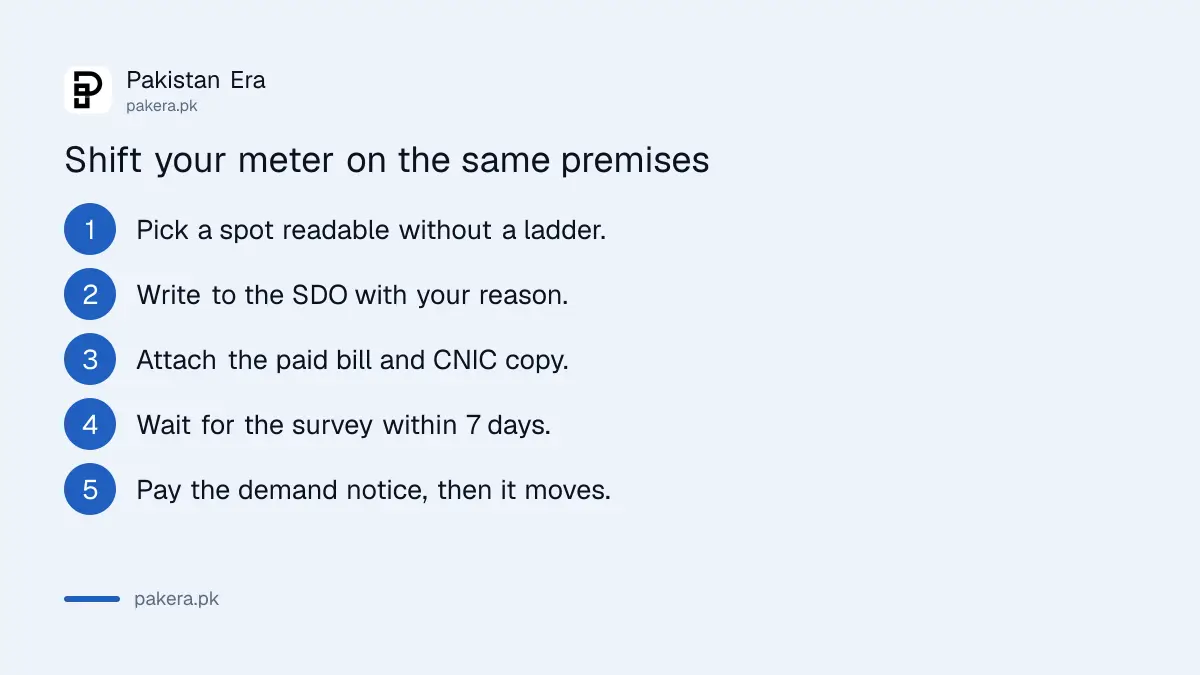
This is the cheapest and most common request. Clause 4.2.8 says you can apply "in person or online", giving your reasons. The company must then survey the new location within seven days.
- Choose the new spot. The manual says a meter must sit where it can be read without a ladder or climbing device. A spot on the outer wall or at the gate works best.
- Write a short application. Address it to the SDO, the sub divisional officer named on your bill. Give your reference number, the reason, and where you want the meter.
- Attach your bill and CNIC. Use a copy of the latest paid bill and a CNIC copy of the person named on it.
- Wait for the survey. A team should visit within seven days to check the new place.
- Pay the demand notice. If the company agrees, it issues a demand notice for Rs 500 or Rs 1,000 plus any extra cable. Pay it at a bank, then the team moves the meter.
Never move the meter yourself or pay a private electrician to do it. A meter that has been opened or moved without the company can be treated as tampering, and that is how families end up facing a detection bill. If one arrives anyway, the steps to dispute an electricity detection bill apply.

Moving a pole or line depends on who caused the problem
Poles, overhead wires and transformers are the company's "distribution facility". Chapter 3 of the manual decides who pays to move them, and the answer depends on the history.
- Road or public works: if a road is widened or a street rebuilt, the sponsoring agency pays, not you.
- Your own request: if you want a pole moved for convenience or building work, the company moves it at your cost, if it is feasible. You must also arrange the right of way, meaning the land or permission for the new spot.
- You built near the line: if you built a house or shop near or under an existing line and then ask for it to be moved, you pay.
- The company built over you: if the company put a line or pole over your house without the owner's consent, it must move it at its own cost when you ask.
That last rule is worth knowing. Keep any old photos, sale deeds or approved building plans that show your house came first.
When you do pay, clause 3.1.6 sets the formula. You pay 10 percent of the cost of the material being moved, at today's rates. You pay the cost of any new material plus 12 percent store handling charges. Then you pay 8 percent of that new material cost for installation.
Shift your connection to a new address in the same company
If you are moving house, you can take your connection with you, but only inside the same distribution company. Clause 2.12 covers home, commercial, general services, industrial and farm connections.
The conditions are strict. The new site must be in your name, or your legal heir's name verified from land records, or held on a proper lease. If it is in a legal heir's name, the change of name on the electricity bill is processed at the same time. The new site must also qualify as a new connection, and the local transformer and 11 kV feeder must be able to carry the load.
You will need four documents:
- Ownership proof for both the old and the new site
- A wiring test report from the Electric Inspector or a licensed wiring contractor
- A copy of the last paid bill, with no arrears, deferred amount or pending instalments
- An attested CNIC copy
You pay the same 10, 12 and 8 percent formula, any outstanding dues, and the security deposit at today's rate minus what you already paid. If the old material cannot be moved, you get credit for its depreciated value.
Who approves it depends on the move. The same sanctioning officer approves it if the new site is in their area. For a move from one circle to another, the GM (Technical) approves loads up to 500 kW.
Solar users and online applicants need to know two things
First, net metering moves with the same rules. Clause 2.12.5 says the procedure for shifting a net metering connection is the same as for any other connection. Check the export side afterwards, since the net metering rules for 2026 tie your agreement to the connection.
Second, the online ENC portal does not take shifting requests. We opened its change form on 2 October 2026. It is titled "Change Connection Name /Tariff /Load Application", and it offers no shifting option. So meter, pole and connection moves go to the SDO office on paper.
If you are leaving the company's area completely, shifting is not possible. In that case you apply for permanent disconnection and get your electricity security deposit back, then apply for a new connection at the new address.
Common questions
How much does it cost to shift an electricity meter in Pakistan?
Rs 500 for a single phase meter and Rs 1,000 for three phase, plus the cost of any extra material, under clause 4.2.8 of NEPRA's manual.
How long does the company take to check a meter shifting request?
NEPRA's manual says a survey of the new spot will be carried out within seven days of your request.
Who pays to move an electricity pole in front of my house?
You pay if you asked for it or built near the line. The company pays if it built over your house without consent, and the sponsoring agency pays for road works.
Can I shift my connection to another city?
Only if the new address is inside the same distribution company. Otherwise you disconnect permanently and apply for a new connection.
Can I shift a meter through the ENC portal?
No. The ENC change form covers name, tariff and load only, so shifting requests go to your SDO office.
Will my net metering continue after I shift my connection?
NEPRA's manual applies the same shifting procedure to net metering connections, so apply for both together at the SDO office.
How we verified this
What we checked, where we read it, and what we could not confirm.
Last checked on 2 October 2026. We read NEPRA's revised Consumer Service Manual, a scanned document, at clauses 2.12, 3.1 and 4.2.8, and opened the ENC change form. We did not file a shifting request. The cost of material at "prevailing rates" is set by each company and is not published as a fixed figure, so your demand notice will show the real amount.
About the author

Senior Writer, Public Services and Technology
Shahid joined us in 2024 as an author. He is a senior contributor to Pakistan's leading technology websites. He writes detailed articles, mostly covering his expertise in the latest tech, mobiles, apps, gadgets, and step-by-step guides. His ideology is to help people understand the latest trends and explain complex methods through very easy-to-understand guides.