By-Election Rules in Pakistan: The 60 Day Limit, 5 Ways a Seat Falls Vacant and Who Votes
By-election rules in Pakistan: the 60 day limit in Article 224, the 120 day exception, the five ways a seat falls vacant, reserved seats and ECP notices.
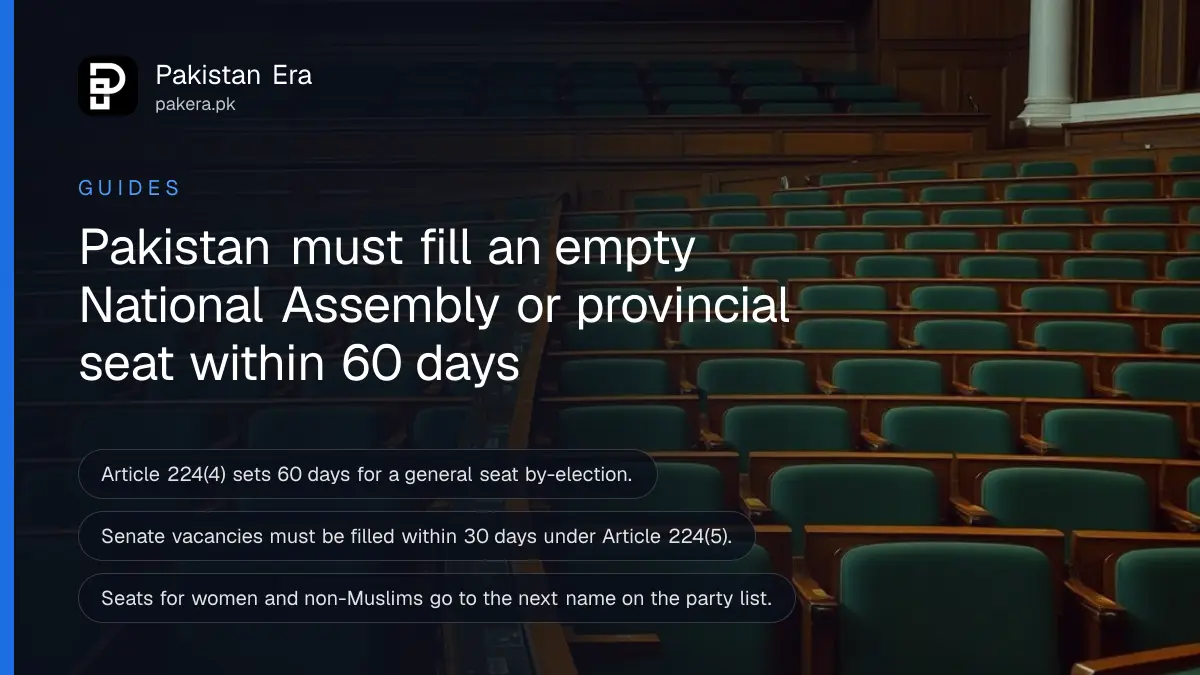
A by-election in Pakistan must be held within 60 days of a National Assembly or provincial assembly seat falling vacant, under Article 224(4) of the Constitution. The rule applies when the seat falls vacant at least 120 days before the assembly's term ends. Senate vacancies must be filled within 30 days. Reserved seats for women and non-Muslims get no by-election at all.
On Sunday 8 November 2026, voters in NA-77 Gujranwala-I and PP-203 Sahiwal-VI go to the polls while the rest of Pakistan carries on as normal. A by-election, written "bye-election" in the law, is an election to fill one empty seat. It happens between general elections, on a timetable the Constitution sets.
We read Articles 64, 223 and 224 of the Constitution in the copy on the National Assembly website, and Sections 102 and 103 of the Elections Act, 2017 in the copy on the Election Commission of Pakistan (ECP) website. This guide explains how a seat falls empty, how fast it must be filled, and how a by-election differs from a general election.
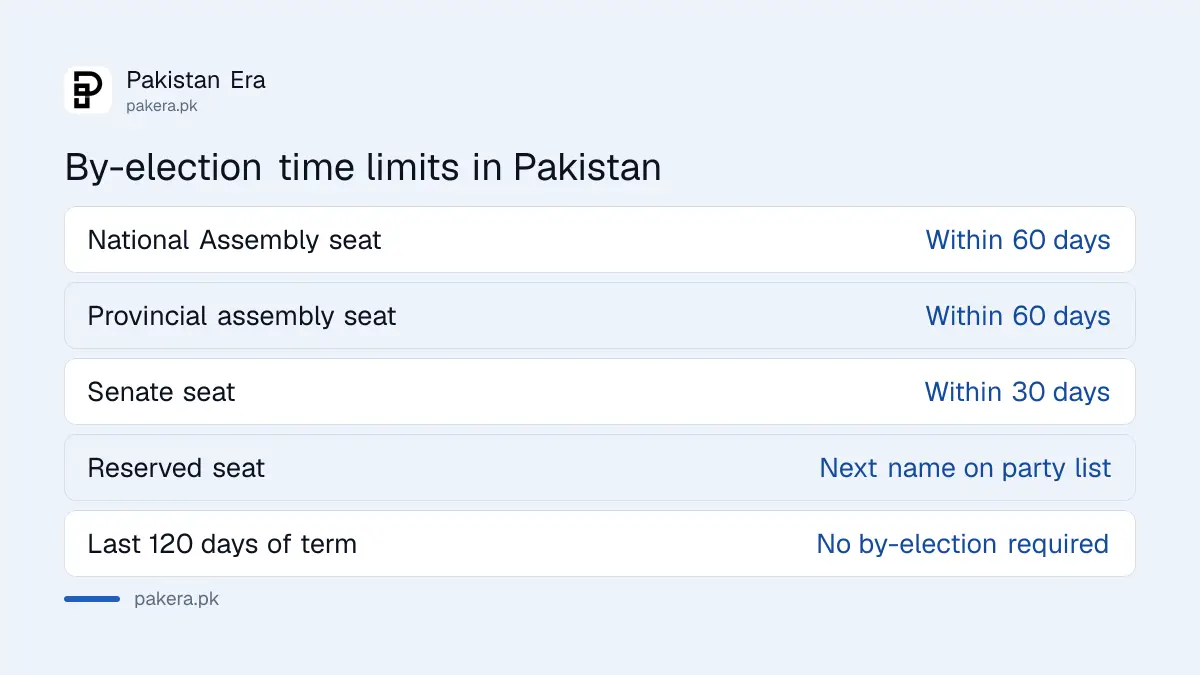
Article 224(4) gives the ECP 60 days to fill a general seat
Article 224(4) says that when a general seat in the National Assembly or a provincial assembly falls vacant, other than by dissolution, an election must be held within 60 days of the vacancy. A general seat is an ordinary constituency seat, such as NA-77 or PP-203.
There is one condition. The seat must fall vacant not later than 120 days before the assembly's term is due to end. If it falls vacant in the last 120 days, the Constitution does not require a by-election, because a general election is close.
| Seat | Time limit | Rule |
|---|---|---|
| National Assembly general seat | Within 60 days | Article 224(4) |
| Provincial assembly general seat | Within 60 days | Article 224(4) |
| Senate seat | Within 30 days | Article 224(5) |
| Seat for women or non-Muslims | No by-election, next name on the party list | Article 224(6) |
| Vacancy in the last 120 days of a term | No by-election required | Article 224(4) |
A seat falls vacant in five common ways
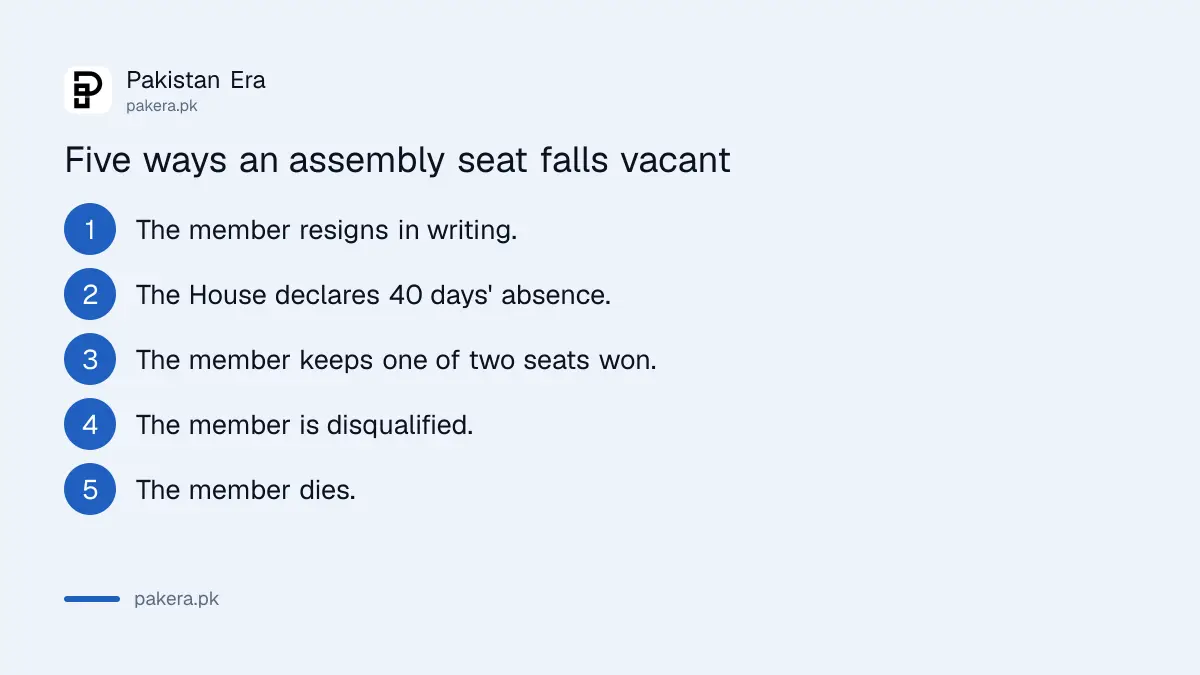
The Constitution and the law give several routes to an empty seat. These are the ones that cause most by-elections.
- Resignation: a member resigns in writing to the Speaker or the Chairman, and the seat becomes vacant, under Article 64(1).
- Absence: a House can declare a seat vacant if the member stays away for 40 days in a row of its sittings without leave, under Article 64(2).
- Winning two seats: a person elected to more than one seat must resign all but one within 30 days of the last result, under Article 223(2). The seats given up go to by-elections.
- Disqualification: a member found disqualified under Article 63 loses the seat.
- Death of a sitting member.
Article 223(2) also has a default. If a winner of several seats does not choose within 30 days, all those seats fall vacant except the one won last.
The ECP calls a by-election by notice in the Gazette
Section 102 of the Elections Act, 2017 sets the process. When a member's seat falls vacant, the ECP issues a notification in the official Gazette calling on that constituency to elect a new member. The notification sets the date.
The ECP also sets the dates for every stage in that notification. In a general election, Section 57 fixes the stages. In a by-election, Section 102(2) lets the ECP fix them, so the schedule can be shorter to fit inside 60 days.
After that, the same rules apply as in a general election. Candidates file nomination papers, pay the same deposit and face the same scrutiny. Our guide on how to contest an election covers those steps.
Only voters of that one constituency take part
A by-election is local. Only voters registered in the vacant constituency vote. Everyone else in the province or the country has no poll to attend that day.
Check whether you are a voter there by sending your CNIC number to 8300. Our guide on checking your vote by 8300 explains the reply. Postal ballot rules also apply, but the deadline for applications comes early in the schedule.
Polling day is not a public holiday across Pakistan. For the 8 November polls the question does not arise, as it is a Sunday.
By-elections are where the ECP can test new voting machines
Section 103 of the Elections Act lets the ECP run pilot projects in by-elections. It can try electronic voting machines and biometric verification, alongside the usual paper process. It must share the results with the government, which must put them before Parliament.
This makes by-elections the testing ground for any change to how Pakistan votes. Whether a pilot runs in a given by-election is the ECP's call. We found no ECP notice of a pilot for 8 November.
The result is notified the same way as any election
The count follows the usual forms. Each polling station's count goes on Form 45, the provisional result on Form 47, and the final result on Form 49. Our guide to Forms 45, 47 and 49 explains each one.
The winner's name is then published in the official Gazette. A losing candidate has 45 days from that publication to file an election petition. The winner sits for the rest of the assembly's term, not a fresh five years.
Common questions
Within how many days must a by-election be held in Pakistan?
Within 60 days of the vacancy for a National Assembly or provincial assembly general seat, under Article 224(4) of the Constitution.
Is there a by-election for a women's reserved seat?
No. Article 224(6) says the seat goes to the next person on the party's list submitted to the ECP.
Why is there no by-election near the end of an assembly's term?
Article 224(4) applies only when the seat falls vacant at least 120 days before the term ends.
What happens if someone wins two seats?
They must resign all but one within 30 days of the last result, under Article 223(2), and the others go to by-elections.
Who announces the by-election date?
The ECP, by notification in the official Gazette, under Section 102 of the Elections Act, 2017.
Is a by-election day a public holiday?
Not across Pakistan. Only voters of that constituency vote, and the 8 November 2026 polls fall on a Sunday.
How we verified this
What we checked, where we read it, and what we could not confirm.
Last checked 7 November 2026. We read Articles 64, 223 and 224 in the National Assembly's copy of the Constitution (consolidated to 2012) and Sections 102 and 103 of the Elections Act, 2017 (updated to 5 August 2023) on the ECP election laws page. Later amendments to these articles were not checked.
About the author

Global Affairs & Political Economy Writer
Muhammad Hatim is a book lover who started writing because he enjoys it. At Pakistan Era he writes about international relations, geopolitics and the global economy, with a particular interest in South Asia and the forces behind current events.