How to Contest an Election in Pakistan: Age 25, Rs 30,000 Deposit, Nomination Papers and Spending Limits
How to contest an election in Pakistan: age 25, who is disqualified, Form A nomination steps, Rs 30,000 or Rs 20,000 deposit, scrutiny, and the spending limits.
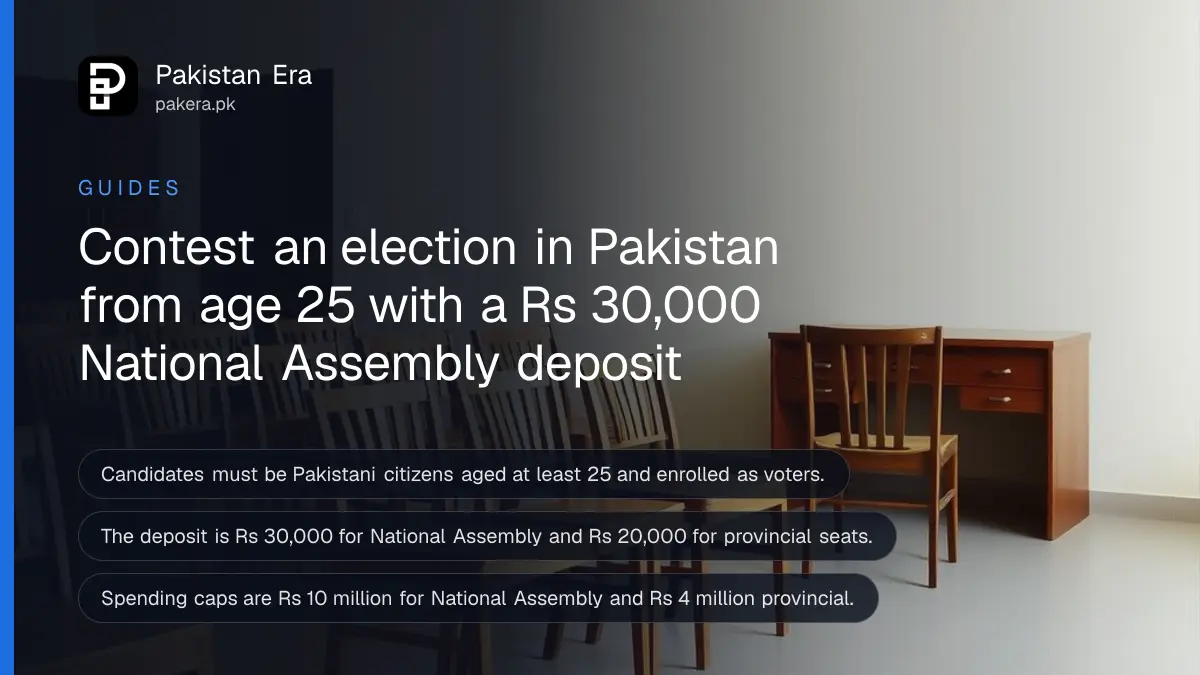
To contest a National Assembly or provincial assembly election in Pakistan, you must be a Pakistani citizen aged at least 25 and enrolled as a voter. You file a nomination paper on Form A, signed by a proposer and a seconder from the constituency, with a non-refundable deposit of Rs 30,000 for a National Assembly seat or Rs 20,000 for a provincial seat. Spending is capped at Rs 10 million and Rs 4 million.
The NA-77 Gujranwala-I by-election on 8 November 2026 has 11 candidates. PP-203 Sahiwal-VI has 7. Most of them are independents. Each one went through the same steps, from a nomination paper to a symbol on the ballot.
We read the Elections Act, 2017, Sections 60 to 68 and 132, in the copy published by the Election Commission of Pakistan (ECP). We also read Articles 62, 63 and 113 of the Constitution, in the copy on the National Assembly website. This guide puts the rules, the fees and the limits in one place.
You must be 25, a citizen and a registered voter
Article 62 of the Constitution sets the qualifications for the National Assembly. You must be a citizen of Pakistan and at least 25 years old. For a general seat, you must be enrolled as a voter on an electoral roll anywhere in Pakistan.
So you do not have to be a voter of the seat you contest. A voter registered in Lahore can contest in Gujranwala. Your proposer and seconder, though, must be voters of that constituency.
Article 113 applies the same rules to provincial assemblies. Article 62 also lists character tests, such as being "sagacious, righteous, non-profligate, honest and ameen", with no court declaration to the contrary.
Article 63 lists who is disqualified
Article 63 sets out the disqualifications. These are the ones that catch candidates most often. Each one can be raised as an objection at scrutiny.
- Being declared of unsound mind by a court.
- Being an undischarged insolvent, meaning declared bankrupt and not cleared.
- Ceasing to be a citizen of Pakistan, or taking the citizenship of another country.
- Holding an office of profit in the service of Pakistan, or working for a statutory body.
- Certain criminal convictions, and dismissal from government service, for set periods.
The dual nationality rule matters for overseas Pakistanis. A second passport is a disqualification under Article 63(1)(c).
File the nomination paper in six steps
Section 60 sets out the paper and what goes with it. The Returning Officer, the official who runs the election in the constituency, receives it.
- Find a proposer and a seconder who are voters of the constituency. Each voter can back only one nomination paper.
- Fill in Form A and get it signed by the proposer and the seconder.
- Sign a declaration that you meet Article 62 and are not caught by Article 63.
- Open a separate bank account for election expenses, or dedicate an existing one, and attach its statement from seven days before the schedule.
- Attach an attested copy of your CNIC and your statement of assets and liabilities on Form B, for you, your spouse and dependent children.
- Pay the deposit and deliver the paper to the Returning Officer yourself, through your proposer or seconder, or through a person you authorise in writing.
You can be nominated by up to five nomination papers in the same constituency. Many candidates file more than one, so one rejected paper does not end the bid. Only one deposit is needed.
The deposit is Rs 30,000 or Rs 20,000, and you do not get it back
Section 61 sets the deposit. It can be paid in cash to the Returning Officer, by bank draft, or into a set National Bank of Pakistan account with the receipt shown to the Returning Officer.
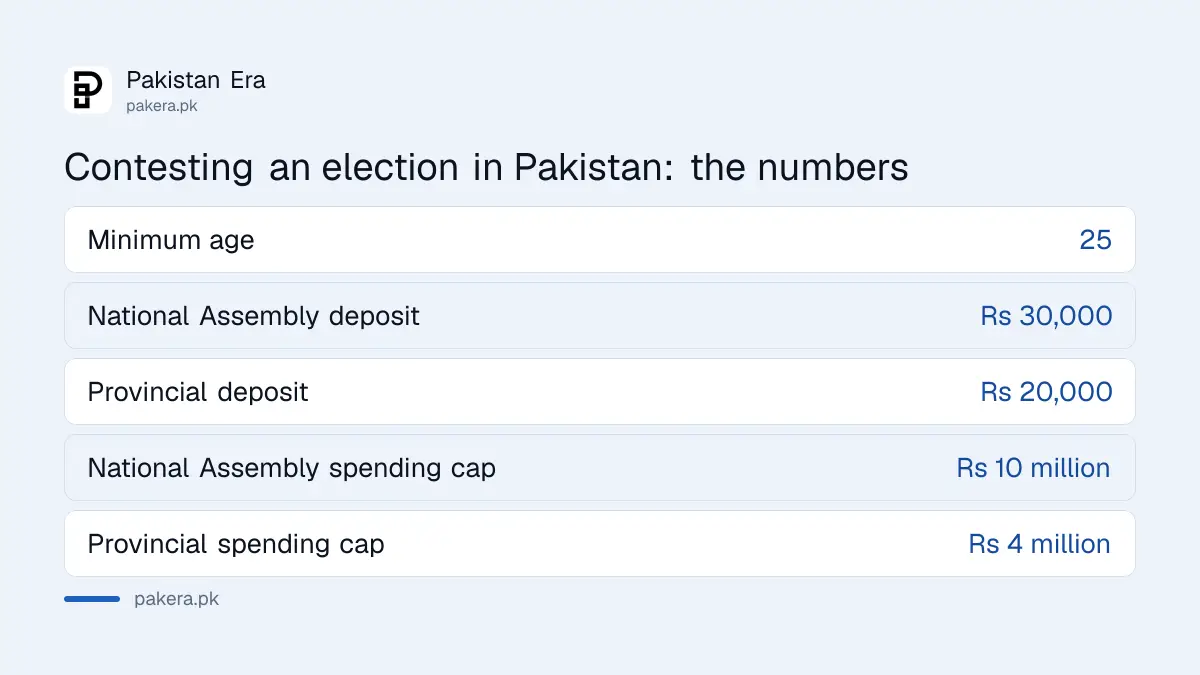
| Item | National Assembly | Provincial assembly |
|---|---|---|
| Minimum age | 25 | 25 |
| Nomination deposit | Rs 30,000 | Rs 20,000 |
| Refundable | No | No |
| Spending limit | Rs 10 million | Rs 4 million |
| Nomination papers allowed | Up to 5 | Up to 5 |
Section 61(3), in the text amended in August 2023, says the deposit is non-refundable. Winning or losing makes no difference.
Scrutiny, appeal, withdrawal and symbol come next
After filing, the paper goes through four stages. The dates for each are set in the ECP's election schedule for that seat.
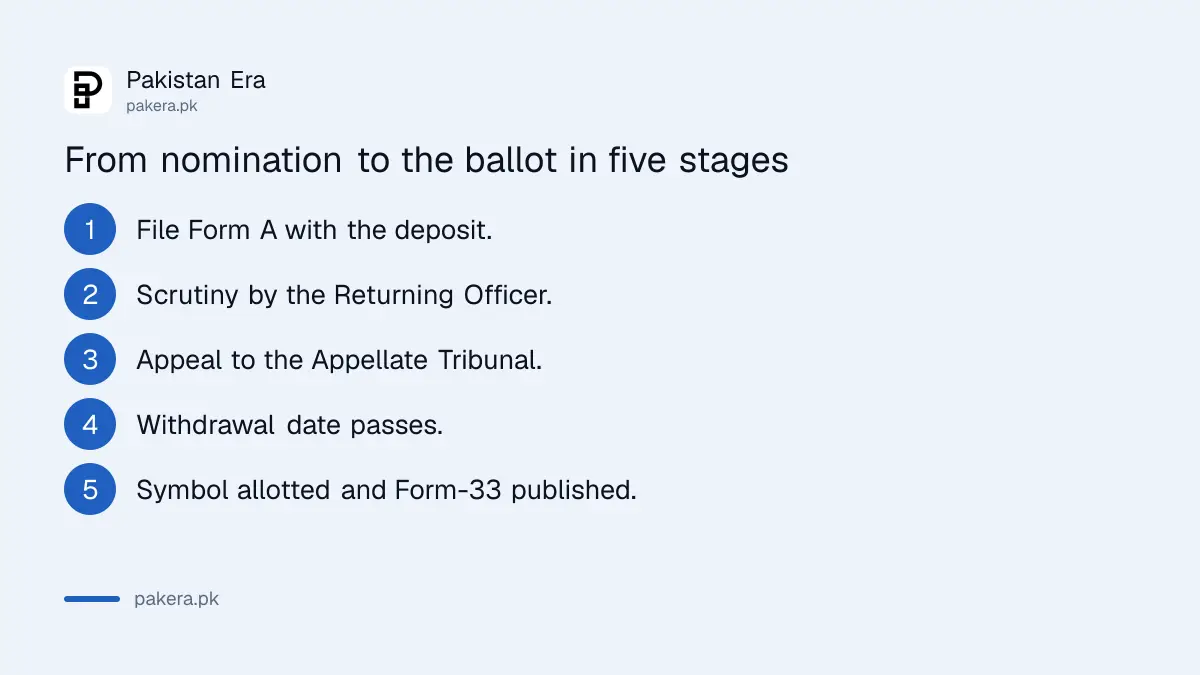
- Scrutiny (Section 62): any voter of the constituency can object to a nomination paper. The Returning Officer accepts or rejects it.
- Appeal (Section 63): the candidate or the objector can appeal to an Appellate Tribunal, a High Court judge. Its order is final. If it does not decide in time, the Returning Officer's decision stands.
- Withdrawal (Section 65): a candidate can withdraw by a signed notice to the Returning Officer by the withdrawal date. A withdrawal cannot be taken back.
- Symbol (Section 67): the Returning Officer allots each candidate a symbol, and a party candidate gets the party's symbol. The final list of contesting candidates is published on Form-33.
The NA-77 and PP-203 Form-33 lists, with every symbol, are on our page on the 8 November by-elections.
Spending is capped and every rupee must be vouched
Section 132 caps election expenses. The limit is Rs 10 million for a National Assembly seat, Rs 4 million for a provincial seat, and Rs 1.5 million for the Senate. Money a party or a supporter spends on your behalf counts towards your limit.
The count runs from the day you file your nomination paper to the final consolidated result. You must keep bills and receipts for every payment of Rs 1,000 or more. Breaking the expense rules under Section 134 is an illegal practice, which our list of election offences and penalties covers.
If you win, the Form B filing continues every year. Our page on the 31 December asset statement deadline explains it.
Common questions
What is the minimum age to contest an election in Pakistan?
25 years for the National Assembly and the provincial assemblies, under Articles 62 and 113 of the Constitution. The Senate needs 30.
What is the nomination fee for a National Assembly seat?
A deposit of Rs 30,000 under Section 61 of the Elections Act, 2017. For a provincial assembly seat it is Rs 20,000.
Is the nomination deposit refunded?
No. Section 61(3) of the Elections Act, as amended in 2023, says the deposit is non-refundable.
Can I contest from a constituency where I am not a voter?
Yes, for a general seat, if you are enrolled as a voter anywhere in Pakistan. Your proposer and seconder must be voters of that seat.
How much can a candidate spend on a National Assembly election?
Up to Rs 10 million under Section 132. The provincial assembly limit is Rs 4 million.
Can a dual national contest an election in Pakistan?
No. Article 63(1)(c) disqualifies a person who has acquired the citizenship of a foreign state.
How we verified this
What we checked, where we read it, and what we could not confirm.
Last checked 7 November 2026. We read Sections 60 to 68 and 132 of the Elections Act, 2017 (updated to 5 August 2023) on the ECP election laws page, and Articles 62, 63 and 113 in the National Assembly's copy of the Constitution. That copy is consolidated to 2012; later amendments to these articles were not checked.
About the author

Global Affairs & Political Economy Writer
Muhammad Hatim is a book lover who started writing because he enjoys it. At Pakistan Era he writes about international relations, geopolitics and the global economy, with a particular interest in South Asia and the forces behind current events.