Child Arrested in Pakistan: Rights Under the Juvenile Justice System Act 2018
An arrested child under 18 in Pakistan goes to an observation home, gets a State-paid lawyer within 24 hours and cannot be handcuffed. See the bail rules.
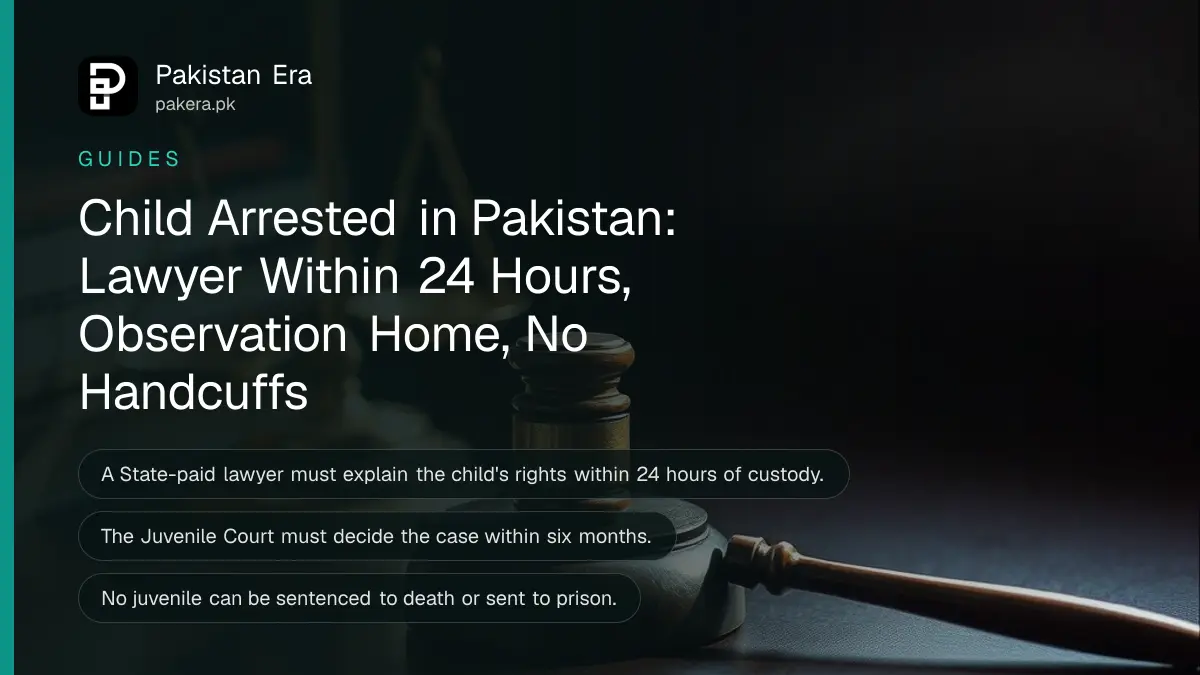
If a child under 18 is arrested in Pakistan, the Juvenile Justice System Act, 2018 requires the police to keep the child in an observation home, tell the guardian, and have a lawyer explain the child's rights within 24 hours. A child cannot be handcuffed, sent to prison or sentenced to death.
The Act applies across the whole of Pakistan. It overrides other laws where they conflict. We read its text on the Pakistan Code portal on 22 October 2026. A parent who knows these rules at the police station can ask for the right thing on the first night. That is the whole purpose of this page. It is general information, not legal advice.
Anyone under 18 is a child, and the police must inquire into age
Section 2 defines a child as a person who has not reached 18. Section 8 tells the police to check age from a birth certificate, school certificates or other papers. If none exist, a medical officer's examination can decide. The court must also record its finding on age before it grants more detention.
So bring papers. A B-Form, a school leaving certificate or a birth certificate can settle the question. If the police treat a boy as an adult, produce these papers and ask in writing that his age be recorded. For problems getting a missing certificate, see the guide to correcting birth records with NADRA.
The child must be kept in an observation home, never with adult prisoners
Section 5 says an arrested juvenile is kept in an observation home. The station officer must inform the guardian and tell them the date, time and court where the child will appear. The probation officer must also be informed. Preventive detention laws cannot be used against a juvenile.
Section 6 adds that a juvenile released on bail may not be kept in a police station or jail. The court may place him with a suitable person or a rehabilitation centre under a probation officer's supervision. A girl can only be apprehended or questioned by a female officer.
A State-paid lawyer must explain the child's rights within 24 hours
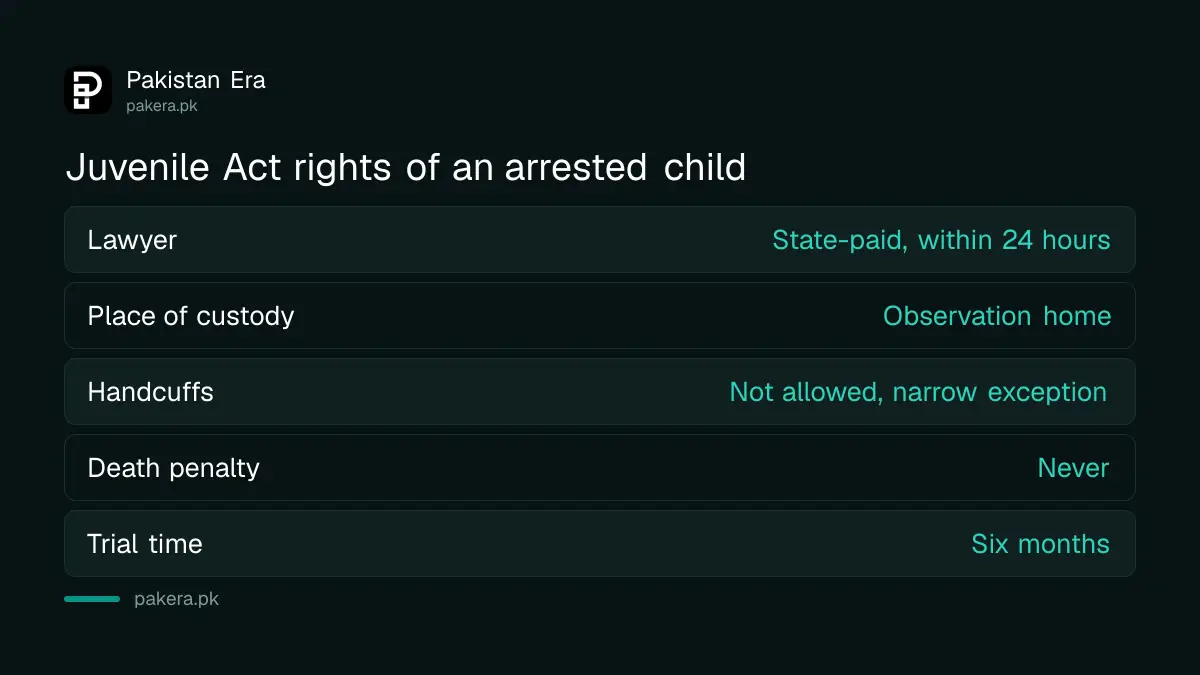
Section 3 gives every juvenile the right to legal help at the State's expense. A legal practitioner must tell the child his rights within 24 hours of custody. A lawyer appointed for this must have at least seven years at the Bar.
Ask for this lawyer by name at the station. Also see the free help routes in the Punjab legal aid guide, or the Supreme Court's 1818 free legal advice line for first advice by phone.
Bail is the rule, with one exception for older teenagers
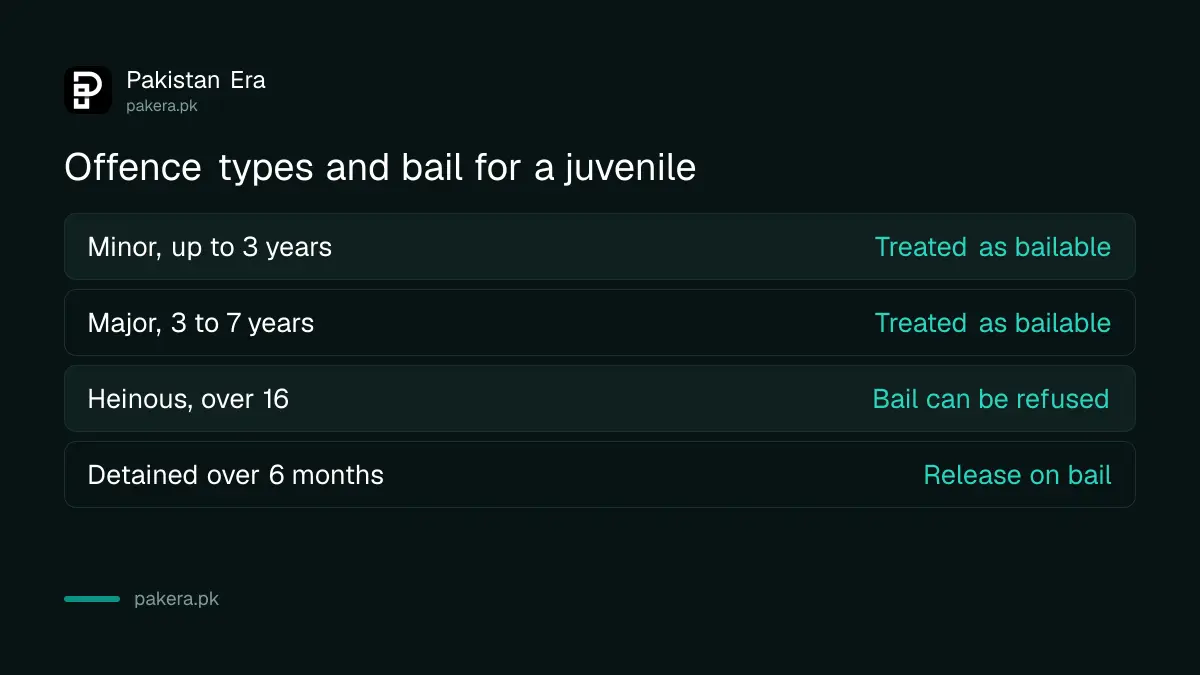
Section 6 treats a minor or major offence as bailable for a juvenile. The exception is a heinous offence by a juvenile over 16, where bail can be refused if there are reasonable grounds to believe he took part. A juvenile detained over six months without trial finishing, through no fault of his own, shall be released on bail.
| Type of offence | Maximum punishment for an adult | Bail for a juvenile |
|---|---|---|
| Minor | Up to 3 years | Treated as bailable |
| Major | Over 3 and up to 7 years | Treated as bailable |
| Heinous, age 16 or under | Death, life, or over 7 years | Not listed in section 6, so ask a lawyer |
| Heinous, over 16 | Death, life, or over 7 years | Court may refuse bail |
The ordinary bail rules for adults are explained in the guide to bailable and non-bailable offences. For a juvenile the Act changes them.
Minor cases can be settled through a Juvenile Justice Committee
Section 9 lets a committee dispose of a case by diversion, meaning an alternative to a trial, if the child or guardian agrees. It applies to minor offences, and to major offences if the child was 16 or younger. The committee decides within one month and needs the victim's consent.
The outcomes include returning property, repairing the damage, an apology, community service, a fine, or placement in a rehabilitation centre. All minor and major offences are compoundable for this purpose. The committee has a magistrate, the district public prosecutor, a lawyer of seven years' standing and a probation or social welfare officer.
Rules for questioning, trial and punishment
An officer of Sub Inspector rank or above, supervised by the SP or SDPO, must interrogate the child with help from a probation officer. A juvenile court must decide within six months. The identity of the child cannot be published, on pain of up to three years' jail for the publisher.
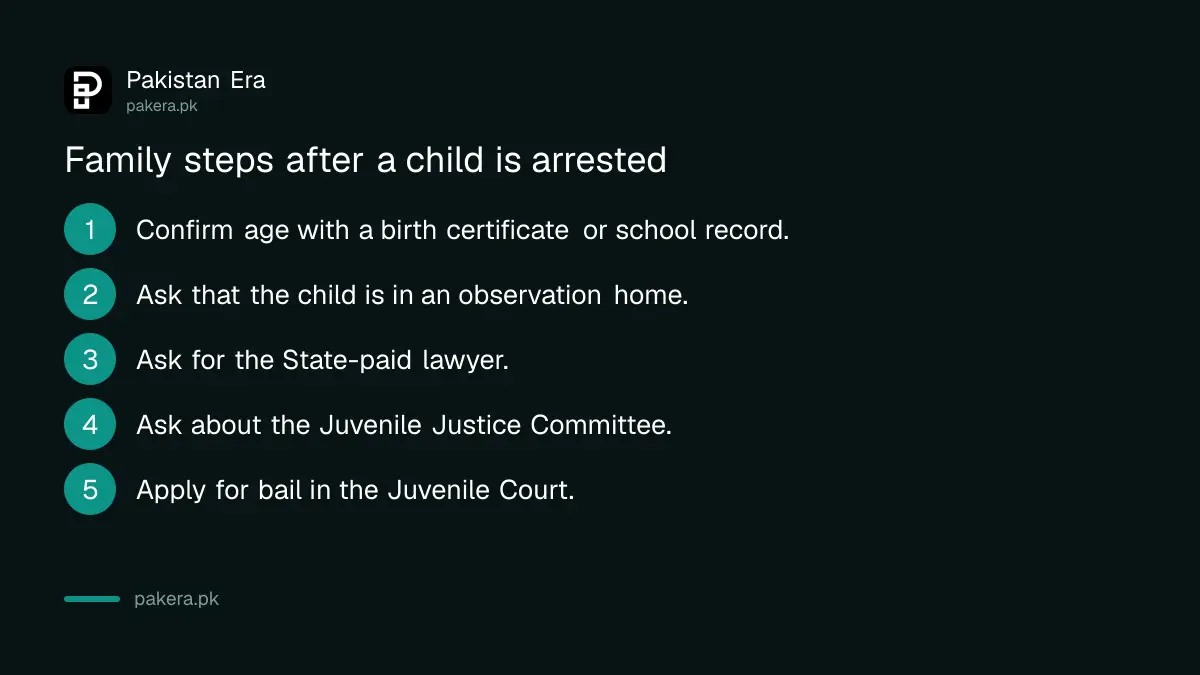
- Confirm age with a birth certificate or school record.
- Ask the station to confirm the child is in an observation home.
- Ask for the State-paid lawyer and the probation officer.
- Ask whether the case can go to the Juvenile Justice Committee.
- Apply for bail in the Juvenile Court.
- Check that the trial finishes within six months.
No juvenile can be given the death penalty, put in fetters, handcuffed or made to do labour. A narrow exception allows handcuffing or solitary confinement for up to 24 hours for an escape risk over 16 charged with a heinous offence. A conviction under the Act does not carry later legal disqualifications.
Common questions
At what age is someone a juvenile in Pakistan?
Under the Juvenile Justice System Act, 2018 a child is anyone who has not reached the age of eighteen years.
Can police keep a child in the lock-up?
No. Section 5 says an arrested juvenile is kept in an observation home, and section 6 bars keeping a bailed juvenile in a police station or jail.
Can a juvenile be handcuffed?
Generally no. The only exception is a juvenile over 16 charged with a heinous offence who may escape, for up to 24 hours, with reasons recorded.
Can a juvenile get the death penalty?
No. Section 16 says nobody who was a juvenile offender at the time of the offence can be punished with death.
Which court tries a juvenile?
The Juvenile Court has exclusive jurisdiction. It must decide the case within six months. If it cannot, it must ask the High Court for an extension.
Can the newspaper print the child's name?
No. Publishing a juvenile's identity can lead to up to three years in prison and a fine. Publishing court proceedings without the court's permission can lead to up to two years.
How we verified this
What we checked, where we read it, and what we could not confirm.
Last checked 22 October 2026. We read the Juvenile Justice System Act, 2018 (Act No. XXII of 2018, as amended in 2022) on the Pakistan Code portal, in the copy dated 22 July 2024 on that portal. We did not check whether a Juvenile Court or Juvenile Justice Committee is working in each district, or the rules made under section 24. Provincial rules and local practice may differ.
About the author

Senior Writer, Public Services and Technology
Shahid joined us in 2024 as an author. He is a senior contributor to Pakistan's leading technology websites. He writes detailed articles, mostly covering his expertise in the latest tech, mobiles, apps, gadgets, and step-by-step guides. His ideology is to help people understand the latest trends and explain complex methods through very easy-to-understand guides.