Check a Blood Bank Is Registered in Balochistan Before a Transfusion
Every blood bank in Balochistan must be registered and licensed by the Safe Blood Transfusion Authority. See 4 checks before a transfusion and the penalties.
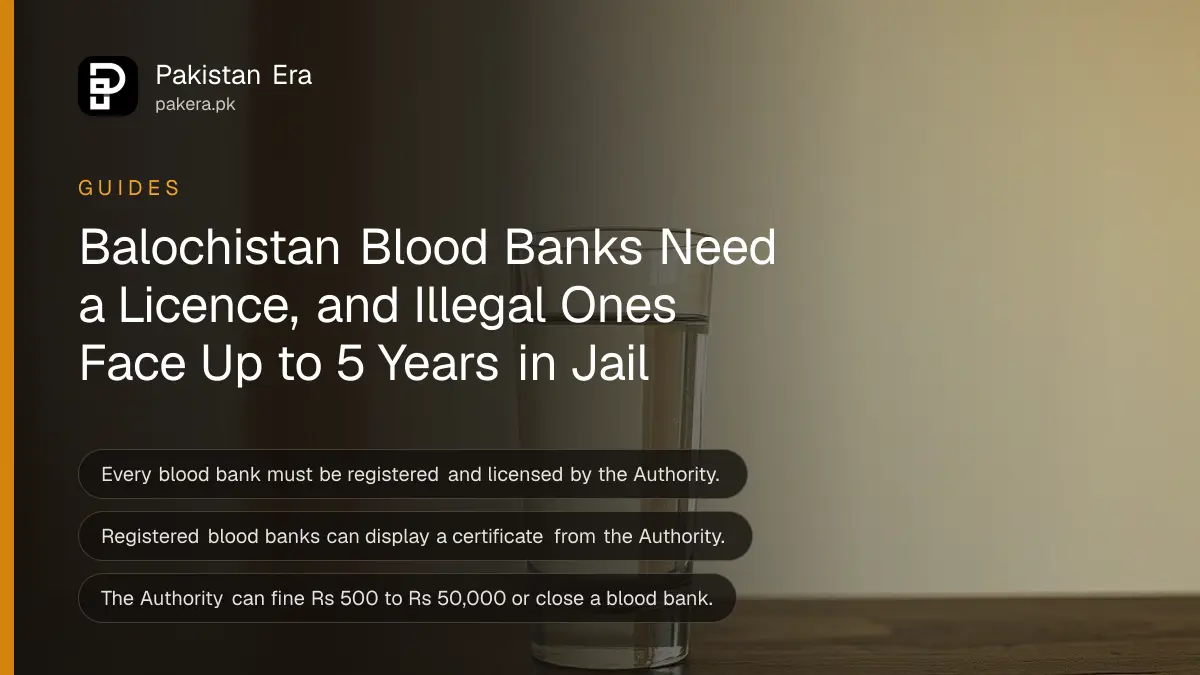
In Balochistan, every blood bank must be registered and licensed by the Balochistan Safe Blood Transfusion Authority, and the Authority issues certificates for registered blood banks to display. Before a transfusion in Quetta or any district, ask to see that certificate. Running a blood bank in breach of the law can bring up to three years in jail, or five if a patient is hurt.
The rules come from the Balochistan Safe Blood Transfusion Authority Act. Its aim, in the Act's own words, is transfusion of safe and healthy blood free from infective and injurious agents. We read the full Act on the Balochistan Code, the provincial law website, on 20 October 2026.
Every blood bank in Balochistan needs registration and a licence
The Act covers any place that receives, stores, tests, screens, processes or issues human blood for transfusion, public or private. Section 8 says no blood bank may operate after the grace period unless it is registered with the Authority and holds a valid licence to operate.
Section 8 also gives the Authority its main powers. It registers and licenses blood banks, sets minimum standards and staff qualifications, keeps a register of blood banks, inspects them, and regulates the fees and charges for blood bank services.
| Authority's power | What it means for a patient |
|---|---|
| Register and license blood banks | A legal blood bank has both |
| Issue certificates to display | You can ask to see one on the wall |
| Keep a register of blood banks | The Authority knows which ones are legal |
| Set staff qualifications | Trained staff must run the bank |
| Regulate fees and charges | Charges for services are meant to be controlled |
| Appoint inspectors | Blood banks can be checked and reported |
Breaking the blood law can mean up to five years in jail
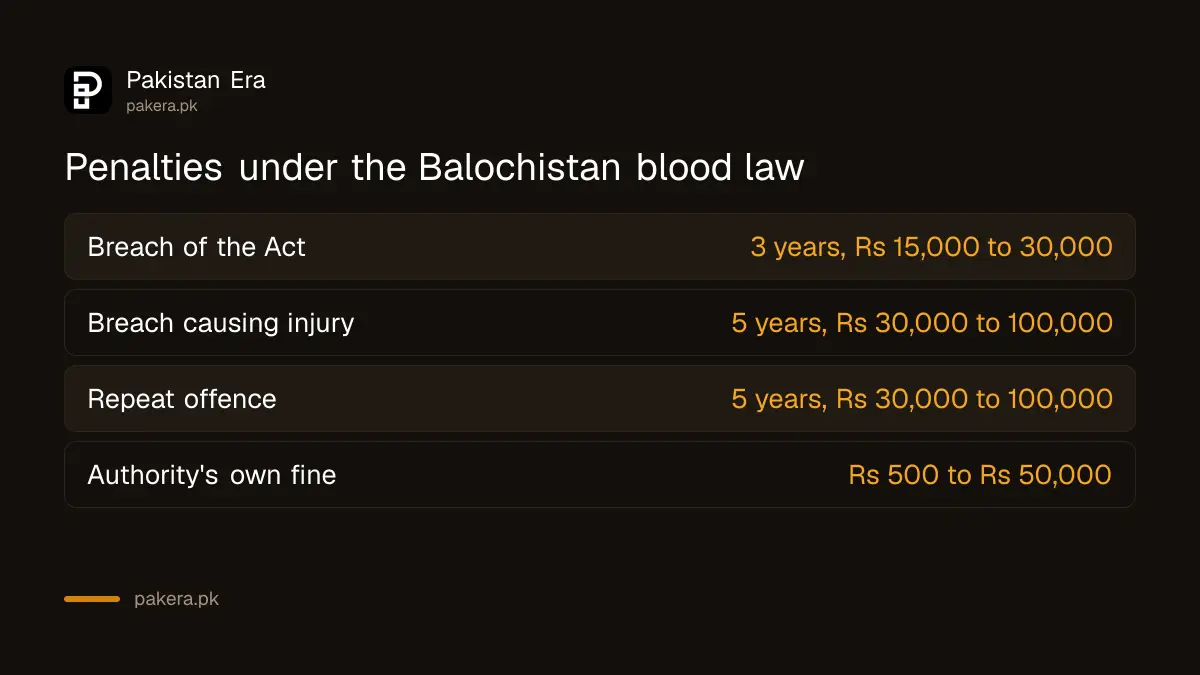
Section 9 sets the penalties. A wilful or reckless breach carries up to three years in jail, a fine of Rs 15,000 to Rs 30,000, or both. If the breach causes physical injury to someone, the maximum rises to five years, or a fine of Rs 30,000 to Rs 100,000.
| Breach | Jail, up to | Fine |
|---|---|---|
| Breaking the Act, rules or regulations | 3 years | Rs 15,000 to Rs 30,000 |
| Breach that causes physical injury | 5 years | Rs 30,000 to Rs 100,000 |
| Damaging a licensed blood bank's work | 3 years | Rs 20,000 to Rs 50,000 |
| Repeat offence | 5 years | Rs 30,000 to Rs 100,000 |
Hiding or faking records, or blocking an inspector, is also an offence. When a hospital or company is at fault, its directors, partners and staff can be held guilty unless they show they did not know. After a conviction, the Authority may publish the offender's name and confiscate equipment.
The Authority can also act without going to court
Under section 9(9), the Authority can decide a case itself instead of sending it to court. Its options run from a warning and an adverse report to a fine of Rs 500 to Rs 50,000, seizing blood, barring staff, closing the blood bank, or cancelling its licence and registration.
Courts act only on a written complaint from the Authority's Chairman or someone he authorises, under section 10. So a patient cannot take a blood bank to court directly under this Act. The practical route is a complaint to the Authority, which then decides whether to act or prosecute.
Check a blood bank before a transfusion in four steps
Most families arrange blood in a hurry, often for surgery, childbirth or a child with thalassaemia. A minute spent on these checks protects the patient. A registered blood bank should not mind the questions.
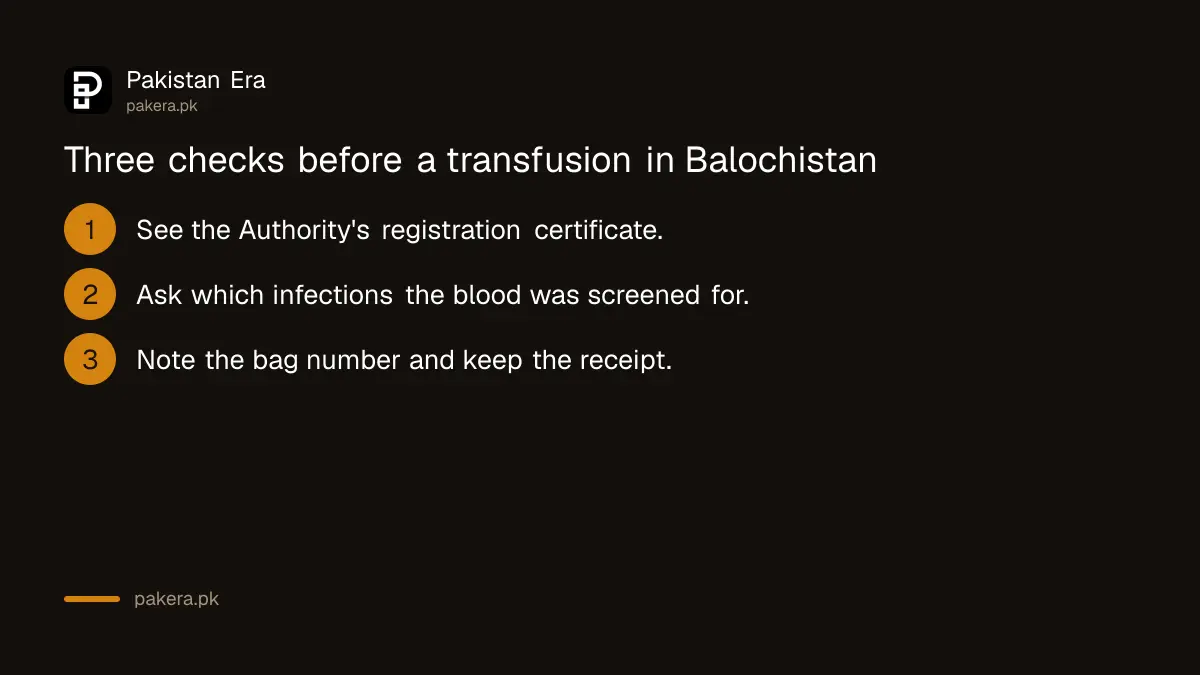
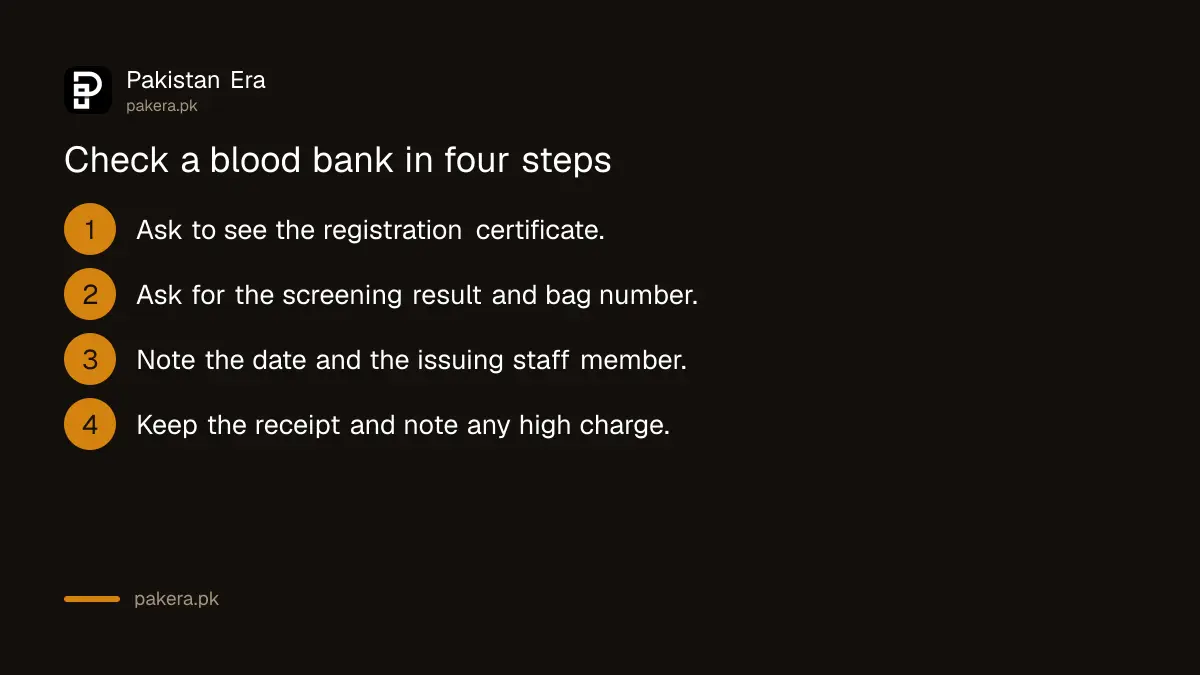
- Ask the blood bank to show its registration certificate from the Balochistan Safe Blood Transfusion Authority.
- Ask which infections the blood was screened for, and ask for the result slip with the bag number.
- Note the bag number, the date and the name of the staff member who issued it.
- Keep the receipt, and write down any charge that seems too high.
If something is wrong, put it in writing to the Authority with your receipt and the bag number. Patients who need regular transfusions can read about free thalassaemia treatment and screening. Anyone worried after a past transfusion can ask a doctor about a free hepatitis test. In Punjab, the system is different, as set out in checking a blood bank is licensed in Punjab.
Common questions
Who regulates blood banks in Balochistan?
The Balochistan Safe Blood Transfusion Authority, set up under the provincial Safe Blood Transfusion Authority Act. It registers, licenses and inspects blood banks.
Must a blood bank display a certificate?
The Act lets the Authority issue certificates and insignia for registered blood banks to display their status. Ask to see it before you accept blood.
What is the penalty for running an illegal blood bank?
Up to three years in jail, a fine of Rs 15,000 to Rs 30,000, or both. If a patient is hurt, up to five years or a fine of up to Rs 100,000.
Can I take a blood bank to court myself?
Not under this Act. Section 10 says courts act only on a written complaint by the Authority's Chairman or his nominee. Complain to the Authority first.
Are blood bank charges fixed in Balochistan?
The Act gives the Authority power to set and regulate fees and charges for blood bank services. We could not find a published fee list.
Does the law cover government hospital blood banks?
Yes. The Act's definition of a blood bank covers premises run by public or private bodies, in a hospital, clinic, laboratory or standalone.
How we verified this
What we checked, where we read it, and what we could not confirm.
Last checked 20 October 2026. We read the full Balochistan Safe Blood Transfusion Authority Act on the Balochistan Code, listed as Baln Act III of 2004. The copy carries two dates: the heading gives 8 May 2004, while its footnote says the Assembly passed it on 4 May 2014 and it was gazetted on 8 May 2014. We could not resolve which is right. We could not find the Authority's website, its register of blood banks, its address or any rules on screening tests, so we cannot say which tests are compulsory. This page is not medical advice.
About the author

Public Services and Education Journalist
Fajr Riaz is a journalist and content writer at Pakistan Era, based in Lahore. She covers the questions people meet in everyday life in Pakistan: how a public service works, what a change in the rules means, and where to find a reliable answer.