Check the PCB Excluded Persons List: One Name, Four-Year Order Runs to November 2026
The PCB Excluded Persons list has one name, barred for four years from 23 November 2022. See what an exclusion order bans and how to check the list in a minute.
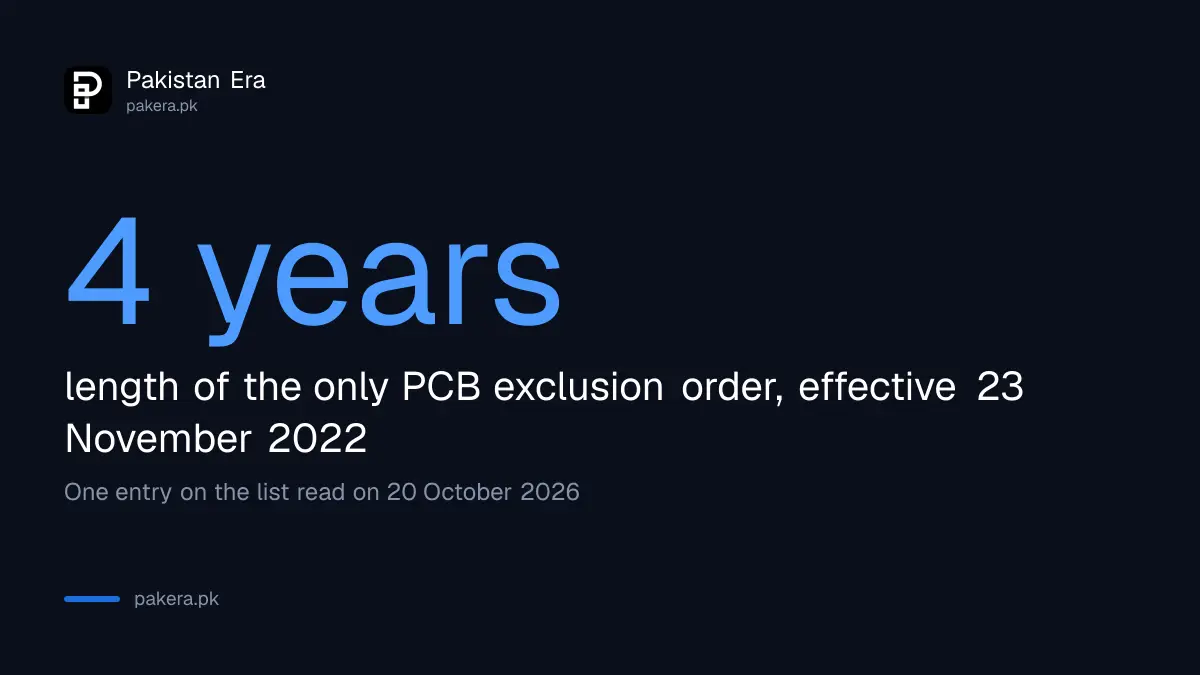
The PCB's Excluded Persons list has one name on it: Alamgir Khan of Pakistan, under an exclusion order effective from 23 November 2022 for four years. The order bars him from any role in cricket the PCB or another national board recognises. By our count the four years run to November 2026, about a month from now.
We read the Pakistan Cricket Board (PCB) Excluded Persons Policy page and the exclusion order itself on 20 October 2026. This matters to players, coaches, league organisers and anyone who runs a franchise or a tournament. Dealing with an excluded person after a warning is itself an offence under the PCB Anti-Corruption Code.
The PCB list names one excluded person
The PCB's current list has one entry: Alamgir Khan, country Pakistan, no alias, effective from 23 November 2022. The order says the exclusion lasts four years. The list has a download link to the signed order, which gives the PCB's reasons in a short paragraph.
| Field on the PCB list | Entry |
|---|---|
| Name | Alamgir Khan |
| Alias | None listed |
| Country | Pakistan |
| Effective from | 23 November 2022 |
| Length, from the order | Four years |
The order states the PCB's finding in summary: that he "has been involved in an attempt to solicit cricket player to engage in Corrupt Conduct". It says the exclusion was imposed because his activity posed "a genuine threat to the integrity of the sport". We are reporting the PCB's order as published. We have not seen the evidence behind it.
An exclusion order shuts a person out of all official cricket
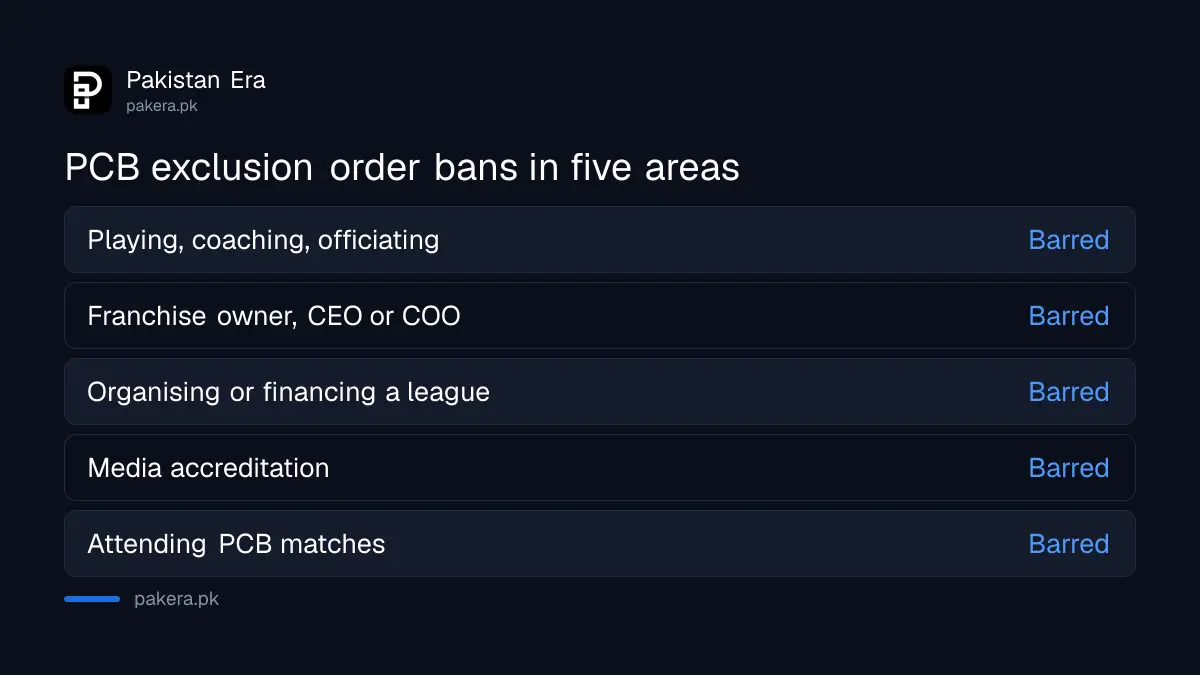
An excluded person cannot play, coach, officiate or take any role in a match, team, league or event that the PCB or any national cricket board authorises or supports. The ban covers owning or running a franchise and getting media accreditation. It also stops them attending PCB matches.
The policy page spells out how wide this is. It covers being a team or franchise owner, a CEO or COO, and any part in organising or financing a league, even indirectly through a company hired to run an event. The order adds that it applies to activity recognised "in any way" by a national federation.
So a private league that wants official status, or a club tournament played under a regional association, falls inside it too. That is the practical point for organisers: checking the list takes a minute, and missing a name could cause real trouble later.
Players commit an offence by dealing with an excluded person after a warning
Article 2.4.9 of the PCB Anti-Corruption Code makes it an offence for a player or other participant to associate with an excluded person in a professional or sport-related way, after the PCB or their national board has warned them. Association includes calls, messages and meetings.
The policy page defines "associating" broadly. It includes meeting in person or online, talking by phone, digital or electronic messages, and taking direction or instructions from the excluded person by any means. On that wording, a chat on a messaging app would count. A warning comes first, and the offence applies after it.
For the separate on-field disciplinary system, the levels and demerit points are in our explainer on the ICC code of conduct levels, and domestic fines are in our piece on President's Trophy code of conduct fines. Anti-corruption is a different code with much heavier stakes.
The PCB's Anti-Corruption Unit starts the process
The PCB Anti-Corruption Unit (ACU) can investigate anyone outside the game who it reasonably believes is a genuine threat to cricket's integrity. If the investigation shows that, the PCB can issue an exclusion order under Appendix 2 of its Anti-Corruption Code. The person does not need to be a player.
The policy gives two examples of the people it targets: someone actively trying to corrupt participants, and someone acting as a go-between for such a person. That is why the list matters most to the people around players, such as agents, sponsors and tournament staff.
How to check the PCB Excluded Persons list
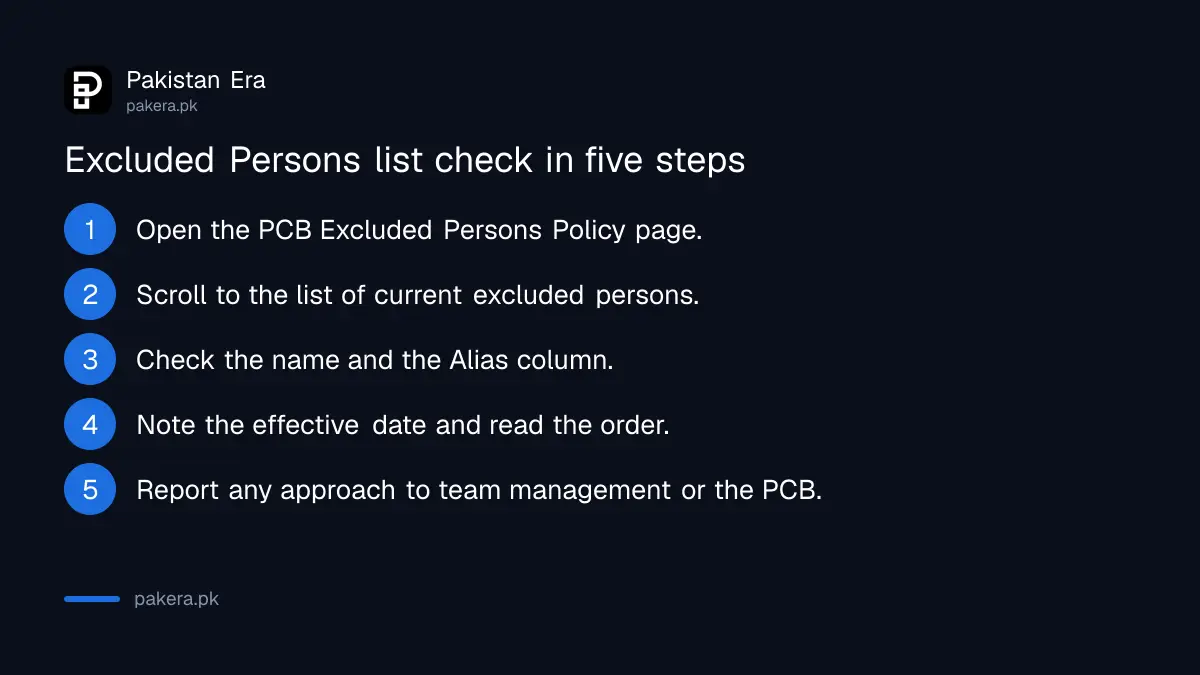
The check takes about a minute and needs no login. Open the PCB's Excluded Persons Policy page, scroll to the list of current excluded persons, and compare the name, any alias and the country. Download the order for the dates and the reason.
- Open the PCB website and find the Excluded Persons Policy page.
- Scroll to "the list of current Excluded Persons".
- Check the name and the Alias column, since people can use other names.
- Note the "Effective From" date and download the order for its length.
- If you are a player who has been approached, tell your team management or the PCB at once.
Check again before any event, because the list can change. And if you run a league or a franchise, keep a dated copy of the list you checked. If questions come up later, that record shows you did the check.
Players heading abroad should check this as well as their paperwork. The PCB permissions for foreign leagues are in our PCB NOC list for 2026.
Common questions
Who is on the PCB Excluded Persons list?
One person, Alamgir Khan of Pakistan, from 23 November 2022, on the list we read on 20 October 2026.
How long does the PCB exclusion order last?
Four years from 23 November 2022, the order says. By our count that runs to November 2026.
What does an excluded person lose?
Any role in officially recognised cricket: playing, coaching, officiating, franchise roles, media accreditation and attending PCB matches.
Can a player be punished for talking to an excluded person?
Yes, after a warning. Article 2.4.9 of the PCB Anti-Corruption Code makes associating with an excluded person an offence once warned.
Who decides an exclusion order?
The PCB, after an investigation by its Anti-Corruption Unit, under Appendix 2 of the Anti-Corruption Code.
How we verified this
What we checked, where we read it, and what we could not confirm.
We read the PCB Excluded Persons Policy page and the exclusion order dated 23 November 2022 on 20 October 2026. The end date in November 2026 is our own count from the four-year term. We could not confirm whether the order has been appealed, varied or will be extended, or a direct contact for the PCB Anti-Corruption Unit.
About the author

Tax, Bills and Technology Writer
Ali Akhtar is a young and curious voice here at Pakistan Era. He is currently pursuing his A-Levels and has a growing interest in Pakistan’s changing industrial landscape and educational trends. Ali likes to write in a way that helps him explain and explore the world around him. His writing reflects the perspective of the new generation navigating the evolving trends of Pakistan where technology, youth innovation, and shifting opportunities are reshaping the country’s future.