Check the ICC Code of Conduct Levels: Fines, Demerit Points and Bans for Players
Read an ICC fine or ban: the four Code of Conduct levels, the demerit points each carries and how 24 months of points become a suspension. See the table.
Short answer: The ICC Code of Conduct has four levels. Level 1 is a warning or a fine of up to 50 per cent of the match fee. Level 4 is the worst, and can mean a ban of a year or more. Every breach also adds demerit points that stay on a player's record for 24 months.
After a heated match, a headline says a player was "fined" or "reprimanded", and readers are left to guess what it means. Was it serious? Does it count towards a ban? The ICC's Code of Conduct answers these questions, and the rules are published in full.
We read the ICC Code of Conduct page and the Code for Players and Player Support Personnel, effective from 16 June 2023, on 14 October 2026. This page covers international matches and ICC events. It does not cover the PCB's own domestic rules, which are separate.
The code rates every offence from Level 1 to Level 4
Level 1 covers conduct of a minor nature and Level 4 covers conduct of an extremely serious nature. The person reporting the offence must pick one of the levels assigned to that offence. A report cannot be laid at a level the code does not list for it.
The code says it is not meant to punish trivial behaviour. It is meant to deter conduct that harms the image of the game. It also applies broadly: "during an International Match" covers everything at the ground on match day, including the changing rooms and the intervals, not only the field.
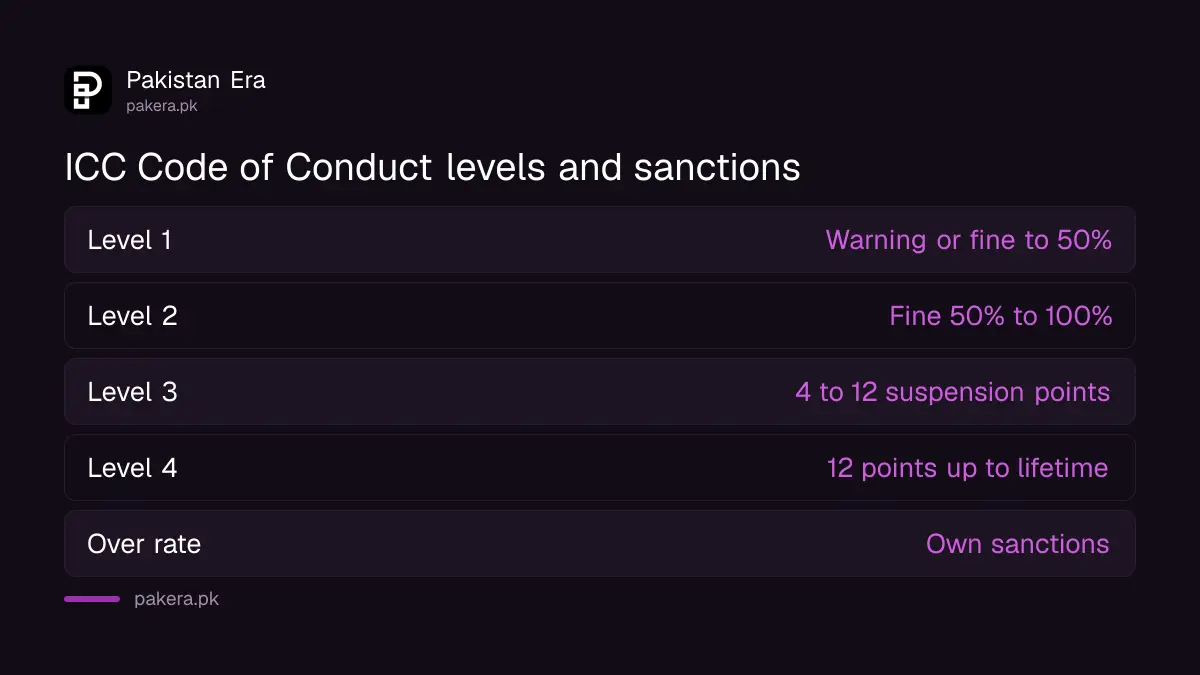
| Level | Range of sanctions | Demerit points |
|---|---|---|
| Level 1 | Warning and/or fine up to 50% of match fee | 1 or 2 |
| Level 2 | Fine of 50% to 100% of match fee, or up to 2 suspension points | 3 or 4 |
| Level 3 | 4 to 12 suspension points, with a one year maximum in practice | 5 or 6 |
| Level 4 | 12 suspension points, or a fixed ban from one year up to a lifetime | 7 or 8 |
The demerit figures depend on the exact sanction. A Level 1 warning or a fine of up to 25 per cent gets 1 point. A Level 1 fine of 26 to 50 per cent gets 2. The ICC table works the same way for the higher levels.
Common offences have set levels
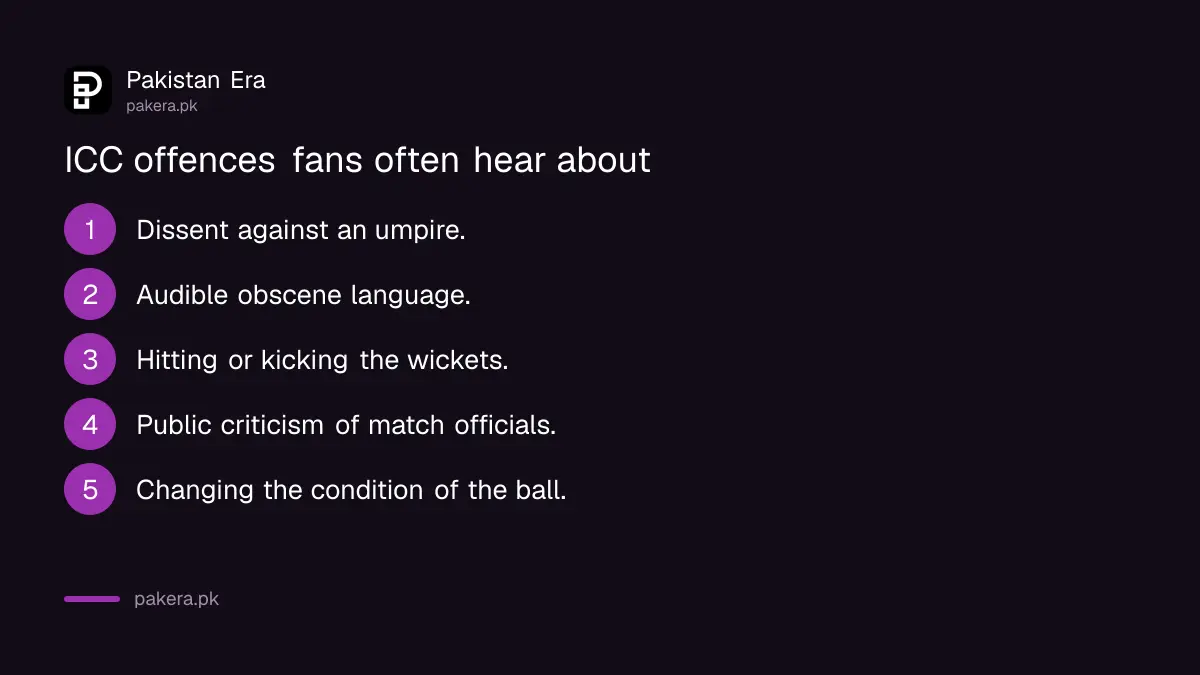
The code lists specific conduct, such as dissent against an umpire, hitting or kicking the wickets, audible obscene language, public criticism of match officials, and changing the condition of the ball. Each has its own range of levels, so a single offence does not always mean the same penalty.
Two points surprise many fans. First, obscene or profane language that can be heard by spectators or the viewing public, including through the stump microphone, is an offence even when it is swearing at your own mistake. Second, social media posts count as public comment. A player who criticises match officials on a platform can breach the code.
Throwing the ball at a person, disobeying an umpire's instruction and ball tampering also appear in the list. The code notes that ordinary actions to keep a ball in condition, with no artificial substance, are allowed. Scratching the surface with a fingernail or lifting a seam is not.
Demerit points add up and become suspension
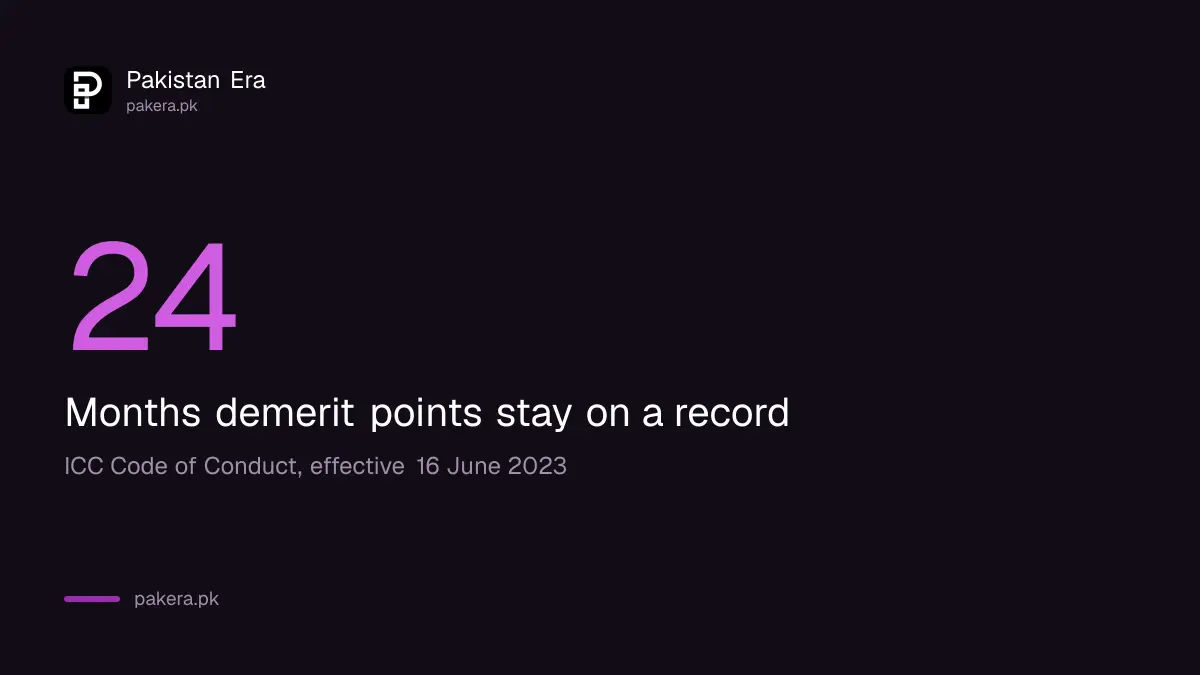
Demerit points remain on a record for 24 months and then are removed. When a player reaches four or more, the points convert into suspension points: 4 to 7 demerit points give 2, 8 to 11 give 4, 12 to 15 give 6, and 16 or more give 8.
The ICC then counts matches. A Test, or any international match of four days or more, has a weighting of two suspension points. An ODI or T20I has a weighting of one. So a player with two suspension points misses one Test or two limited-overs matches.
- The match referee decides the sanction for the offence.
- The sanction gives a set number of demerit points.
- Points are added to any from the previous 24 months.
- At four points or more, they convert into suspension points.
- The ICC tells the player and board, and the ban takes effect on notice.
The conversion happens on top of the penalty for the offence itself. For the series Pakistan is hosting, the PCB has named the referee for every match, and the rules that guide those officials are explained in the ODI rules for the tri-series.
A player can accept or challenge a charge
A charged player has three choices. He can admit the offence and accept the sanction. He can admit the offence but dispute the sanction. Or he can deny the offence, and the matter then goes to a hearing. The code sets out the hearing process in detail.
The ICC can also act only on conduct linked to an international match or an ICC event. For an off-field incident, the code says the ICC consults the player's national board on the right course of action. That is why a domestic fine and an ICC penalty can both exist for different incidents.
Over-rate offences are handled separately, with their own sanctions listed in the code's appendix. For domestic rules in Pakistan, the PCB's fines for slow over-rates and Level 1 breaches use a similar structure with different amounts.
How to read a fine headline
A headline fine tells you the level only if it quotes a percentage of the match fee. A fine of 15 per cent is Level 1. A fine of 75 per cent is Level 2. A suspension of "two points" is a Level 2 sanction at most. Use the table above to place it.
The ICC also publishes lists of men's and women's Code of Conduct breaches, with a date range, on the same page. We saw the lists, dated to 30 June 2026, and did not use any one player's record here. Check the ICC page for the current list if you want a name.
Tourists, journalists and fans can use the same code to judge a controversy. Ask three questions. What was the offence? What level was it charged at? How many demerit points does that carry? Most arguments end once you have those three answers.
Common questions
What is the difference between a demerit point and a suspension point?
A demerit point records a past offence for 24 months. A suspension point is a match ban unit: two for a Test, one for an ODI or T20I.
How long do demerit points last?
They stay on a record for 24 months from the date they are imposed. After that they are removed.
Can a Level 1 offence lead to a ban?
Not by itself. Level 1 is a warning or fine. But its demerit points add up, and four or more convert into suspension points.
Does the ICC code cover domestic matches in Pakistan?
No. Its jurisdiction covers international matches and ICC events. The PCB applies its own code to domestic cricket.
Where can I read the full code?
The full Code for Players and Player Support Personnel is on the ICC Code of Conduct page, with the men's and women's breach lists.
How we verified this
What we checked, where we read it, and what we could not confirm.
Last checked on 14 October 2026, Pakistan time. We read the ICC Code of Conduct page and the Code for Players and Player Support Personnel it links. We did not check any named player's record, the over-rate sanctions in the appendix, or the current breach lists in detail.
About the author

Tax, Bills and Technology Writer
Ali Akhtar is a young and curious voice here at Pakistan Era. He is currently pursuing his A-Levels and has a growing interest in Pakistan’s changing industrial landscape and educational trends. Ali likes to write in a way that helps him explain and explore the world around him. His writing reflects the perspective of the new generation navigating the evolving trends of Pakistan where technology, youth innovation, and shifting opportunities are reshaping the country’s future.