ODI Rules for the Pakistan Tri-Series: Three Powerplays, Two New Balls and 10 Overs a Bowler
ICC ODI rules for the Pakistan tri-series: three Powerplays, two new balls to over 34, 10 overs a bowler, a 20 over minimum, the Super Over and reviews.
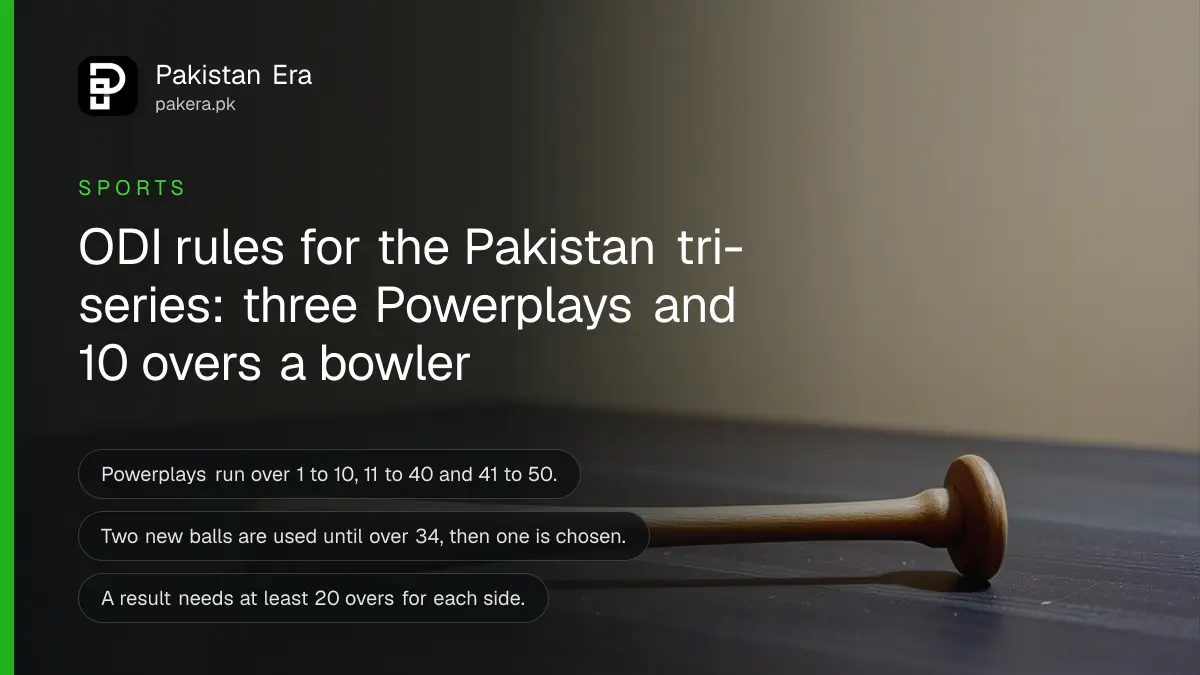
Short answer: In an ODI, each side bats 50 overs. Fielding restrictions run in three Powerplays: overs 1 to 10, 11 to 40 and 41 to 50. Two new balls are used until over 34. No bowler may send down more than 10 overs. A result needs at least 20 overs for each side, and a tie is settled by a Super Over. These are the ICC rules from October 2026.
Pakistan, England and Sri Lanka play an ODI tri-series from 18 to 31 October 2026, as we set out in our page on the Pakistan ODI tri-series. We read the ICC's Men's One-Day International Playing Conditions, effective from October 2026, to write this guide. It explains the rules that decide matches, in short plain steps.
Three Powerplays decide how many fielders can stand deep
A 50 over innings is split into three phases. The ICC calls them Powerplay 1, 2 and 3. In each phase, only some fielders may stand outside a 30 yard circle at the moment the bowler delivers.
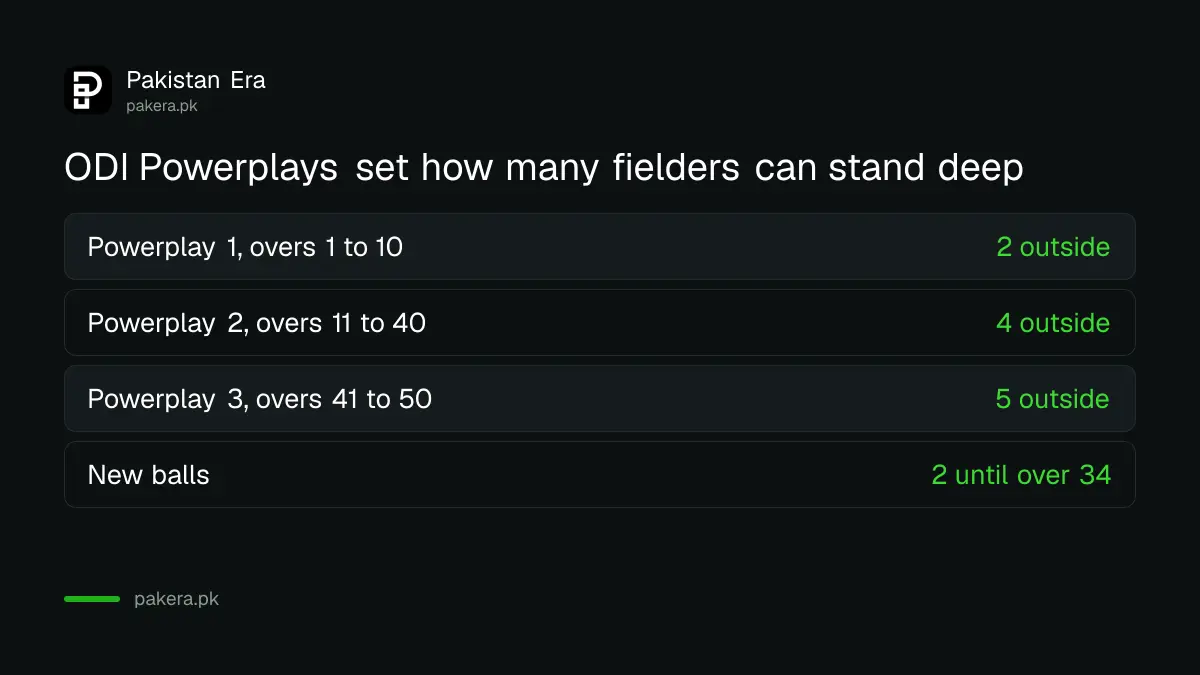
Powerplay 1 covers overs 1 to 10. Only two fielders may be outside the circle. Powerplay 2 covers overs 11 to 40, with up to four fielders outside. Powerplay 3 covers overs 41 to 50, with up to five outside. There is no choice of when to take a Powerplay. The phases are fixed.
If rain cuts an innings short, the phases are cut too. The playing conditions have a table that gives the length of each Powerplay for every innings from 20 overs upward. For a 20 over innings, for example, it is 4, 12 and 4 overs.
| Phase | Overs in a 50 over innings | Fielders allowed outside the circle |
|---|---|---|
| Powerplay 1 | 1 to 10 | 2 |
| Powerplay 2 | 11 to 40 | 4 |
| Powerplay 3 | 41 to 50 | 5 |
Two new balls are used until the end of over 34
Each fielding team has two new balls for its innings. They are used from alternate ends, one for each end, for overs 1 to 34. At the end of over 34, the fielding team chooses one of the two balls for the rest of the innings. The other goes back into the pool of spare balls.
This is why a one day ball does not swing or wear in the same way as a Test ball. If a match is cut to 25 overs or fewer per side before the first innings starts, each team uses only one new ball.
No bowler can bowl more than 10 overs
The limit is 10 overs for any one bowler in an innings. If rain cuts the overs, the limit is one fifth of the overs allowed. When the total does not divide by five, one extra over is allowed so that the match can be completed.
For a normal 50 over innings, a team therefore needs at least five bowlers. In practice this often means one all-rounder shares the last overs. For a view of the Pakistan bowlers' form before the series, see our guide to checking Pakistan players on the ICC ODI rankings.
- A bowler may bowl up to 10 overs in a full 50 over innings.
- If overs are cut, the limit becomes one fifth of the overs left.
- If the total is not divisible by five, one extra over is allowed.
- The team still needs five bowlers to cover the full innings.
Rain, a 20 over rule and the Super Over
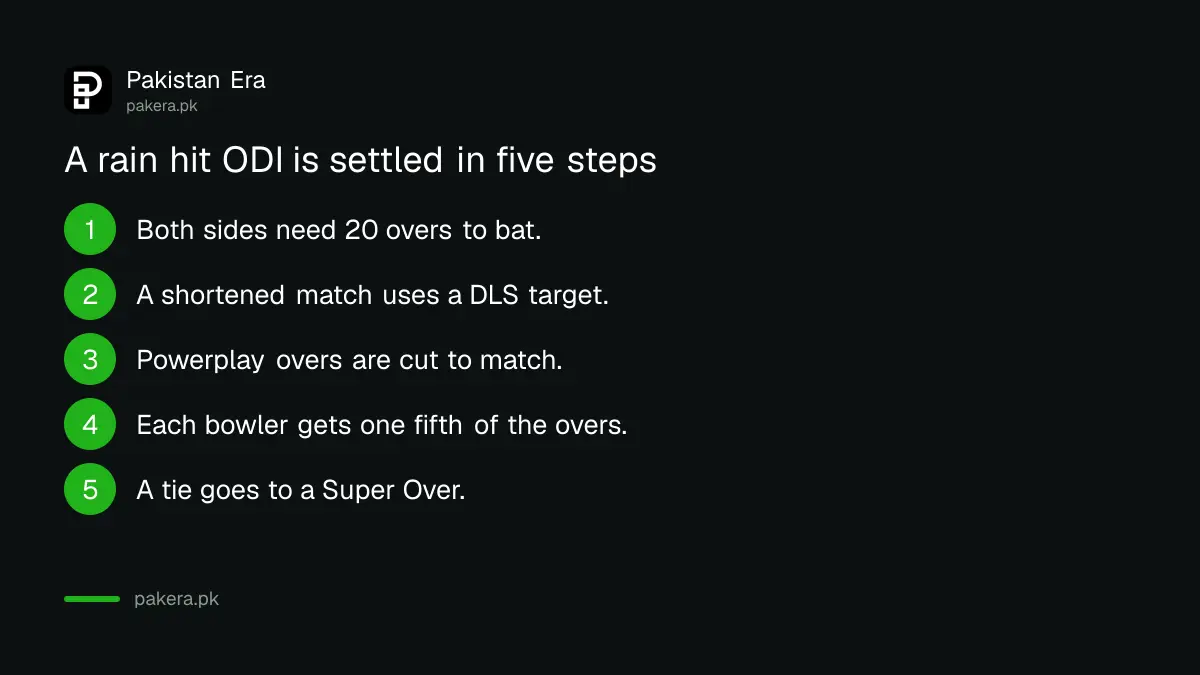
A result is possible only if both teams get at least 20 overs to bat. The two exceptions are a team that is all out in fewer than 20 overs, or a team batting second that scores enough to win in fewer than 20 overs. If neither applies, the match is a No Result.
When a match is cut short, the target is worked out with the Duckworth-Lewis-Stern method (DLS). Team 2 then chases a revised target in a reduced number of overs. For the refund policy that applies if rain stops a day, see the page on PCB cricket ticket refund rules for rain.
If the scores are level after both innings, the ICC conditions say a Super Over is played. Each team faces one over of six balls. If that is also level, more Super Overs follow until there is a winner. Series rules can differ from the standard text, and we did not read the tri-series regulations.
Over rates, reviews and the stop clock
The minimum over rate in ODIs is 14.28 overs an hour. If the fielding side is not in position to start the penultimate over by the scheduled cut-off time, no more than four fielders may stand outside the circle for the rest of that innings. The umpires give time back for reviews, injuries and other delays that the fielding side cannot control.
Each team is allowed two failed player reviews in each innings. The condition also asks the bowling side to begin each over within 60 seconds of the previous one. The Code of Conduct adds further penalties for slow over rates. For ground rules and entry on match day in Lahore, read our Gaddafi Stadium match day guide.

Common questions
How many overs can one bowler bowl in an ODI?
A maximum of 10 overs in a 50 over innings. If the innings is shortened, the limit is one fifth of the overs allowed.
How many fielders can be outside the circle in an ODI?
Two in overs 1 to 10, four in overs 11 to 40 and five in overs 41 to 50. The limit is checked at the moment of delivery.
How many overs must be bowled for a result?
Twenty overs for each side, unless a team is all out sooner or the chasing side wins in fewer than 20 overs.
What happens if an ODI is tied?
The ICC playing conditions call for a Super Over, one over for each side. More Super Overs follow if it is level again.
How many reviews does each team get?
Two failed player reviews in each innings. A review that overturns the on-field decision does not count against the team.
How we verified this
What we checked, where we read it, and what we could not confirm.
Last checked on 13 October 2026, Pakistan time. We read the ICC's playing conditions page and the Men's ODI Playing Conditions document it links, effective from October 2026. We did not read the tri-series competition regulations, and the Pakistan Cricket Board website refused automated requests. We did not compare the edition with the previous one, so we do not say what changed in October.
About the author

Tax, Bills and Technology Writer
Ali Akhtar is a young and curious voice here at Pakistan Era. He is currently pursuing his A-Levels and has a growing interest in Pakistan’s changing industrial landscape and educational trends. Ali likes to write in a way that helps him explain and explore the world around him. His writing reflects the perspective of the new generation navigating the evolving trends of Pakistan where technology, youth innovation, and shifting opportunities are reshaping the country’s future.