Punjab Labour Code 2026: Overtime at Two Times Pay, 8 Hour Day and Rest Breaks
The Punjab Labour Code 2026 caps work at 8 hours a day, pays overtime at two times, and gives a one hour break after six hours. See night work and penalties.
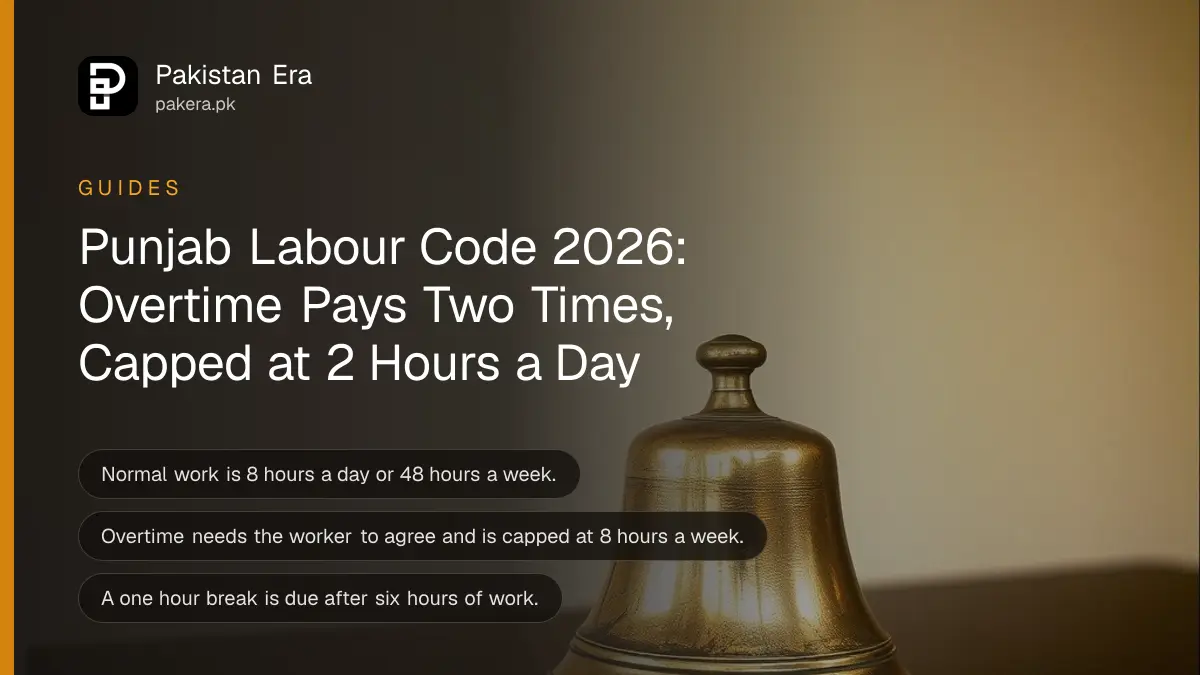
The Punjab Labour Code 2026 caps normal work at 8 hours a day or 48 hours a week, pays overtime at two times the normal hourly rate, limits it to 2 hours a day or 8 hours a week, and gives a one hour break after six hours. It is enacted law. Reports in late May 2026 said the Government has notified it as in force, but we could not confirm the start date from the Gazette.
Long shifts and unpaid extra hours are among the most common complaints from factory, shop and warehouse staff in Punjab. We read the working time chapter of the Code, Act IX of 2026, on 21 October 2026. We could not open the Gazette to confirm the commencement notice, so check the start date before relying on the rules below.
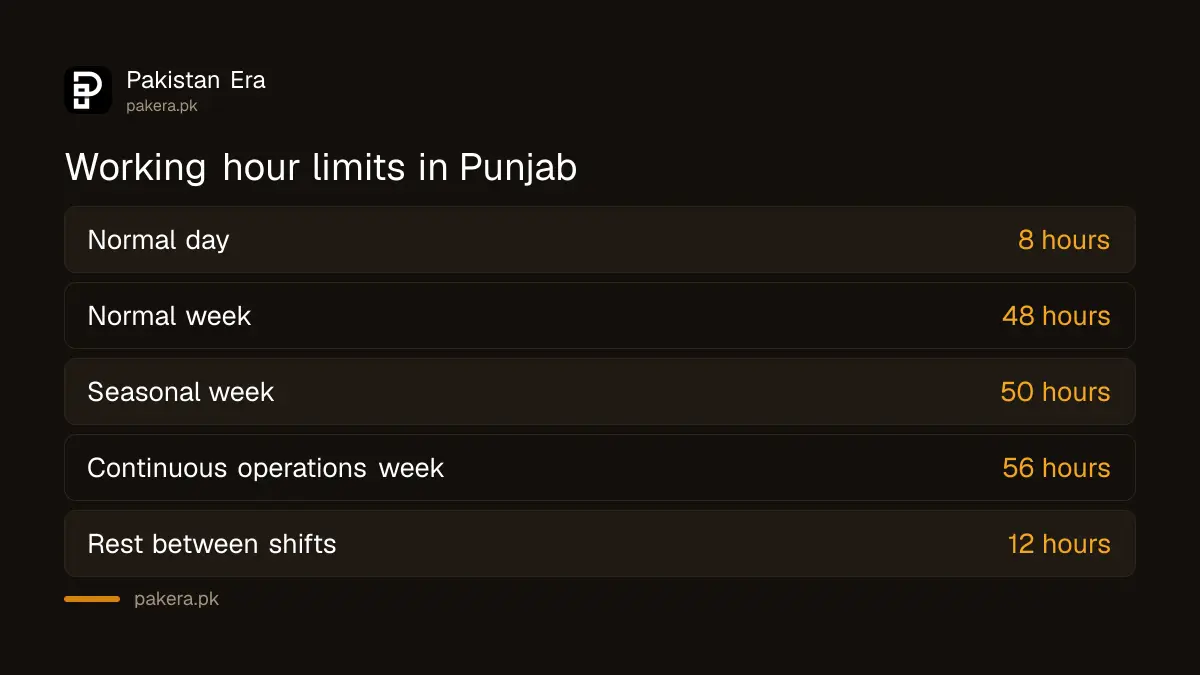
Normal hours are 8 a day or 48 a week, with longer limits in a few cases
Section 176 sets the standard at eight hours a day or 48 hours a week. Seasonal establishments may work up to nine hours a day and 50 a week. Workplaces with continuous technical operations may work up to 56 hours a week.
A five day week may use up to 10 hours a day without overtime pay, but the weekly total stays at 48 and the Chief Inspector must approve. Hours can also be moved around without overtime if no day goes more than two hours over and the 48 hour limit holds.
Overtime needs your consent and is paid at two times the normal rate
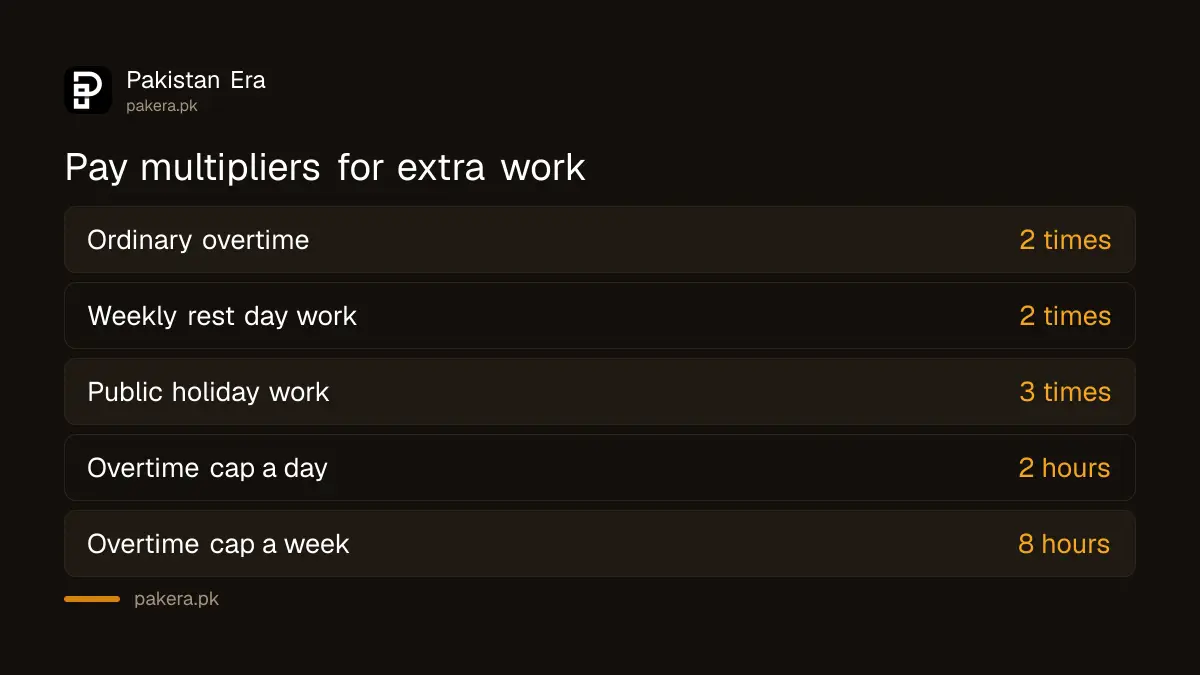
Section 179 says overtime must be agreed by the worker, cannot pass two hours on any day or eight hours in a week, and is paid at two times the normal hourly pay. Work on a rest day is also double, and a public holiday pays three times.
| Type of work | Pay rate | Limit |
|---|---|---|
| Ordinary overtime | 2 times normal hourly pay | 2 hours a day, 8 hours a week |
| Work on the weekly rest day | 2 times, unless a substitute day is agreed within 3 days | Worker must agree |
| Work on a public holiday | 3 times, unless a day off and a compensatory rest day are agreed within 7 days | Worker must agree |
The Code also says workers must get compensatory rest of at least two weekly rest days a month and at least half the declared public holidays in a year. For a worked example of today's rule, read the guide to overtime and working hours in Pakistan.
A one hour break after six hours and 12 hours of rest between shifts
Section 180 requires a rest break of at least one hour after more than six continuous hours of work. Section 181 requires at least 12 consecutive hours of rest between finishing and restarting work. Shift workers get the same 12 hour gap before a new shift.
Every worker also gets a weekly rest of at least 24 consecutive hours under section 182. It may include Sunday unless a written agreement says otherwise. Employers must also give paid time off on the public holidays the Government declares.
Night work is capped at 8 hours and women have extra protections
A night shift may not exceed eight hours in 24, and night work may not run beyond six months without a written exemption from the Chief Inspector. Workers should not do consecutive nights for more than one week. First aid and quick emergency care must be available.
A woman may work beyond 8 pm only with her prior consent. Her employer must then arrange pick and drop transport to her doorstep or nearest point, unless a hostel is provided nearby. Women must also be offered an alternative to night work for a month before and after maternity leave. For the current picture, see the guide to women's night shift rules.
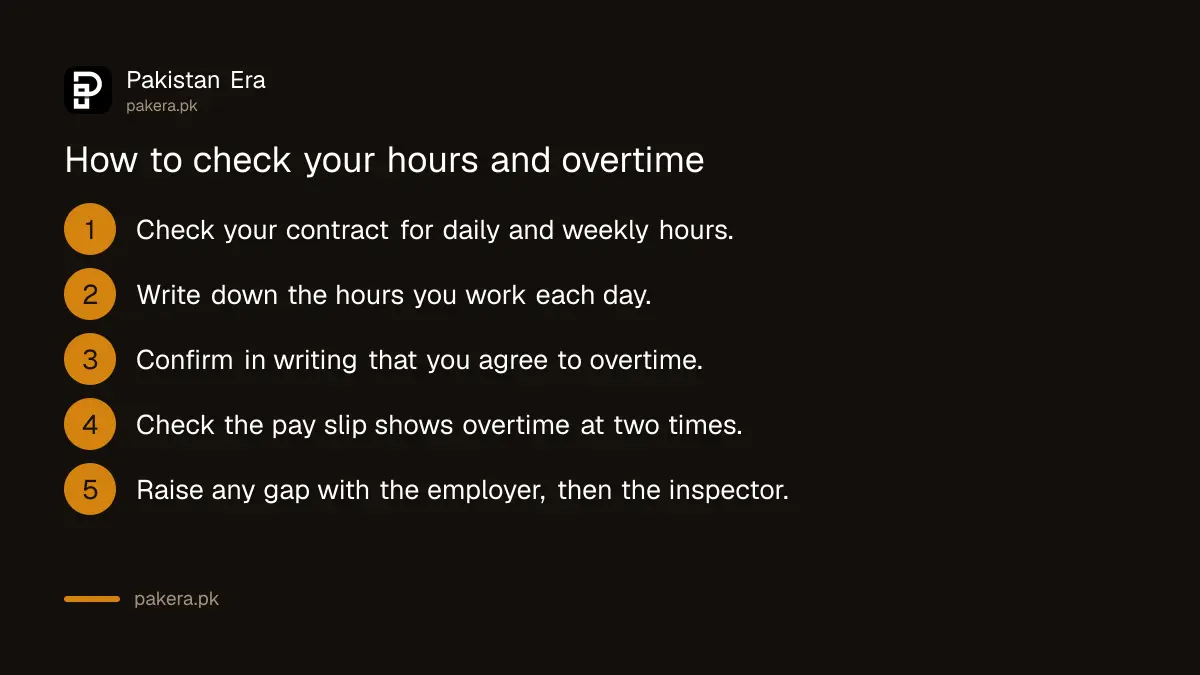
- Check your contract for daily and weekly hours.
- Write down the hours you actually work each day.
- Confirm in writing that you agree to any overtime.
- Check the pay slip shows overtime at two times.
- Raise any gap with the employer, then the labour inspector.
Breaking the hours and leave rules costs an employer 2 to 10 penalty units
Section 382 sets a fine of 2 to 10 penalty units for breaking the working time and leave chapters. One unit is the monthly unskilled minimum wage. At Rs 40,000 that is Rs 80,000 to Rs 400,000, our own arithmetic.
A repeat offence doubles the fine. A worker, a union or an inspector can file the complaint with a Labour Court or a First Class Magistrate. The unit value is the wage in force when the offence happens, so the rupee range can change.
Common questions about Punjab Labour Code hours and overtime
Can my employer force me to do overtime?
No. Section 179 says the employee must agree to overtime, and it is limited to two hours a day and eight hours a week.
How much is overtime paid under the Code?
Two times the normal hourly pay. Rest day work is also double and public holiday work is three times.
Is the Code in force now?
Reportedly yes. Reports in late May 2026 said the Government notified it, but we could not open the Gazette to confirm the date.
How long is the lunch break?
At least one hour after more than six continuous hours of work, under section 180.
Can a woman be made to work at night?
Not beyond 8 pm without her prior consent, and the employer must arrange transport to her door or nearest point.
Who can file a complaint for unpaid overtime?
The worker, a trade union or an inspector. Others must show they were affected. See the Punjab Labour Department for current notices.
How we verified this
What we checked, where we read it, and what we could not confirm.
Last checked 21 October 2026. We read sections 175 to 190 of the working time chapter and the penalty chapter of the Punjab Labour Code 2026, Act IX of 2026, gazetted on 10 February 2026, from a full-text copy of the Act. We could not open the Gazette copy to confirm the commencement notice. The rupee fine range is our arithmetic. The text of the Act is also listed on the Punjab laws portal.
About the author

Public Services and Education Journalist
Fajr Riaz is a journalist and content writer at Pakistan Era, based in Lahore. She covers the questions people meet in everyday life in Pakistan: how a public service works, what a change in the rules means, and where to find a reliable answer.