Women, Night Shifts and Working Hours in Pakistan
A woman may work evenings and nights in a factory only if the employer arranges safe transport and she consents. Both conditions apply.
A woman can be asked to work an evening or night shift in a factory only if the employer arranges safe and secure transport, and only with her consent. Both conditions, not one.
The default in the Act is narrower than most workplaces assume, and the exception that widens it comes with obligations attached to the employer rather than to her.
We read section 45 of the Factories Act, 1934 on 6 September 2026, in the text published by the Law and Parliamentary Affairs Department, Government of the Punjab.
What the section actually says
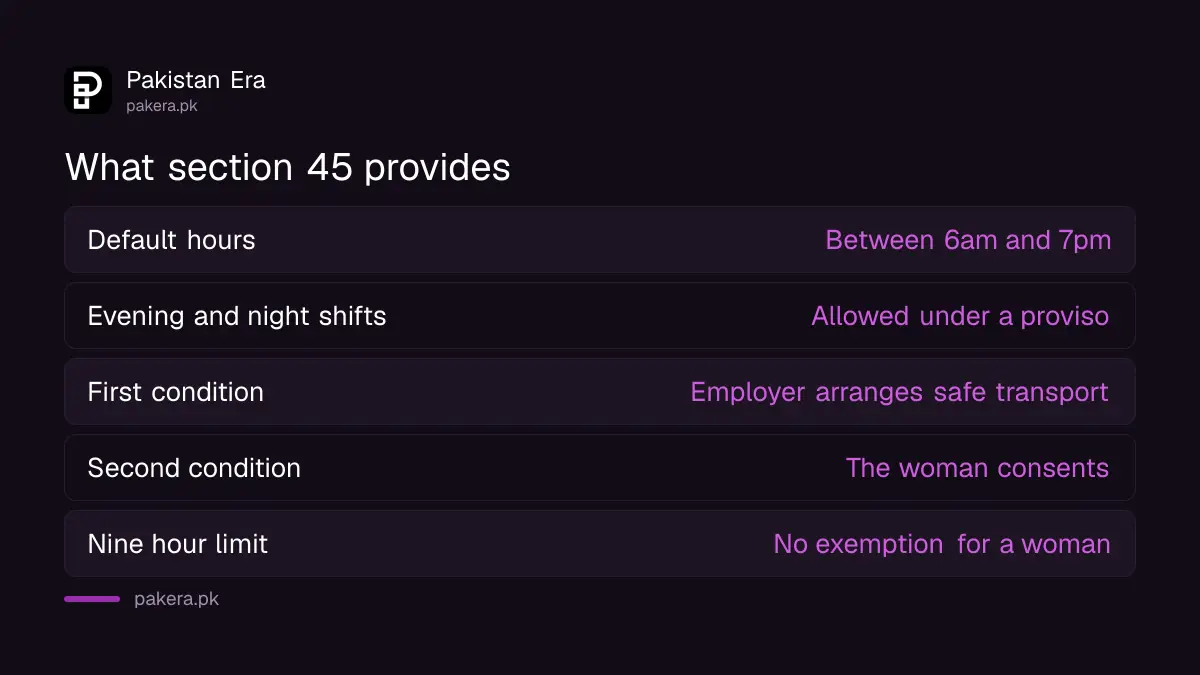
| Point | What section 45 provides |
|---|---|
| Default hours | Between 6am and 7pm |
| Evening and night shifts | Permitted under a proviso |
| First condition | The employer arranges safe and secure transport |
| Second condition | The woman consents |
| The nine hour limit | No exemption may be granted for a woman |
That last row is easy to miss and it matters. Section 45(1)(a) states that no exemption from section 36 may be granted in respect of any woman. Section 36 is the nine hour daily limit, and elsewhere the Act allows exemptions from it. For a woman worker, that door is closed.
The transport condition is on the employer
The proviso reads that if the employer arranges for safe and secure transport facilities, a woman with her consent may also work in evening and night shifts.
Read the order of it. The transport is what unlocks the shift. It is not an optional benefit offered afterwards, and it is not satisfied by a transport allowance paid in cash and left to the worker to sort out.
So a woman told she is on nights, with no transport arranged, can point at the condition the permission rests on. The question to ask is not whether she may work nights but whether the employer has done the thing that makes it lawful.
Consent is the second condition, and it is separate
Transport alone does not do it. The words are "with her consent", which means the arrangement is agreed rather than assigned.
Consent given once for one shift is not consent for a rota. If night working becomes permanent, that is a change to the terms she agreed to, and it is reasonable to have the agreement in writing.
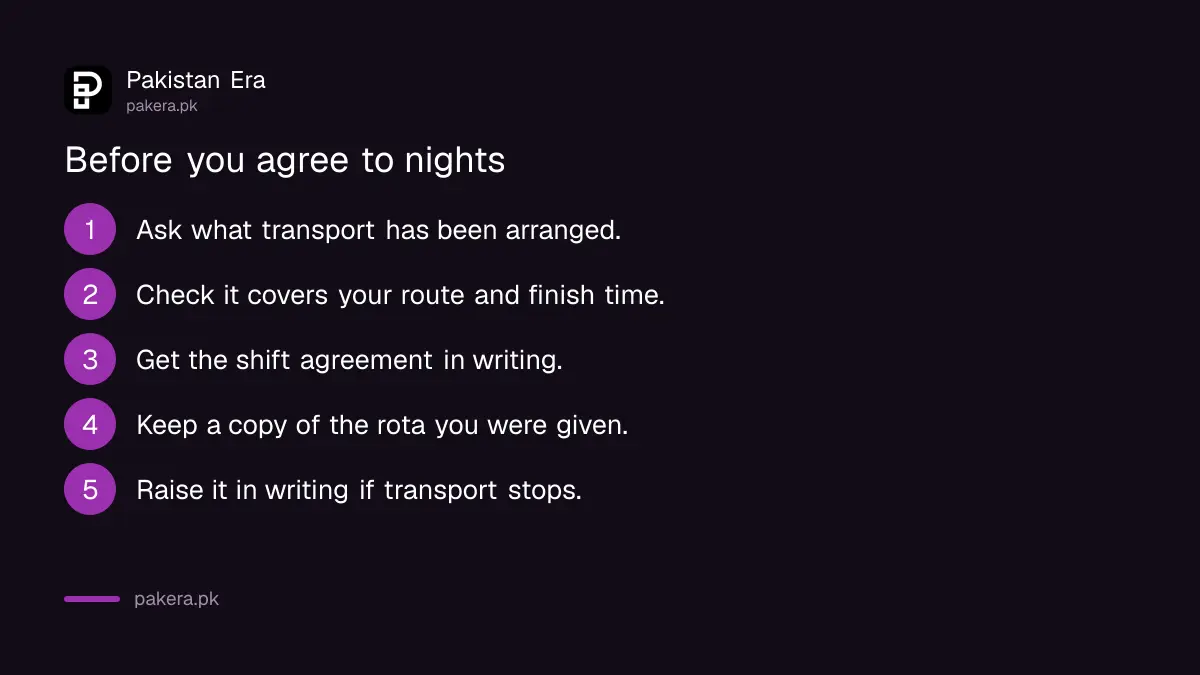
- Ask what transport has been arranged, specifically.
- Ask whether it covers your actual route and finishing time.
- Get the shift agreement in writing rather than verbally.
- Keep a copy of the rota you were given.
- Raise it in writing if transport stops being provided.
Night shifts and which day your hours count against
Section 46 decides how a shift crossing midnight is counted, and it applies to every worker.
Where a shift extends over midnight, the ensuing day is deemed to be the twenty-four hours beginning when the shift ends, and hours worked after midnight count towards the previous day. The Chief Inspector may direct otherwise for a specified factory or class of workers.
That is what stops a night shift being split across two days so that neither appears to breach the nine hour limit. Our guide to overtime and working hours sets out those limits and the double pay that follows them.
Exemptions exist, and they are narrow
Section 45(2) allows the Government to make rules exempting women from these restrictions, to the extent and on the conditions it prescribes, in fish-curing or fish-canning factories where the work has to follow the catch.
That is the shape of a lawful exemption: made by rules, for a named type of work, on stated conditions. A verbal arrangement inside one factory is not one.
What this covers, and what it does not
The Factories Act applies to factories as defined in it, so this section does not settle hours in an office, a shop, a hospital or a call centre. Those fall under separate provincial legislation.
Labour is a provincial subject and this text is the Punjab one. Provinces have been amending these provisions, so check the version that applies where you work before relying on a section number.
Harassment at work is a different matter with its own forum, and our guide to filing a workplace harassment complaint covers that route, which is free and does not require a lawyer.
If the conditions are not being met
Start with a written record. Note the shifts worked, the finishing times, and what transport was or was not provided on each occasion.
Raise it with the employer in writing first. Our guide to misconduct and dismissal rules sets out the protections that apply if raising it leads to trouble, including written notice within one month and an independent inquiry before any dismissal.
Common questions
Can women work night shifts in Pakistan?
In a factory, yes, under the proviso to section 45, if the employer arranges safe and secure transport and the woman consents.
What are the default hours?
The section says no woman shall be allowed to work in a factory except between 6am and 7pm, before the proviso applies.
Is a transport allowance enough?
The proviso speaks of the employer arranging safe and secure transport facilities, not of paying an allowance.
Can my daily hours be extended?
Section 45(1)(a) says no exemption from the nine hour limit in section 36 may be granted in respect of any woman.
Does this apply to offices and shops?
No. The Factories Act applies to factories as defined in it. Other workplaces fall under separate provincial law.
What if I did not agree to nights?
The proviso requires her consent. Ask for the arrangement in writing.
How we verified this
What we checked, where we read it, and what we could not confirm.
Last checked 6 September 2026. We downloaded the Factories Act, 1934 from the Punjab Code portal at punjablaws.punjab.gov.pk, in the text published by the Law and Parliamentary Affairs Department, Government of the Punjab, and read it. Section 45(1)(a) providing that no exemption from section 36 may be granted in respect of any woman, section 45(1)(b) providing that no woman shall be allowed to work in a factory except between 6 A.M. and 7 P.M., the proviso allowing a woman with her consent to work evening and night shifts where the employer arranges safe and secure transport facilities, section 45(2) permitting rules exempting women working in fish-curing or fish-canning factories to a prescribed extent and on prescribed conditions, and section 46 on how hours are counted where a shift extends over midnight, are all taken from that text. The Act applies to factories as defined in it and does not govern offices, shops or hospitals, which fall under separate provincial legislation. Labour is a provincial subject and the text we read is the Punjab one; provinces have been amending these provisions, so confirm the version that applies where you work. Nothing here is legal advice.
About the author

Public Services and Education Journalist
Fajr Riaz is a journalist and content writer at Pakistan Era, based in Lahore. She covers the questions people meet in everyday life in Pakistan: how a public service works, what a change in the rules means, and where to find a reliable answer.