Which Laboratories Test Suspect Medicines in Pakistan: DRAP's Central Drugs Laboratory in Karachi
See which government labs test suspect medicines in Pakistan: the CDL in Karachi, the NCLB in Islamabad and provincial labs, how samples arrive and what to do.
When a medicine in Pakistan is suspected of being fake or poor quality, it is tested by a government laboratory: DRAP's Central Drugs Laboratory in Karachi, its National Control Laboratory for Biologicals in Islamabad, or a provincial laboratory such as the Drug Testing Laboratory Sindh. A patient cannot simply walk in. Samples reach these laboratories through drug inspectors, customs or other law enforcement agencies.
Every DRAP alert ends with the same line in effect: a laboratory tested it and found a problem. Who are these laboratories, and what do they actually do? We read DRAP's quality control laboratories page and the page for the Central Drugs Laboratory on 22 October 2026, plus the alert DRAP issued that day. This is not medical advice.
DRAP names four kinds of testing laboratory
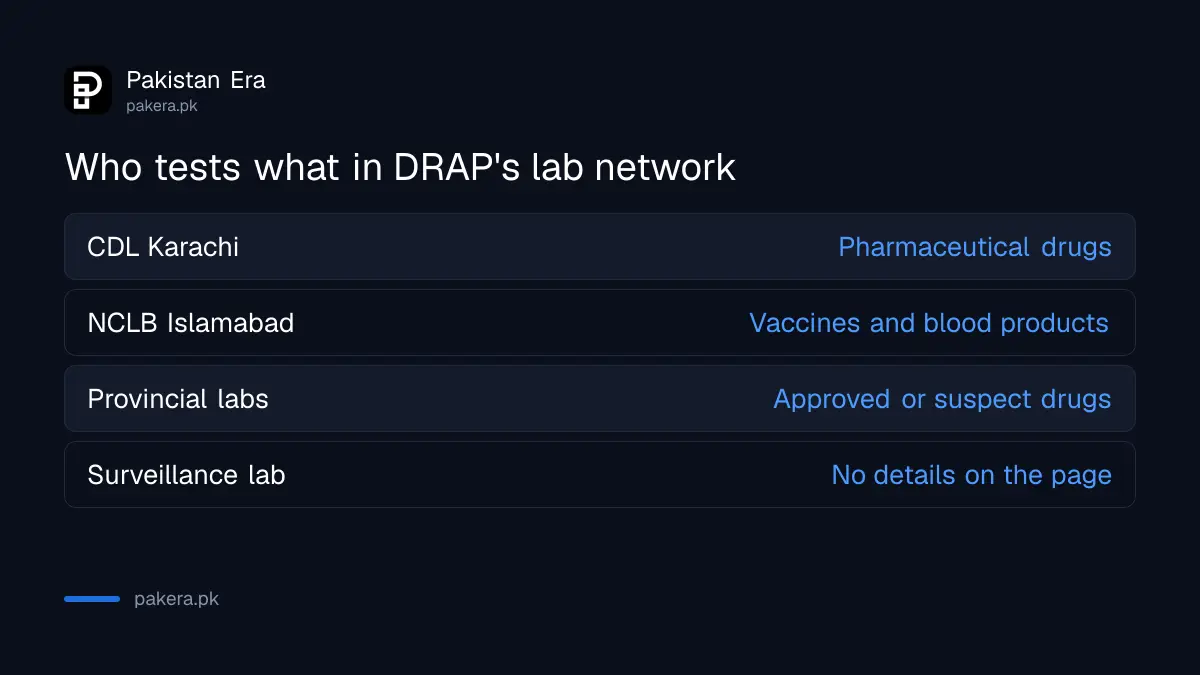
DRAP's menu lists the Central Drugs Laboratory, the National Control Laboratory for Biologicals, the Federal Drugs Surveillance Lab and provincial quality control laboratories. Each province has its own lab that tests approved or suspect drugs as needed, DRAP says.
| Laboratory | Where | What DRAP's page says it does |
|---|---|---|
| Central Drugs Laboratory (CDL) | Karachi | Chemical analysis and microbiological testing of pharmaceutical drugs |
| National Control Laboratory for Biologicals (NCLB) | Islamabad | Tests locally made and imported biologicals, vaccines and blood products |
| Federal Drugs Surveillance Lab | Not stated | Listed in the menu, no details on the page |
| Provincial quality control laboratories | Each province | Test approved or suspect drugs as needed |
The page that should list the provincial laboratories did not load for us, so we cannot give you their names or addresses. We did not find a list on DRAP's site.
The Central Drugs Laboratory in Karachi tests drugs two ways
Its first job is compliance testing: checking active ingredients, excipients and finished products against pharmacopoeial standards, validated maker methods or the lab's own methods. Its second is investigative testing of suspicious, illegal or counterfeit products sent by Federal Drug Inspectors, customs or other law enforcement agencies.
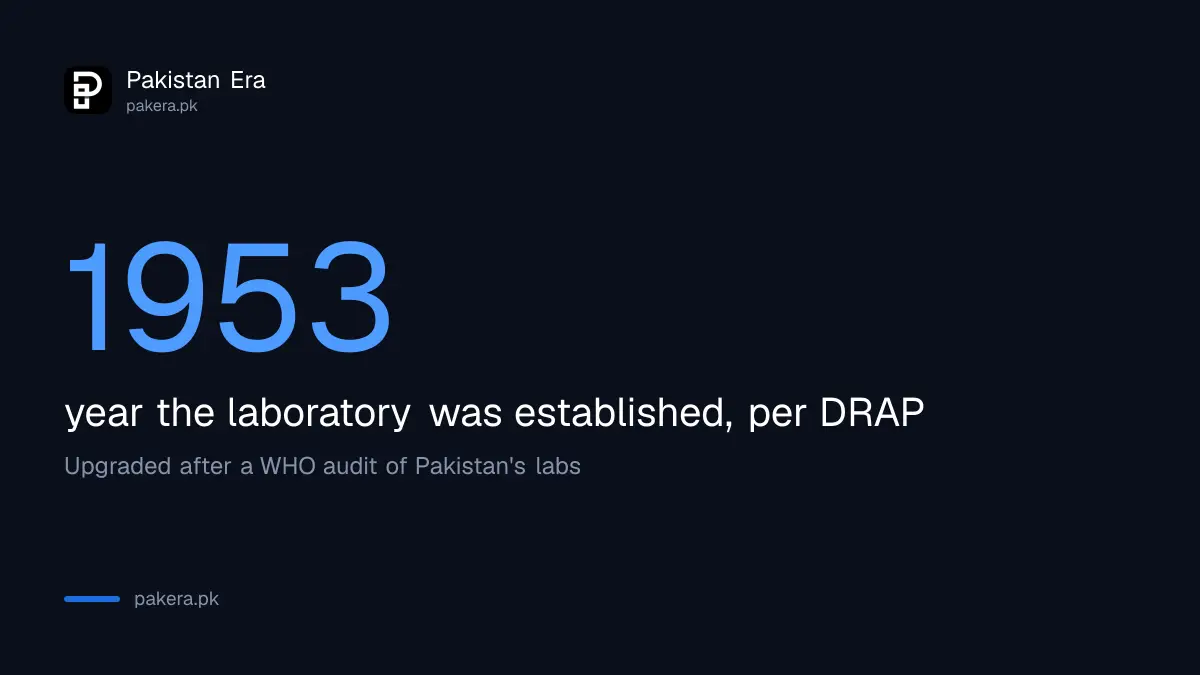
An excipient is a non-active ingredient such as a filler. A pharmacopoeia is an official book of drug standards. The CDL was set up in 1953 and its role grew under the Drugs Act of 1976 and the DRAP Act of 2012. DRAP gives its address as 4-B, SMCHS, Block B, Karachi, with phone numbers +92-21-34392159 and +92-21-34382979.
The CDL was upgraded after a World Health Organization audit
DRAP says the upgrade followed a WHO audit of Pakistan's quality control laboratories that came after the Punjab Institute of Cardiology incident. New chemical, physical, microbiological and light-sensitive drug testing labs were built to meet ISO 17025 and WHO good practice standards.
The page also says the laboratory received WHO prequalified status in 2026. It says PNAC, the national accreditation body, audited the lab for ISO 17025:2017 and recommended accreditation, but it does not confirm the final grant, so we do not say the lab is accredited. We did not check WHO's own list.
The Brexin alert shows the route a suspect sample takes
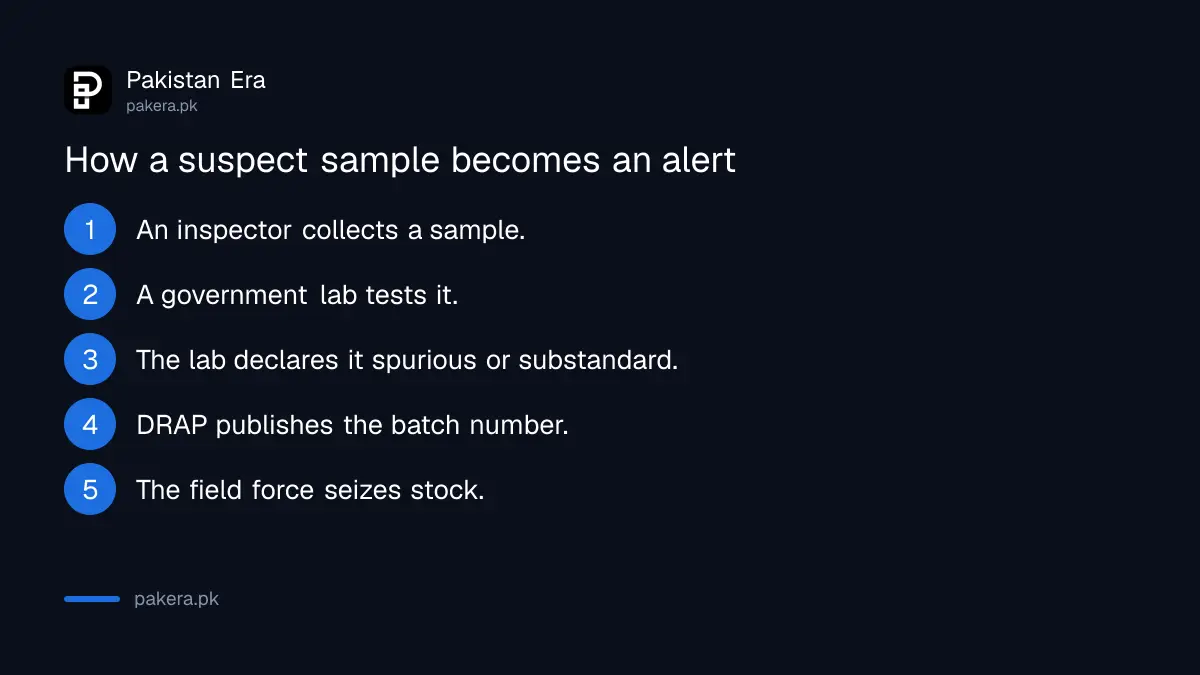
In the Brexin batch W68C alert, the Area Provincial Inspector of Drugs in Karachi sent the sample. Drug Testing Laboratory Sindh in Karachi declared it spurious under the Drugs Act. DRAP then told its field force to seize the batch.
- A drug inspector or an agency collects a suspect sample.
- A government laboratory tests it.
- If it fails, the lab declares the sample spurious, substandard or misbranded.
- DRAP issues an alert with the batch number.
- The field force and provincial drug control departments act on the supply chain.
We explain the three words in step three in what spurious, substandard and counterfeit mean. To see whether your own batch has been named, use the steps in checking whether a medicine batch was recalled.
What an ordinary buyer can do
DRAP's pages do not describe a way for the public to send a sample for testing, or a fee, so we cannot offer one. What you can do is report: keep the pack, note the batch number, and use the steps in reporting counterfeit medicine to DRAP. The DRAP helpline is 0800-03727, Monday to Friday, 8 am to 4 pm.
Do not try to test tablets at home. Ask your doctor or pharmacist whether to stop a medicine you are already taking.
Common questions
Which laboratory tests suspect medicines in Pakistan?
DRAP's Central Drugs Laboratory in Karachi and provincial laboratories do, among others. Biologicals go to the NCLB in Islamabad.
Can I send a medicine to the laboratory myself?
DRAP's pages do not describe a public route. Samples come from inspectors and law enforcement. Report your pack to DRAP instead.
Where is the Central Drugs Laboratory?
DRAP lists 4-B, SMCHS, Block B, Karachi.
Does the CDL test vaccines?
No. DRAP says vaccines and blood products are tested at the NCLB in Islamabad.
Is the Central Drugs Laboratory WHO prequalified?
DRAP's page says it received WHO prequalified status in 2026. We did not confirm this on WHO's site.
Who declared the Brexin batch spurious?
The Drug Testing Laboratory Sindh in Karachi, according to DRAP's alert.
How we verified this
What we checked, where we read it, and what we could not confirm.
Last checked 22 October 2026. We read DRAP's quality control laboratories page, its Central Drugs Laboratory page, its Federal Drugs Surveillance Lab page and Rapid Alert No I/S/10-26-44. The surveillance lab page was last updated in February 2022 and gave no details. The list of provincial laboratories would not load. We did not visit a laboratory or call the listed numbers, and we could not verify the WHO prequalification or the ISO accreditation outcome.
About the author
Public Services and Education Journalist
Fajr Riaz is a journalist and content writer at Pakistan Era, based in Lahore. She covers the questions people meet in everyday life in Pakistan: how a public service works, what a change in the rules means, and where to find a reliable answer.