Who Can Drive on Pakistan's National Highways: Age 18, 21 and 60, and 8 Medical Bars
Check the minimum driving age (18 and 21), the transport vehicle limit of 60 and the 8 medical conditions that bar a licence on Pakistan's national highways.
On Pakistan's national highways and motorways, you must be 18 to drive a car or motorcycle for yourself, 21 to drive a car or transport vehicle for pay, and no older than 60 to drive a transport vehicle. The law also names eight medical conditions that bar a licence. We read the text on 22 October 2026.
Most drivers never read the federal safety law. They learn the rules from a licence office. But the National Highways Safety Ordinance, 2000 sets the age and health bars for roads patrolled by the National Highways and Motorway Police (NHMP), and it is short enough to read in an evening. We opened the Gazette copy that NHMP publishes on its traffic rules page on 22 October 2026. It is the 2000 text, so later amendments may have changed a detail.
You need a valid licence for your vehicle class, and you must carry it
Section 3 says no one may drive on a national highway without holding, and carrying on their person, a valid licence for the particular class and type of vehicle. A car licence does not cover a truck or a bus. The paper in your drawer at home does not count.
Section 5 puts a duty on the owner too. An owner or person in charge of a vehicle must not let anyone drive it who fails the licence or age rules. So lending your car to an unlicensed relative is an offence of its own, not just their problem. Documents the police may ask for are listed in the guide to documents the motorway police can demand.
The minimum age is 18 for yourself and 21 for paid driving
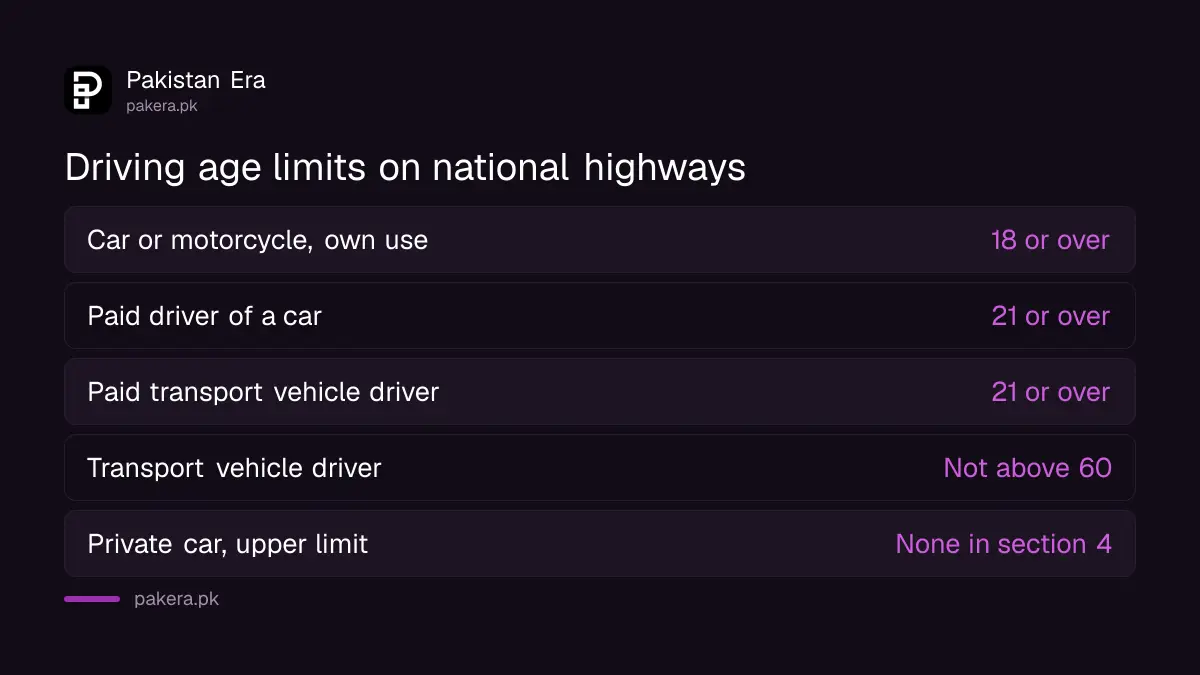
Section 4 sets the age limits. A motorcycle or a car may be driven by someone aged 18 or over, unless they drive as a paid employee. A paid driver of a transport vehicle, public service vehicle, car or animal-drawn vehicle must be 21 or over.
| Who drives | Vehicle | Age limit in section 4 |
|---|---|---|
| Anyone, for themselves | Motorcycle or car | 18 or over |
| Paid employee | Transport vehicle, public service vehicle, car, animal-drawn vehicle | 21 or over |
| Anyone | Transport vehicle | Not above 60 |
The upper limit applies only to transport vehicles, meaning goods trucks and passenger carriers. Section 4 does not set a maximum age for a private car.
Eight medical conditions bar a licence under the Third Schedule
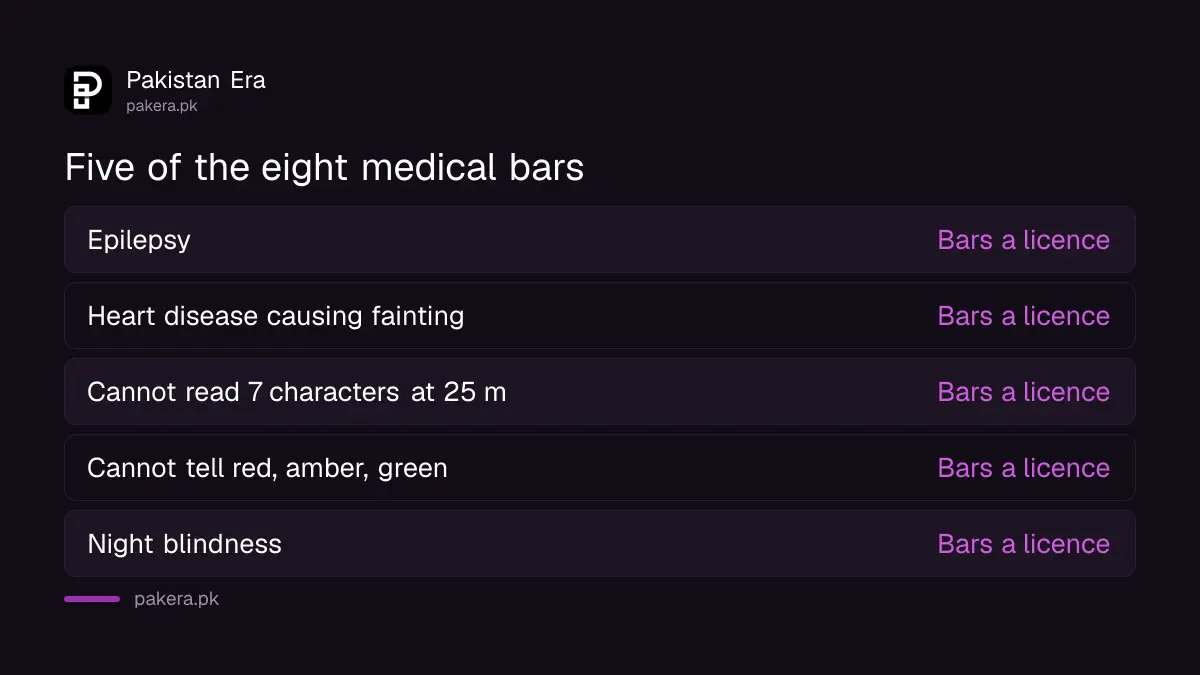
The Third Schedule lists eight diseases and disabilities that disqualify an applicant. A licensing authority must refuse a licence if a medical test shows one of them. For other conditions it can still refuse if the condition is a danger to the public.
- Epilepsy.
- Mental illness. The 2000 text uses the old word "lunacy".
- Heart disease likely to cause sudden giddiness or fainting.
- Poor eyesight: not being able to read seven letters and numerals, white on black, at 25 metres in good daylight, with glasses if you wear them.
- Deafness that stops you hearing ordinary sound signals without hearing aids.
- Colour blindness, meaning you cannot readily tell red, amber and green.
- Night blindness.
- Addiction to excessive use of alcohol or drugs.
Section 6(5) adds a small door. A person with a disability that is not on the Third Schedule list may ask to be tested on a vehicle of a particular design, and if they pass the licence can be limited to that vehicle. For the eight listed conditions that door is closed.
Transport drivers need a medical board certificate
Where the licence is for a transport vehicle, section 6(3) requires a medical certificate in Form B signed by the Chairman of a Medical Board. The Second Schedule says that board has a Medical Superintendent as chairman, a physician and an optometrist. For other licences the authority can ask for it in writing.
A heavy transport licence has one more rule. Section 6(8) says the applicant must have held an effective licence for another road vehicle, not a motorcycle, for at least three years immediately before applying.
Passing the tests and owning the Highway Code come before a licence
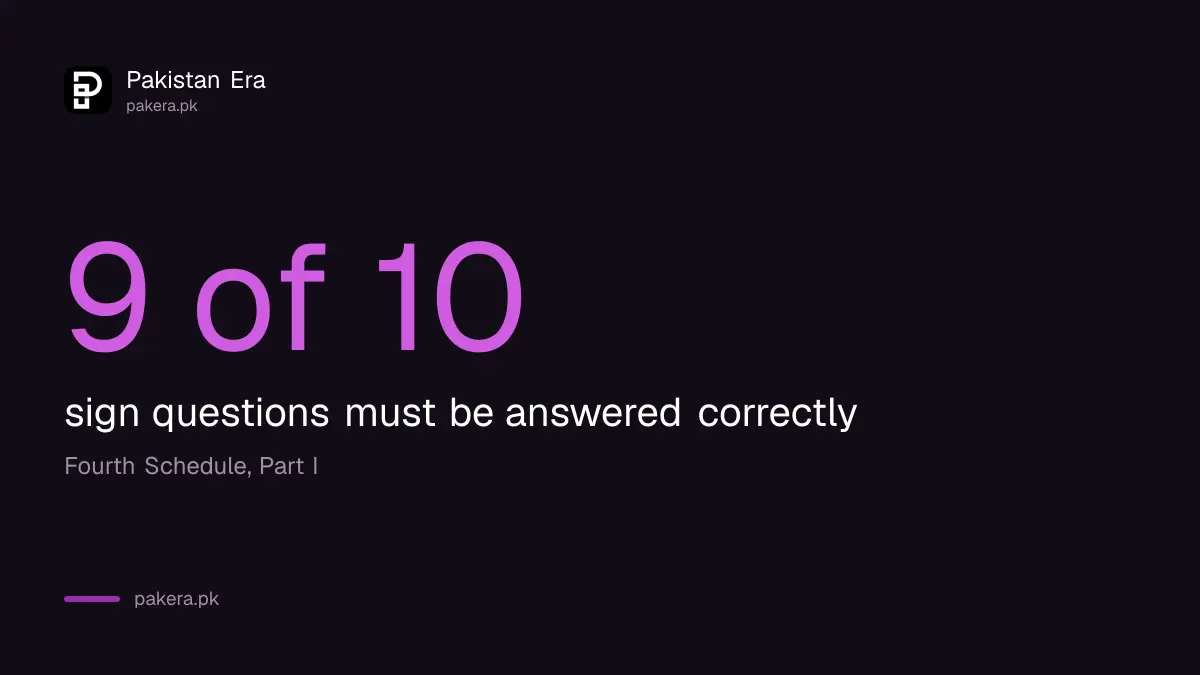
Section 6(6) bars a licence unless the applicant passes the Fourth Schedule tests of competence and has a personal copy of the most recent official Highway and Motorway Code. Part I is a sign test: you must give nine correct answers to ten questions about the Seventh Schedule signs.
Part II is a rule test on the Eighth Schedule. If you can read and write the answers are written. If not, they are oral. The licence office for the NHMP in Islamabad is covered in the guide to the NHMP driving licence and theory test.
A licence can be cancelled for illness, and you can be asked to retest
Section 12 lets the licensing authority ask any licence holder for a fresh Form B medical certificate if it has reasonable grounds to think illness or disability makes them unfit. It can also require the driving tests, if the holder has not taken them, or if a paid driver last took them five or more years ago.
If you cannot produce the certificate or fail the test, the authority may cancel or refuse to renew the licence until you do. Driving while unfit is a separate offence, which is covered in our guide to racing, unfit driving and tinted glass penalties.
Common questions
What is the minimum age to drive a car on a Pakistani motorway?
It is 18 for your own use, under section 4 of the National Highways Safety Ordinance. A paid driver must be 21.
Is there a maximum driving age in Pakistan?
For national highways, only for transport vehicles: no one above 60 may drive one. Section 4 sets no upper age for private cars.
Does colour blindness stop me getting a licence?
Yes, if you cannot readily tell red, amber and green. It is item 6 on the Third Schedule list.
Can I get a licence with weak eyesight?
Yes with glasses, if you can read the seven letter and number test at 25 metres in good daylight while wearing them.
Who needs a medical board certificate?
Anyone applying for a transport vehicle licence. The authority may also ask others in writing.
Can a licence holder be asked to retest?
Yes. Section 12 lets the authority ask for a fresh medical certificate and driving tests where it has reasonable grounds.
How we verified this
What we checked, where we read it, and what we could not confirm.
Last checked 22 October 2026. The ages, medical conditions and test rules come from sections 3 to 6 and 12 and the Second, Third and Fourth Schedules of the National Highways Safety Ordinance, 2000, in the Gazette copy at nhmp.gov.pk. The copy is a scan, so we read it as text and checked the numbers twice. It is the 2000 text, and we did not check for later amendments. Provincial licence offices may apply extra rules on provincial roads. We did not test the licence process.
About the author
Technology Journalist & Multimedia Producer
Ahmad Ali is a technology journalist and multimedia producer at Pakistan Era, joining the team in October 2026. He covers consumer technology and digital life for Pakistani readers, combining research with hands-on product testing.