Motorway Penalties in Pakistan for Racing, Tinted Glass and Unsafe Vehicles: Rs 500 to Rs 2,000
Check the motorway penalties for racing, unfit driving, unsafe vehicles and shaded glass in Pakistan: up to one month in jail or Rs 500 to Rs 2,000 (2000 text).
On Pakistan's national highways, the law punishes racing, driving while unfit, driving an unsafe vehicle and driving with shaded glass with up to one month in jail, a fine, or both. The fines run from Rs 500 to Rs 2,000 in the text we read. We read the sections on 22 October 2026.
Dark window film, a worn tyre or a late-night race with a friend all feel like private choices. On a motorway they are offences with their own section numbers. The penalties sit in sections 69 to 73 of the National Highways Safety Ordinance, 2000. We read the Gazette copy that the National Highways and Motorway Police publish on nhmp.gov.pk. It is the 2000 text, so a later amendment may have raised the amounts.
Racing needs written consent, and without it costs up to one month in jail
Section 70 punishes anyone who permits or takes part in a race or trial of speed on a national highway without the written consent of the prescribed authority. The penalty is up to one month in jail, or a fine of Rs 1,000 to Rs 2,000, or both.
Racing is also one of the nine offences for which police can arrest without a warrant, listed in the guide to when NHMP can arrest without a warrant. Section 71 adds that anyone who abets the offence gets the same punishment, so a friend who films and cheers is not safe either.
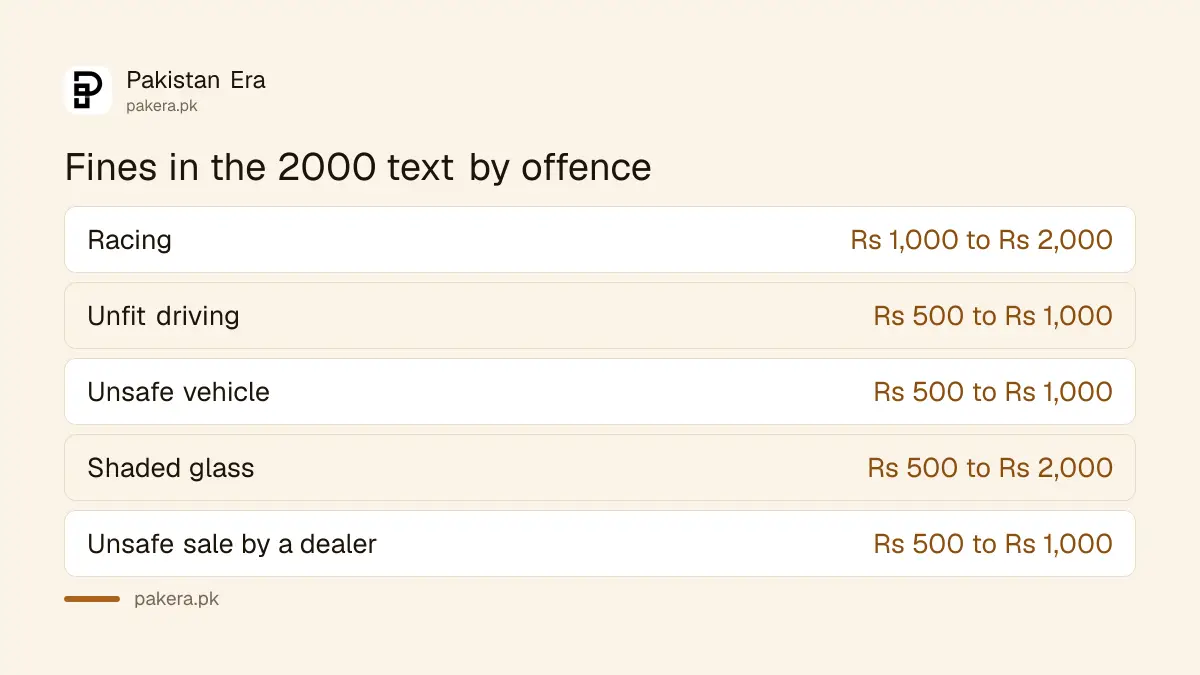
| Offence | Section | Jail | Fine |
|---|---|---|---|
| Racing or trial of speed | 70 | Up to 1 month | Rs 1,000 to Rs 2,000 |
| Driving while mentally or physically unfit | 69 | Up to 1 month | Rs 500 to Rs 1,000 |
| Driving an unsafe vehicle | 72 | Up to 1 month | Rs 500 to Rs 1,000 |
| Driving with shaded glass | 73 | Up to 1 month | Rs 500 to Rs 2,000 |
| Abetting sections 60, 65 to 70 | 71 | Same as the offence | Same as the offence |
Driving while unfit is punished only after a Medical Board decides
Section 69 covers a driver with a disease or disability that makes driving a danger to the public. The penalty is up to one month in jail, or a fine of Rs 500 to Rs 1,000, or both. But no one can be convicted unless a Medical Board under the Second Schedule says so.
The conditions that bar a licence are set out in the guide to who can drive on national highways. A tired or ill driver is not automatically guilty. Section 69 needs the board's finding, not an officer's opinion.
An unsafe vehicle costs up to one month or Rs 500 to Rs 1,000
Section 72 punishes anyone who drives, or lets someone drive, a vehicle or trailer on a national highway in a condition that is liable to make it unsafe and a source of danger to the driver and others. The penalty is up to one month in jail, or a fine of Rs 500 to Rs 1,000, or both.
The owner is covered too, not just the driver, because the section says "causes or allows". A worn tyre, a broken light or a failed brake before a long drive is the owner's problem. The checks to make before a trip are in the guide to the motorway driving rules.
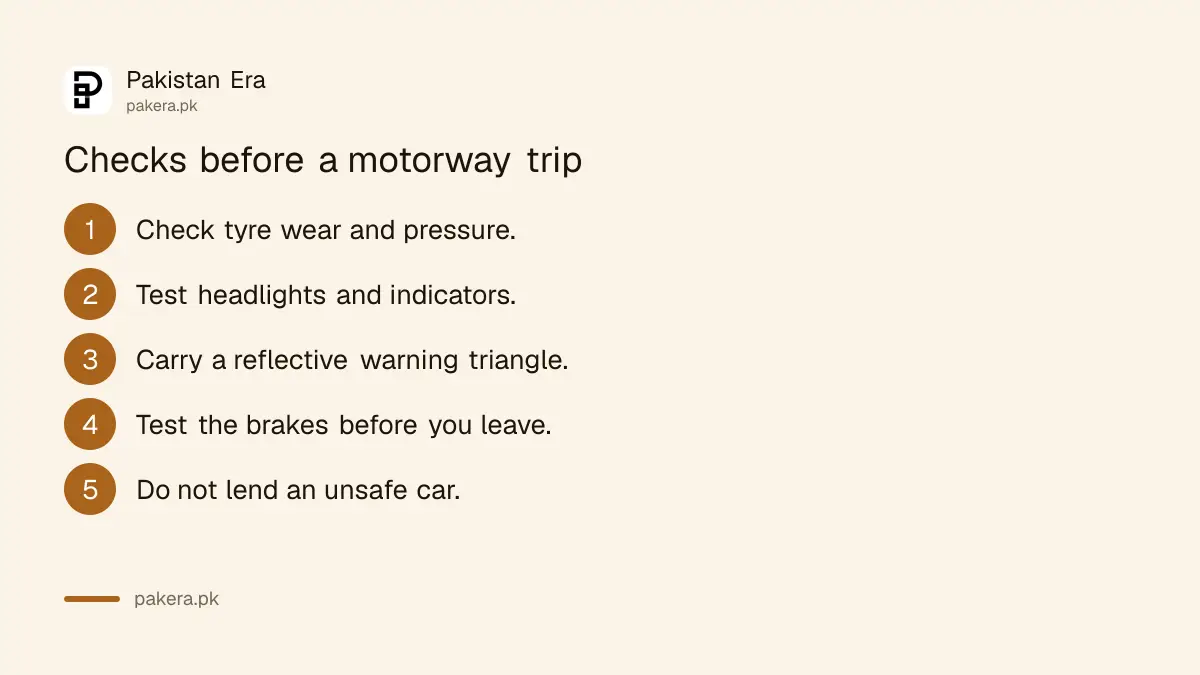
- Check tyres for wear and pressure.
- Test headlights, brake lights and indicators.
- Carry a reflective warning triangle, which section 43(3) requires.
- Check the brakes before you leave, not on the motorway.
- Do not lend a car you know is unsafe.
Shaded glass is an offence on a national highway, and the text sets no darkness level
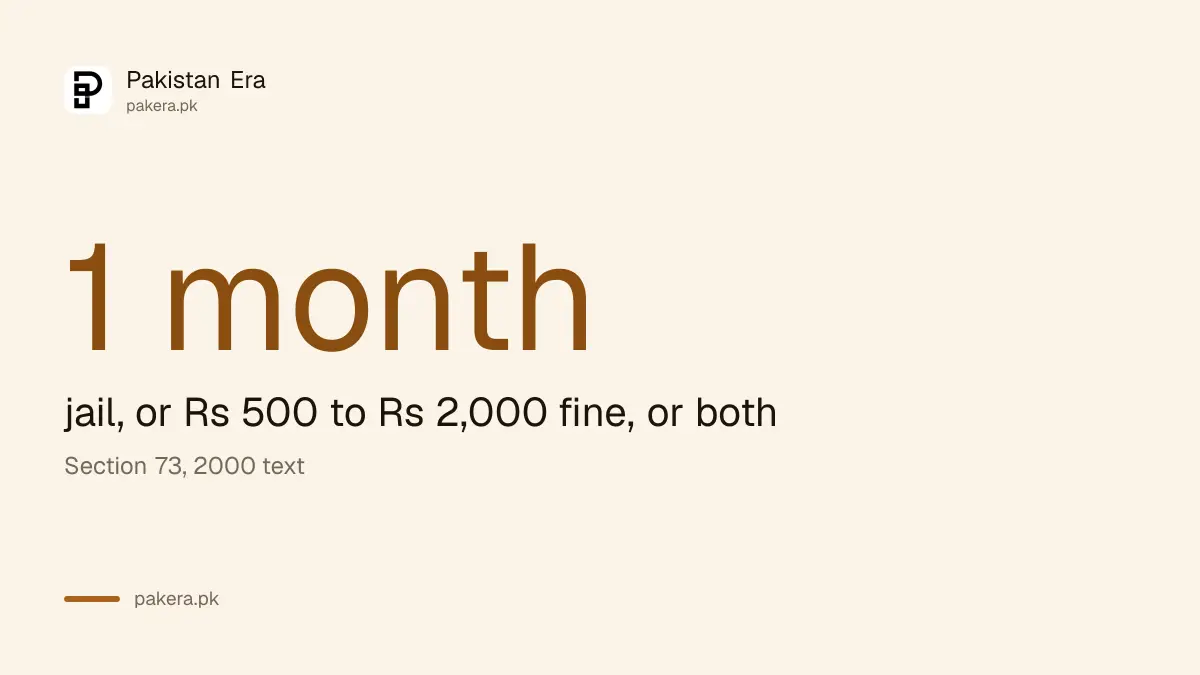
Section 73 punishes driving, or letting someone drive, a road vehicle with shaded glass on a national highway. The penalty is up to one month in jail, or a fine of Rs 500 to Rs 2,000, or both. We searched the ordinance for a definition of shaded glass and found none.
That means the text we read gives no percentage of darkness, and no list of exempt vehicles. We could not confirm whether any exemption or permit applies, so we cannot tell you that film within a certain limit is safe. If your car has dark glass, ask NHMP on 130 before a long motorway trip.
Dealers and importers are liable too
Section 74 punishes a fabricator, assembler, dealer or importer who sells or delivers a vehicle in such a state that its use on a national highway would be dangerous or unsafe. The penalty is up to six months in jail, or a fine of Rs 500 to Rs 1,000, or both.
There is a defence. A seller is not convicted if he proves he had reasonable cause to believe the vehicle would not be used on a national highway until it had been put right. For buyers, a used car check helps, as in the guide to inspecting a used car before buying.
Common questions
What is the penalty for racing on a motorway?
Up to one month in jail, or a fine of Rs 1,000 to Rs 2,000, or both, under section 70 of the ordinance as we read it.
Is tinted glass illegal on Pakistani motorways?
Section 73 makes driving with shaded glass an offence on a national highway. It sets no darkness level in the text we read.
What is the fine for tinted glass?
Rs 500 to Rs 2,000, or up to one month in jail, or both, in the 2000 text. A later amendment may have changed it.
Can I be punished for lending an unsafe car?
Yes. Section 72 covers anyone who causes or allows an unsafe vehicle to be driven on a national highway.
Who decides if a driver is unfit?
A Medical Board under the Second Schedule. Without its finding, section 69 gives no conviction.
Do these rules apply on city roads?
No. They apply to national highways and motorways. City roads follow provincial law.
How we verified this
What we checked, where we read it, and what we could not confirm.
Last checked 22 October 2026. Sections 43, 69 to 74 and the Second Schedule come from the National Highways Safety Ordinance, 2000, in the Gazette copy at nhmp.gov.pk. The copy is a scan, so we read it as text and cross-checked the amounts. We did not check for later amendments, for any notification on window glass, or for what fine an officer writes today.
About the author

Technology Journalist & Multimedia Producer
Ahmad Ali is a technology journalist and multimedia producer at Pakistan Era, joining the team in October 2026. He covers consumer technology and digital life for Pakistani readers, combining research with hands-on product testing.