Check Pakistan Motorway Driving Rules: Warning Triangle, Lights, Following Distance
Pakistan motorway driver rules from the National Highways Safety Ordinance: warning triangle, fog lights, following gap and tinted glass. See the pre-trip list.
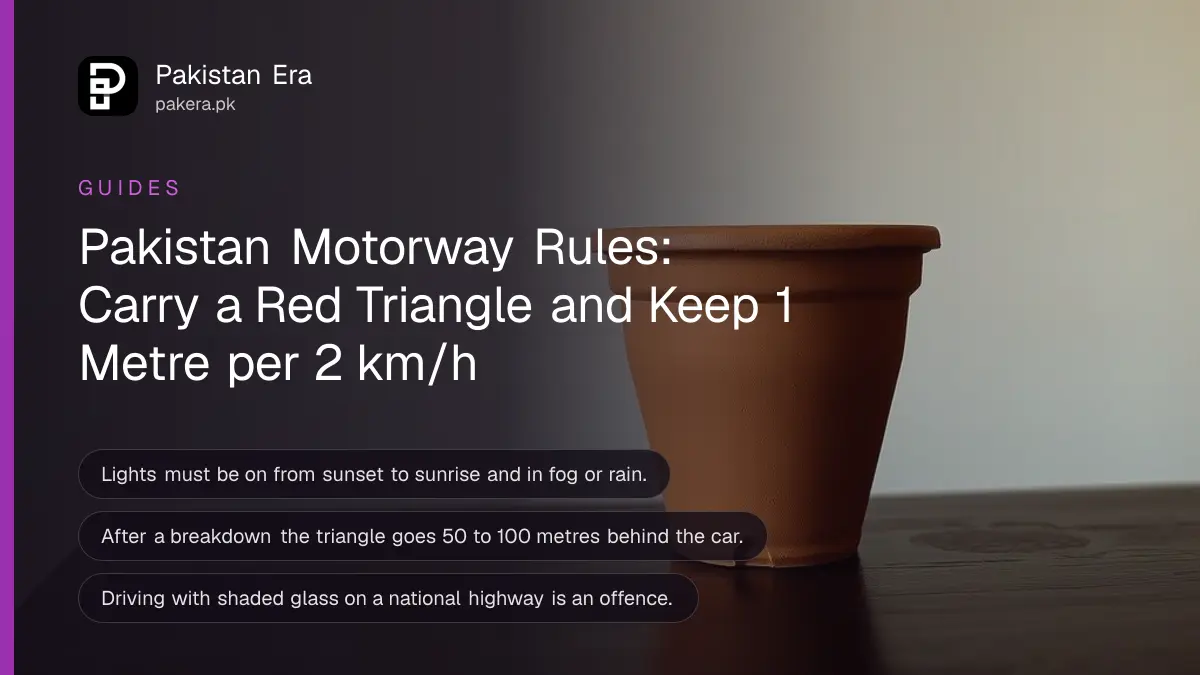
The National Highways Safety Ordinance 2000 sets driver rules that apply on motorways and national highways. Among them: carry a red reflecting warning triangle, keep seat belts and lights working, switch lights on from sunset to sunrise and in fog, and keep one metre of gap for every 2 km/h of speed. On a breakdown, park on the shoulder and place the triangle 50 to 100 metres back.
Most of us drive the motorway on habit. A rule you have never read is easy to break, especially going into the fog season. We opened the ordinance text that the National Highways and Motorway Police (NHMP) publishes on its website on 15 October 2026 and picked out the rules a private driver can check before a trip. Fine amounts in the text date from 2000, so we flag them.
A red warning triangle must be in the car at all times
The ordinance lists "not be without a warning triangle" among the driver rules, and section 43 says no vehicle may drive on a national highway without pneumatic tyres or without carrying reflective emergency warning triangle signs, unless the rules say otherwise. Check that yours is in the boot.
The use is set out too. After a breakdown outside city limits, the driver must park on the shoulder if there is one, switch on the hazard lights and place a red reflecting triangle 50 to 100 metres before the place where the vehicle stopped. A triangle behind your car gives fast traffic time to react.
Open the boot before you leave and look. A triangle cannot be bought on the shoulder at night.
Lights go on from sunset to sunrise and whenever fog or rain cuts the view
The Eighth Schedule tells drivers to turn on lights from sunset to sunrise, and also when there is not enough natural light because of mist, fog, rain, dust storm or snow. Dip the headlights for oncoming traffic on undivided roads, and when following close behind another vehicle at night.
The schedule also forbids driving without seat belts or without properly working lights and indicators. Headlights must not be left on when the vehicle is parked, and parking lights must be on when you park outside city limits at night. Check every bulb before a long drive.
Fog can close motorways from late autumn. Our report on fog and motorway closures explains what happens when it does.
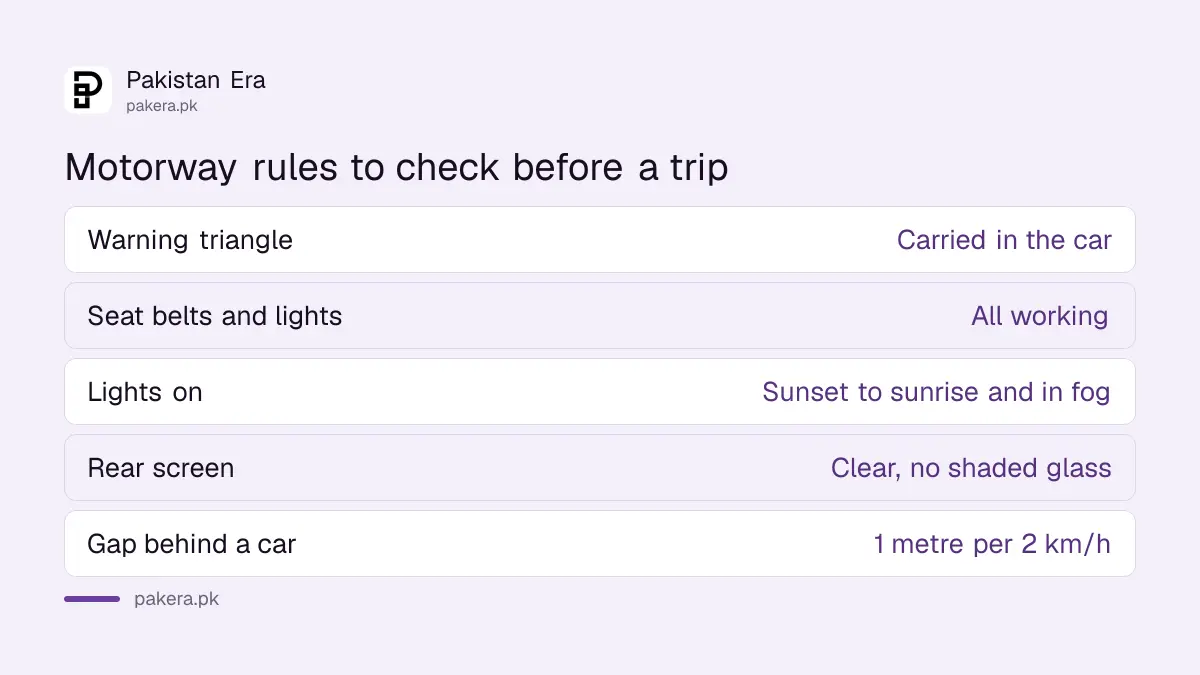
| Rule in the ordinance | What to check before the trip |
|---|---|
| Warning triangle always carried | Triangle in the boot |
| Seat belts and working lights | Belts click, all bulbs and indicators work |
| Lights from sunset to sunrise and in fog | Dipped headlights switched on in poor light |
| Clear rear screen and mirror view | Nothing blocks the rear window or mirror |
| Pneumatic tyres | Tyres sound and inflated |
| Helmet for rider and pillion | Both riders wearing helmets |
Keep one metre of gap for every 2 km/h of speed
The Eighth Schedule sets a following distance of one metre for every two kilometres per hour of speed. It gives its own example: 30 metres at 60 km/h. By that rule, 120 km/h needs a 60 metre gap.
Many drivers follow far closer than that on a busy road. The 120 km/h figure is our arithmetic from the rule, not a number printed in the text. For legal speed limits by vehicle, see motorway speed limits in Pakistan.
The schedule also says to keep to the left lane on a four lane highway unless overtaking, turning right or passing parked vehicles. Heavy vehicles and anything towing a trailer must stay in the extreme left lane on a multi-lane highway.
Tinted glass can be an offence on a national highway
Section 73 makes it an offence to drive a vehicle with shaded glass on a national highway. As printed in the 2000 text, the penalty is up to one month in prison, or a fine of Rs 500 to Rs 2,000, or both. The Eighth Schedule also says to keep the rear screen clear at all times.
The text does not say how dark the glass can be. We could not find a limit on the NHMP page. If your car has dark film, remove it before a motorway trip, or ask NHMP for the current position in writing.
Whether the fine is still Rs 500 to Rs 2,000 is not clear. The government can amend the penalty schedules, and the NHMP page does not publish a later amendment that we could find. To see a live challan, use the NHMP challan check.
Standard fines printed in the ordinance are small and may have changed
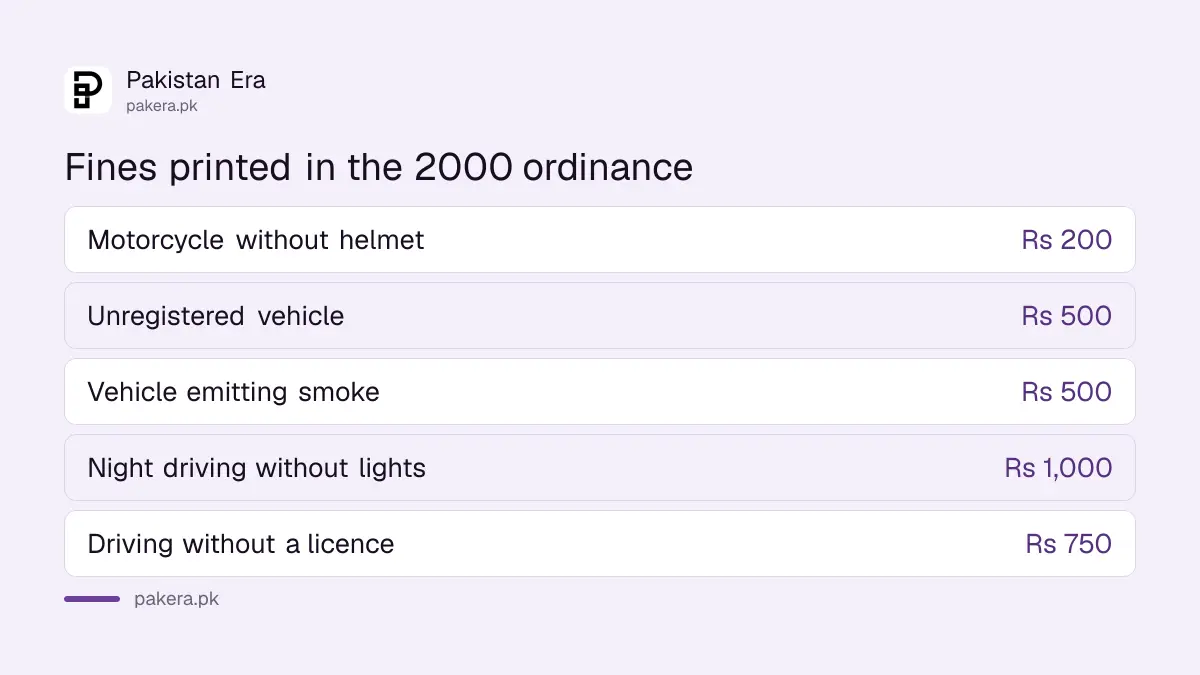
The Twelfth Schedule lists standard fines for common offences. As printed, a motorcycle rider without a helmet pays Rs 200, an unregistered vehicle Rs 500, a vehicle that emits smoke Rs 500, driving at night without proper lights Rs 1,000, and driving without a driving licence Rs 750.
These are the 2000 amounts, copied from a scanned gazette where some digits were hard to read. Treat them as a guide to which offences exist, not as today's charge. The schedule also lets police take a fine within ten days on a citation, and keep your registration or licence if it is not paid.
| Offence | Fine as printed in the 2000 text |
|---|---|
| Motorcycle driver without helmet | Rs 200 |
| Driving an unregistered vehicle | Rs 500 |
| Vehicle emitting smoke | Rs 500 |
| Driving at night without proper lights | Rs 1,000 |
| Driving without a driving licence | Rs 750 |
A ten minute check before you leave
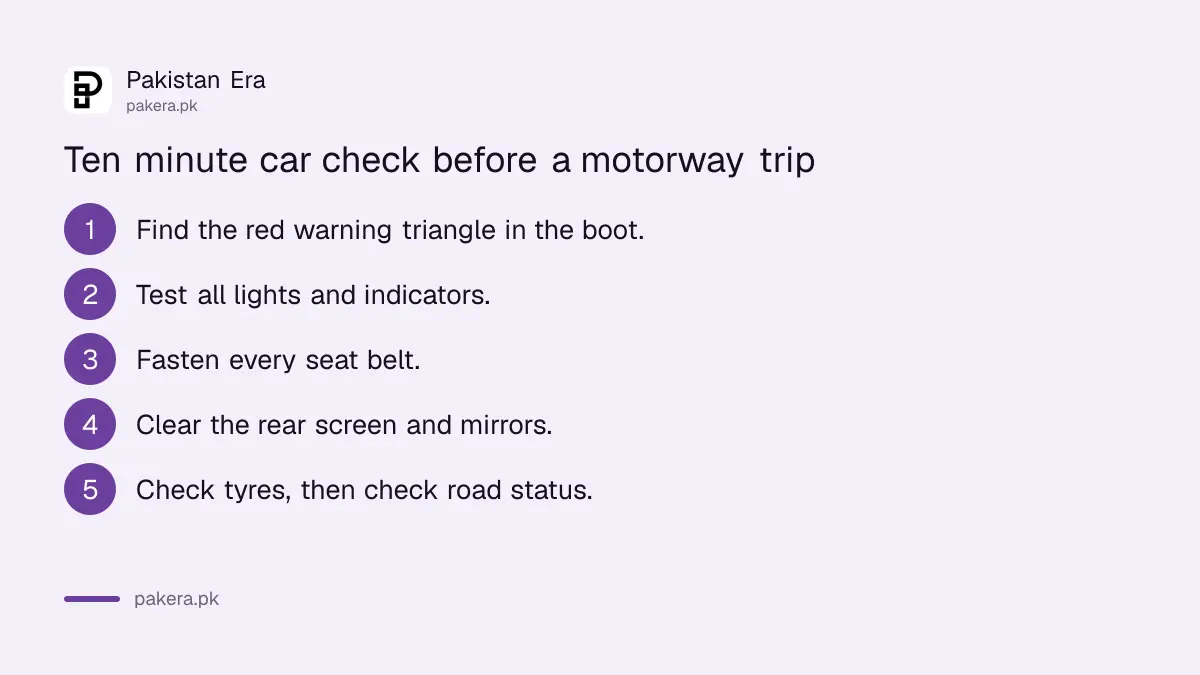
You do not need a mechanic for most of this. Walk around the car, open the boot, and sit in the driver's seat. If something is wrong, fix it before the road, because the shoulder of a motorway is a poor place to learn that the triangle is missing.
- Open the boot and find the red warning triangle. Buy one if it is missing.
- Switch on all lights and indicators and walk around the car to check each bulb.
- Fasten every seat belt and check that it clicks and holds.
- Check that the rear screen and mirrors are clear, with no dark film or stickers blocking the view.
- Check tyre condition and pressure, including the spare.
- Check the road before you go with the NHMP motorway status check.
Common questions about motorway driving rules in Pakistan
Is a warning triangle compulsory on the motorway?
Yes, under the National Highways Safety Ordinance 2000, which lists a reflective warning triangle as required equipment on a national highway.
When must headlights be on?
From sunset to sunrise, and whenever fog, mist, rain, dust storm or snow reduces the natural light, per the Eighth Schedule of the ordinance.
How far behind another car should I drive?
One metre for every 2 km/h of speed, so 30 metres at 60 km/h, as the Eighth Schedule gives it.
Is tinted glass allowed on a motorway?
Section 73 makes driving with shaded glass on a national highway an offence. The text sets no darkness limit that we could find.
Where do I put the triangle after a breakdown?
Park on the shoulder, switch on the hazard lights and place the red triangle 50 to 100 metres before the vehicle.
Are the fines in the ordinance still current?
Not necessarily. The text on the NHMP site shows the 2000 amounts, and the schedules can be amended. Check a live challan for today's charge.
How we verified this
What we checked, where we read it, and what we could not confirm.
Last checked 15 October 2026. The rules and fines come from the National Highways Safety Ordinance 2000 as published on the NHMP traffic rules page, which we opened on that date. The file is a scanned gazette with some unclear words, so check the original. We found no later amended schedule on that page. The 60 metre figure for 120 km/h is our own arithmetic. This is general information, not legal advice.
About the author

Tax, Bills and Technology Writer
Ali Akhtar is a young and curious voice here at Pakistan Era. He is currently pursuing his A-Levels and has a growing interest in Pakistan’s changing industrial landscape and educational trends. Ali likes to write in a way that helps him explain and explore the world around him. His writing reflects the perspective of the new generation navigating the evolving trends of Pakistan where technology, youth innovation, and shifting opportunities are reshaping the country’s future.