How to Claim Unpaid or Late Salary in Sindh: Payment of Wages Authority
Claim unpaid, late or wrongly cut salary in Sindh before the Payment of Wages Authority. Pay deadlines, allowed deductions, steps, compensation and appeal.
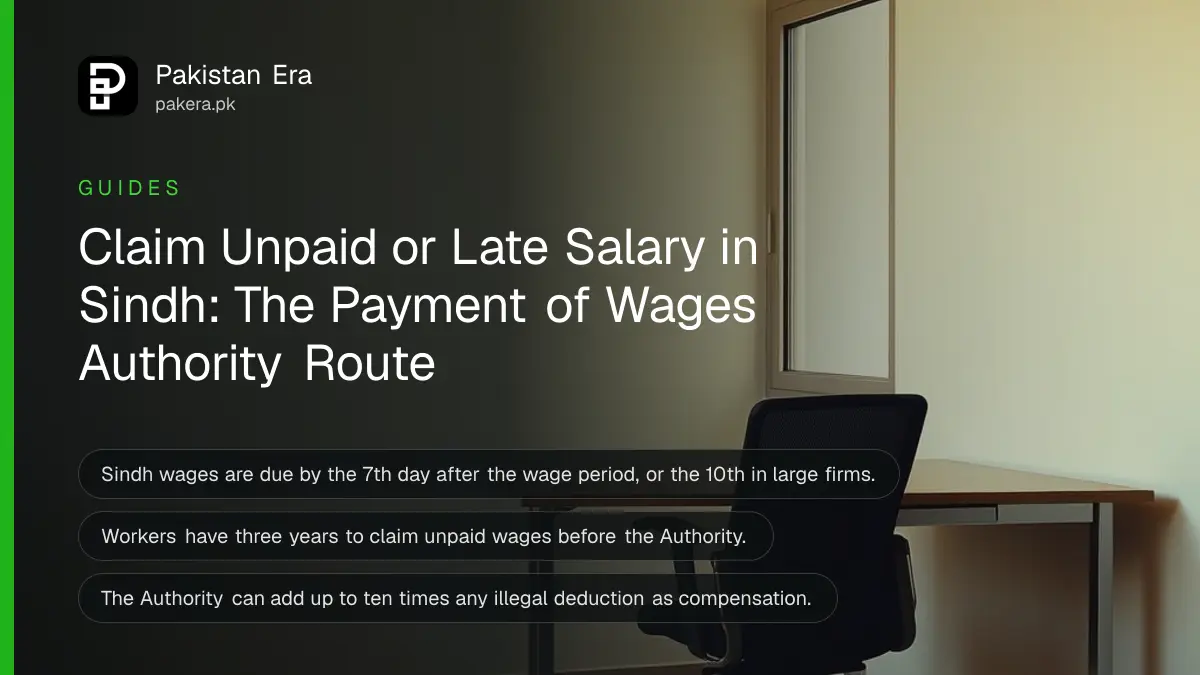
In Sindh, a worker whose salary is unpaid, late or wrongly cut applies to the Payment of Wages Authority under section 15 of the Sindh Payment of Wages Act, 2015. File within three years. The Authority can order the wages paid plus compensation of up to ten times any illegal deduction. Unpaid provident fund and gratuity dues can be claimed the same way.
Late salary is a familiar problem in Karachi's private offices, factories, schools and security companies. Many workers think the only option is the Labour Court and a lawyer. The Sindh Act gives a cheaper first route: a direct application to an officer of the Labour Directorate.
| Point | Sindh Payment of Wages Act, 2015 |
|---|---|
| Who decides | The Payment of Wages Authority: a Workers' Compensation Commissioner or a Labour Directorate officer of BPS-18 or above |
| Time limit | 3 years from the date the wages were due or the deduction was made |
| What you can recover | Unpaid or late wages, illegal deductions, provident fund and gratuity dues |
| Extra compensation | Up to 10 times the amount wrongly deducted |
| Appeal | To the Labour Court within 30 days |
Sindh law says when your wages must be paid
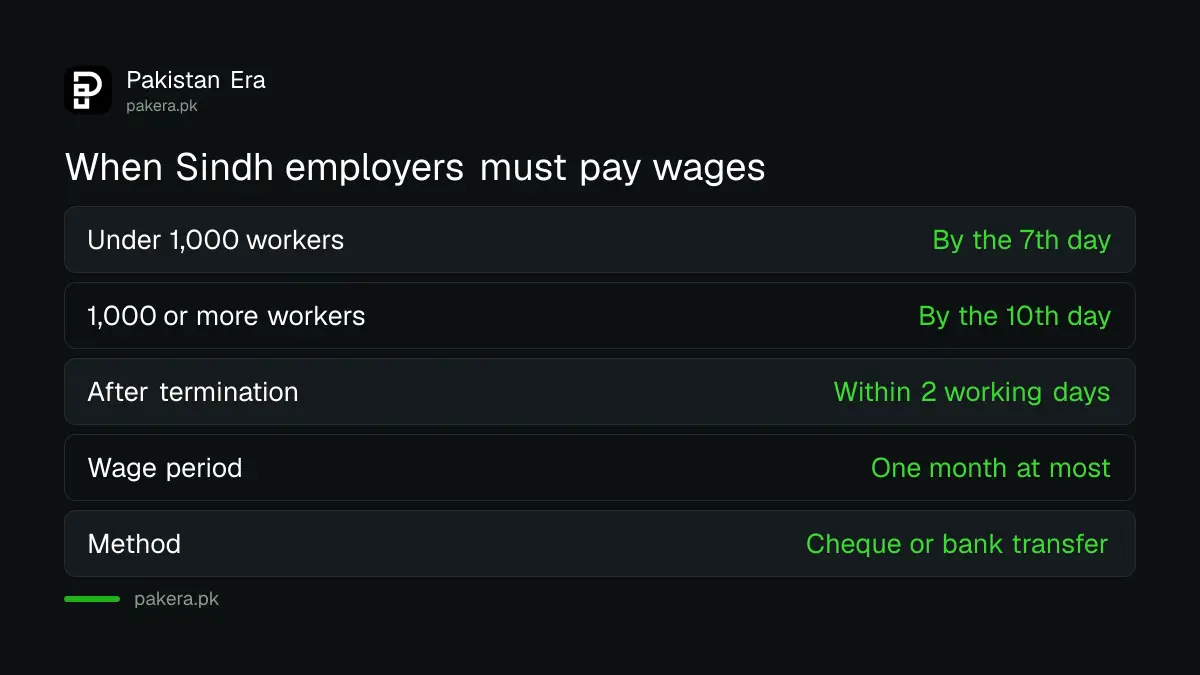
Section 5 of the Sindh Payment of Wages Act, 2015 sets the deadline. Where fewer than 1,000 people work, wages are due before the seventh day after the wage period ends. In larger establishments the limit is the tenth day. No wage period can be longer than one month.
Two more rules help when a job ends. If the employer terminates you, the wages you earned must be paid before the end of the second working day after termination. And section 6 says all wages must be paid by crossed cheque or bank transfer, with a pay slip showing the details.
The Act covers people doing skilled, unskilled, manual or clerical work in factories, industrial establishments, commercial establishments, mines and railways. It names permanent, probationary, temporary, contract and apprentice workers. Commercial establishments include banks, hotels, restaurants, private schools and colleges, private hospitals and clinics, laboratories and private security agencies.
Owners and managers who hold hiring and firing power are not covered. Everyone below them is.
Only six kinds of deduction are allowed from your pay
Section 7 bans every deduction except those the Act allows: fines, absence from duty, damage or loss you caused through neglect, approved amenities, recovery of advances or overpayments, and income tax. Any other cut, including a cut for "tools" or a security deposit, can be claimed back.
Fines have their own limits. The total fines in one wage period cannot be more than 3 per cent of that period's wages, and a fine cannot be recovered after 60 days. A deduction for damage cannot be more than the actual loss.
| Deduction | Allowed? |
|---|---|
| Income tax | Yes |
| Recovery of a salary advance | Yes |
| Absence from duty | Yes, for the days absent |
| Fine | Yes, up to 3% of the period's wages |
| Cost of tools or raw material | No |
| Cut for a customer complaint with no loss | No |
Apply to the Payment of Wages Authority in seven steps
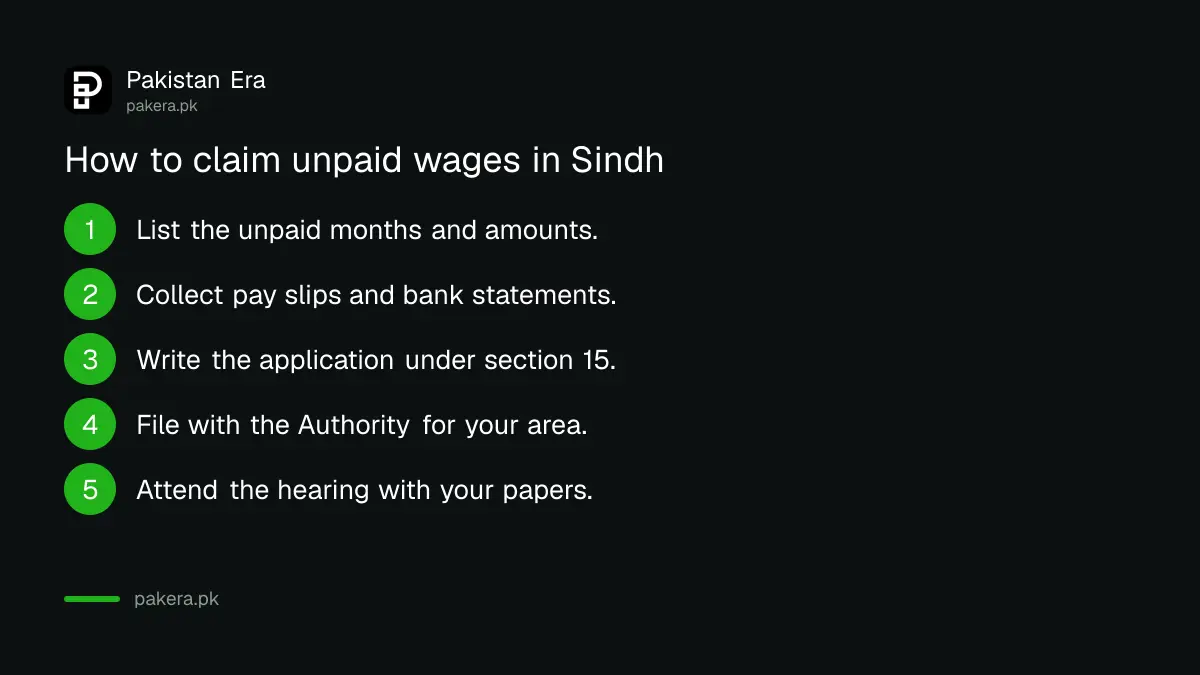
The claim is a written application to the Authority appointed for your area under section 15. You can file it yourself, through a lawyer, through an authorised union official, or through a labour inspector. Heirs of a worker who has died can file for the unpaid wages too.
- Write down each month that is unpaid or short, and the amount.
- Collect proof: appointment letter, pay slips, bank statements showing salary credits, attendance records, messages from the employer about pay.
- Find the Authority for your area through the Directorate General of Labour Sindh. Its page lists 021-99202608.
- Write the application: your name and job, the employer's name and address, the months and amounts, and any deduction you dispute.
- Ask for the unpaid wages and compensation under section 15(3).
- File it with the Authority, keep a stamped copy and note the hearing date.
- Attend the hearing with your papers. The employer is heard too.
Colleagues with the same unpaid months can file together. Section 16 allows one application for an "unpaid group" on the same establishment. The catch is that compensation is capped at ten rupees a head in a group case, so a worker with a large illegal deduction may do better filing alone.
The Authority can order payment and recover it from the employer
After hearing both sides, the Authority can order the employer to pay the delayed wages or refund the deduction, plus compensation of up to ten times the amount deducted. It has the powers of a civil court to summon witnesses and documents, and it can recover the money like arrears of land revenue.
No compensation is ordered for late wages if the delay came from a genuine dispute over the amount, a real emergency, or the worker's own failure to collect pay. The wages themselves are still owed.
A claim made in bad faith carries a risk. If the Authority finds an application malicious or vexatious, it can order the applicant to pay the employer up to Rs 5,000. Stick to the months and amounts you can prove.
Provident fund and gratuity dues delayed by an employer can go to the same Authority. How those benefits are calculated is set out under gratuity and provident fund rules in Pakistan. If your pay is below the legal floor, the current rate is in the Sindh minimum wage notification.
Appeals go to the Labour Court within 30 days
Either side can appeal the Authority's direction to the Labour Court set up under the Sindh Industrial Relations Act, 2013, within 30 days. An employer can appeal only after depositing the amount ordered. Without an appeal, the Authority's direction is final.
If you were dismissed rather than just left unpaid, the dismissal is a separate grievance, and the general rules are in job termination rules in Pakistan.
Common questions
How long do I have to claim unpaid salary in Sindh?
Three years from the date the wages were due, or from the date of the deduction. A later claim is allowed for sufficient cause.
When must a Sindh employer pay salary?
Before the seventh day after the wage period ends, or the tenth day where 1,000 or more people work.
Can an employer pay salary in cash in Sindh?
Section 6 says wages must be paid by crossed cheque or bank transfer, with a pay slip.
Do private school teachers and security guards count?
Yes. The Act names private schools, colleges and private security agencies as commercial establishments.
Can I claim unpaid gratuity at the same place?
Yes. Section 15 covers delayed provident fund and gratuity dues payable under any law.
Do I need a lawyer to file?
No. You can file yourself, or through an authorised union official or a labour inspector.
How we verified this
What we checked and where we read it.
Last checked 24 November 2026. We read the full text of the Sindh Payment of Wages Act, 2015 (Sindh Act No. VI of 2017) on the Sindh Code portal: sections 2 to 7 and 15 to 18. We also read the Directorate General of Labour Sindh page of the Labour and Human Resources Department, which lists adjudication of individual claims under this Act among its functions, and the contact number above.
Free on WhatsApp
Get last dates and rule changes on WhatsApp
We post new last dates, fee changes and fixes for common problems, a few short posts a day.
Follow Pakera on WhatsAppOther followers cannot see your number.
Pakera Solves It
Which online process wasted your time this week?
A portal that will not load, a form nobody explains, a complaint that went nowhere. Tell us. Every week we pick one, solve it step by step and publish the answer.
About the author

Tax, Bills and Technology Writer
Ali Akhtar is a young and curious voice here at Pakistan Era. He is currently pursuing his A-Levels and has a growing interest in Pakistan’s changing industrial landscape and educational trends. Ali likes to write in a way that helps him explain and explore the world around him. His writing reflects the perspective of the new generation navigating the evolving trends of Pakistan where technology, youth innovation, and shifting opportunities are reshaping the country’s future.