9C CNSA Punishment in Pakistan: Full Table for Charas, Heroin, Ice and Every Drug by Weight (2026)
9C CNSA punishment table for Pakistan after the 2022 amendment: jail and fine for charas, heroin, opium, cocaine and ice by weight, plus bail and parole rules.
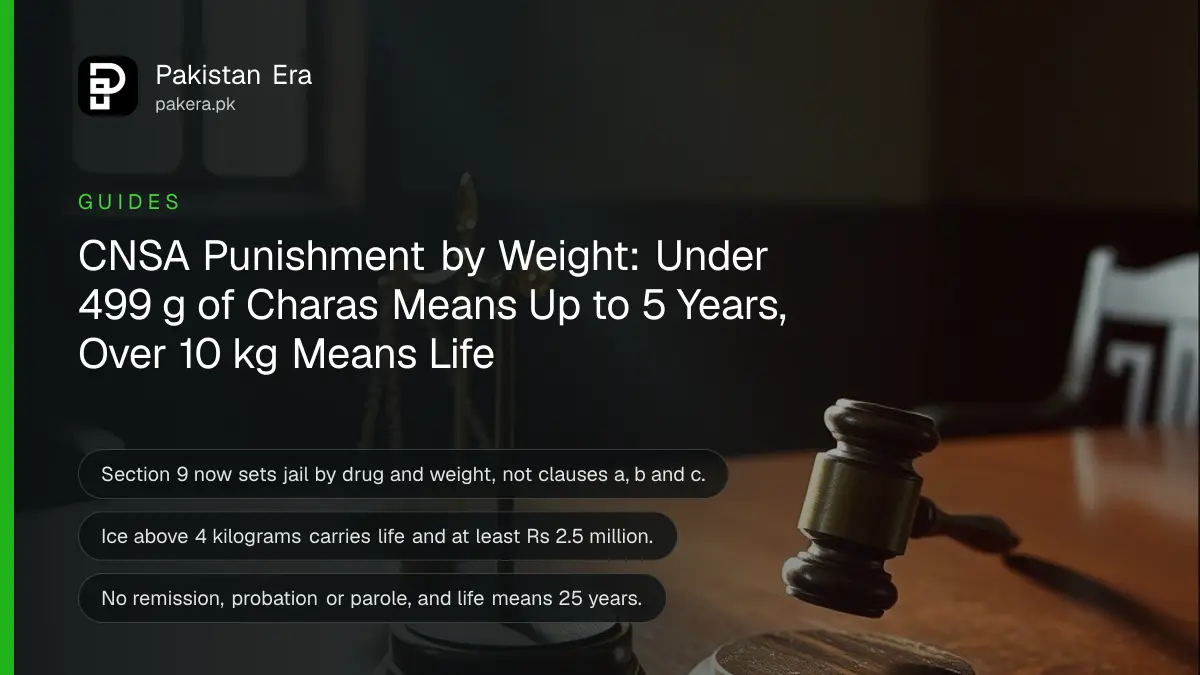
Under section 9 of Pakistan's Control of Narcotic Substances Act (CNSA), the punishment depends on the drug and its weight: up to 499 grams of charas carries up to 5 years, 10 kilograms or more carries life, and ice (methamphetamine) over 4 kilograms means life imprisonment. Below is the full quantity table for charas, heroin, opium, bhang, poppy straw, hashish oil, cocaine and ice, with the bail rule and what "9-C" on an FIR means today.
We read the CNSA, marked "Updated till 04.08.2023", on Pakistan Code, the Ministry of Law and Justice website, on 1 November 2026. Section 9 was replaced by the CNSA (Amendment) Act 2022 and changed again in 2023.
9-C is the old label; section 9 now works by quantity tables
Before 2022, section 9 graded offences in clauses (a), (b) and (c), and "9-C" meant the largest quantities. The 2022 amendment replaced that with three tables: 9(1) for narcotic drugs, 9(2) for psychotropic substances like ice, and 9(3) for controlled substances.
Many FIRs and most people still say "9-C". What matters now is the drug and the exact weight in the recovery memo, because each band has its own minimum and maximum sentence. The minimums are real: a court cannot go below them.
Charas and heroin punishment by weight
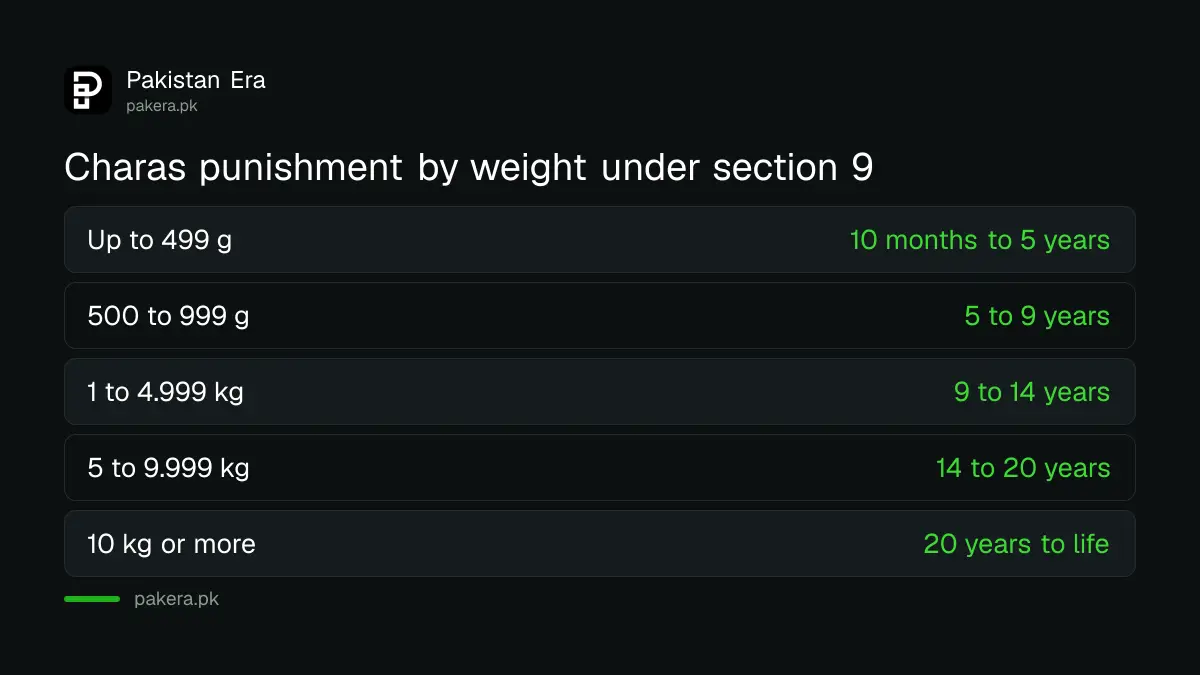
For charas, the bands start at up to 499 grams (up to 5 years, at least 10 months) and end at 10 kilograms or more (life, at least 20 years). For heroin and morphine, the first band is up to 99 grams, and 6 kilograms or more means at least life imprisonment.
| Drug and weight | Jail | Fine |
|---|---|---|
| Charas, up to 499 g | 10 months to 5 years | Up to Rs 40,000 |
| Charas, 500 to 999 g | 5 to 9 years | Rs 40,000 to Rs 80,000 |
| Charas, 1 to 4.999 kg | 9 to 14 years | Rs 80,000 to Rs 400,000 |
| Charas, 5 to 9.999 kg | 14 to 20 years | Rs 400,000 to Rs 800,000 |
| Charas, 10 kg or more | 20 years to life | At least Rs 800,000 |
| Heroin or morphine, up to 99 g | 18 months to 7 years | Up to Rs 25,000 |
| Heroin, 100 to 499 g | 7 to 10 years | Rs 25,000 to Rs 125,000 |
| Heroin, 500 g to 1.999 kg | 10 to 14 years | Rs 125,000 to Rs 500,000 |
| Heroin, 2 to 3.999 kg | 14 to 20 years | Rs 500,000 to Rs 1 million |
| Heroin, 4 to 5.999 kg | 20 years to life | Rs 1 million to Rs 1.5 million |
| Heroin, 6 kg or more | Not less than life | Rs 1.5 million to Rs 2 million |
Opium, bhang, poppy straw, hashish oil and cocaine
The same law has separate bands for five more narcotic drugs. Bhang has the lightest bands, starting at up to 3 years for under a kilogram. Cocaine is the heaviest: 100 grams or more already means at least 7 years.
| Drug | Lowest band | Highest band |
|---|---|---|
| Bhang | Up to 999 g: 6 months to 3 years | 20 kg or more: 14 years to life |
| Poppy straw | Up to 999 g: 8 months to 4 years | 15 kg or more: 14 years to life |
| Hashish oil | Up to 499 g: 14 months to 7 years | 5 kg or more: 20 years to life |
| Opium | Up to 499 g: 1 to 6 years | 8 kg or more: 20 years to life |
| Cocaine | Up to 99 g: 18 months to 7 years | 5 kg or more: life, at least 20 years |
Each band also carries a fine. For the top bands the minimum fine runs from Rs 200,000 (bhang) to Rs 2.5 million (cocaine).
Ice and other psychotropic substances
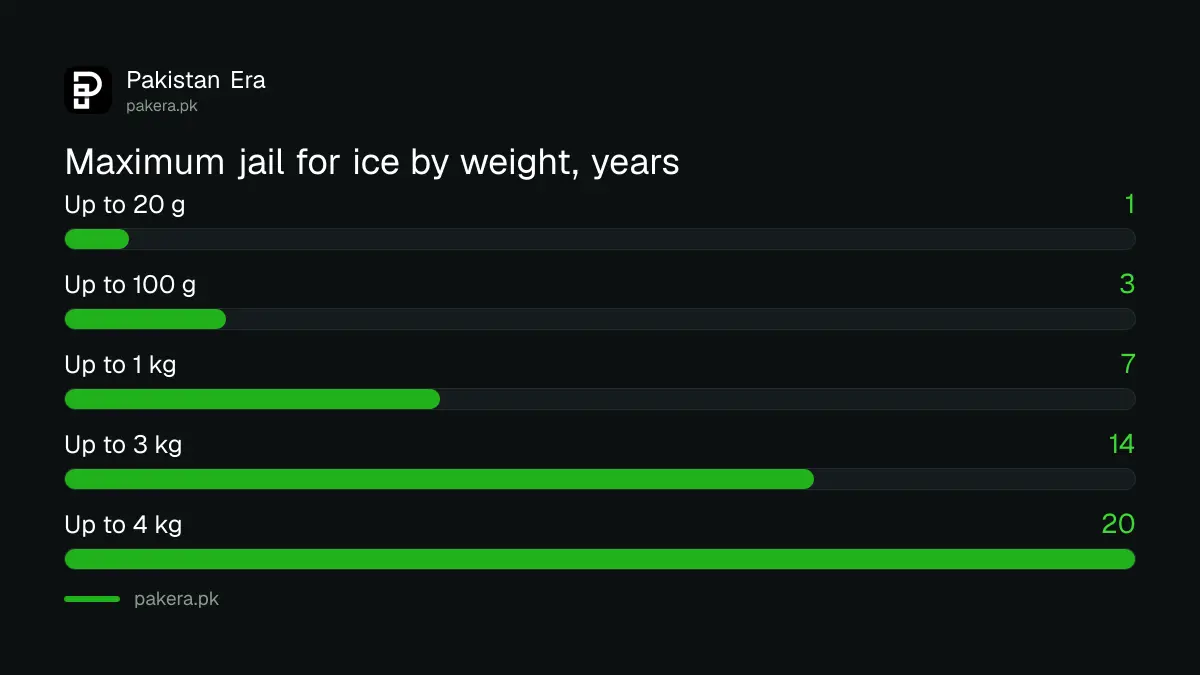
Section 9(2) covers psychotropic substances, including methamphetamine, known as ice. Up to 20 grams carries 2 months to 1 year. More than 4 kilograms carries at least life imprisonment. For ice above 4 kilograms, the law fixes life imprisonment and a fine of at least Rs 2.5 million.
| Weight | Jail | Fine up to |
|---|---|---|
| Up to 20 g | 2 months to 1 year | Rs 50,000 |
| More than 20 g to 50 g | 1 to 2 years | Rs 100,000 |
| More than 50 g to 100 g | 2 to 3 years | Rs 200,000 |
| More than 100 g to 500 g | 3 to 5 years | Rs 400,000 |
| More than 500 g to 1 kg | 5 to 7 years | Rs 800,000 |
| More than 1 kg to 2 kg | 7 to 10 years | Rs 1.2 million |
| More than 2 kg to 3 kg | 10 to 14 years | Rs 1.6 million |
| More than 3 kg to 4 kg | 14 to 20 years | Rs 1.8 million |
| More than 4 kg | Not less than life | At least Rs 2 million |
Schools, repeat offences and trafficking get the maximum
Section 9 adds three rules that push a sentence to the top of its band. An offence inside or near a school, college or university gets the maximum. A person with a previous CNSA conviction gets the maximum. Anyone convicted of trafficking into or out of Pakistan gets the maximum.
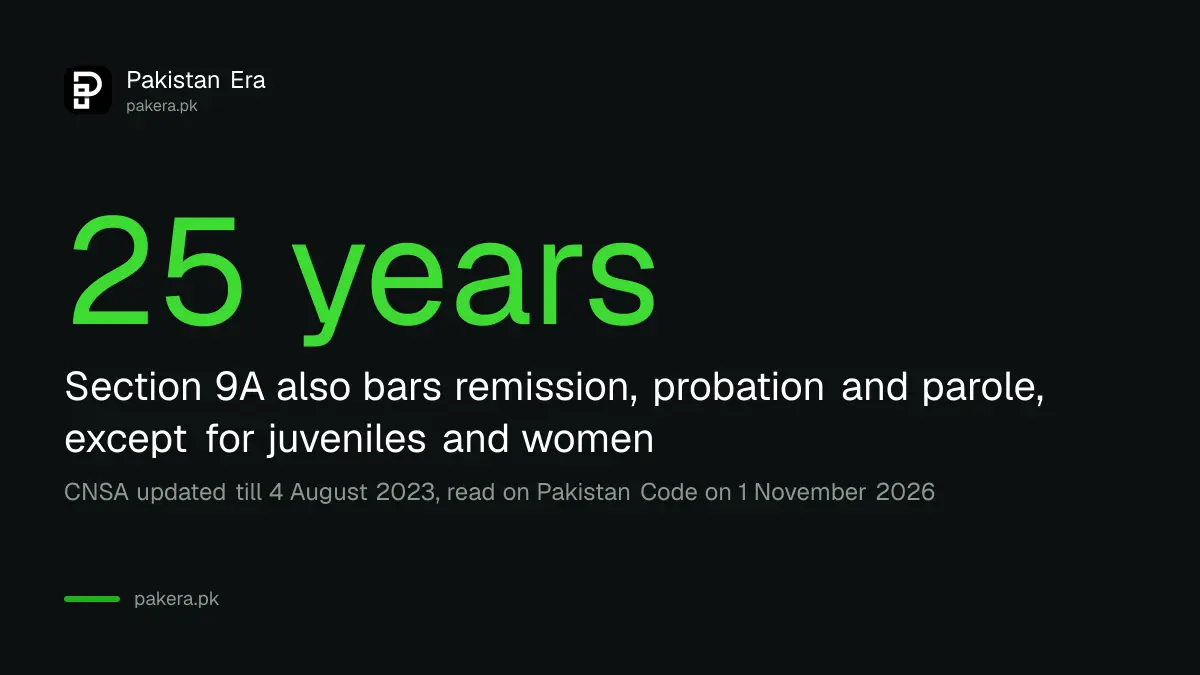
Section 9A then closes the usual exits. No remission is allowed on a CNSA sentence. Probation and parole are not allowed. Both rules have an exception for juveniles and women. And "life imprisonment" under the CNSA means 25 years in jail, not the shorter period sometimes assumed.
Bail in a narcotics case is harder than in a PPC case
Section 51 of the CNSA says bail shall not be granted for a CNSA offence punishable with death. For other CNSA offences, bail "shall not be normally granted" unless the court thinks it a fit case, and then against security of a substantial amount. That is stricter than for most offences in the PPC sections list, where courts weigh only the ten year bar.
Cases go to a Special Court under section 46. Offences carrying two years or less go to a Special Court of a judicial magistrate. All others go to a Special Court of a Sessions or Additional Sessions Judge. An appeal from a Sessions-level Special Court goes to the High Court, before at least two judges. Police can hold an accused for investigation for up to 90 days, with remand of up to 15 days at a time (section 49A).
- Get a copy of the FIR and the recovery memo, and note the exact weight.
- Find the drug and weight band in the tables above.
- Check whether the case is before a magistrate or a Sessions-level Special Court.
- Ask a lawyer to check the sample and the chemical examiner's report.
- Apply for bail with a surety ready.
The weight band is the single most important fact in the case, which is why defence lawyers look hard at how the sample was weighed and sent for testing. How general bail works is explained in getting bail in Pakistan, and children arrested in such cases have extra protections, set out in the rights of an arrested child.
Common questions
What is the punishment for 9C CNSA?
"9-C" is the old label for the largest quantities. Under the current tables, charas of 10 kilograms or more carries 20 years to life, and heroin of 6 kilograms or more carries at least life imprisonment.
What is the punishment for 1 kg of charas?
One to 4.999 kilograms of charas carries 9 to 14 years in jail and a fine of Rs 80,000 to Rs 400,000.
What is the punishment for ice in Pakistan?
It depends on weight, from 2 months to 1 year for up to 20 grams to at least life imprisonment above 4 kilograms. Ice above 4 kilograms means life and a fine of at least Rs 2.5 million.
Is bail possible in a CNSA case?
Yes, but it is not normally granted. Section 51 lets the court grant it only in a fit case, against substantial security. It is barred where the offence carries death.
Does a CNSA prisoner get remission?
No. Section 9A bars remission, probation and parole, except for juveniles and women. Life imprisonment means 25 years.
How we verified this
What we checked, where we read it, and what we could not confirm.
We read sections 4 to 18, 45 to 51 of the Control of Narcotic Substances Act 1997, as updated to 4 August 2023, on pakistancode.gov.pk on 1 November 2026. Provinces can make their own narcotics laws, and a case registered by provincial police may be charged under one; we did not read any provincial Act. The wording of the pre-2022 section 9 is described from its well-known structure, not from a text we read. This page is a reference, not legal advice.
About the author

Global Affairs & Political Economy Writer
Muhammad Hatim is a book lover who started writing because he enjoys it. At Pakistan Era he writes about international relations, geopolitics and the global economy, with a particular interest in South Asia and the forces behind current events.