Pakistan's 2027 Power Purchase Price Forecast Is Rs 27.31 a Unit, NEPRA Hears It on 3 November
CPPA-G forecasts the 2027 power purchase price at Rs 27.309 a unit, with six cases from Rs 25.88 to Rs 29.26. NEPRA hears it on 3 November. See what it means.
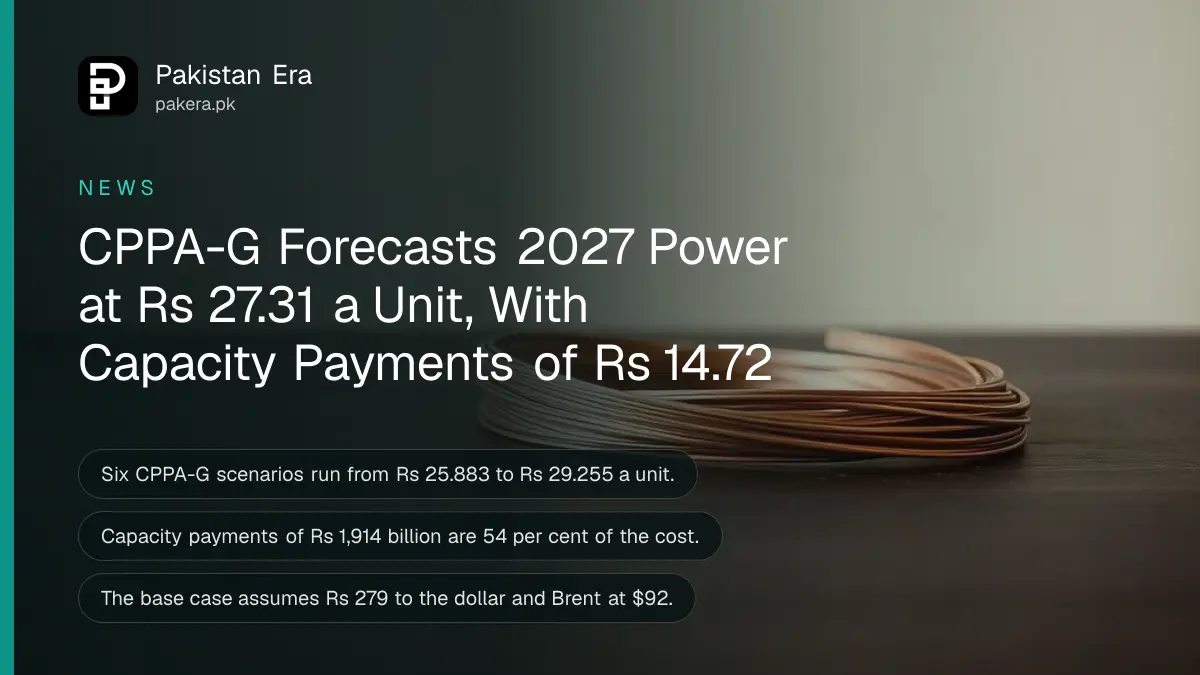
Short answer: CPPA-G has told NEPRA that power will cost distribution companies Rs 27.309 a unit on average in 2027 under its base case. Its six scenarios run from Rs 25.883 to Rs 29.255. NEPRA will hear the forecast on Tuesday, 3 November 2026, at 2:00 pm. The figure feeds the electricity tariff that resets on 1 January 2027.
The Central Power Purchasing Agency (CPPA-G) buys electricity from power plants on behalf of the ex-WAPDA distribution companies. Its forecast of the power purchase price (PPP), what that electricity will cost, is the biggest single input to your unit rate. NEPRA posted the hearing notice and the 21 page CPPA-G report on its website on 19 October 2026. We read both.
CPPA-G's base case puts 2027 power at Rs 27.309 a unit
In the base case, CPPA-G expects to sell 130,081 million units in 2027 for Rs 3,552 billion. That works out to Rs 27.309 a unit. It assumes demand grows 2.6 per cent, the dollar costs Rs 279 and Brent crude averages $92 a barrel.
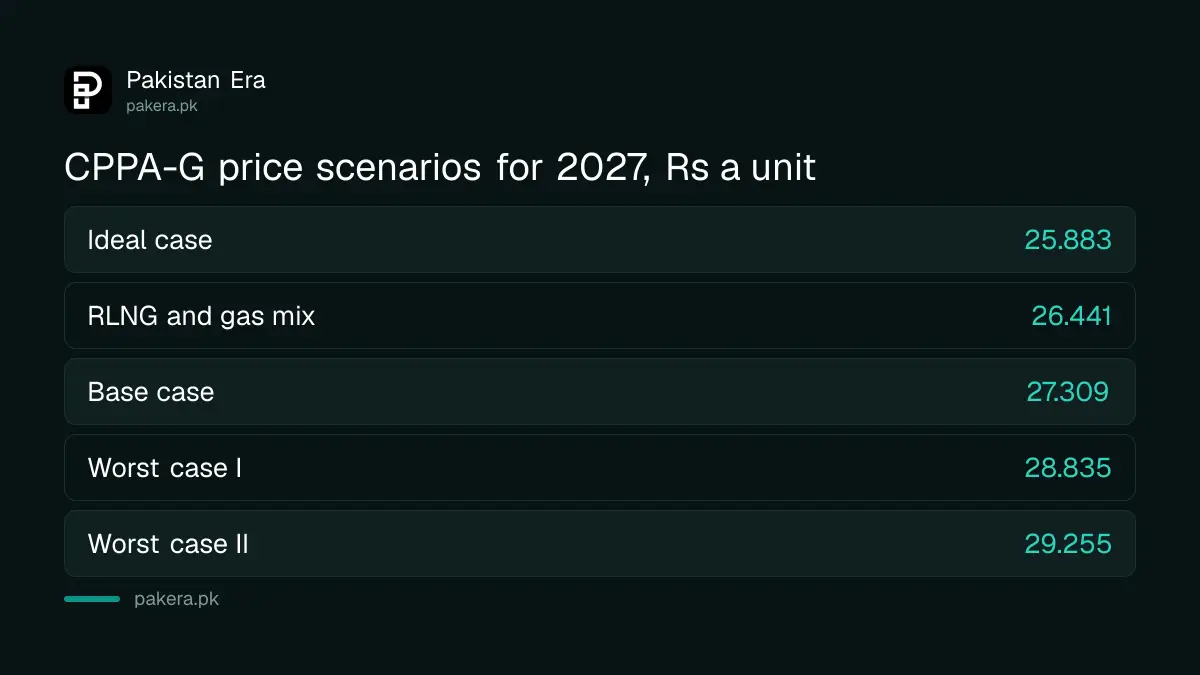
| Scenario | Rupee to dollar | Brent, $ a barrel | RLNG, $ per MMBTU | Power purchase price, Rs a unit |
|---|---|---|---|---|
| Ideal case | 279 | 70 | 15.12 | 25.883 |
| RLNG and local gas mix | 279 | 92 | 15.05 | 26.441 |
| Base case | 279 | 92 | 19.96 | 27.309 |
| Low demand, 0.7% growth | 279 | 92 | 19.96 | 27.568 |
| Worst case I | 290 | 110 | 22.19 | 28.835 |
| Worst case II | 290 | 118 | 23.61 | 29.255 |
Every scenario uses KIBOR of 11.70 per cent, local inflation of 8.2 per cent and grid losses of 2.5 per cent. RLNG is imported liquefied natural gas. The gap between the best and worst case is Rs 3.372 a unit, which shows how much rides on oil prices and the rupee.
Capacity payments make up Rs 14.717 of every unit
More than half the base case price is capacity payments, the fixed sums owed to power plants whether they run or not. CPPA-G puts these at Rs 1,914 billion for 2027, or Rs 14.717 a unit. Fuel adds Rs 10.141, other running costs Rs 0.543 and grid charges Rs 1.909.
| Part of the base case price | Rs billion | Rs a unit | Share |
|---|---|---|---|
| Capacity charges | 1,914.4 | 14.717 | 53.9% |
| Fuel cost | 1,319.1 | 10.141 | 37.1% |
| Transmission and market charges | 248.3 | 1.909 | 7.0% |
| Variable running costs | 70.6 | 0.543 | 2.0% |
| Total | 3,552.4 | 27.309 | 100% |
Capacity cost barely moves between scenarios. CPPA-G says it depends on the exchange rate, interest rates and inflation, not on fuel. A weaker rupee at Rs 290 adds Rs 47 billion, or 2.46 per cent. The same split for this year is explained in what a unit costs in fuel and capacity.
Winter units would cost Rs 36.47, summer units Rs 22.90
The monthly forecast swings widely. In the base case, January 2027 power costs Rs 36.471 a unit and August Rs 22.897. The reason is simple: capacity payments are roughly fixed each month, so they weigh far more on each unit when winter demand is low.
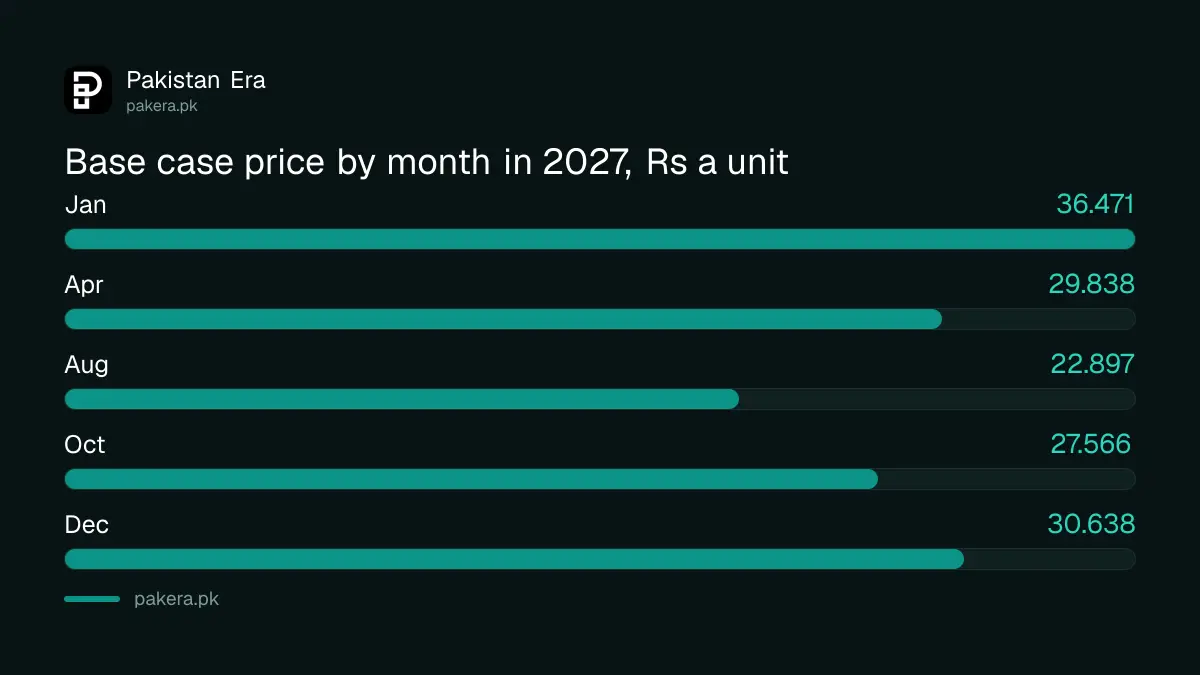
January's capacity charge alone is Rs 18.453 a unit on 8,963 million units. In July, with 14,860 million units sold, it falls to Rs 11.552. For households this is mostly hidden, because NEPRA sets monthly references and the uniform tariff evens the year out. But it explains why winter fuel charges are often bigger.
CPPA-G assumes the 2026 fuel shortages end
The base case assumes no power cuts for lack of fuel in 2027. CPPA-G's report says load management because of fuel constraints cost about 1,254 million units from March to August 2026. If those constraints continue, it expects demand growth of only 0.7 per cent.
The report is blunt about the risk. It says the Middle East war made fuel forecasts unreliable, and it notes Brent rose from about $69 a barrel in February 2026 to about $127 by end-March. It asks NEPRA to consider updating the references during the year if fuel prices swing. It also says data on net metering and captive plants is still awaited from the distribution companies.
NEPRA hears the forecast on 3 November, before the 1 January reset
NEPRA's hearing is on 3 November 2026 at 2:00 pm at NEPRA Tower and on Zoom. Anyone affected can file written or spoken comments. NEPRA then sets the monthly PPP references used to rebase the consumer tariff from 1 January 2027.
The power purchase price is one part of the tariff. The distribution companies' own costs were heard on 13 to 15 October, set out in each company's 2027 revenue request. The steps from here, as far as the documents show, are:
- CPPA-G filed the forecast on 12 October 2026, after NEPRA asked for it on 17 September.
- NEPRA hears it on 3 November 2026.
- NEPRA decides the PPP references and each company's revenue for 2027.
- The federal government files its uniform tariff motion, and NEPRA rules on it.
- The rebased tariff applies from 1 January 2027 once notified.
For context, NEPRA's decision of 12 January 2026 on this year's tariff records a generation cost of Rs 28.88 per unit sold to consumers. That is measured after line losses, while CPPA-G's Rs 27.309 is per unit sold to the companies, so the two are not a like for like comparison. Who will qualify for targeted help from January is covered in the BISP-based electricity subsidy.
Common questions about the 2027 power purchase price
Does Rs 27.309 mean my unit rate will be Rs 27.31?
No. It is the cost of buying power. Your tariff adds distribution costs, losses, past adjustments and taxes, and slabs differ by category.
When will NEPRA hear the 2027 forecast?
On Tuesday, 3 November 2026, at 2:00 pm at NEPRA Tower in Islamabad and online on Zoom.
Why are capacity payments so large?
Power plant contracts promise fixed payments for available capacity. CPPA-G puts them at Rs 1,914 billion in 2027, more than half the total cost.
Does the forecast cover K-Electric?
CPPA-G's demand tables include K-Electric's supply from the national grid. The hearing is on the consumer tariff of the ex-WAPDA companies.
What would make 2027 power dearer?
A weaker rupee and higher oil and gas prices. At Rs 290 to the dollar and $118 Brent, CPPA-G's worst case reaches Rs 29.255 a unit.
Can the references change during 2027?
CPPA-G has asked NEPRA to consider updating them if fuel prices swing. Monthly fuel charges already adjust bills for the gap.
How we verified this
What we checked, where we read it, and what we could not confirm.
Last checked 20 October 2026. The scenarios, assumptions, cost split, monthly figures and hearing date come from NEPRA's notice of hearing on the projected power purchase price for January to December 2027 and the CPPA-G report "Power Purchase Price Forecast CY 2027" with its covering letter of 12 October 2026, both posted on NEPRA's website on 19 October 2026. The Rs 28.88 figure comes from NEPRA's decision of 12 January 2026 on the federal government's tariff motion, listed on NEPRA's tariff page. Shares and the scenario gap are our arithmetic. We could not find a NEPRA timetable for its 2027 decision or the tariff notification.
About the author

Global Affairs & Political Economy Writer
Muhammad Hatim is a book lover who started writing because he enjoys it. At Pakistan Era he writes about international relations, geopolitics and the global economy, with a particular interest in South Asia and the forces behind current events.