Check What a Unit of Electricity Costs in Pakistan: Rs 9.04 for Fuel, Rs 14.21 for Capacity
NEPRA says grid power cost Rs 9.04 a unit in fuel and Rs 14.21 in capacity fees in 2024-25. See why the fixed part is bigger and find the fuel line on your bill
Short answer: NEPRA's State of the Industry Report 2025 says power bought for the main grid cost Rs 9.04 a unit in fuel and running cost in 2024-25, and another Rs 14.21 a unit in capacity payments. So the fixed part was the bigger part. You pay it whether or not the plant runs.
A unit of electricity is one kilowatt hour, the number on your meter. Your bill puts a price on every unit, but the price is built from several costs. Two of them come from the power stations themselves. One is for fuel and the other is for being ready to run.
We downloaded NEPRA's State of the Industry Report 2025 from nepra.org.pk on 14 October 2026 and read its generation chapters. It covers the financial year to June 2025. Every figure below is from that report unless we say it is our own sum.
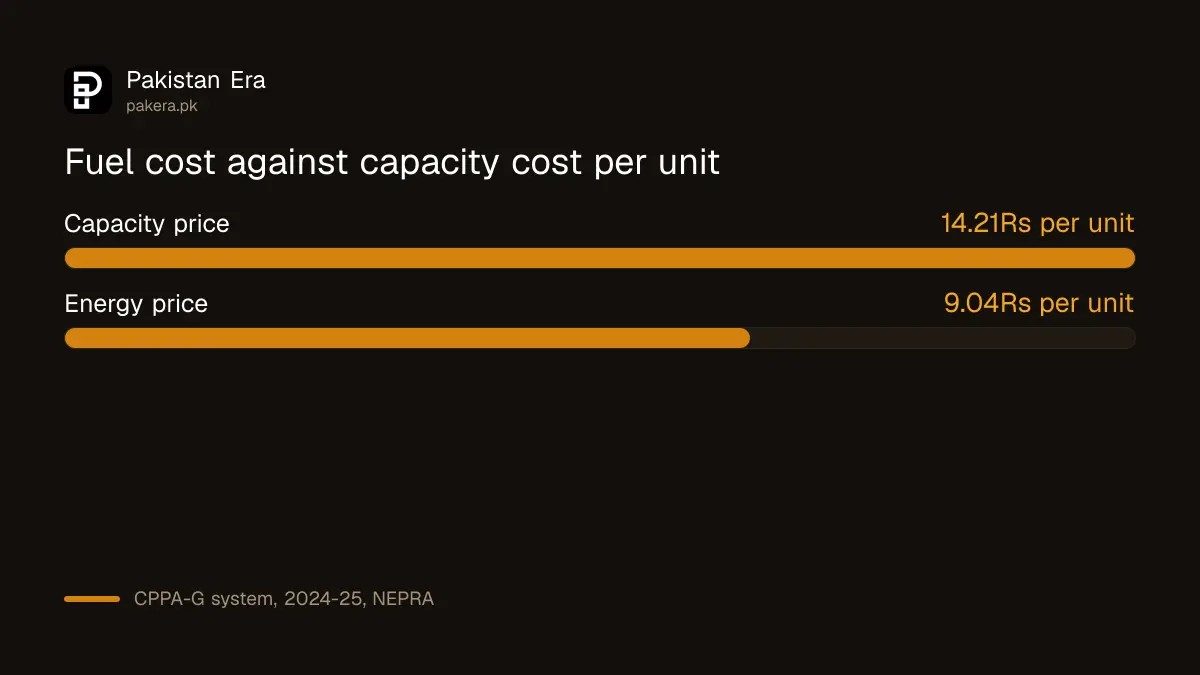
Fuel and running cost was Rs 9.04 a unit in 2024-25
The report calls this the Energy Purchase Price, or EPP. For the main grid run by the Central Power Purchasing Agency (CPPA-G), it averaged Rs 9.04 a unit in 2024-25. That was down from Rs 9.37 the year before, and well under the Rs 10.94 NEPRA had projected.
EPP is the cost of fuel and other costs that arise only when a plant runs. A solar panel or a wind turbine has no fuel bill, so its EPP is close to zero. The report puts the renewable average at Rs 0.74 a unit, against Rs 13.54 for thermal plants, meaning plants that burn gas, coal or oil.
Capacity payments added Rs 14.21 a unit
The second cost is the Capacity Purchase Price, or CPP. It averaged Rs 14.21 a unit on the main grid in 2024-25. That was Rs 0.77 lower than in 2023-24. It is the fixed fee paid to a power plant for being available, whatever the grid asks it to produce.
The report gives the total as Rs 1,807.40 billion. Thermal plants took Rs 1,242.70 billion and renewable plants, including dams, took Rs 564.70 billion. Divide that by the 127,159 gigawatt hours the grid bought, and you get our own check of about Rs 14.21 a unit. NEPRA elsewhere rounds the average to Rs 15.
| Part of the power price | Per unit, 2024-25 | When you pay it |
|---|---|---|
| Energy price (fuel and running cost) | Rs 9.04 | Only when plants run |
| Capacity price (fixed fee) | Rs 14.21 | Always |
| Both together | Rs 23.25 | Our sum |
The Rs 23.25 total is our own addition of the two averages. NEPRA does not print it as a single line. It also does not include line losses, wires, taxes or the other items on your bill.
Why the fixed part is so large
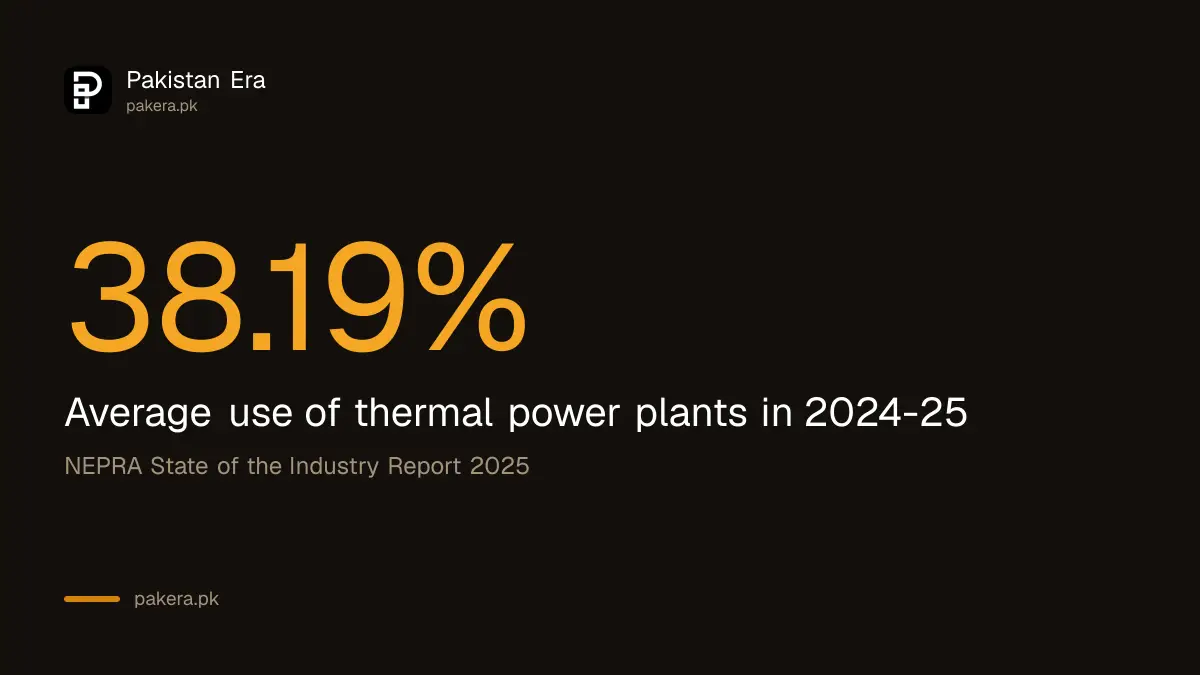
NEPRA says the cause is low use of the plants Pakistan has already contracted. Many were signed on "take or pay" terms. The buyer pays the fixed fee even if it takes no power. Thermal plants ran at an average 38.19 per cent of their capacity in 2024-25.
The report says capacity payments become cheap per unit when a plant runs most of the time and expensive when it sits idle. Spread over fewer units, the same fixed fee costs more for each one. That is the reason the capacity price is above the fuel price. The wider picture is in our report on why Pakistan still has load shedding.
Wind and solar plants carry high capacity charges
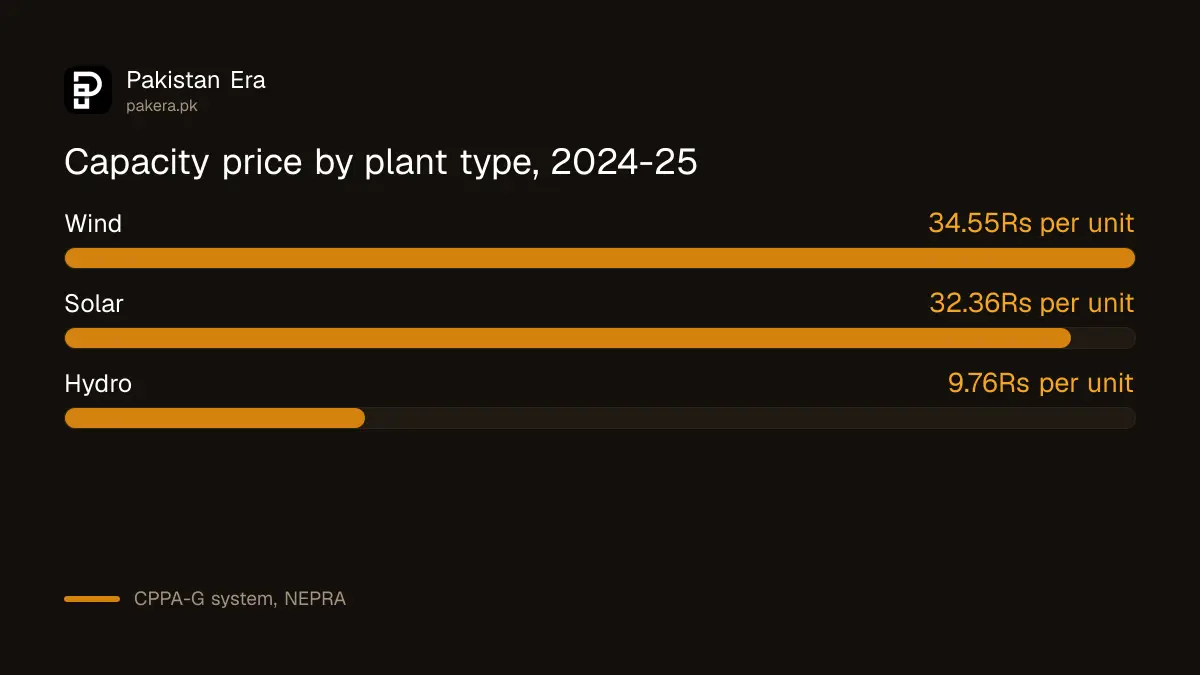
NEPRA lists the capacity price by type for the main grid in 2024-25. Hydro was Rs 9.76 a unit, wind Rs 34.55 and solar Rs 32.36. The report says many renewable plants supplied power at up to Rs 49 a unit in total, while some thermal plants that could generate at Rs 20 to Rs 25 in fuel cost stayed idle.
The reason, the report says, is that renewable plants have "must run" status. The grid has to take their power first. That pushes cheaper thermal plants down the order. This is NEPRA's view of the market, and it is the regulator's own criticism of how the system was planned.
Karachi's figures are different
K-Electric makes much of its own power. NEPRA puts K-Electric's own fleet at Rs 23.36 a unit for energy in 2024-25, down Rs 4.03, with capacity at about Rs 8.33. K-Electric buys more from the national grid than before, which explains the fall. Karachi customers still pay the national rate, as we explain in K-Electric's uniform tariff.
Check what this means for your own bill
The power price is only one slice of what you pay. NEPRA says generation is 82 per cent of the total cost of the sector. The rest covers line losses, wires, supplier margins, market fees and past-year adjustments. Use these steps to find the fuel part on your own bill.
- Find the units you used this month on your bill.
- Find the line called fuel price adjustment, or FCA. It is the gap between the fuel cost built into your tariff and what fuel actually cost.
- Compare it with NEPRA's monthly decision, such as the Rs 1.1086 a unit set for October bills.
- Multiply the per-unit charge by your units to see the rupee amount.
- If it does not match, ask your company for a check, or follow the steps to check your electricity bill online.
Your tariff slab sets the base rate. The slab rates for 2026 are in our guide to electricity unit prices by slab. And part of every bill pays for units that never reach a meter, which we cover in each company's line losses.
Common questions
What is the average cost of electricity generation in Pakistan?
On the main grid, NEPRA reports Rs 9.04 a unit for energy and Rs 14.21 for capacity in 2024-25. Together that is about Rs 23.25 a unit before losses, wires and taxes.
What is a capacity payment?
It is a fixed fee paid to a power plant for being ready to produce. The buyer pays it even if the plant produces nothing. NEPRA calls it the Capacity Purchase Price.
Why is the capacity price so high?
NEPRA says plants are underused. Thermal plants ran at 38.19 per cent of capacity in 2024-25, so the fixed fee is spread over few units and costs more for each one.
Is the fuel part of my bill the same as the capacity part?
No. The fuel part moves each month and shows on your bill as the fuel charge adjustment. The capacity part is fixed in contracts and sits inside your base tariff.
Do Karachi customers pay different power costs?
K-Electric's own plants cost Rs 23.36 a unit for energy in 2024-25. Customers still pay the same national tariff as the rest of the country.
How we verified this
What we checked, where we read it, and what we could not confirm.
Last checked on 14 October 2026. We read NEPRA's State of the Industry Report 2025, chapter 2 on the power sector and chapter 3 on generation, from the PDF on nepra.org.pk. The report shows no publication date, so we cannot say how new it is. The Rs 23.25 total and the 127,159 GWh division are our own sums. We did not check how any of these costs reach a bill after tariff decisions, and we did not read the capacity payment contracts.
About the author

Global Affairs & Political Economy Writer
Muhammad Hatim is a book lover who started writing because he enjoys it. At Pakistan Era he writes about international relations, geopolitics and the global economy, with a particular interest in South Asia and the forces behind current events.