Dalda Foundation Scholarship in Pakistan: Apply After Matric by 30 October
The Dalda Foundation scholarship needs 80% in matric and a government college. It covers 80 to 85% of costs. How to apply online or on paper before 30 October.
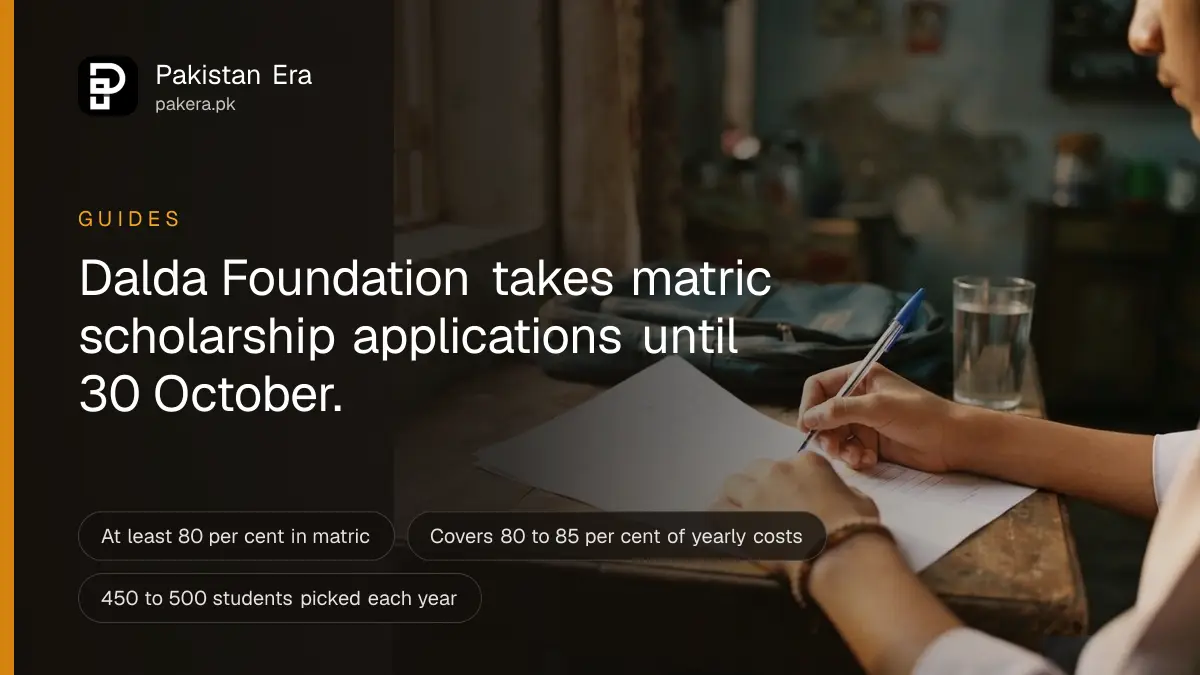
The Dalda Foundation scholarship is for students who got at least 80 per cent in matric, come from a low-income family and join a government college. The foundation says it takes applications every year from 15 July to 30 October. You register at daldafoundation.pk/register or send a paper form through your college.
One correction first, because many people search for it as a university scholarship. The Dalda Foundation Trust (DFT) picks its students after matric. It then supports them from intermediate through university, as long as they keep up their results. Its own pages describe no separate route for a student who is already at university.
We read every scholarship page on daldafoundation.pk on 27 September 2026: the process to apply, the screening criteria, the education page and the about page. We also opened the student registration form, but did not submit it. Dalda Foods' own sustainability page confirms that the company set up the trust.
Who the Dalda Foundation scholarship is for
The scholarship is for talented students from poor families across Pakistan. DFT asks for at least 80 per cent marks in matric, admission to a government college or university, and family income and home property within its own limits. It says it gives particular consideration to girls.
The foundation does not publish its income or property limits. Instead, its application form asks detailed questions about your family's money, and a DFT team checks the answers. So you cannot work out in advance whether you pass on income. You find out through the screening.
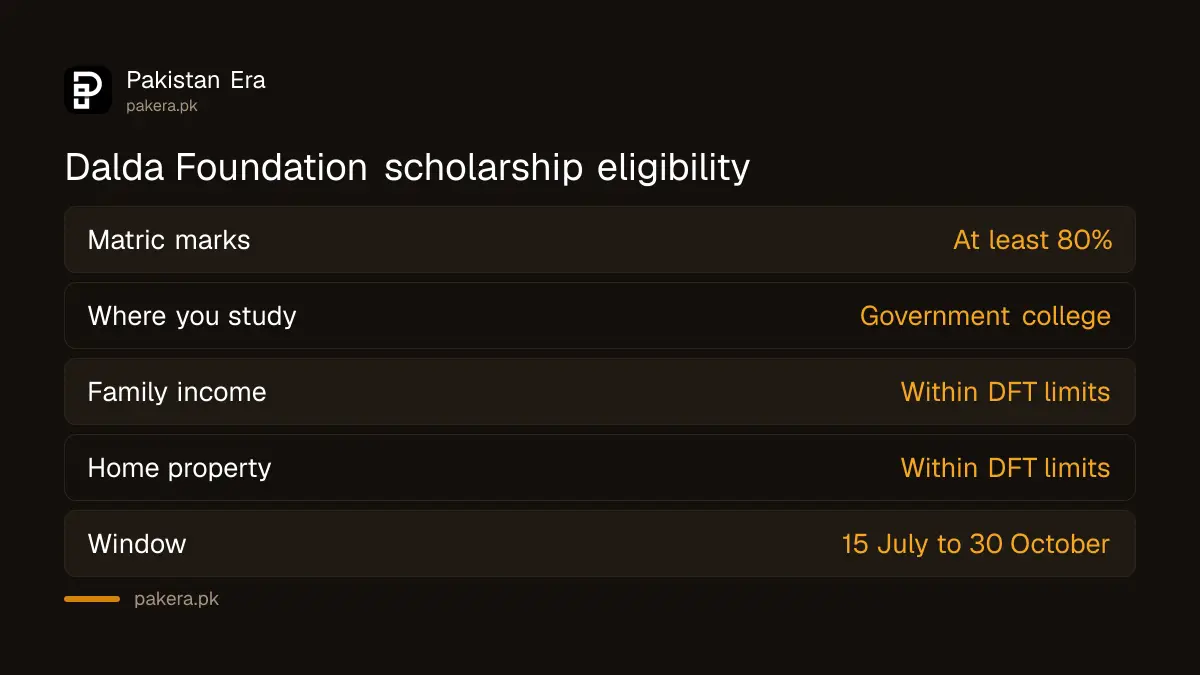
| Requirement | What DFT's own pages say |
|---|---|
| Matric marks | At least 80 per cent |
| Where you study | A government college or university |
| Family income | Within DFT's limits (not published) |
| Home property | Within DFT's limits (not published) |
| Application window | Every year, 15 July to 30 October |
Some notices shared online give a lower bar, 70 per cent, for arts and DAE students. We did not find that on the foundation's own site, which says 80 per cent. If you are between 70 and 80 per cent, ask the foundation before you post a form.
Dalda also runs a separate scheme for the families of its own daily wage and service staff. That scheme is not open to the public.
What the Dalda scholarship pays
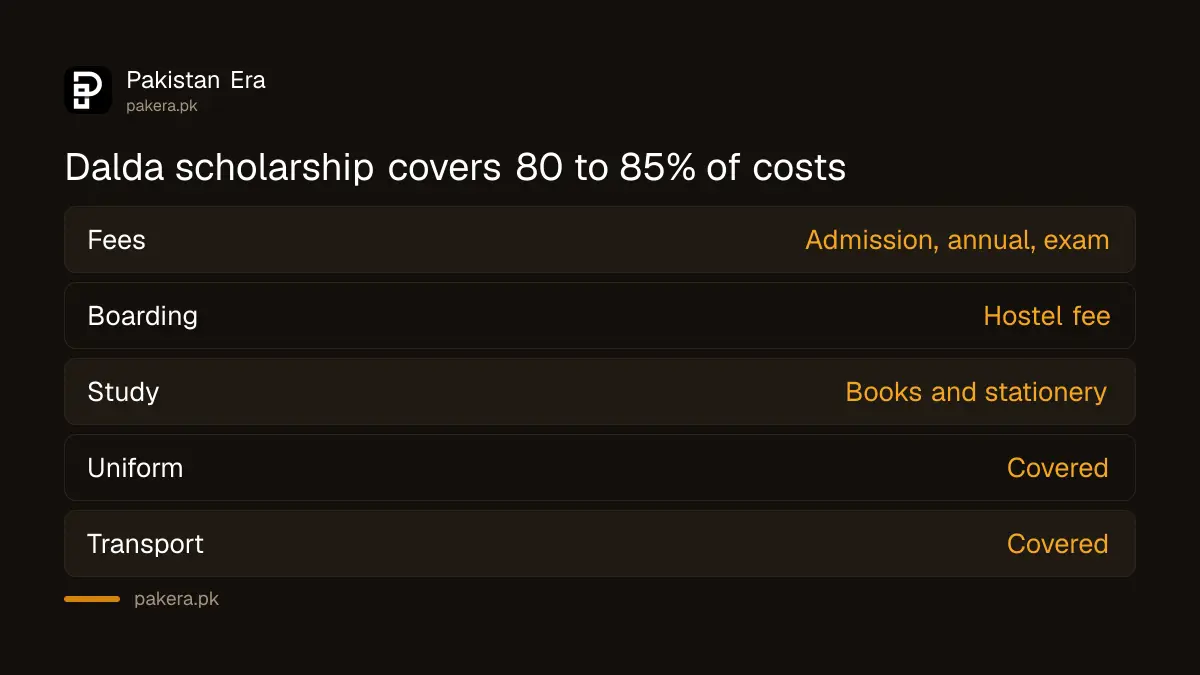
DFT pays 80 to 85 per cent of a student's yearly study cost at a government institution. It works out that cost every year from a survey of colleges and universities in each province. The payment covers fees, boarding, books, uniform and transport, not tuition alone.
The foundation lists five parts of the cost it covers:
- Admission, annual and examination fees
- Boarding fee, if you live in a hostel
- Books and stationery
- Uniform
- Transport
DFT does not publish a fixed rupee amount. That makes sense, because the cost of an FSc year in Quetta is not the cost of an engineering year in Lahore. Be careful with any poster that promises a set sum per month; it did not come from the pages we read.
The support does not stop at intermediate. The foundation says it builds a path from matric to post-graduation. To keep it, you must reach the required marks in your intermediate exams and then move on to the next level, such as a professional degree.
How to apply for the Dalda Foundation scholarship
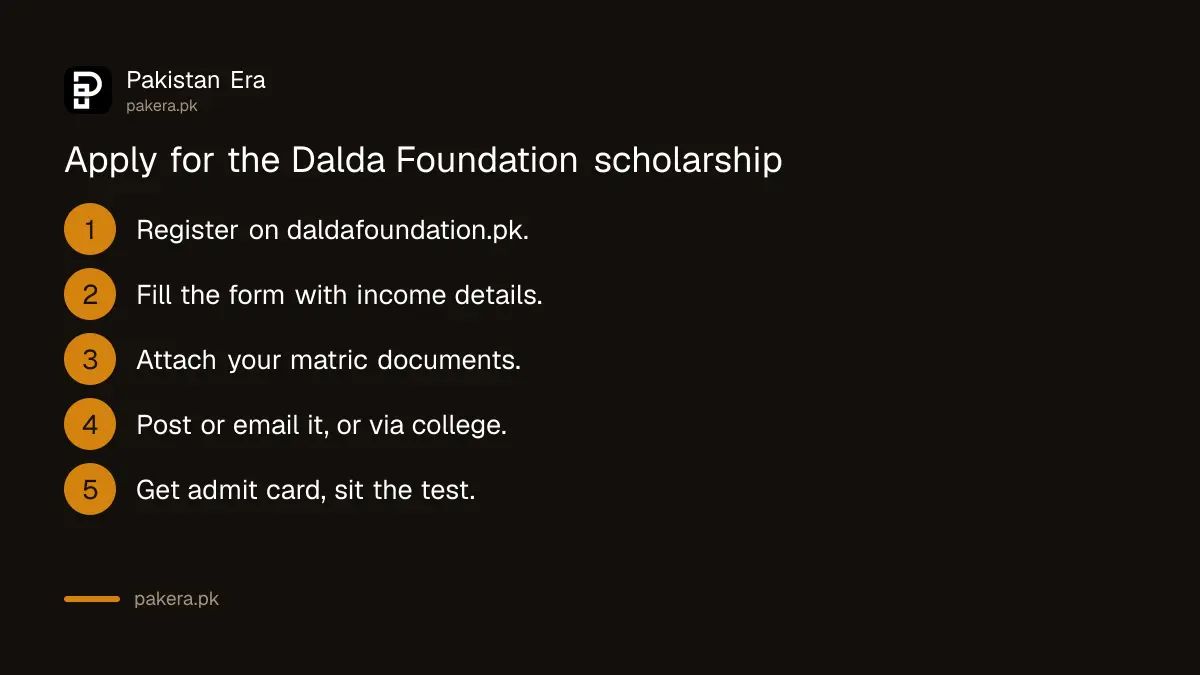
You can apply online by registering on daldafoundation.pk, or on paper. DFT puts scholarship posters in colleges and sends forms to them. Your college can post the form for you, or you can post or email it yourself with copies of your educational documents.
- Open daldafoundation.pk, click "Sign up now" and choose "I am a student and want to apply for scholarships".
- Register with your name, father's name, email, a password, date of birth and postal address.
- Fill the application form fully, including the family income questions, and attach your matric result and other educational documents.
- If you use a paper form, hand it to your college administration to post, or send it yourself by post or email.
- Wait for your admit card. DFT posts it to approved applicants with your name, roll number and test centre.
Use a postal address where someone will actually receive mail. The admit card comes by post, and you cannot enter the test without it. Keep a copy of everything you send.
The foundation's free lines are 0331 0107922 and 0331 1200897, working hours 9:00 to 17:00. Its email is info@daldafoundation.pk, and complaints go to complaint@daldafoundation.pk.
How DFT selects its scholars
DFT shortlists from the forms, then holds a written test at about 26 centres across the country. Students who pass are interviewed. The final list is checked again at the head office in Karachi. It selects 450 to 500 students a year.
About 400 of those places are funded by DFT itself, and the rest by outside donors. Selection mixes two scores. In most years, the foundation says, your board marks count for 60 per cent and its own written test for 40 per cent.
It also balances merit against region. Half the places usually go on merit and half on a quota linked to each area's population, so a strong student from a small district still has a chance. Places funded by outside donors are purely on merit.
The competition is heavy. The foundation says applications have gone above 50,000 in a year for 400 to 500 places. Its home page counts more than 5,665 scholarships awarded so far. Students who do not win a place are guided towards technical and vocational courses, such as IT, electrical work and medical sales training.
The 2026 round and what to prepare
DFT says its round runs every year from 15 July to 30 October, so the 2026 window should close on 30 October 2026. The registration form was working when we checked on 27 September. The site did not show a dated 2026 notice, so confirm on the free line.
That timing follows the matric results, which is why the round opens in July. If you are still choosing a group, the choice between FSc, ICS or DAE matters here too, because the scholarship follows you through intermediate and into a degree.
Before you apply, gather these:
- Matric result card or detailed marks certificate
- CNIC copies of your parents, and your own B-Form
- Proof of family income, such as a salary slip or an employer letter
- Proof of your admission to a government college, once you have it
- A postal address and a phone number that someone answers
The foundation does not publish its full document list. These are what its income and education questions will ask about, so have them ready rather than stopping halfway through the form.
Other schemes cover different stages. In Punjab, the Honhaar scholarship helps students once they are at university. The federal BISP undergraduate scholarship, formerly Ehsaas, is need-based and paid through universities. Later, some Dalda scholars have gone on to Fulbright and Chevening, and graduates can look at the Commonwealth scholarship through HEC for a master's abroad.
Common questions
What is the last date for the Dalda Foundation scholarship 2026?
The foundation says its yearly window closes on 30 October. It had not posted a separate dated notice for 2026 when we checked on 27 September 2026.
Can university students apply for the Dalda scholarship?
The foundation's pages describe selection after matric only. Its scholars carry the support into university. We found no separate entry route for students already at university.
How many marks do I need in matric?
At least 80 per cent, according to the foundation's process page. You also need a place at a government college.
How much money does the Dalda scholarship give?
It covers 80 to 85 per cent of your yearly cost at a government institution, including fees, boarding, books, uniform and transport. There is no fixed published amount.
Is there a test for the Dalda Foundation scholarship?
Yes. Approved applicants get an admit card by post and sit a written test at one of about 26 centres, followed by an interview.
Can I apply on paper instead of online?
Yes. Forms go to colleges, and your college can post yours, or you can send it by post or email yourself.
How we verified this
What we checked, where we read it, and what we could not confirm.
Last checked on 27 September 2026. The 80 per cent matric requirement, government institution rule, income and property condition, the 15 July to 30 October window, the application and admit card steps are read on the Dalda Foundation Trust's process to apply page. The test centres, interviews, 450 to 500 places, the 60:40 and 50:50 weightings and renewal rules are on its screening criteria page. The 80 to 85 per cent cost cover and what it includes are on its education page. The 50,000 applications figure is on its about page and the scholarship count on its home page. The registration form fields are read on daldafoundation.pk/register; we did not submit it. Dalda Foods' sustainability page confirms the company set up the trust. The foundation does not publish its income limits, a fixed amount or a dated 2026 notice.
About the author

Tax, Bills and Technology Writer
Ali Akhtar is a young and curious voice here at Pakistan Era. He is currently pursuing his A-Levels and has a growing interest in Pakistan’s changing industrial landscape and educational trends. Ali likes to write in a way that helps him explain and explore the world around him. His writing reflects the perspective of the new generation navigating the evolving trends of Pakistan where technology, youth innovation, and shifting opportunities are reshaping the country’s future.