Does Your New Electricity Connection Need Its Own Transformer? Load Limits in Pakistan
NEPRA lets homes up to 20 kW and shops up to 15 kW use the common transformer. See what a bigger load pays, and the grid sharing rates for plazas. Read on.
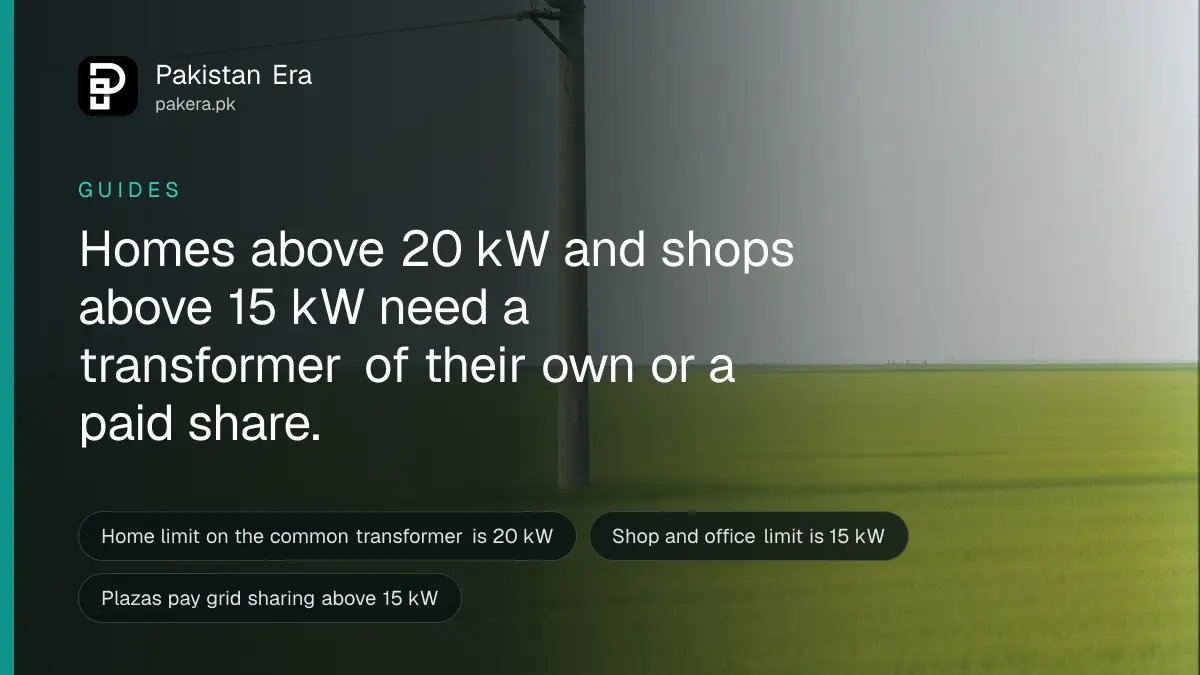
Under NEPRA's rules, a home in Pakistan with a load up to 20 kW is served from the common neighbourhood transformer. Above 20 kW it needs its own transformer or a paid share of one. For a shop or office the common limit is 15 kW. Above 100 kW, homes and shops need a dedicated transformer.
A shopkeeper asks for a 30 kW connection and gets a demand notice with a transformer on it. A builder plans a small plaza and hears about "grid sharing charges". These are not random. They come from one table in NEPRA's Consumer Service Manual, the rulebook for every electricity company. We read it to set out where each load size falls.
Small loads share the neighbourhood transformer
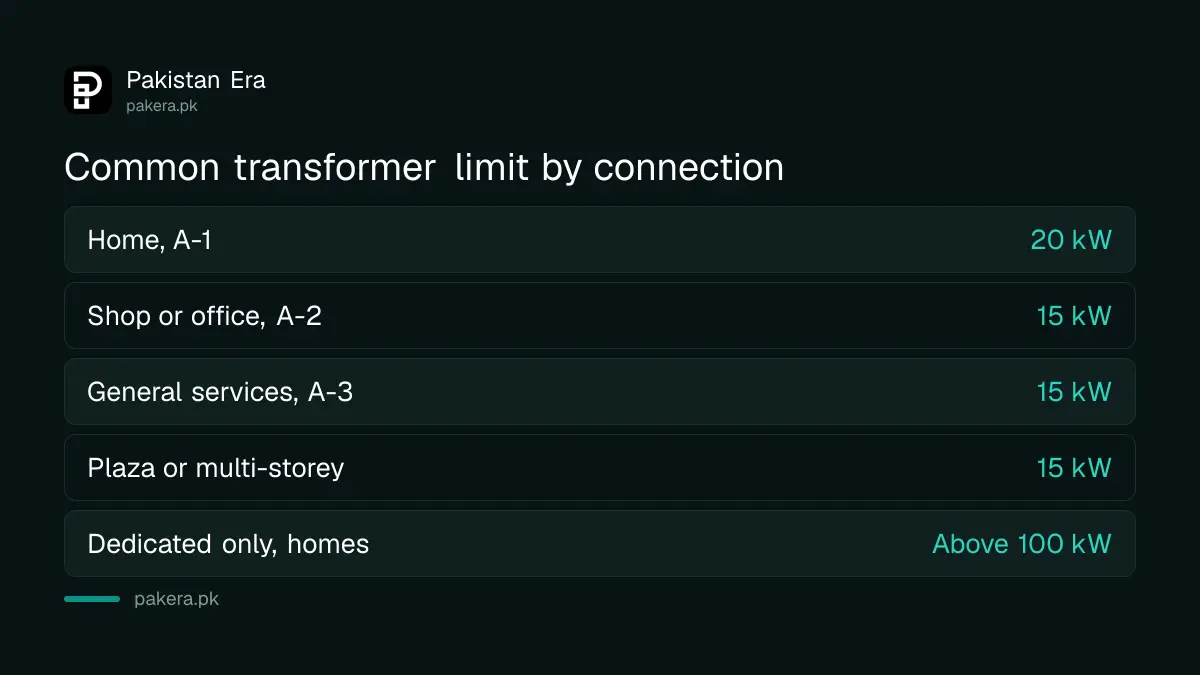
Clause 2.6 of the manual sets the connection arrangement by premises type and load. For individual homes outside housing schemes, a load up to 20 kW comes from a common distribution transformer. That is the pole or ground transformer that feeds many houses on your street.
For individual commercial and general services connections, the common limit is 15 kW. Multi-storey buildings and commercial plazas also use 15 kW as the common limit.
Your tariff category and building type decide which row applies. A home is category A-1. A shop or office is A-2, and general services such as clinics and schools are A-3.
Above the limit you pay for a transformer or a share of one
The manual gives two routes above the common limit. The first is a dedicated transformer, bought and installed for you. The second is transformer sharing charges, which means you pay a part of an existing transformer in proportion to your load. The second route applies only if the transformer has spare capacity, and both sides agree.
| Connection type | Common transformer up to | Dedicated or shared transformer | Dedicated only |
|---|---|---|---|
| Home (A-1) | 20 kW | Above 20 kW to 100 kW | Above 100 kW |
| Shop or office (A-2, A-3) | 15 kW | Above 15 kW to 100 kW | Above 100 kW to 2.5 MW |
| Plaza or multi-storey building | 15 kW | Above 15 kW to 1 MW | Above 1 MW |
The home row does not apply inside housing schemes where the company works out the ultimate load for the whole scheme. For those, our guide to how load is assessed by plot size explains the planning figures.
A kilowatt (kW) measures load, and a megawatt (MW) is 1,000 kW. A dedicated transformer is one that serves only you, so the cost lands on the applicant.
Larger commercial loads add rehabilitation and grid charges
For commercial and general services loads above 100 kW, the manual lists a dedicated transformer plus rehabilitation charges, on an actual basis if any, when the supply comes from an 11 kV feeder. For general services (A-3) these apply above 1 MW. Rehabilitation charges pay for repairing or strengthening the existing line.
Plazas and high rise buildings face one more charge. Above 15 kW, the manual adds 50 per cent grid sharing charges, including the transmission line, in proportion to the load. A note says a building of ground floor plus three storeys is not counted as multi-storey, so no grid sharing charge applies to it.
The manual gives the rates. For a sponsor of a scheme or building with ultimate load up to 10 MW, the applicant pays Rs 4,474 per kW for an air insulated grid station, or Rs 6,076 per kW for a gas insulated one. The company pays the other half. These exclude the cost of land.
| Plaza load | Applicant share, air insulated | Applicant share, gas insulated |
|---|---|---|
| 200 kW | Rs 894,800 | Rs 1,215,200 |
| 500 kW | Rs 2,237,000 | Rs 3,038,000 |
| 1,000 kW | Rs 4,474,000 | Rs 6,076,000 |
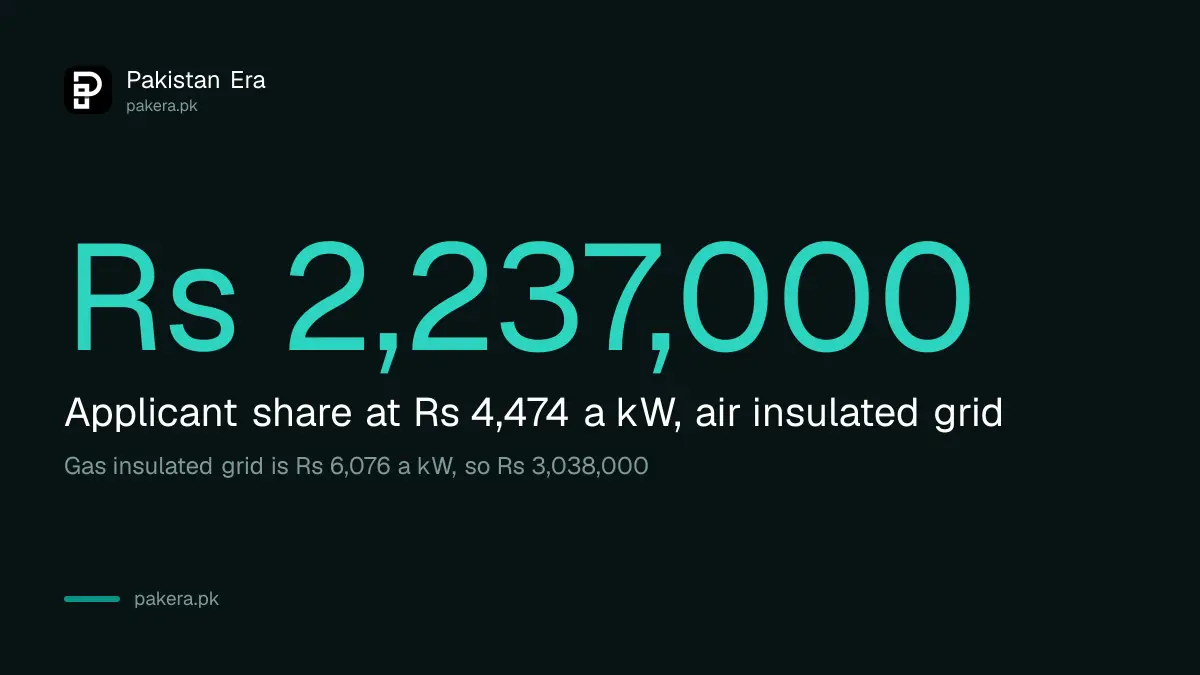
These are our own sums, from the per kW rates in the manual. Your demand notice shows the real amount. Ask the company how it reached each line.
You must provide space for the transformer
Clause 2.9 says that for a transformer up to 630 kVA, you do not have to provide space for a full substation. You still have to provide suitable, hazard free space and a right of way for it. The right of way is your responsibility under clause 14.5.
If the company takes space from you for a transformer, it must return the space on request when the facility is permanently disconnected. There is one exception. If the transformer has been converted into part of the common system with your consent and now serves other consumers, the space stays with the company.
The manual also covers a neighbour's dedicated system. The company may connect you to an existing dedicated system if it is technically feasible and you hold a no objection certificate from its owner. The whole group then shares repair costs in proportion to load.
Plan the load before you apply
- Find your tariff category from your bill or application: A-1, A-2 or A-3.
- Add up your connected load in kW, with a margin for growth.
- Compare it with the common limit for your category in the table above.
- If it is higher, ask the sub division whether a shared or a dedicated transformer is offered.
- Check the demand notice for rehabilitation and sharing lines before you pay.
Our guide to documents and demand notice rules for a new electricity connection covers the paperwork, and our guide to extending an existing load explains what happens when a later increase crosses a limit. For a plain home meter, how to apply for a new electricity connection is the place to start.
Common questions
What load needs a dedicated transformer for a house in Pakistan?
Above 20 kW, a home needs a dedicated transformer or a paid share of one. Above 100 kW it must be dedicated.
How much load can a shop run on the common transformer?
Up to 15 kW. Above that, the shop needs a dedicated transformer or transformer sharing charges, up to 100 kW. Above 100 kW it must be dedicated.
What are transformer sharing charges?
They are a part of an existing transformer's cost, charged in proportion to your load. They apply only when the transformer has spare capacity and both sides agree.
Do I pay for a transformer if I opt for a dedicated system?
Yes. The manual says a dedicated system chosen instead of the common one is provided on a cost deposit basis, so you pay the cost.
Who provides the space for the transformer?
You do. For up to 630 kVA, you provide suitable hazard free space and a right of way, though not a full substation.
Does a ground plus three building pay grid sharing charges?
No. The manual's note says a building of ground plus three storeys is not treated as multi-storey, so grid sharing charges do not apply.
How we verified this
What we checked, where we read it, and what we could not confirm.
Last checked 11 October 2026. We read clauses 2.6 and 2.9 and the notes on sharing charges in NEPRA's Consumer Service Manual, as on 26 November 2025, in a copy published by a distribution company. The table layout was machine extracted, so we left out the rows for housing schemes and industrial supply above 5 MW. We did not check whether any company has published its own rates. Sums are our own arithmetic. Check your demand notice and nepra.org.pk before you pay.
About the author

Global Affairs & Political Economy Writer
Muhammad Hatim is a book lover who started writing because he enjoys it. At Pakistan Era he writes about international relations, geopolitics and the global economy, with a particular interest in South Asia and the forces behind current events.