Dowry Law in Pakistan: The Rs 5,000 Limit, Who Owns the Jahez and How to Complain
Pakistan's 1976 dowry law caps dowry and bridal gifts at Rs 5,000 each and says the jahez belongs to the bride. How to protect it and complain to the DC.
Under the Dowry and Bridal Gifts (Restriction) Act 1976, the dowry and presents a bride's parents give her must not be worth more than Rs 5,000 in total, and the same Rs 5,000 limit applies to bridal gifts from the groom's side. Everything given as dowry, bridal gifts or presents to the bride belongs to her alone. A complaint about a breach goes to the Deputy Commissioner, and the case can only start within three months of the nikah or rukhsati.
The Act still sits on the Pakistan Code and extends to the whole country. Its limits have not been raised since 1976, so almost every wedding today goes over them. For a bride, the most useful part is not the limit but section 5: the jahez is hers, without conditions, and no one in the family can take it back.
This page explains what the law says and how to use it. It is not legal advice. For a dispute over your own jahez, see a family lawyer.
The law caps dowry and bridal gifts at Rs 5,000 each
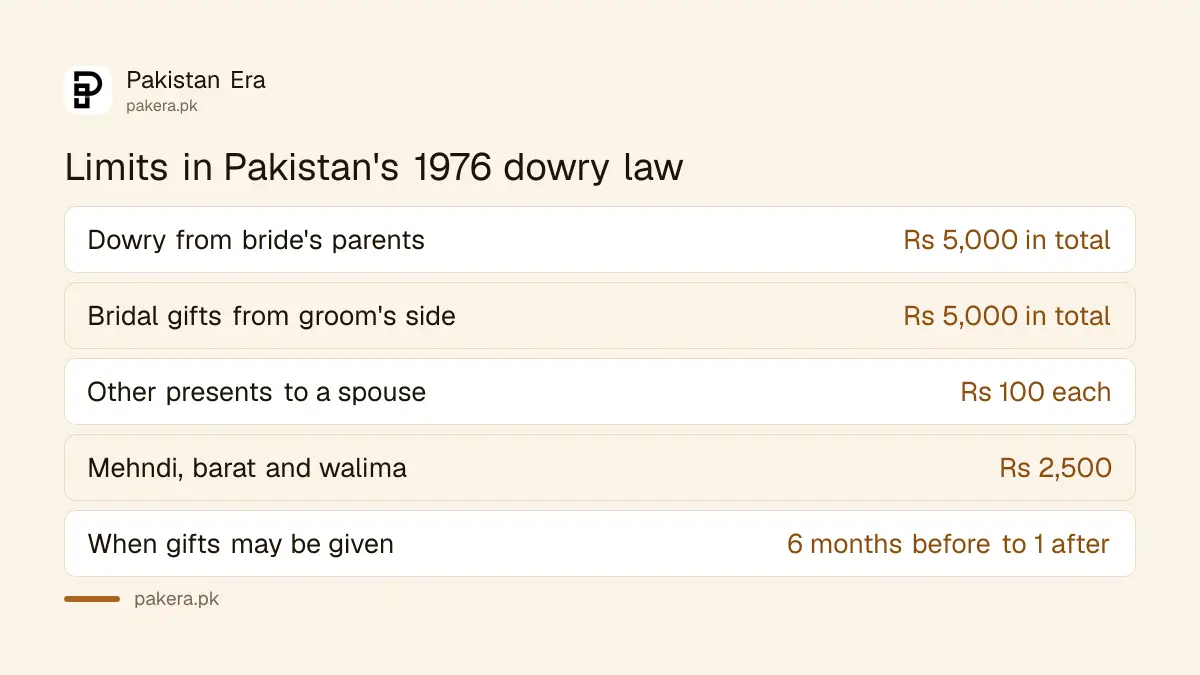
Section 3(1) says the total value of dowry and presents from the bride's parents must not exceed Rs 5,000. The total of bridal gifts, and of presents to the groom, has the same limit. Section 3(1A) makes it an offence to give, accept or agree to either above that.
| Rule | Section | Limit in the Act |
|---|---|---|
| Dowry and presents to the bride from her parents | 3(1) | Rs 5,000 in total |
| Bridal gifts from the groom or his parents, and presents to the groom | 3(1) | Rs 5,000 in total |
| Any other present to either spouse | 4 | Rs 100 each |
| Other wedding spending, including mehndi, barat and walima | 6 | Rs 2,500, not counting dowry and gifts |
| When dowry and gifts may be given | 3(2) | From 6 months before the nikah to 1 month after it, or after the rukhsati |
The Act defines dowry as property the bride's parents give her in connection with the marriage, not property she inherits. Bridal gifts come from the groom or his parents, and do not include mehr. The Rs 100 limit on presents does not cover neundra and salami.
Section 4 also stops senior office holders, such as ministers, members of the assemblies and government servants, from accepting presents for their own or their children's weddings except from relatives. Government servants below grade 17 who hold no judicial, revenue or executive authority are left out of this rule.
The jahez belongs to the bride and nobody else
Section 5 says all dowry, bridal gifts and presents given to the bride "vest absolutely" in her. Her right to them cannot be restricted, conditional or limited. The husband and his family hold them, at most, on her behalf.
That rule matters most when a marriage breaks down. A woman who leaves her husband's home, takes khula or is divorced can claim her jahez back. Dowry and a wife's personal property are both listed in the Schedule of the Family Courts Act, so the Family Court hears the claim. The steps are in recovering dowry and haq mehr in Punjab.
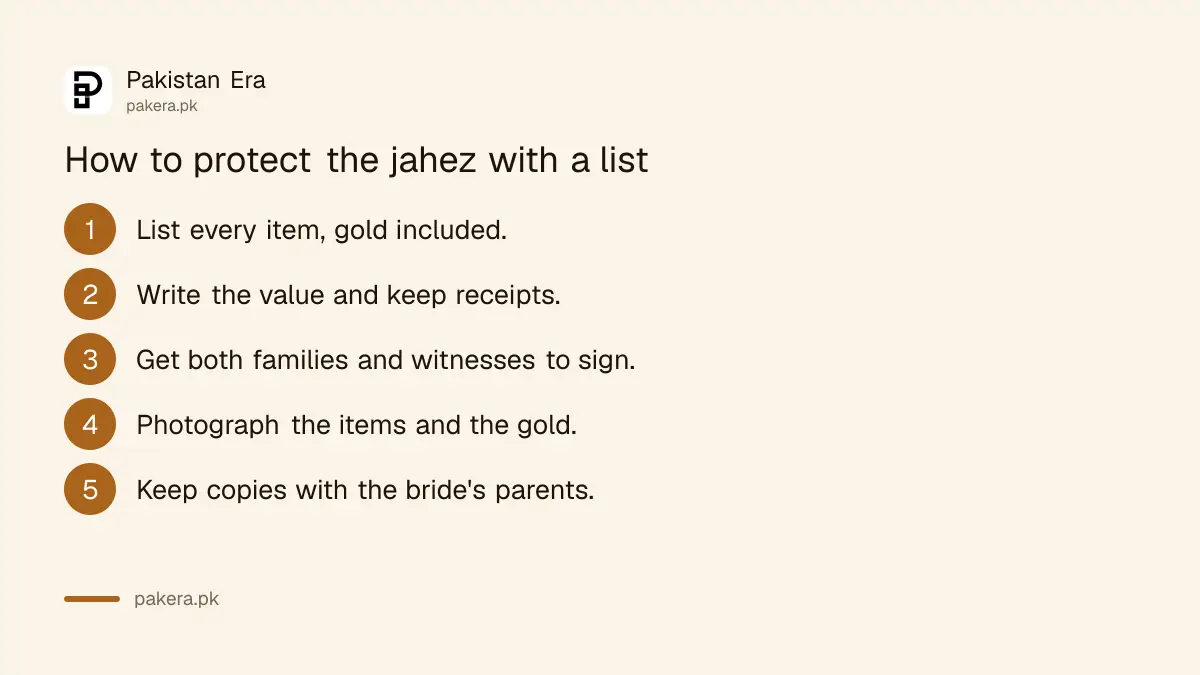
Protect the jahez at the time of the wedding. Courts decide these claims on evidence, so keep it simple and written.
- Make a list of every item: furniture, gold, clothes, appliances, utensils.
- Write the value or price next to each item, and keep shop receipts.
- Have the list signed by both families and two witnesses, with dates.
- Take photos of the items in the new home and of the gold.
- Keep copies with the bride and with her parents, not only in the in-laws' house.
A declaration goes to the Nikah Registrar after the wedding
Section 8 asks the groom's father, or whoever arranges the marriage, to file a declaration with the Nikah Registrar. It must say the total spending, including dowry, gifts and entertainment, stayed within the Act's limits. The Registrar sends it on to the Deputy Commissioner.
The declaration is due within 15 days after the period for giving dowry and gifts ends, which is one month after the nikah, or after the rukhsati if that came later. The Registrar then has 15 days to forward it.
Complaints go to the Deputy Commissioner within three months
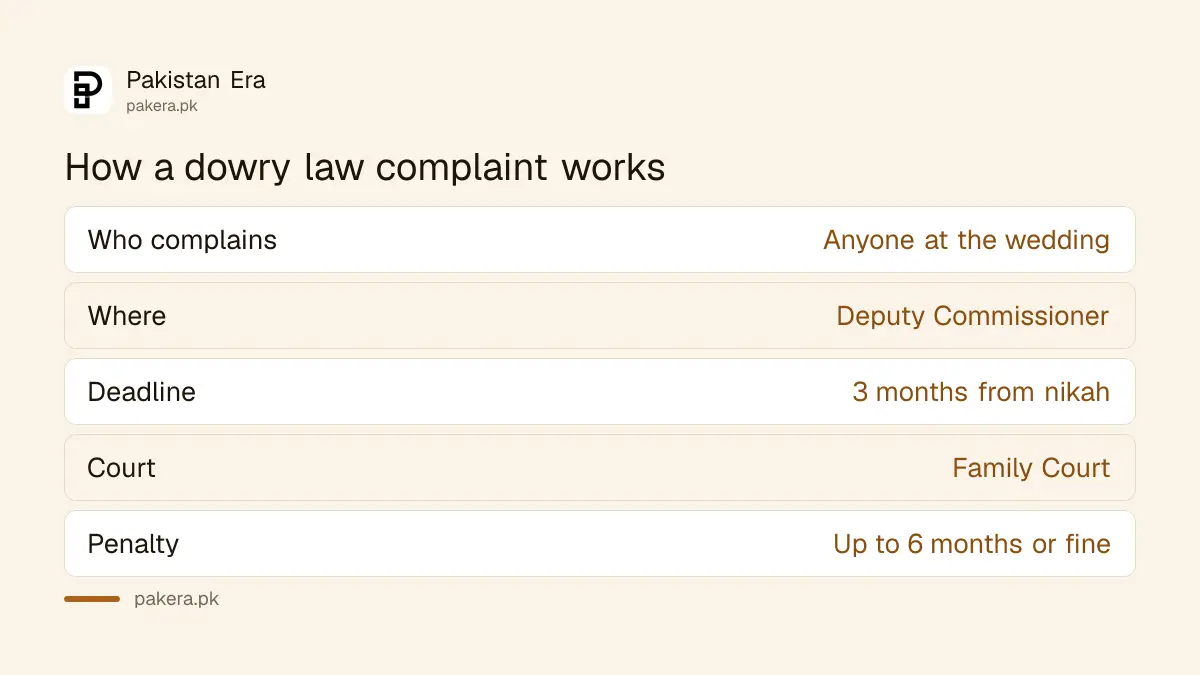
Under section 8A, anyone who attends a wedding and believes the Act was broken can complain to the Deputy Commissioner, giving full details. Only a complaint made by, or with the authority of, the Deputy Commissioner can start a case in the Family Court.
| Point | What the Act says |
|---|---|
| Who can complain | Any person who attended the ceremony (section 8A) |
| Where to complain | The Deputy Commissioner of the district |
| Deadline for the case | Within 3 months of the nikah, or of the rukhsati if later (section 9(3)) |
| Which court tries it | The Family Court, using magistrate trial procedure (section 9(2) and (4)) |
| Penalty | Up to 6 months, or a fine of at least the amount spent above the limit, or both |
| Excess dowry or gifts | Forfeited to the Federal Government for the marriage of poor girls |
If both parents break the Act, only the father is proceeded against. A mother who breaks it can be fined only. Write the complaint with names, the date and place of the wedding, what was given and its value, and attach any photos or lists.
Other wedding rules sit in a separate law
The Marriage Functions (Prohibition of Ostentatious Displays and Wasteful Expenses) Ordinance 2000 is a separate federal law. It limits meals at wedding venues to one dish, meaning one salan, rice with roti and one sweet dish, and bans fireworks, firing and outdoor lighting beyond what is needed.
Its fine is Rs 100,000 to Rs 500,000, or up to one month in jail, or both. Your province may have its own marriage functions law as well, so ask your district administration which rules it enforces. Families who need help paying for a daughter's wedding can compare the grants in Punjab marriage and jahez grants.
Common questions
Is giving dowry illegal in Pakistan?
Giving dowry is not banned outright. The 1976 Act limits it to Rs 5,000 from the bride's parents, and giving or accepting more is an offence under section 3(1A).
Who owns the jahez after a divorce?
The bride. Section 5 says dowry, bridal gifts and presents given to her vest absolutely in her. She can claim them in the Family Court.
Is haq mehr part of dowry?
No. The Act's definition of bridal gifts excludes mehr. Mehr is a separate right recorded in the nikah nama.
Can I complain to the police about excess dowry?
The Act sends complaints to the Deputy Commissioner, and a Family Court can act only on a complaint made by or under the authority of the Deputy Commissioner.
What if the in-laws demand more dowry after the wedding?
Section 3(1A) bars agreeing to give or accept dowry above the limit, and section 3(2) bars giving it more than one month after the nikah or rukhsati. If the demand comes with abuse, the provincial domestic violence and protection order laws may apply, as set out in getting a protection order in Punjab.
Does a jahez list need to be on stamp paper?
The Act does not require one. A dated list signed by both families and witnesses, with receipts and photos, is good evidence. Ask a lawyer if you want a formal deed.
How we verified this
What we checked and where we read it.
Last checked 24 November 2026. We read the full text of the Dowry and Bridal Gifts (Restriction) Act 1976 on the Pakistan Code, sections 1 to 10 with the 1980 amendments, and the Marriage Functions Ordinance 2000 on the same portal, with its 2006 amendment. We also read Part I of the Schedule of the Family Courts Act 1964 as amended in Punjab, which lists dowry and a wife's personal property. Section 10 of the 1976 Act lets each province and the Islamabad administration make rules, so local procedures can differ.
Free on WhatsApp
Get last dates and rule changes on WhatsApp
We post new last dates, fee changes and fixes for common problems, a few short posts a day.
Follow Pakera on WhatsAppOther followers cannot see your number.
Pakera Solves It
Which online process wasted your time this week?
A portal that will not load, a form nobody explains, a complaint that went nowhere. Tell us. Every week we pick one, solve it step by step and publish the answer.
About the author

Global Affairs & Political Economy Writer
Muhammad Hatim is a book lover who started writing because he enjoys it. At Pakistan Era he writes about international relations, geopolitics and the global economy, with a particular interest in South Asia and the forces behind current events.