EA Goes Private in the Biggest Buyout Ever Recorded
EA's $55 billion take private closes in August, funded largely by Saudi Arabia's PIF. What changes for FIFA, Sims and Apex players.
The company that makes the football game everyone in Pakistan plays is about to stop being a public company, in the largest leveraged buyout anyone has recorded.
The EA buyout closes in early August. A consortium of Saudi Arabia's Public Investment Fund, Silver Lake and Affinity Partners is taking Electronic Arts private for $55 billion, paying shareholders $210 a share. Andrew Wilson stays as chief executive.
The number that should interest you is not the $55 billion. It is the $20 billion of debt underneath it.
How is the deal structured?
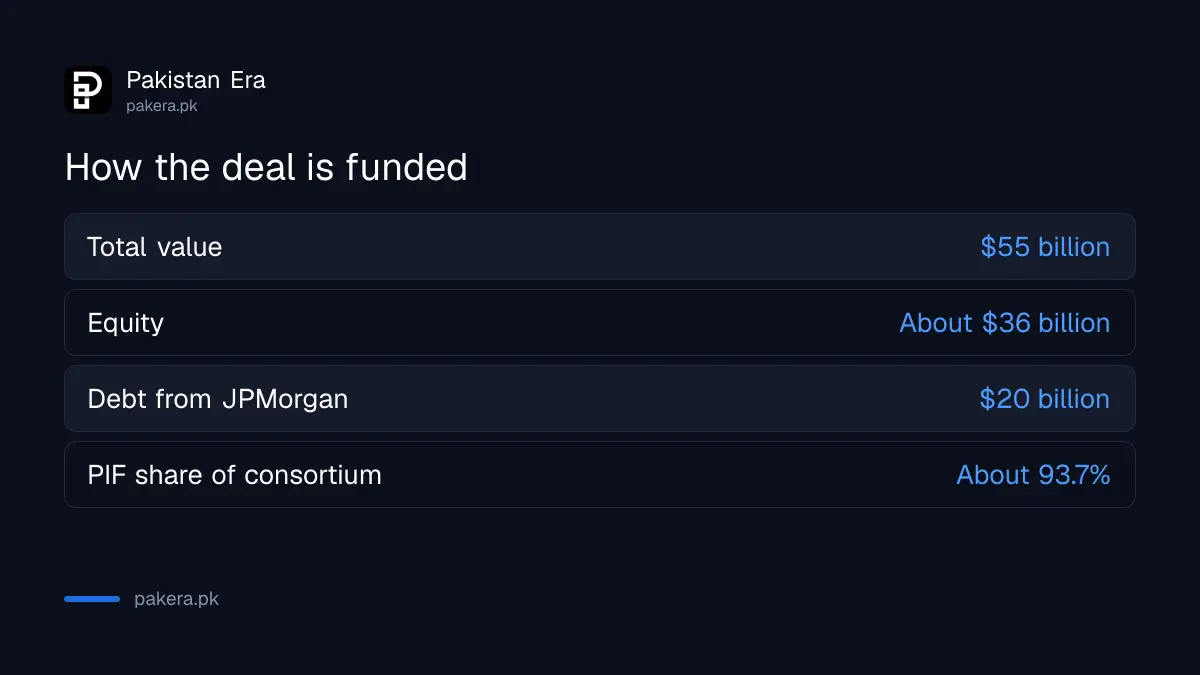
Roughly $36 billion of equity and $20 billion of debt, the latter committed entirely by JPMorgan Chase. PIF is not just writing a cheque, it is rolling its existing 9.9 percent stake in EA into the new private structure rather than cashing out.
| Element | Figure |
|---|---|
| Total transaction value | $55 billion |
| Equity investment | About $36 billion |
| Debt financing | $20 billion, JPMorgan |
| Price per share | $210 |
| Premium on unaffected price | 25% over $168.32 |
| PIF share of the consortium | About 93.7% |
PIF at 93.7 percent means this is a Saudi acquisition with two co investors rather than a genuine three way partnership. The fund manages over $700 billion, and gaming has been a stated priority for years.
Why does the debt matter?
Because EA has to service it, and it will be serviced out of the games you buy.
In a leveraged buyout, the debt used to purchase a company typically ends up on that company's own balance sheet. EA will emerge owing money it did not owe before, with interest payments that arrive whether or not the next football game sells well.
That changes the incentives inside the business. Revenue that is predictable and recurring becomes far more valuable than revenue that depends on a game being good. Which is a polite way of saying: expect more emphasis on Ultimate Team, subscriptions and in game purchases, because those pay interest reliably and a well reviewed single player game does not.
What actually changes for players?
Nothing immediately, and that is worth saying because the internet will tell you otherwise this week. The games ship, the servers run, and the CEO is the same one.
Over a longer horizon, the honest expectations:
- More monetisation pressure in the sports titles, since those already generate the most reliable recurring revenue.
- Less appetite for expensive single player projects, which are the first casualty when debt has to be serviced.
- No public quarterly reporting, so you will learn much less about how EA is actually doing.
- Possible studio consolidation, which is the standard playbook after a leveraged deal.
None of that is certain. All of it is what usually follows.
Why does this matter in Pakistan?
Because EA Sports FC is one of the most played games in the country, on console, PC and increasingly mobile, and Ultimate Team spending is where EA makes its money from exactly that audience.
Pakistani players already deal with the awkward part of this: buying points requires international payment methods that are difficult here, which is its own long running frustration. A company under pressure to grow recurring revenue is not likely to make that cheaper.
If you buy in game currency, our guides to virtual dollar cards and international payment cards cover the practical side of paying for it from here.
Why is Saudi Arabia buying game companies?
Because gaming is one of the few industries large enough to matter to a fund managing over $700 billion, and one of the few that reaches young people worldwide every day.
PIF has been building a gaming position for years rather than opportunistically. It already held 9.9 percent of EA before this deal and is rolling that stake in rather than selling it, which is what an investor does when the goal is control rather than return.
The stated logic is economic diversification away from oil. The unstated one is influence: owning the company that makes the world's most played football game is a different kind of asset from owning shares in it. Whether that troubles you is a separate question from whether the games get better.
Worth being clear that EA is not a Saudi company now. It is an American company owned by a consortium a Saudi fund controls, and the practical difference shows up in governance rather than in what appears on screen.
Is this good or bad for gaming?
Genuinely unclear, and anyone certain either way is guessing.
The optimistic case is that private ownership frees EA from quarterly earnings pressure, which is the thing publishers blame for short termism. A patient owner with a very long horizon could fund things a public company would not.
The pessimistic case is that $20 billion of debt is a harsher master than quarterly earnings ever were. Public shareholders want growth; lenders want payment, and they want it on schedule regardless of how the year went.
My read is that the second pressure is the real one. Removing the stock market does not remove financial discipline, it replaces a flexible creditor with an inflexible one.
Frequently asked questions
Who is buying EA?
A consortium of Saudi Arabia's Public Investment Fund, Silver Lake and Affinity Partners. PIF holds about 93.7 percent of it.
How much is the EA buyout worth?
$55 billion, at $210 per share, a 25 percent premium on the unaffected share price of $168.32. It is described as the largest leveraged buyout ever in nominal dollars.
When does the deal close?
Early August 2026, with all required regulatory approvals settled.
Will EA games change?
Not immediately. Over time, $20 billion of debt tends to push a publisher towards recurring revenue like Ultimate Team and subscriptions rather than expensive single player games.
Is Andrew Wilson still CEO?
Yes. He remains chief executive after the company goes private.
Does this affect EA Sports FC in Pakistan?
Not the games themselves. The pressure to grow in game spending is the part most likely to reach Pakistani players, who already face difficulty buying points from here.
About the author

Tax, Bills and Technology Writer
Ali Akhtar is a young and curious voice here at Pakistan Era. He is currently pursuing his A-Levels and has a growing interest in Pakistan’s changing industrial landscape and educational trends. Ali likes to write in a way that helps him explain and explore the world around him. His writing reflects the perspective of the new generation navigating the evolving trends of Pakistan where technology, youth innovation, and shifting opportunities are reshaping the country’s future.