Erasmus Mundus Scholarship for Pakistanis: EUR 1,400 a Month
Erasmus Mundus scholarships for Pakistanis pay EUR 1,400 a month with no tuition. Most programmes close October to January. Who qualifies and how to apply.
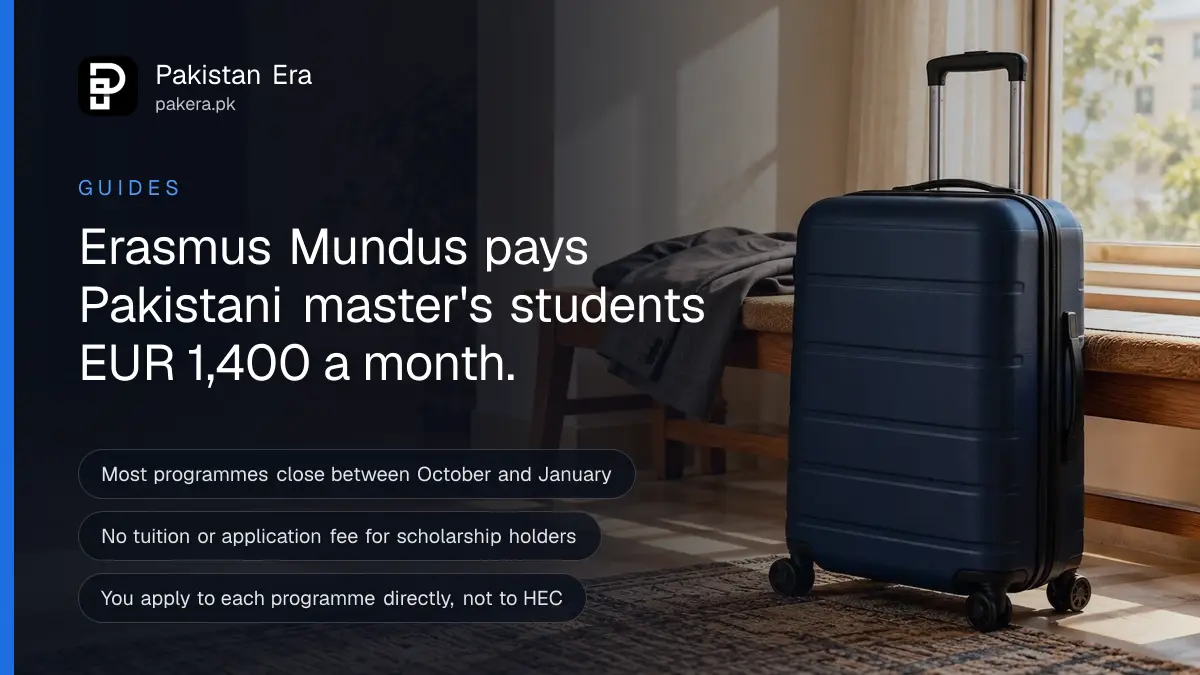
Pakistani students can apply for an Erasmus Mundus Joint Master's scholarship, which pays EUR 1,400 a month and covers tuition. There is no single deadline. Each master's programme sets its own, and the European Commission says most fall between October and January for courses starting the next academic year. For a September 2027 start, that means applying between October 2026 and January 2027.
We read the European Commission's Erasmus+ student page, the Erasmus Mundus Catalogue run by the European Education and Culture Executive Agency (EACEA), and the Erasmus+ Programme Guide on 29 September 2026. Those three pages set the rules every programme has to follow.
The catch is simple. You do not apply to the EU. You apply to one programme at a time, on that programme's own website, and each one has its own form, documents and closing date.
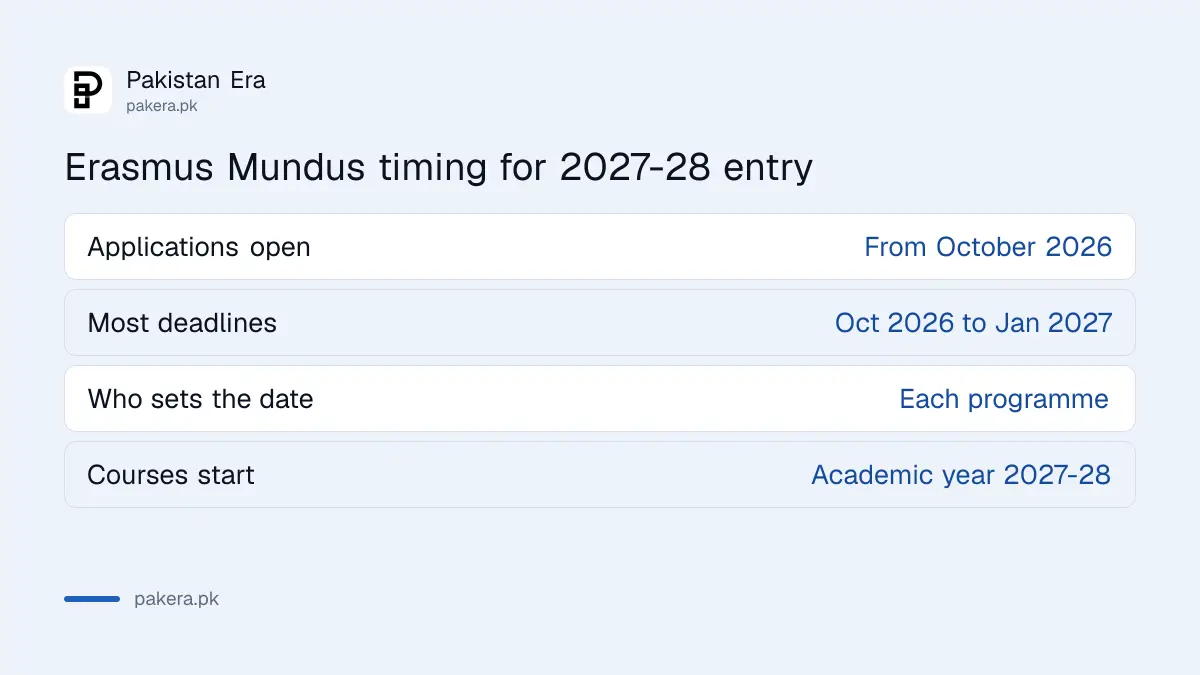
Erasmus Mundus deadlines for Pakistanis run from October to January
Most Erasmus Mundus programmes take applications between October and January for courses starting the following September. The exact closing date is on each programme's own website, not on any EU page, so you must check every programme you want separately.
| Stage | Usual timing | Where it is set |
|---|---|---|
| Programmes open applications | From October 2026 | Each programme's website |
| Most scholarship deadlines | October 2026 to January 2027 | Each programme's website |
| Courses start | Academic year 2027-28 | Each programme |
| Course length | 1 to 2 years | Erasmus+ student page |
Both EU pages use the same wording: "in most cases" and "most master's programmes". So a few programmes close earlier or later. We did not check individual programme deadlines, because there are well over a hundred of them and each changes yearly.
A new batch of programmes is added to the catalogue every year. A course that was not listed last year may be open now, and one you liked may have ended its funding.
What an Erasmus Mundus Joint Master is
An Erasmus Mundus Joint Master is a master's degree run together by at least three universities in at least three different countries. You study in two or more of them, and you finish with a joint degree or several degrees from the partner universities.
Courses last one to two academic years, worth 60, 90 or 120 ECTS credits. ECTS is the European credit system, and 60 credits equals one year of full-time study. Most programmes mix classes, research, an internship and a thesis.
The EU says almost 50,000 students have joined since 2004. Students from every country can apply, Pakistan included. There is no Pakistani quota and no nominating body in between, which makes it different from the HEC-routed schemes.
What the Erasmus Mundus scholarship pays
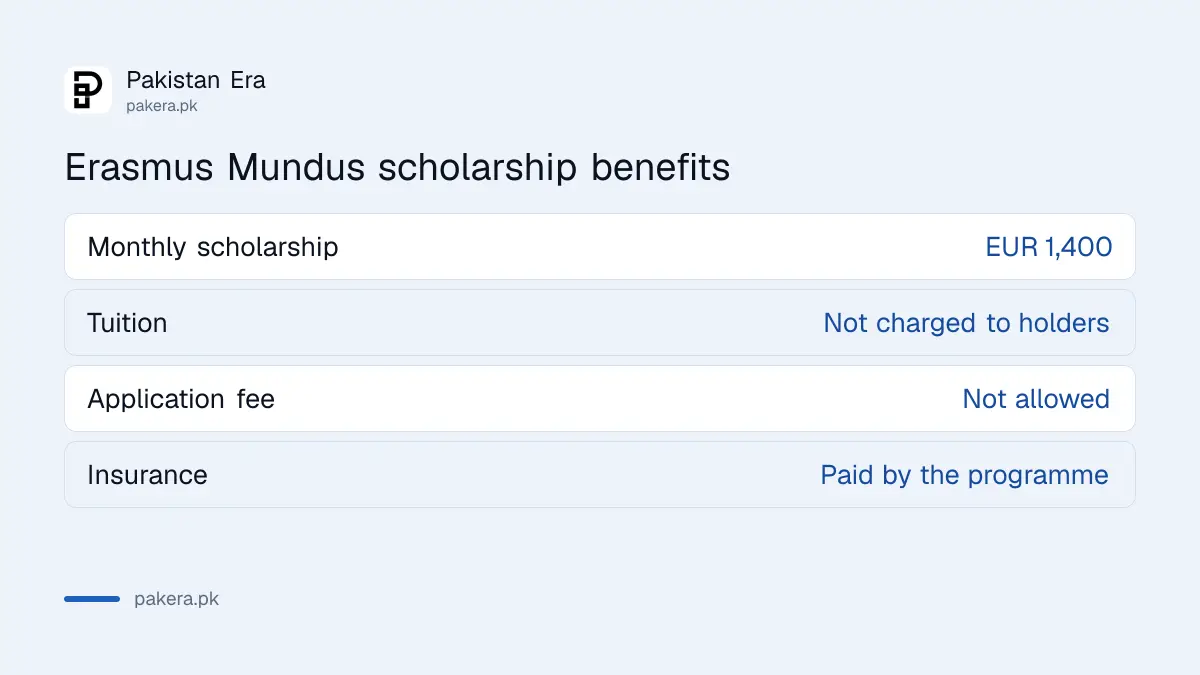
The scholarship is EUR 1,400 a month for the full length of the programme, paid for travel, visa, settling in and living costs. The programme cannot charge scholarship holders tuition or any other compulsory fee, and it cannot charge anyone an application fee.
| Item | What the Programme Guide says |
|---|---|
| Monthly scholarship | EUR 1,400 a month for the programme's full length |
| What it is for | Travel, visa, installation and living costs |
| Tuition and compulsory fees | Cannot be charged to scholarship holders |
| Application fee | Cannot be charged to any applicant |
| Insurance | Paid for by the programme for enrolled students |
A two year programme at EUR 1,400 a month adds up to EUR 33,600. That is our own sum from the Programme Guide's formula, which multiplies the monthly rate by the programme's length in months.
Not every programme in the catalogue offers scholarships. EACEA says some are near the end of their funding, and some only keep the Erasmus Mundus name after funding stopped. Check that the programme still awards scholarships before you spend a week on the application.
Who can apply from Pakistan
You need a bachelor's degree, or you must be in your final year and graduate before the master's starts. You also must not have held an Erasmus Mundus scholarship before. Each programme then adds its own subject, grade and English requirements.
- Degree: a first degree, or final year of one, finished before the course begins. A recognised equivalent level of learning also counts.
- No second scholarship: past Erasmus Mundus scholarship holders cannot get another one.
- Programme rules: each course sets its own entry requirements, usually a related bachelor's, a grade level and an English test.
There is also a fairness rule that matters for Pakistan. The Programme Guide says no more than 10% of a programme's scholarships should go to one nationality. So you compete with other Pakistanis for a small share, and a strong motivation letter counts.
Get your papers ready early. Most programmes want certified copies of your degree and transcripts, and HEC degree attestation is the usual first step for a Pakistani degree.
How to apply for Erasmus Mundus from Pakistan
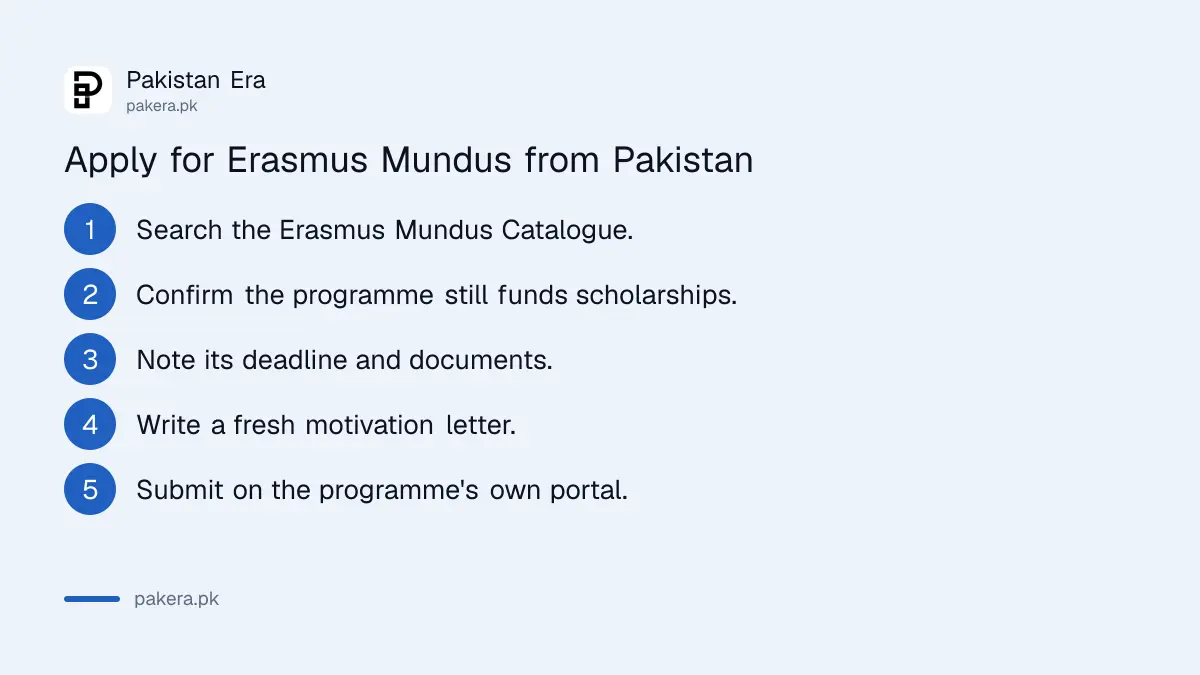
Search the Erasmus Mundus Catalogue, shortlist programmes that still offer scholarships, read each programme's own rules, and apply on its website before its deadline. Applying is free, and you can apply to more than one programme.
- Open the Erasmus Mundus Catalogue and filter by subject or country.
- Visit each programme's own website and confirm it still offers scholarships this year.
- Note its deadline, required documents and English test.
- Prepare your CV, motivation letter, reference letters, degree, transcripts and passport.
- Submit on the programme's portal and keep the confirmation email.
Write a new motivation letter for each programme. A programme in water management and one in data science want to hear different things, and selection panels can spot a copied letter quickly.
EACEA warns about fraud. It says EU scholarships are not granted for a fee. Anyone asking you to pay to be "selected" is not the EU, and the checks you would run on a study abroad agent apply here too.
If you want a single country and one deadline instead, the Chevening scholarship for the UK works that way, with one form for one master's year.
Common questions
What is the last date for Erasmus Mundus 2027 in Pakistan?
There is no single last date. Each programme sets its own, and most close between October 2026 and January 2027.
How much is the Erasmus Mundus stipend?
EUR 1,400 a month for the full programme, for travel, visa, settling in and living costs. Tuition is not charged to scholarship holders.
Is there an application fee?
No. The Programme Guide says selected programmes cannot charge student application fees.
Can I apply in my final year of BS?
Yes, if you will graduate before the master's programme starts. The programme will ask for your final degree later.
Does HEC nominate Erasmus Mundus candidates?
No. You apply directly to each programme. There is no HEC nomination or Pakistani quota.
How many programmes can I apply to?
The EU pages we read set no limit. Each programme runs its own selection, so check its rules before applying.
How we verified this
What we checked, where we read it, and what we could not confirm.
Last checked on 29 September 2026. The October to January application window, the course length, the degree types, the bachelor's degree requirement and the 50,000 student figure are read on the European Commission's Erasmus+ page "Erasmus Mundus Joint Masters (students)". The catalogue's yearly update, the warning that some listed programmes no longer fund scholarships, the application advice and the fee scam warning are read on EACEA's Erasmus Mundus Catalogue and scholarships pages. The EUR 1,400 monthly rate, what it covers, the ban on tuition and application fees, insurance, the one-scholarship rule and the 10% nationality cap are read in the Erasmus Mundus Joint Masters section of the Erasmus+ Programme Guide. We did not check the deadline of any single programme.
About the author
Public Services and Education Journalist
Fajr Riaz is a journalist and content writer at Pakistan Era, based in Lahore. She covers the questions people meet in everyday life in Pakistan: how a public service works, what a change in the rules means, and where to find a reliable answer.