FCC Refuses LESCO Appeal: Faulty Meter Bills Stay Cancelled, High Court Can Review NEPRA Board
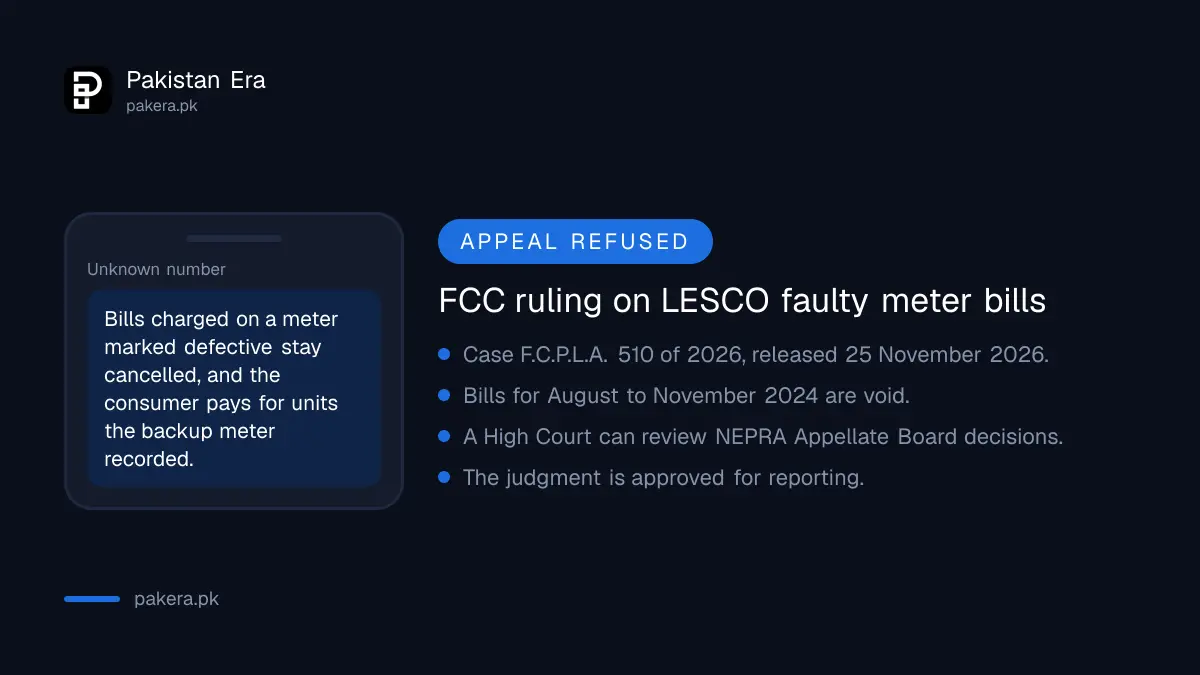
The FCC refused LESCO's appeal, so bills charged on a faulty meter stay cancelled. It also confirmed a High Court can review NEPRA Appellate Board decisions.
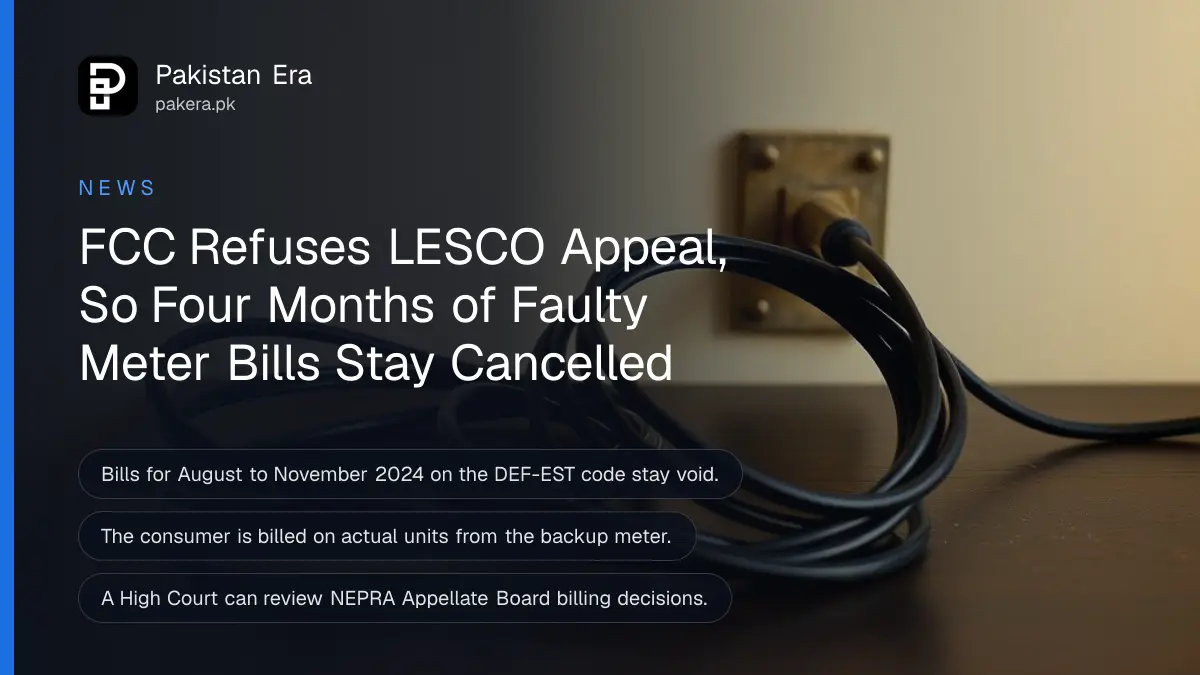
The Federal Constitutional Court of Pakistan has refused LESCO's appeal against an order that cancelled four months of electricity bills charged on a meter treated as faulty. The judgment, released on 25 November 2026, also confirms that a consumer can take a NEPRA Appellate Board billing decision to the High Court.
The case is F.C.P.L.A. No. 510 of 2026, Lahore Electric Supply Company (LESCO) against Hamdard Laboratories (Waqf) Pakistan. Justice Syed Arshad Hussain Shah wrote the judgment, sitting with Justice Aamer Farooq. It is marked approved for reporting, so lawyers can cite it in other billing cases.
The FCC refused LESCO's appeal over faulty meter bills
The court dismissed LESCO's petition and refused leave to appeal. The bills LESCO charged for August to November 2024 under the DEF-EST tariff code stay cancelled, and the consumer is billed on actual units recorded by a backup meter.
DEF-EST is the billing code used when a meter is marked defective and the bill is estimated rather than read. Hamdard Laboratories said the bills were wrong and went to the Electric Inspector in Lahore, the Provincial Office of Inspection (POI), under section 38 of the NEPRA Act 1997.
The FCC said the facts had already been settled by the forums below and it would not disturb them. Its main work was on a legal objection LESCO raised about which court could hear the dispute.
Each forum decided the bills differently
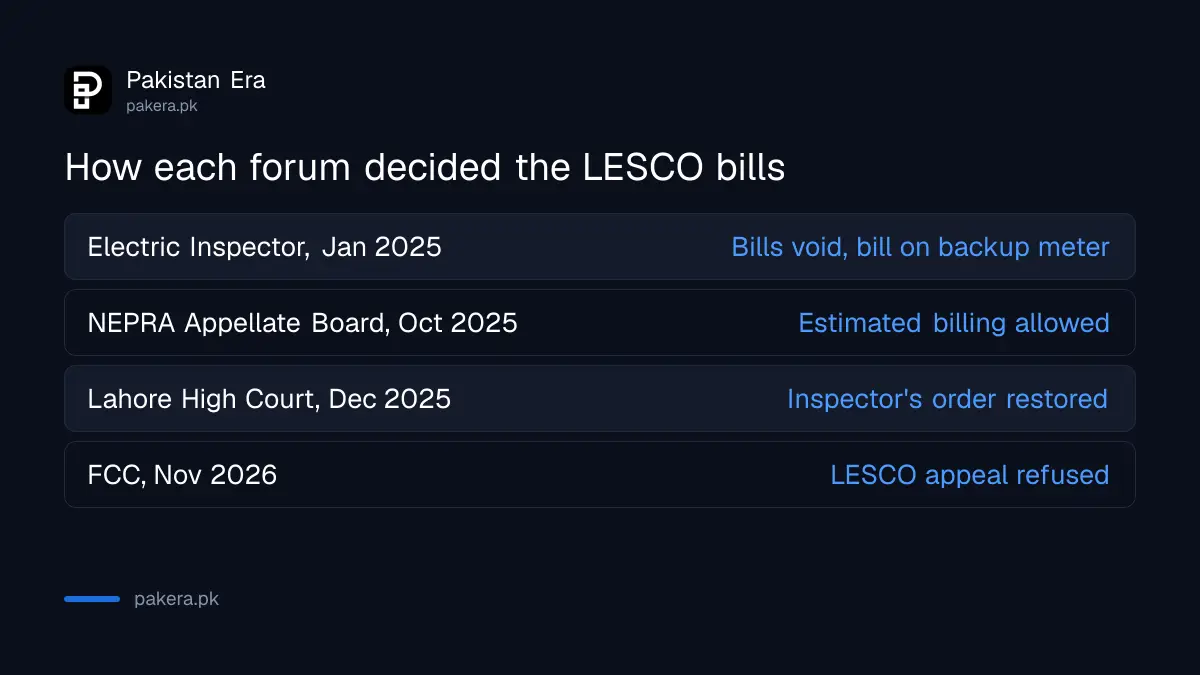
The dispute passed through four forums in two years. The Electric Inspector cancelled the bills, the NEPRA Appellate Board partly reversed that, the Lahore High Court restored the Inspector's order, and the FCC has now left the High Court's order in place.
| Forum | Date | Decision |
|---|---|---|
| Electric Inspector, Lahore (POI) | 22 January 2025 | Bills for August to November 2024 void. Revised bills on actual units of the backup meter. Account to be overhauled, excess adjusted in future bills, faulty meter replaced. |
| NEPRA Appellate Board | 28 October 2025 | Bills cancelled, but LESCO allowed to charge revised bills on the DEF-EST code from August 2024 until the meter was replaced. |
| Lahore High Court | 3 December 2025 | Board's decision set aside. The Electric Inspector's order restored. |
| Federal Constitutional Court | Released 25 November 2026 | LESCO's petition dismissed and leave refused. |
The practical difference was large. Under the Inspector's order the consumer pays for units the backup meter actually recorded. Under the Board's version, LESCO could keep estimating the bill on the defective code until it changed the meter.
A High Court can review a NEPRA Appellate Board decision
LESCO argued the consumer should have used the tribunal under section 11 of the NEPRA Act instead of a writ petition. The FCC agreed with the High Court that this tribunal hears contract disputes between licensees, not appeals against the Appellate Board.
The court then explained why a writ under Article 199 of the Constitution was open to the consumer:
- LESCO supplies electricity, an essential public utility, inside a framework set by law.
- The dispute was about charges raised under a regulated tariff code, and about metering, billing and collection.
- Section 38 of the NEPRA Act gives the Provincial Office of Inspection power to decide such disputes, with an appeal to the Board.
- That makes the dispute a public law matter, not only a private contract quarrel, so judicial review is available.
The court relied on an earlier ruling, Federation of Pakistan versus Spencer Powergen Company of Pakistan Limited (2026 SCMR 339), which says public bodies and those with a public character are open to judicial review.
What to do if you are billed on an estimated or faulty meter
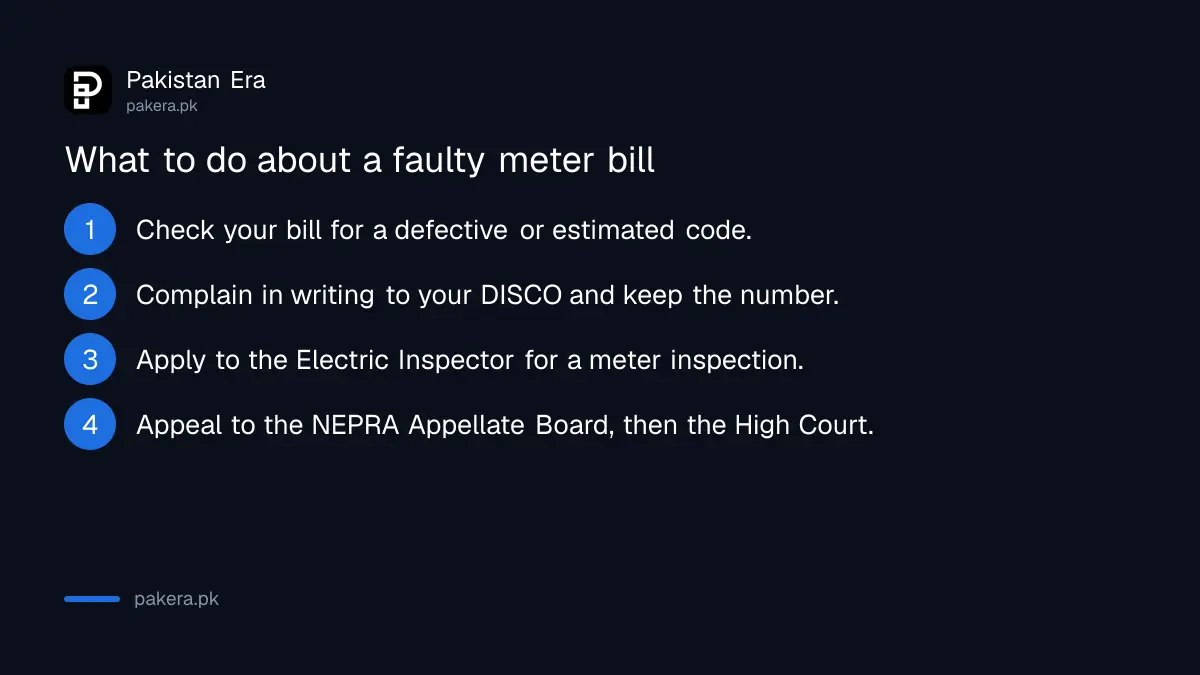
Keep paying undisputed amounts, gather your old bills, and complain first to your distribution company. If that fails, take the dispute to the Electric Inspector, then to the NEPRA Appellate Board, and only then consider a High Court writ.
- Check the tariff or status code printed on your bill. A defective or estimated code means the units were not read from a working meter.
- Collect at least 12 months of bills so you can show your normal use before the meter fault.
- Complain in writing to your DISCO and keep the complaint number. The steps and time limits are set out under electricity bill complaint deadlines.
- If the company does not fix it, apply to the Electric Inspector for your area. Punjab offices are listed on the Electric Inspector contact numbers page. Ask for a site inspection of the meter, as Hamdard did.
- If you lose at the Board after winning before the Inspector, or the other way round, speak to a lawyer about a writ petition and cite F.C.P.L.A. No. 510 of 2026.
If the Board has already decided your appeal, you can check the NEPRA Appellate Board decision online before deciding on the next step. For bills that look too high for other reasons, the overbilling guide covers detection bills and refunds.
Who this ruling helps and what it does not decide
The ruling helps consumers in billing disputes with any distribution company, because it confirms a route to the High Court after the Appellate Board. It does not set a rule on how much a faulty meter bill may be, which still depends on each case's facts.
The FCC did not rewrite the billing rules. It said the factual questions, such as how many units were really used, had been settled by the Electric Inspector after an inspection in the presence of both sides. A consumer still needs evidence, such as a backup meter reading or past bills, to win a similar case.
The judgment also does not change the order of forums. A consumer who skips the Electric Inspector and goes straight to court will usually be told to use that remedy first.
Common questions
What did the FCC decide in LESCO versus Hamdard Laboratories?
It refused LESCO leave to appeal. The bills for August to November 2024 charged on the DEF-EST code stay cancelled, and the account is billed on actual units from the backup meter, as the Electric Inspector ordered on 22 January 2025.
What does DEF-EST mean on an electricity bill?
It is the code used when a meter is marked defective and the units are estimated rather than read. If you see it for months, ask your DISCO when the meter will be replaced and keep a record of your complaints.
Can I go to the High Court against the NEPRA Appellate Board?
Yes. The FCC agreed that a billing decision of the Appellate Board can be challenged through a writ petition under Article 199, because the dispute carries a public law element. The section 11 tribunal does not hear such appeals.
Do I have to go to the Electric Inspector first?
Yes, in practice. Section 38 of the NEPRA Act gives the Provincial Office of Inspection power over metering, billing and collection disputes, with an appeal to the Board. Courts expect you to use these forums first.
Does this ruling cancel my own faulty meter bill?
No. It decides one consumer's case. It helps you by confirming the route to the High Court and by showing that an inspection and a backup meter reading can defeat an estimated bill.
How we verified this
What we checked and where we read it.
We read the full judgment in F.C.P.L.A. No. 510 of 2026, downloaded from the judgments page of the Federal Constitutional Court of Pakistan on 25 November 2026, where it is listed with an upload date of 25 November 2026. The judgment is dated 29 October 2026, the date of hearing, and marked approved for reporting. The forum orders and dates quoted above are taken from the judgment itself. Section 38 and section 11 references are to the Regulation of Generation, Transmission and Distribution of Electric Power Act 1997, as cited by the court. Appellate Board decisions are published by NEPRA. Last checked 25 November 2026.
About the author

Global Affairs & Political Economy Writer
Muhammad Hatim is a book lover who started writing because he enjoys it. At Pakistan Era he writes about international relations, geopolitics and the global economy, with a particular interest in South Asia and the forces behind current events.