FCC Rules Imported Prefabricated Factory Structures in Pakistan Can Get Duty and Tax Exemption
The FCC ruled imported prefabricated industrial structures can qualify as plant or capital goods for exemption, and struck down two 2021 FBR memos. Details.
The Federal Constitutional Court of Pakistan has ruled that imported prefabricated industrial structures can qualify for duty and tax exemptions as plant, capital goods or capital equipment, even when the customs tariff classes them as buildings and they are not bolted to production machinery. The judgment was announced in open court in Islamabad on 23 November 2026.
The ruling matters to manufacturers and Special Economic Zone (SEZ) investors who import steel sheds, pre-engineered buildings and similar structures for factories. The court also struck down two FBR office memorandums of 2021 that customs officers had used to refuse these claims.
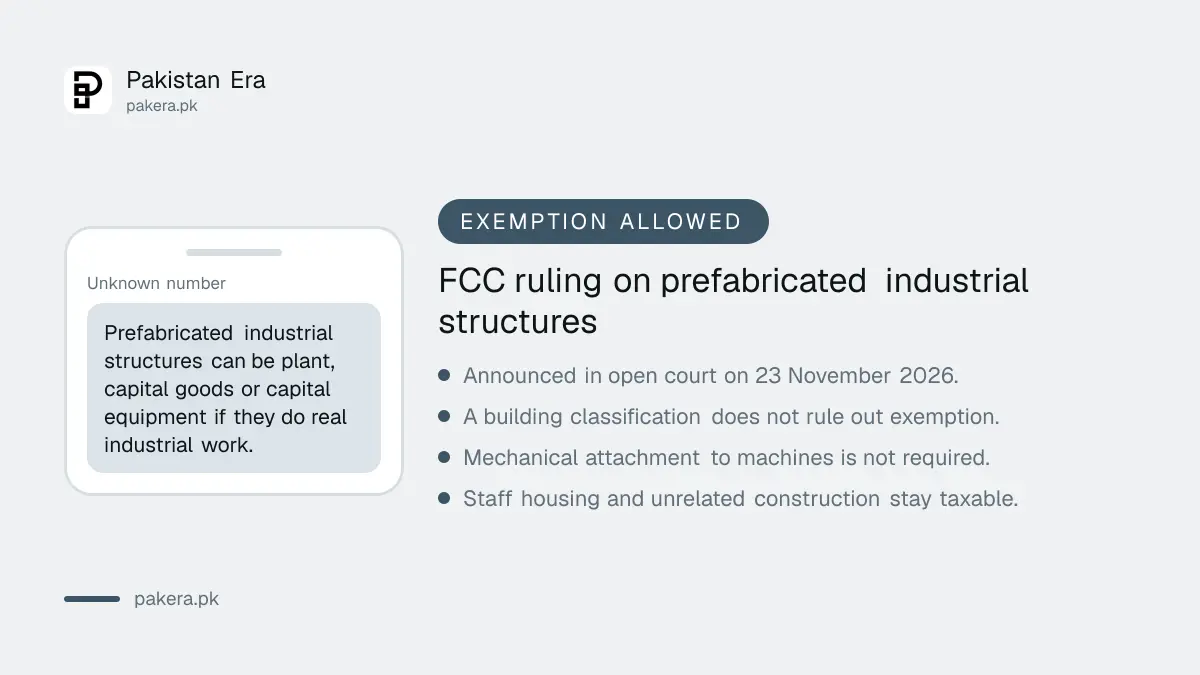
The FCC ruled factory structures can qualify as capital goods
The court held that prefabricated industrial structures cannot be excluded from "plant", "capital goods" or "capital equipment" just because they are called buildings, are classified outside the machinery chapters, or lack mechanical attachment to machines. Eligibility depends on their proven industrial function.
Chief Justice Amin-ud-Din Khan wrote the judgment, sitting with Justice Aamer Farooq. The lead case is C.A. No. 567 of 2011, Federation of Pakistan and FBR against Aisha Steel Mills Limited, heard with two connected appeals and F.C.P.L.A. No. 1576 of 2026 filed by Orient Material (Private) Limited. The court heard the matters on 11 November 2026, and the judgment is approved for reporting.
Two importers, two notifications, one answer
One case involved prefabricated structures imported for a steel rolling mill at Bin Qasim, Karachi, under S.R.O. 575(I)/2006. The other involved steel structures for a ceramics plant in the Faisalabad Special Economic Zone under the SEZ Act 2012.
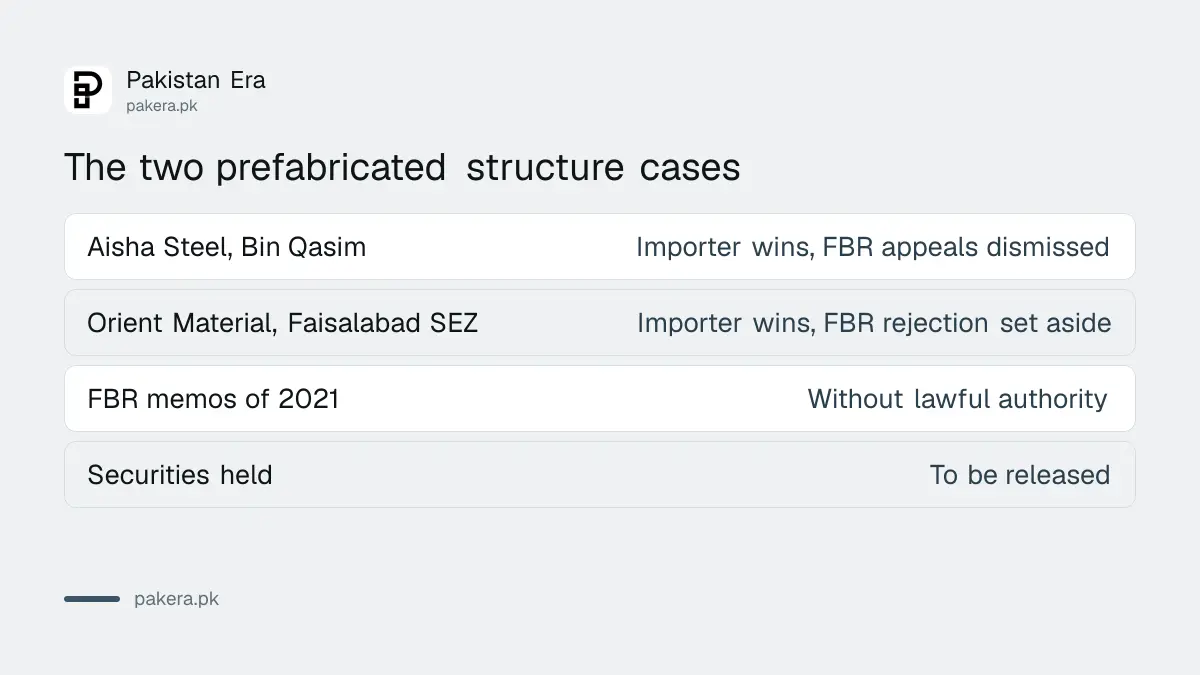
| Case | What was imported | Exemption claimed | FCC result |
|---|---|---|---|
| Aisha Steel Mills and connected appeals | Prefabricated structures for a steel rolling mill, Bin Qasim | Serial 21 of S.R.O. 575(I)/2006 | Sindh High Court's 2010 judgment for the importer upheld, FBR appeals dismissed |
| Orient Material (Private) Limited | Prefabricated steel structures for a ceramics unit, Faisalabad SEZ | PCT heading 9917(2) under the SEZ Act 2012, or S.R.O. 41(I)/2009 | Lahore High Court's May 2026 judgment and the FBR's October 2022 rejection set aside |
The FBR had refused Orient's claim on 7 October 2022 because the structures had no mechanical link with production machinery. The Lahore High Court upheld that on 14 May 2026. The FCC said the FBR had added a condition the law does not contain.
Function decides, not the label or the tariff heading
The court said tariff classification and exemption are separate questions. A structure can stay under heading 94.06 as a building and still be plant or capital goods if it does real industrial work. Mechanical attachment to machines is not a legal requirement.
The judgment set out these points:
- Different words, different meanings. "Plant", "machinery", "equipment" and "capital goods" overlap but are not the same. Treating them all as machinery would erase the law's own distinctions.
- Function is the test. A structure that supports cranes or forms part of the production setup can qualify. A plain shed that only houses work, or staff housing, does not.
- Location alone is not enough. Being inside a factory or SEZ does not make ordinary accommodation or unrelated construction exempt.
- No extra approval for existing SEZ benefits. Approval under section 34(2) of the SEZ Act is for additional incentives and cannot be a condition for an exemption the law already gives.
- Memos cannot change the law. FBR office memorandums dated 22 January 2021 and 2 March 2021 were declared without lawful authority so far as they excluded qualifying structures or required mechanical linkage.
What importers and SEZ investors should do now
If customs refused your exemption on prefabricated structures only because they were classed as buildings or were not attached to machines, that ground is now gone. Gather evidence of the structure's industrial function and take advice on a fresh claim or the release of securities.
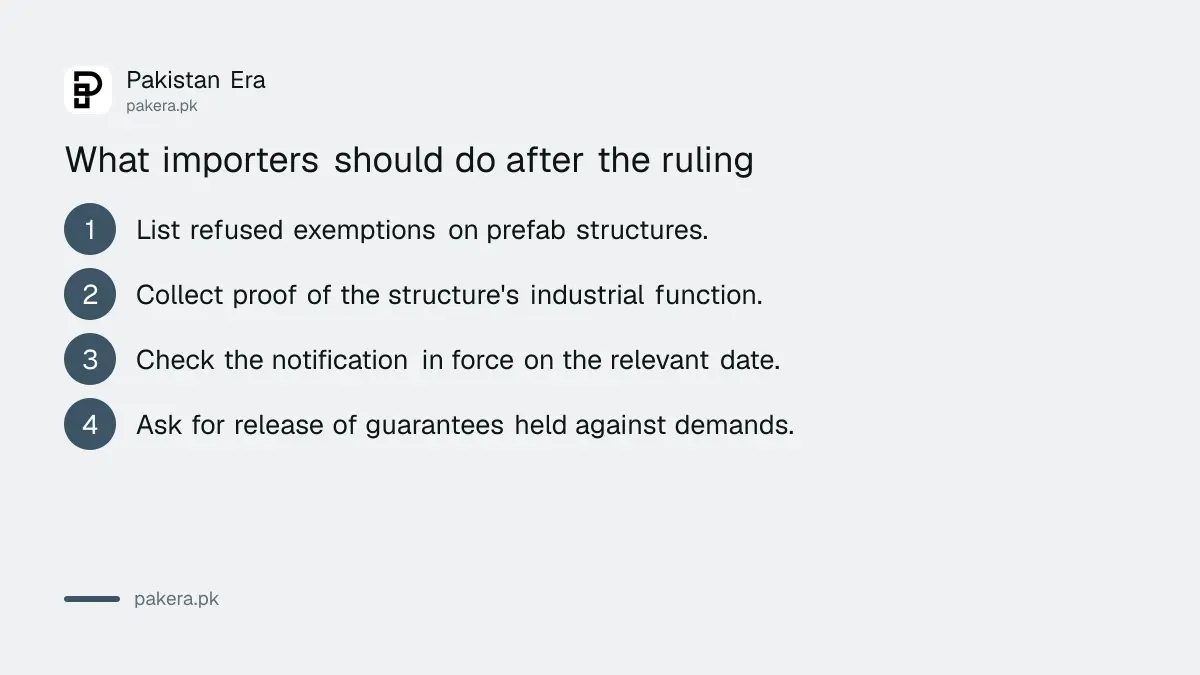
- List each goods declaration where an exemption on prefabricated or pre-engineered structures was refused or is disputed.
- Collect drawings, engineering reports and photos that show what the structure does in production, such as carrying crane rails or supporting process equipment.
- Check the notification in force on the relevant date under section 30 or 30A of the Customs Act 1969. The court said that date decides which notification applies.
- Ask your lawyer about release of any bank guarantee or pay order held against the demand. The court ordered securities in these cases released.
- For SEZ units, keep the Board of Investment verification the law requires, but do not accept a demand for section 34(2) approval to claim an existing benefit.
The general SEZ incentives are set out in the guide to SEZ Act benefits and duty exemption. Importers of second-hand plant should also check the used machinery import rules. Four days earlier the same bench struck down provincial charges on imports, covered in the report on the FCC infrastructure cess ruling.
Common questions
Can a prefabricated building get a customs duty exemption?
Yes, if it performs a real industrial function and meets the conditions of the exemption notification. The FCC said its classification as a building does not by itself rule it out.
Must the structure be attached to machinery?
No. The court said plant and equipment may do structural, protective, supporting or operational work without mechanical attachment to production machinery.
Are staff housing and offices in a factory exempt?
No. The court said ordinary accommodation and unrelated civil construction do not become exempt just because they sit inside an industrial unit or SEZ.
Which FBR memos did the court strike down?
Office memorandums dated 22 January 2021 and 2 March 2021, to the extent they excluded qualifying prefabricated industrial structures or required mechanical linkage.
Does an SEZ unit need section 34(2) approval for this exemption?
No. The court said section 34(2) approval concerns additional incentives and cannot be made a condition of an existing statutory exemption, though Board of Investment verification required by law still applies.
How we verified this
What we checked and where we read it.
We read the full judgment in C.A. Nos. 567, 568 and 569 of 2011 and F.C.P.L.A. No. 1576 of 2026, downloaded from the judgments page of the Federal Constitutional Court of Pakistan on 25 November 2026, where it is listed with an upload date of 24 November 2026. It was announced in open court on 23 November 2026 and is marked approved for reporting. Notification numbers and memo dates are as quoted in the judgment. Customs notifications are published by the Federal Board of Revenue. Last checked 25 November 2026.
About the author

Global Affairs & Political Economy Writer
Muhammad Hatim is a book lover who started writing because he enjoys it. At Pakistan Era he writes about international relations, geopolitics and the global economy, with a particular interest in South Asia and the forces behind current events.