Federal Constitutional Court Strikes Down Sindh and KP Infrastructure Cess on Imports and Exports
On 19 November 2026 the FCC struck down the Sindh and KP infrastructure cess on imports, exports and transit goods. What it means for demands and guarantees.
یہ صفحہ اردو میں پڑھیں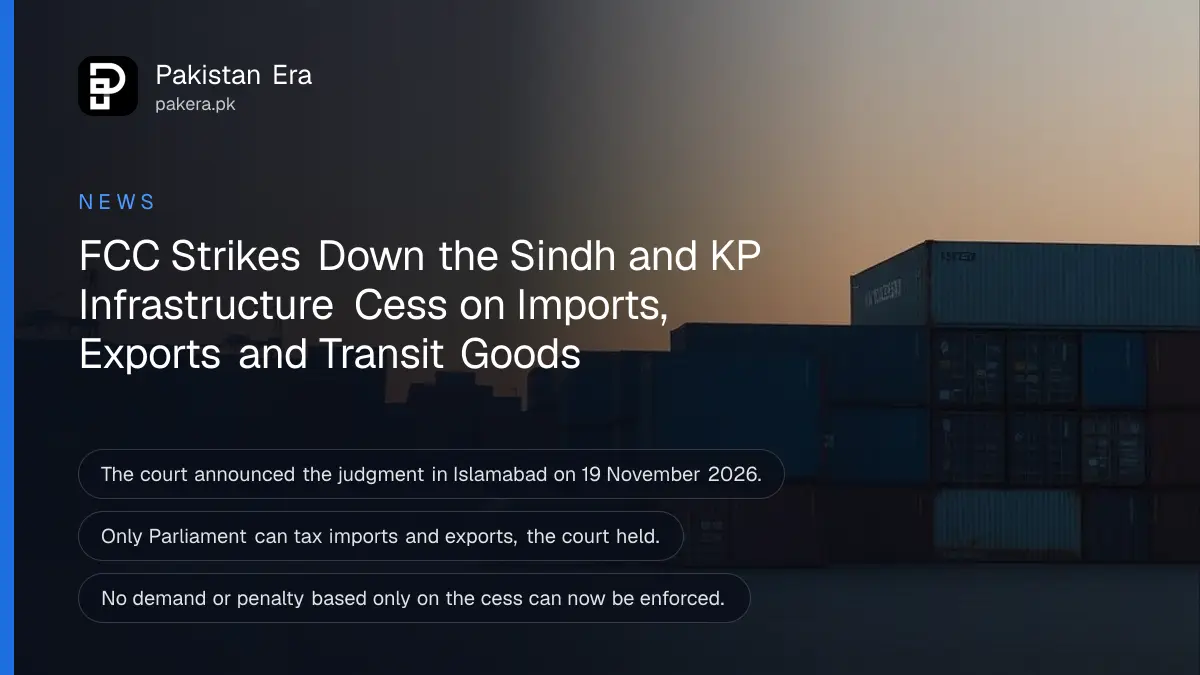
The Federal Constitutional Court of Pakistan has struck down the infrastructure cess that Sindh and Khyber Pakhtunkhwa charge on imported, exported and transit goods. The court announced the judgment in open court at Islamabad on Thursday 19 November 2026, and said no demand, surcharge or penalty based only on these charges can now be enforced.
The ruling decides a fight that importers, exporters and manufacturers have carried through the courts for years. The cess was charged on goods as they came in through Karachi's ports or crossed into Khyber Pakhtunkhwa, usually worked out on the customs value. The court held that only Parliament can tax imports and exports, so the provincial assemblies had no power to pass these charges in the first place.
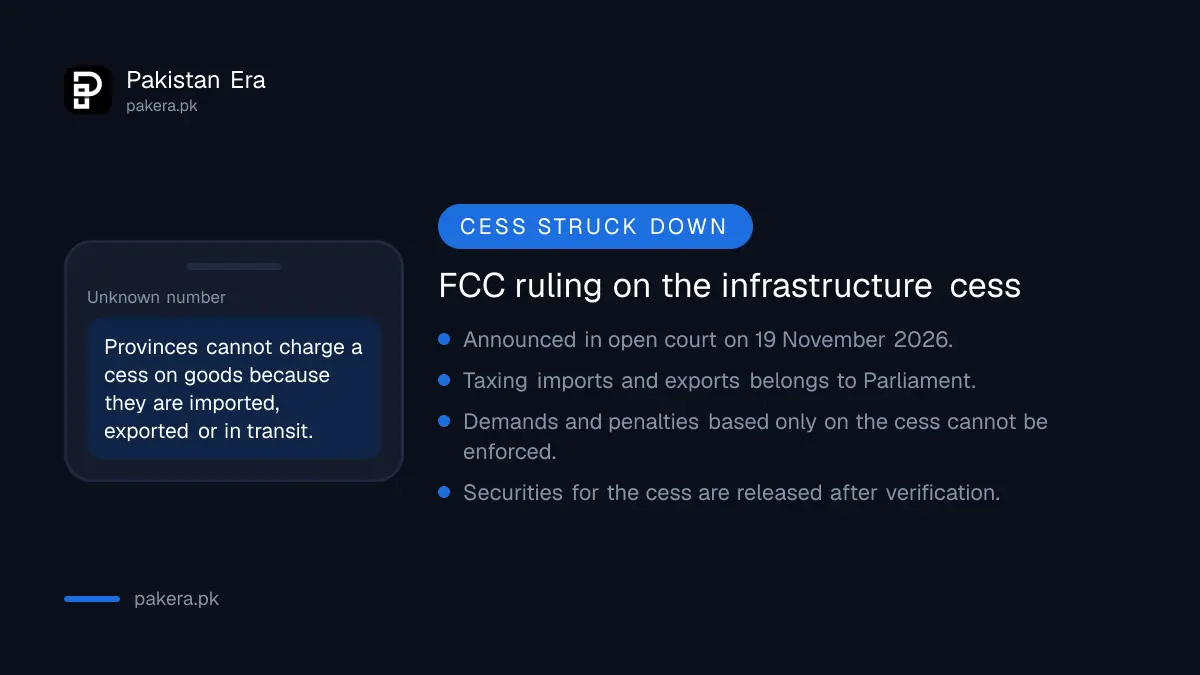
The Federal Constitutional Court ruled the cess unconstitutional
The court held that the Sindh and Khyber Pakhtunkhwa infrastructure cess on imports, exports and transit goods is outside provincial power. Taxing imports and exports belongs to Parliament under Entries 27 and 43 of the Federal Legislative List.
Chief Justice Amin-ud-Din Khan wrote the judgment, sitting with Justice Aamer Farooq. The lead case is C.A. No. 80 of 2020, filed by a Khyber Pakhtunkhwa ghee mill, and it was heard with several hundred connected appeals and petitions. These came from judgments of the Peshawar High Court, the High Court of Sindh and the High Court of Balochistan, plus writ petitions moved from the Lahore High Court. Hearings ran on 10, 11 and 12 November 2026. The judgment is marked approved for reporting.
The key test was simple. The court asked what event makes you liable to pay. For these charges, the answer was the goods entering or leaving Pakistan, or passing through a province. That makes the charge, in substance, a duty on imports and exports, whatever name the province gives it.
These are the provisions the court struck down
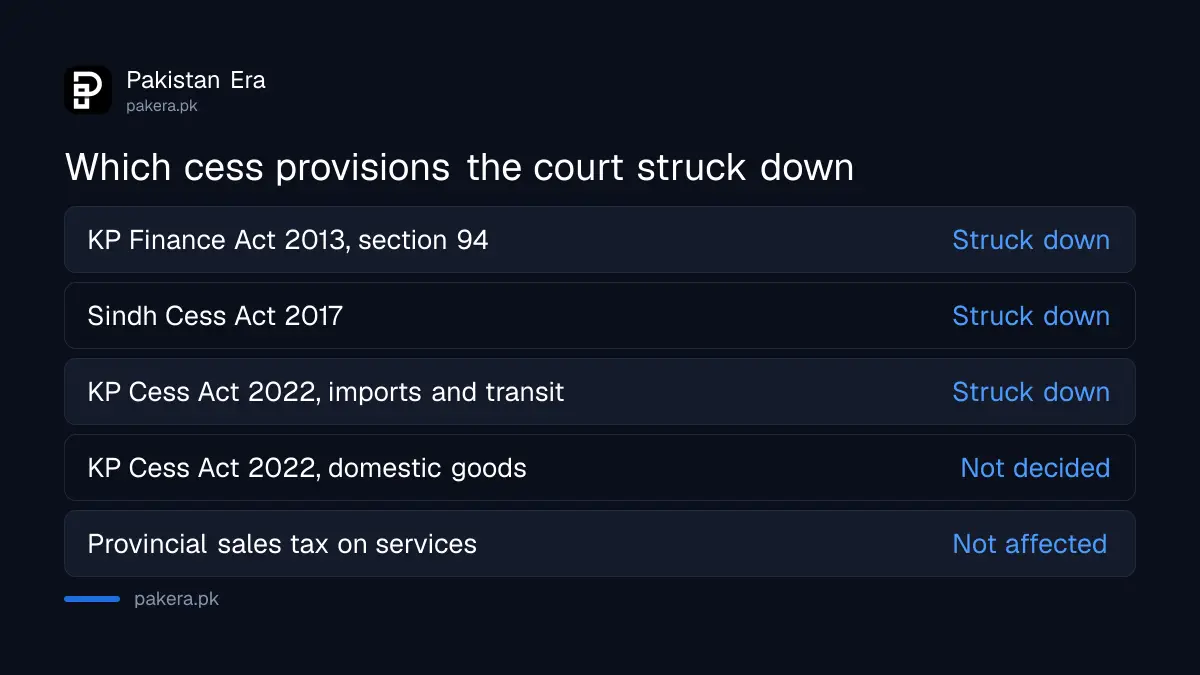
The court named the charges it declared invalid: the old Khyber Pakhtunkhwa cess under the Finance Act 2013, the Sindh cess under its 2017 Act, and the import, export and transit part of the 2022 Khyber Pakhtunkhwa cess law.
| Law | What it charged | Court's finding |
|---|---|---|
| Section 94, KP Finance Act 2013, and the 2014 cess rules | Goods entering or leaving KP from or for outside Pakistan, ad valorem on customs value | Unconstitutional |
| Sindh Development and Maintenance of Infrastructure Cess Act 2017 | Goods entering or leaving Sindh from or for outside Pakistan by air or sea, by customs value, weight and distance | Unconstitutional, including its back-dated effect from 1 July 1994 |
| Section 3(1)(b), KP Infrastructure Development Cess Act 2022, as amended in 2024 | A 2 per cent charge on imported, exported and transit goods | Unconstitutional |
| Section 3(1)(a) of the same KP Act | Domestic goods, from a notified date | Not decided |
All rules, notifications, assessments and recovery steps built on these charges fall with them. The court used a Latin maxim for this: when the foundation goes, the building goes.
Calling it a fee for roads did not save the cess
The provinces argued the money paid for roads and other infrastructure that trucks carrying imports use. The court said the purpose of spending cannot give a province a power the Constitution keeps with Parliament.
The judgment gave four reasons in plain terms:
- The charge followed value, not road use. A small, costly consignment could pay more than a heavy, cheap one that wears roads harder. The provinces showed no service linked to that value.
- Listing roads, police, schools and parks is not enough. A fee needs a real link between the people charged and a service they get.
- Customs collection does not help. Using federal customs officers to collect is an administrative matter. It cannot create legislative power.
- Back-dating cannot cure it. Sindh's Act claimed effect from 1 July 1994 and tried to validate past collections. A law the assembly had no power to make cannot be saved by a validation clause.
The court also pointed to Article 151 of the Constitution, which protects free trade across Pakistan. A charge on goods simply for entering, leaving or passing through a province works as a barrier inside the national market. The Additional Attorney General, the Revenue Division and the Federal Board of Revenue all supported the taxpayers on this point, though the court said its answer came from the Constitution itself, not from the Federation's view.
What importers, exporters and traders should do now
Demands, surcharges and penalties based only on these charges cannot be enforced, and securities given only for them are to be released after verification. Refunds and disputes over amounts still go through the normal process.
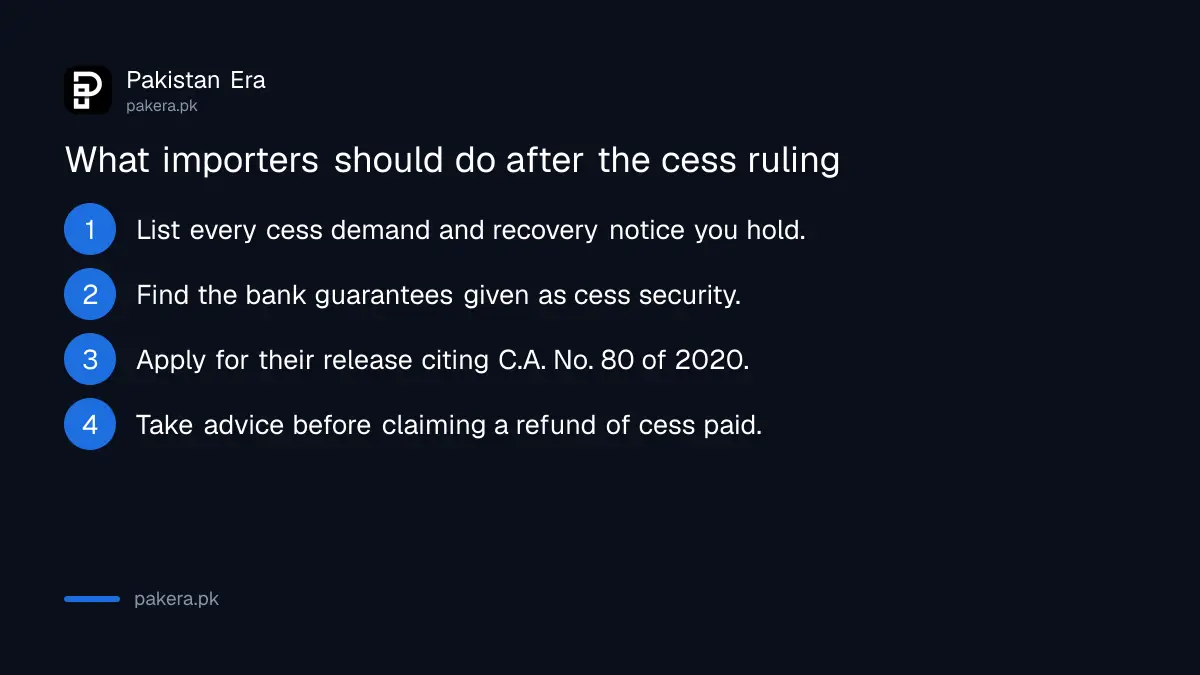
- List every cess demand, notice or recovery letter you have from the Sindh or Khyber Pakhtunkhwa excise and taxation departments.
- Find the bank guarantees or pay orders you gave as security for the cess, often at the time of customs clearance under an interim court order.
- Ask your lawyer or tax adviser to apply for the release of those securities, citing C.A. No. 80 of 2020 decided on 19 November 2026. The court said release happens on verification, and subject to any other order still in force on them.
- For cess you already paid, take advice on a refund claim. The court said disputes about payment, amounts and refunds stay with the proper administrative or judicial forum, so a refund is not automatic.
- Keep paying any purely domestic charge that is still in force until a court or the province says otherwise. The ruling did not decide those.
If you import a lot, the customs value on your goods declaration is the figure the old cess was worked out on. The import figures by product show how much trade passes through Pakistan's ports.
Provinces can still tax goods made and used inside them
The court left room for provinces. Sindh and Khyber Pakhtunkhwa may still pass properly drawn infrastructure or service charges on goods made and consumed within the province, as long as they rest on a real local service.
The judgment gave no final view on purely domestic charges, such as clause (a) of the 2022 Khyber Pakhtunkhwa Act. It also said that leaving that question open does not let a province collect the struck-down charge under a new label. Claims about the former tribal areas were not decided either, because the lack of legislative power settled the case.
Provinces have other taxes on businesses that are not affected. The KPRA sales tax on services and the Sindh sales tax on services rest on a different entry in the Constitution and still apply. So does the KP sales tax on construction services.
Common questions
Do I still have to pay the Sindh infrastructure cess on imports?
No demand based only on the Sindh cess on goods entering or leaving Sindh from or for outside Pakistan can be enforced after the 19 November 2026 judgment. Check any pending order in your own case with your lawyer.
Will I get back the cess I already paid?
Not automatically. The court said disputes over payments, amounts and refunds go through the proper administrative or judicial process, and it noted pleas such as finality and past and closed transactions depend on each case.
What happens to my bank guarantee for the cess?
Securities given only for the struck-down charges are to be discharged once verified, subject to any other order still governing them.
Does the ruling cover Punjab and Balochistan?
The provisions declared invalid are the Sindh and Khyber Pakhtunkhwa ones. Matters from Balochistan and Punjab were heard together, but the operative part names the Sindh and KP charging laws.
Can a province bring the cess back under another name?
Not on imports, exports or transit. The court said the reservation on domestic goods does not allow recovery of the invalid charge by relabelling it.
Where can I read the judgment?
It is on the court's judgments page under C.A. No. 80 of 2020. The search steps are in finding a Federal Constitutional Court judgment online.
How we verified this
What we checked and where we read it.
We read the full 59-page judgment in C.A. No. 80 of 2020 and connected matters on 20 November 2026. It is listed on the Federal Constitutional Court judgments page with an upload date of 20 November 2026, marked approved for reporting, and ends with the line that it was announced in open court at Islamabad on 19 November 2026. The provisions and the relief described above are taken from paragraphs 10 to 31 of the judgment. The rate of 2 per cent comes from the court's description of section 14 of the KP Finance Act 2024. The judgment does not give the total amount of cess collected or held in securities.
About the author

Tax, Bills and Technology Writer
Ali Akhtar is a young and curious voice here at Pakistan Era. He is currently pursuing his A-Levels and has a growing interest in Pakistan’s changing industrial landscape and educational trends. Ali likes to write in a way that helps him explain and explore the world around him. His writing reflects the perspective of the new generation navigating the evolving trends of Pakistan where technology, youth innovation, and shifting opportunities are reshaping the country’s future.