SBP's New Builder Loan Rules: Completion Date Must Be Public Before Booking, Failed Projects Go to a New Builder
SBP replaced its 2014 builder loan rules on 18 November 2026. We compared both: public completion dates, escrow, new borrowers and what buyers should check.
یہ صفحہ اردو میں پڑھیں
Short answer: The State Bank of Pakistan (SBP) issued new guidelines for bank loans to builders and developers on 18 November 2026, replacing the 2014 version. For people buying a flat or house on instalments, two changes matter most. A builder who takes a bank loan must make the approved layout plan and the completion timeline public before booking. And the loan agreement must say the project will be sold to another builder, or wound up, if the builder misses its deadlines.
We put the new SBP guidelines (SH&SFD Circular No. 09 of 2026) next to the 2014 guidelines they replace, clause by clause. Most of the text is the same. The changes that are new open bank loans to more kinds of developers, make some loans easier to approve, and add a few promises that protect buyers.
SBP replaced its 2014 builder loan rules on 18 November 2026
SBP's Small and Medium Housing and Small Finance Department sent the revised guidelines to all banks and development finance institutions (DFIs) on 18 November 2026. They replace the guidelines issued with circular No. 02 of 1 April 2014, which had stayed unchanged for more than 12 years.
SBP says the aim is to increase the supply of housing units that can be bought with a mortgage, and to strengthen housing finance in Pakistan. Banks have been told to implement them. These rules apply to loans a bank gives a builder for a project. They are not the rules for your own home loan, which sit under SBP's housing finance regulations and schemes such as the Apna Ghar programme.
Why should a buyer care? Most flats in Pakistan are sold off plan, on instalments, before the building exists. If the builder runs out of money, buyers are the ones left waiting. A builder backed by a bank loan under these rules is watched by the bank at every stage, and that is a real layer of protection.
The changes that protect flat and house buyers
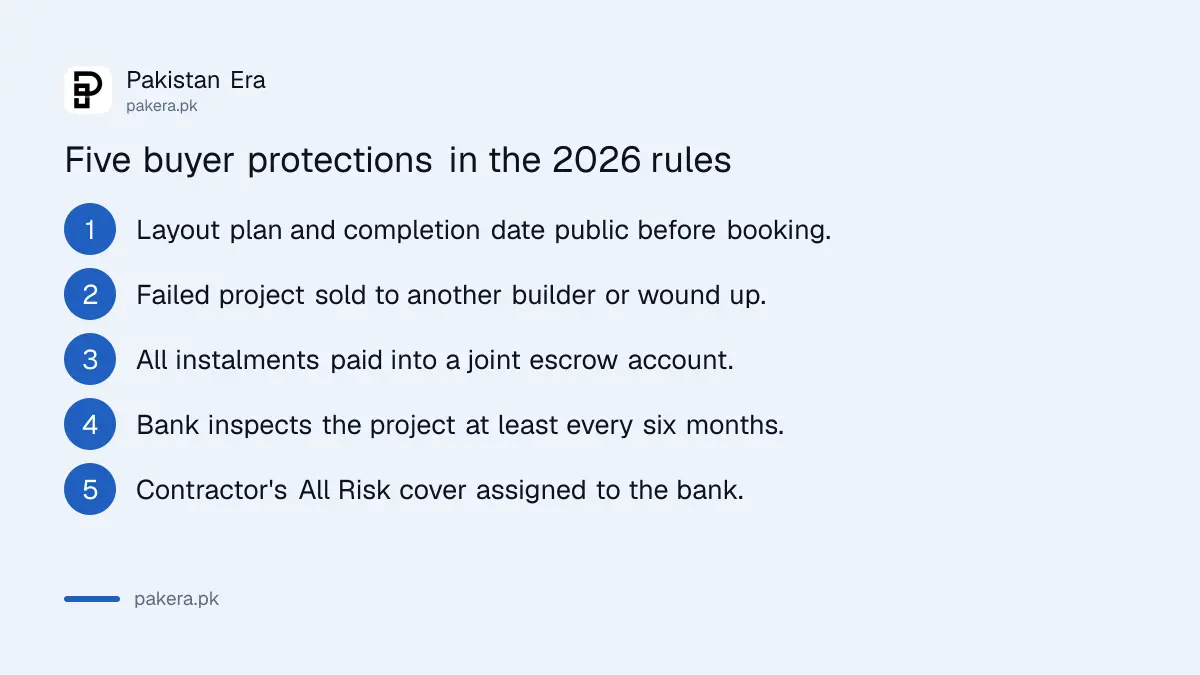
Two new clauses speak directly to buyers. The approved layout plan and the completion timeline must be made public before booking or allotment. And the builder's agreement with the bank must say the project will be sold or wound up if the builder fails its milestones or terms.
Here is what the 2026 guidelines say on each point, in plain words:
- Public plan and date: The builder must publicly disclose the approved layout plan and the project completion timeline before taking bookings or making allotments. The 2014 rules had no such clause.
- A fallback if the builder fails: The loan agreement must state that if the builder misses timelines or milestones, or breaks the financing terms, the project will be liquidated or sold to another builder to complete it, subject to legal formalities. This is new.
- Your instalments go into one account: All booking money and later instalments must go through a project escrow account, run jointly by the builder and the bank, so the money cannot be moved to another project. This was in 2014 too, but it is now written as "shall".
- Inspections every six months: The bank must inspect the project at least once every six months during construction, and each release of loan money must be certified by a technical consultant.
- Insurance on the building: The builder must hold Contractor's All Risk insurance or takaful for the project, assigned to the bank.
The fallback clause is the big one. A stalled project that can be handed to another builder has a far better chance of being finished than one that sits in court for years. That said, it is an agreement between the bank and the builder, and the words "subject to legal formalities" mean a handover will still take time.
Government housing bodies and REITs can now borrow too
The 2026 guidelines name new borrowers. Real Estate Investment Trusts (REITs) and public sector developers are now eligible, including the Federal Government Employees Housing Authority (FGEHA), the PHA Foundation and provincial housing authorities and town planning bodies.
A REIT is a fund that pools investors' money to own and develop property. The 2014 rules spoke only of builders and developers. The new list also covers any other public sector special purpose body later notified for a housing programme, and it lets government approved agencies monitor public projects alongside the bank.
The 2014 rule that a builder must have at least 3 years of experience is gone. A private builder must instead show a good track record, backed by a list of recently completed projects. A builder or team must still hold a valid licence from the building control authority where one applies, or an approved contract from a public sector body.
Loans to builders become easier to approve
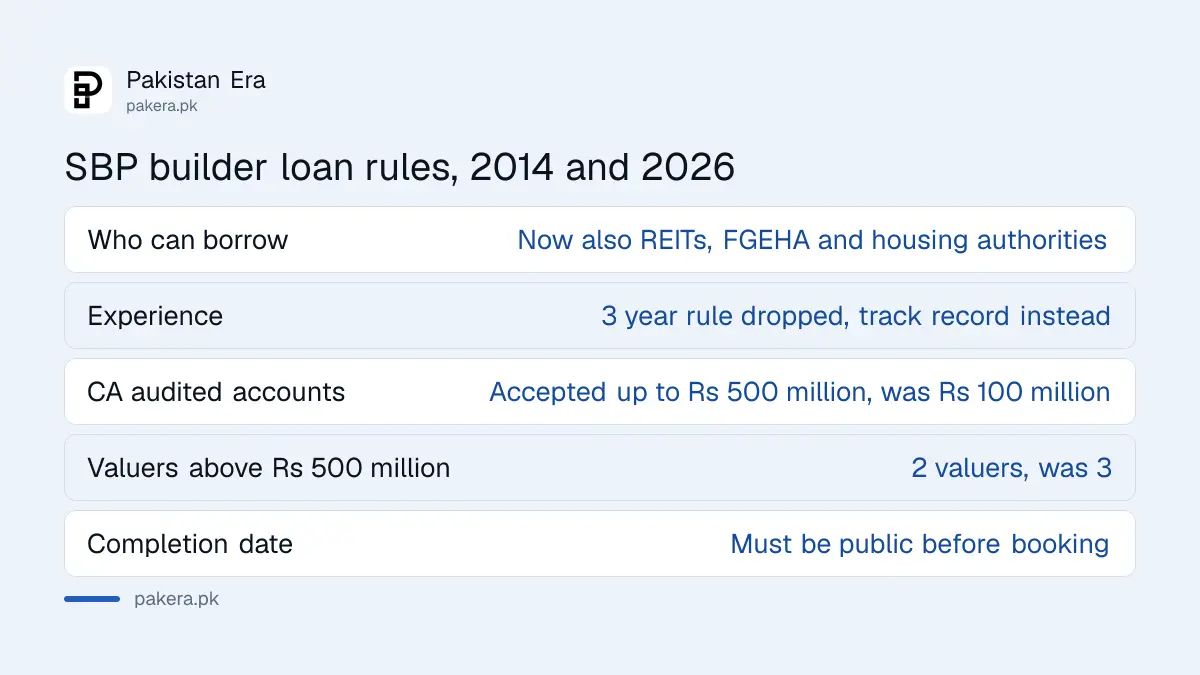
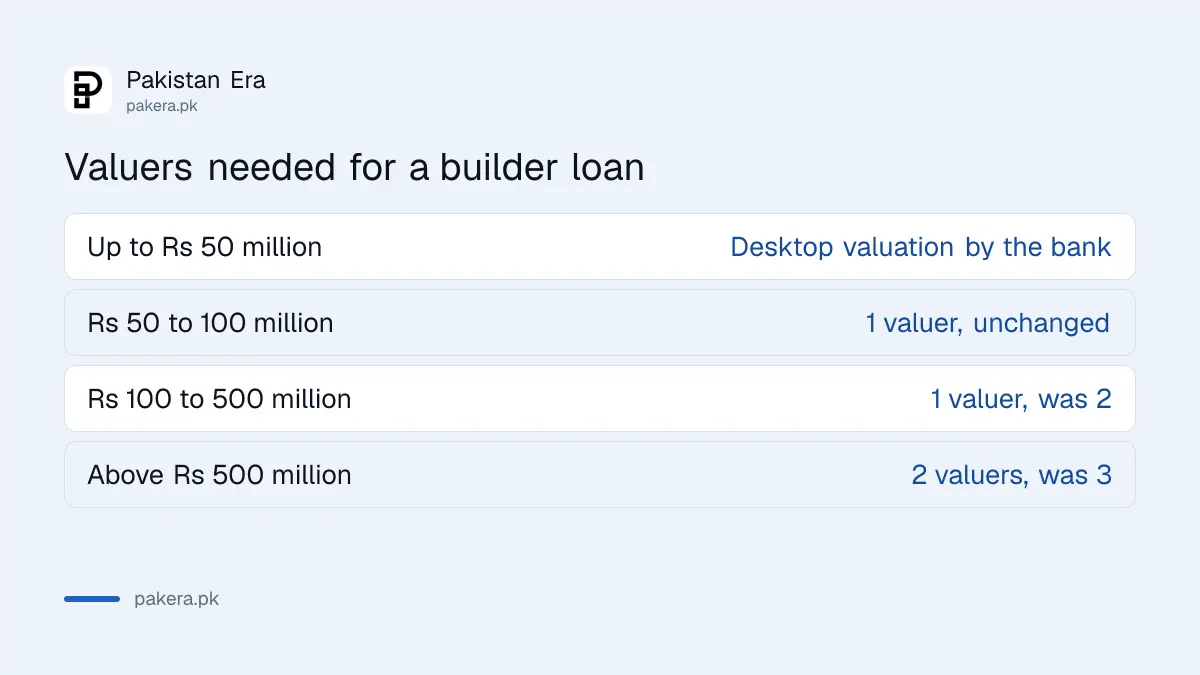
Several limits were loosened. Builders can now use the value of their land as their equity, audits by any practising chartered accountant are accepted for loans up to Rs 500 million instead of Rs 100 million, and fewer outside valuations are needed for each loan size.
| Rule | 2014 guidelines | 2026 guidelines |
|---|---|---|
| Who can borrow | Builders and developers | Builders, developers, REITs, FGEHA, PHA Foundation, provincial housing bodies |
| Experience | At least 3 years | Good track record, list of completed projects |
| Land as equity | Clear title land offered as equity | Land value counted as the builder's equity |
| Accounts by any CA or CMA firm | Up to Rs 100 million | Up to Rs 500 million |
| Loan up to Rs 50 million | No valuer rule listed | Desktop valuation by the bank |
| Rs 50 million to Rs 500 million | 1 valuer up to Rs 100 million, 2 above | At least 1 valuer |
| Above Rs 500 million | At least 3 valuers | At least 2 valuers |
| Builder with no property for collateral | Bank guarantee for foreign builders | Bank or corporate guarantee for any builder |
| Layout plan and completion date public before booking | Not required | Required |
Some clauses were dropped. The 2014 text let banks sanction a project loan for up to 5 years with a repayment break, and it had a separate leverage ratio section and a line on checking directors' credit records. None of these appear in the 2026 text, though banks still follow SBP's prudential regulations for corporate lending.
Horizontal projects, such as housing societies with plots and houses rather than towers, now need an approved master plan. If the project land cannot be mortgaged for a reason other than its title, the builder can offer another clear property instead.
How to check a builder before you book
Ask the builder whether the project has bank finance, then ask for the approved layout plan, the completion date and the escrow account details. A bank financed project must have all three, and your instalments should go only into that escrow account.
- Ask the builder which bank is financing the project. Write the answer down.
- Ask to see the approved layout plan and the public completion timeline. Under the new rules these must be disclosed before booking.
- Ask for the escrow account title and number, and pay every instalment into it by crossed cheque or bank transfer, never in cash.
- Check the building plan approval and the NOC for sale with the development authority. In Lahore and Rawalpindi that means the LDA or RDA, and where to complain is in complaints against a builder to the RDA or LDA.
- Check the official value of the land on the FBR valuation table for the area, such as the FBR valuation table for Lahore, so you know what the plot is worth on paper.
- Keep every receipt, the allotment letter and the payment plan in one file.
A builder without bank finance is not covered by these guidelines at all. That does not make the project bad, but none of the bank checks above apply, so the development authority approvals matter even more. Remember too that builders charge provincial sales tax on construction services, which can show up in your price, as set out in sales tax on builders and property dealers.
Common questions
When did SBP issue the new builder financing guidelines?
On 18 November 2026, through SH&SFD Circular No. 09 of 2026. They replace the guidelines issued on 1 April 2014.
Do these guidelines cover my own home loan?
No. They cover bank loans to builders, developers and REITs for housing projects. Your home loan falls under SBP's housing finance regulations and the bank's own policy.
Must a builder tell buyers the completion date?
Yes, if the project is financed under these guidelines. The approved layout plan and the completion timeline must be disclosed publicly before booking or allotment.
What happens if a bank financed builder stops work?
The agreement between the bank and the builder must say the project will be liquidated or sold to another builder to complete it, subject to legal formalities.
Can FGEHA and provincial housing authorities get bank loans now?
Yes. FGEHA, the PHA Foundation, provincial and territorial housing authorities and town planning bodies are named as eligible borrowers in the 2026 guidelines.
Where should I pay my instalments?
Into the project escrow account run by the builder and the financing bank. The guidelines require all booking money and instalments to pass through it, with payments by crossed cheque.
How we verified this
What we checked and where we read it.
Checked on 20 November 2026. We read SBP's circular page for SH&SFD Circular No. 09 of 2026 dated 18 November 2026 and its four page annex, "Guidelines for Builders/Developers Financing". We compared it clause by clause with the 2014 annex attached to IH&SMEFD Circular No. 02 of 2014, "Guidelines for Financing to Housing Builders/Developers". The valuation table in the 2026 annex prints its columns slightly out of line; we read it as desktop valuation up to Rs 50 million, one valuer up to Rs 500 million and two valuers above that, which matches the row order.
About the author

Tax, Bills and Technology Writer
Ali Akhtar is a young and curious voice here at Pakistan Era. He is currently pursuing his A-Levels and has a growing interest in Pakistan’s changing industrial landscape and educational trends. Ali likes to write in a way that helps him explain and explore the world around him. His writing reflects the perspective of the new generation navigating the evolving trends of Pakistan where technology, youth innovation, and shifting opportunities are reshaping the country’s future.