DRAP Orders Cough Syrup Makers in Pakistan to Test Glycerine and Sorbitol for DEG and EG This Winter
DRAP advisory of 20 November 2026 tells syrup makers to test every batch of glycerine, sorbitol and propylene glycol for DEG and EG. Rules and checks.
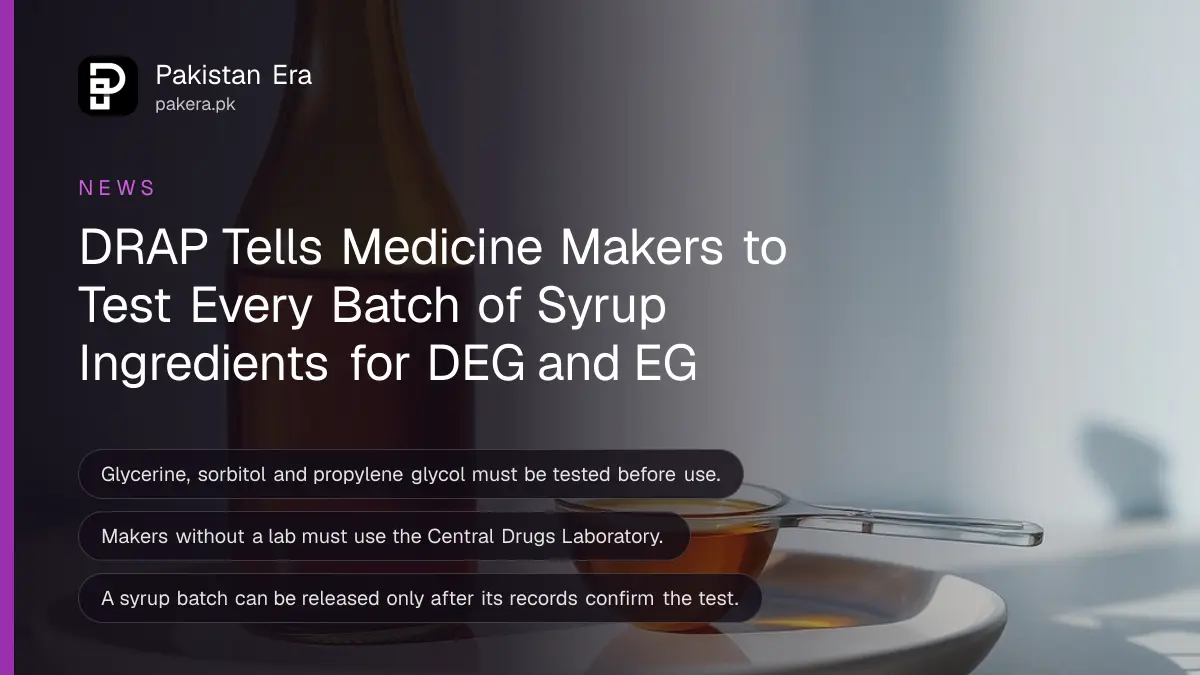
Short answer: DRAP has ordered every medicine maker in Pakistan to test glycerine, sorbitol and propylene glycol for two toxic chemicals, DEG and EG, before using them in cough syrups and other oral liquids this winter. A batch can be released only after its records show the test was done. The advisory is dated 20 November 2026.
The Drug Regulatory Authority of Pakistan (DRAP) posted the advisory, reference 666/2026-DDQA(VII), on its website at 12:41 pm on Friday 20 November 2026. It says demand for cough syrups and other oral liquid medicines is expected to rise with the start of winter. So it is repeating its quality rules before production picks up.
DEG is diethylene glycol and EG is ethylene glycol. Both are industrial chemicals used in products such as antifreeze. They can get into a medicine when a cheap or fake solvent is sold as pharmaceutical grade glycerine, sorbitol or propylene glycol. Even small amounts can damage the kidneys, and children are most at risk.
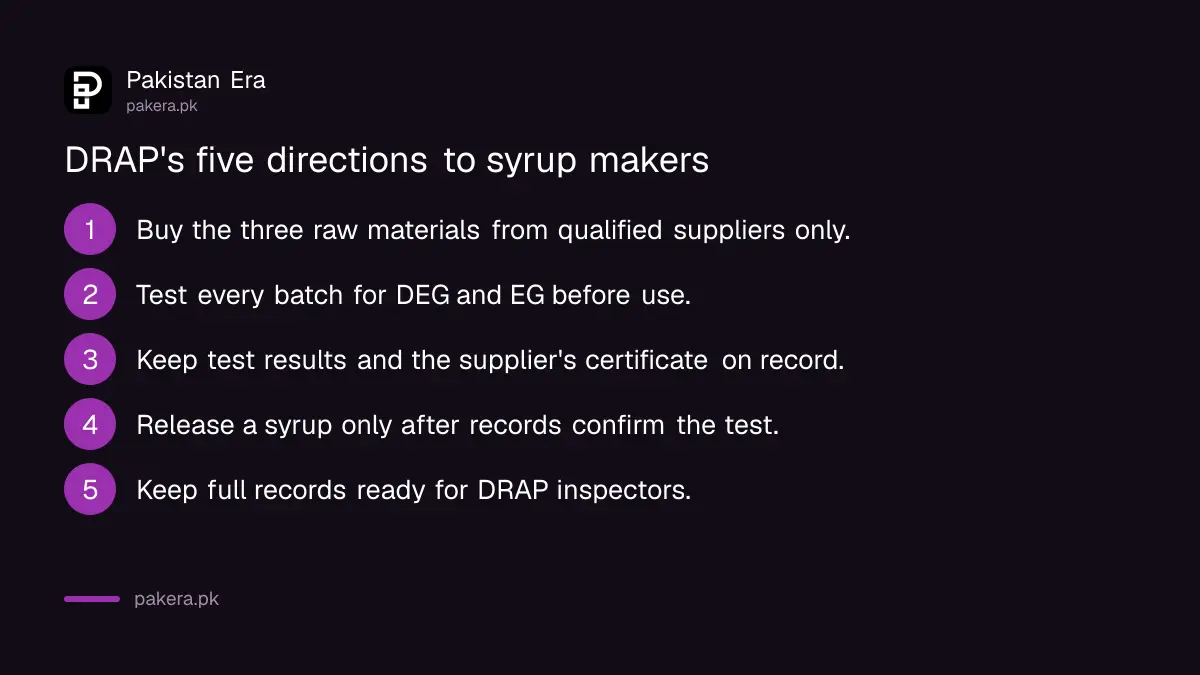
DRAP's five rules for syrup makers this winter
The advisory gives five directions. Makers must buy these three raw materials only from qualified suppliers, test every batch for DEG and EG before use, record the results, release finished syrups only after the records confirm the test, and keep full records for inspectors.
| Direction | What it requires |
|---|---|
| 1. Qualified suppliers only | Glycerine, sorbitol and propylene glycol must be bought from qualified vendors, checked under current Good Manufacturing Practice (cGMP) rules. |
| 2. Test before use | Every batch of these raw materials must be tested for DEG and EG before it goes into production. Makers without their own lab must use the Central Drugs Laboratory (CDL). |
| 3. Record the results | The test results and the supplier's Certificate of Analysis must be checked and kept in the Batch Manufacturing Record. |
| 4. Release only after checks | A finished oral liquid with these ingredients can be released only after the batch records confirm testing was done. |
| 5. Keep records for inspection | Makers must keep records of purchase, supplier details, test results and how each batch was used, and show them to inspectors. |
The advisory warns that breaking these rules will bring strict action under the Drugs Act, 1976 and the DRAP Act, 2012. It is signed by Ishtiaq Shafiq, Deputy Director (I&E), DRAP Islamabad.
The advisory follows two earlier DRAP orders on DEG and EG
This is the third DRAP advisory on the same risk. It continues advisory 13-30/2024-DD(QA-VIII) of 16 April 2025 and advisory 6-2/2025(DDQA VII) of 14 October 2025. The new one does not add a new test. It repeats the rules and ties them to the winter rise in syrup production.
The reason is simple. Glycerine, sorbitol and propylene glycol are used to sweeten and thicken syrups and to dissolve the medicine. They look and taste much like DEG and EG. A supplier who swaps or mixes them cannot be caught without a lab test. That is why DRAP wants a test on every batch, not just a paper certificate from the supplier.
Copies of the advisory went to the Pakistan Pharmaceutical Manufacturers Association, Pharma Bureau, the Pakistan Chemists and Druggists Association and the trade bodies for tibbi, homeopathic and alternative medicine makers. So it covers herbal and homeopathic syrups too, not only allopathic ones.
DRAP field offices and the Karachi lab are told to act
DRAP has asked its additional directors in Lahore, Karachi, Islamabad and Peshawar, and its Quetta office, to enforce the rules through the import and export deputy directors and area inspectors. The Central Drugs Laboratory in Karachi has been asked to test these samples on priority.
Fast lab results matter here. A maker with no lab of its own has to wait for the Central Drugs Laboratory before it can use a new drum of glycerine or propylene glycol. Priority testing keeps that wait short. Which labs DRAP uses for suspect medicines is explained in labs that test suspect medicines in Pakistan.
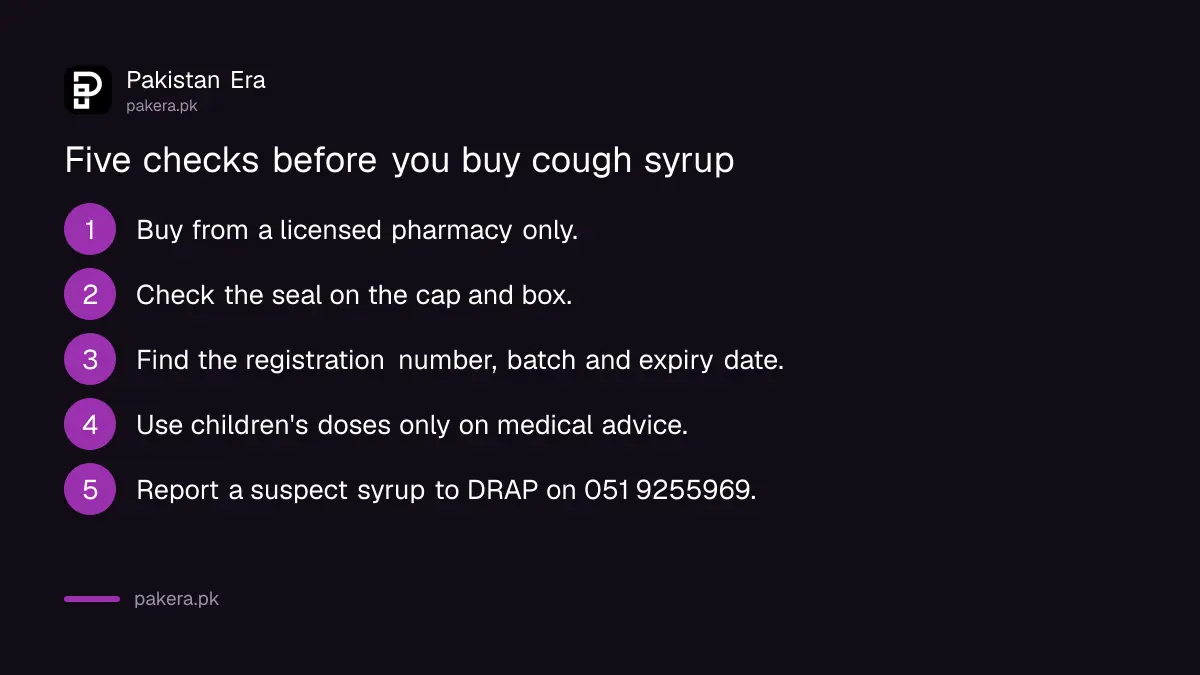
What parents should check before buying cough syrup
The advisory is aimed at factories, but parents can lower the risk at the counter. Buy only from a licensed pharmacy, check the pack is sealed and carries a registration number, batch number and expiry date, and give syrup only as a doctor or pharmacist advises.
- Buy from a licensed pharmacy, not a general store, a roadside stall or an online seller with no licence.
- Check the seal on the cap and box is not broken.
- Look for the DRAP registration number, the batch number and the expiry date on the pack.
- Check the maker's name and address are printed in full. The rules on what a pack must show are in DRAP medicine labelling rules.
- Do not give adult syrups to children, and do not give a cough syrup to a baby without a doctor's advice.
- Keep the pack and receipt until the course is finished.
Most coughs and colds in children get better on their own in about a week. Signs that need a doctor, such as fast breathing or a high fever that will not come down, are listed in how to tell a cold from flu.
Signs of DEG or EG poisoning and where to report
Poisoning from DEG or EG can show up as passing little or no urine, vomiting, stomach pain, drowsiness or confusion after a liquid medicine. If a child shows these signs after a syrup, go to a hospital emergency at once and take the bottle with you.
Report any syrup you suspect to DRAP on 051-9255969 or gsms@dra.gov.pk, with the product name, batch number and where you bought it. The full process is in how to report a counterfeit medicine to DRAP. DRAP's recalls of named batches are collected in the full list of DRAP recall alerts for 2026.
Common questions
What are DEG and EG in cough syrup?
DEG is diethylene glycol and EG is ethylene glycol. They are toxic industrial chemicals that can contaminate syrup ingredients such as glycerine, sorbitol and propylene glycol.
Has DRAP recalled any cough syrup in this advisory?
No. The 20 November 2026 advisory names no product or batch. It is a set of rules for makers. Recalls of named batches come as separate DRAP alerts.
Which ingredients must be tested?
Glycerine, sorbitol and propylene glycol. Every batch bought must be tested for DEG and EG before use, in the maker's own lab or at the Central Drugs Laboratory.
Does the advisory cover herbal and homeopathic syrups?
It is addressed to all therapeutic goods makers. Copies went to the tibbi, homeopathic and alternative medicine makers' associations as well as the main pharma bodies.
What happens to a maker that ignores the rules?
DRAP says non-compliance will bring strict regulatory action under the Drugs Act, 1976 and the DRAP Act, 2012 and the rules made under them.
How do I report a suspect syrup?
Call DRAP on 051-9255969 or email gsms@dra.gov.pk with the product name, batch number and seller. Keep the bottle and the receipt.
How we verified this
What we checked and where we read it.
We checked these DRAP pages on 20 November 2026, about 2:50 pm PKT:
- The DRAP advisory page on DEG and EG contamination in oral liquids, posted 20 November 2026 at 12:41 pm.
- The two-page signed advisory PDF, reference 666/2026-DDQA(VII), dated 20 November 2026, for the five directions, the earlier advisories and the copy list.
- The DRAP November 2026 archive, for the posting time.
The advisory numbers its paragraphs 1, 2 and 4, with no paragraph 3. We have followed its content, not its numbering. The poisoning signs above are general medical guidance, not part of the advisory.
About the author

Technology Journalist & Multimedia Producer
Ahmad Ali is a technology journalist and multimedia producer at Pakistan Era, joining the team in October 2026. He covers consumer technology and digital life for Pakistani readers, combining research with hands-on product testing.