Check a Medicine Pack Label in Pakistan: 11 Details DRAP's Rules Require
Every medicine pack in Pakistan must show 11 details, from generic name and DRAP number to batch, expiry and price. Learn to check a label in one minute.
Every medicine pack sold in Pakistan must print 11 details by law: the brand name, the generic name in brackets, the strength, the maker's name and address, the manufacturing licence number, the DRAP registration number, the batch number, the manufacture date, the expiry date, the maximum retail price and Urdu instructions. From 9 October 2026, allopathic medicine packs also need a 2D barcode. A pack missing any of these is a warning sign.
These rules come from the Drugs (Labelling and Packing) Rules, 1986. The Drug Regulatory Authority of Pakistan (DRAP) published a copy updated to September 2026 on its website. We read all 15 rules and both schedules on 20 October 2026. The checks below take one minute at the pharmacy counter.
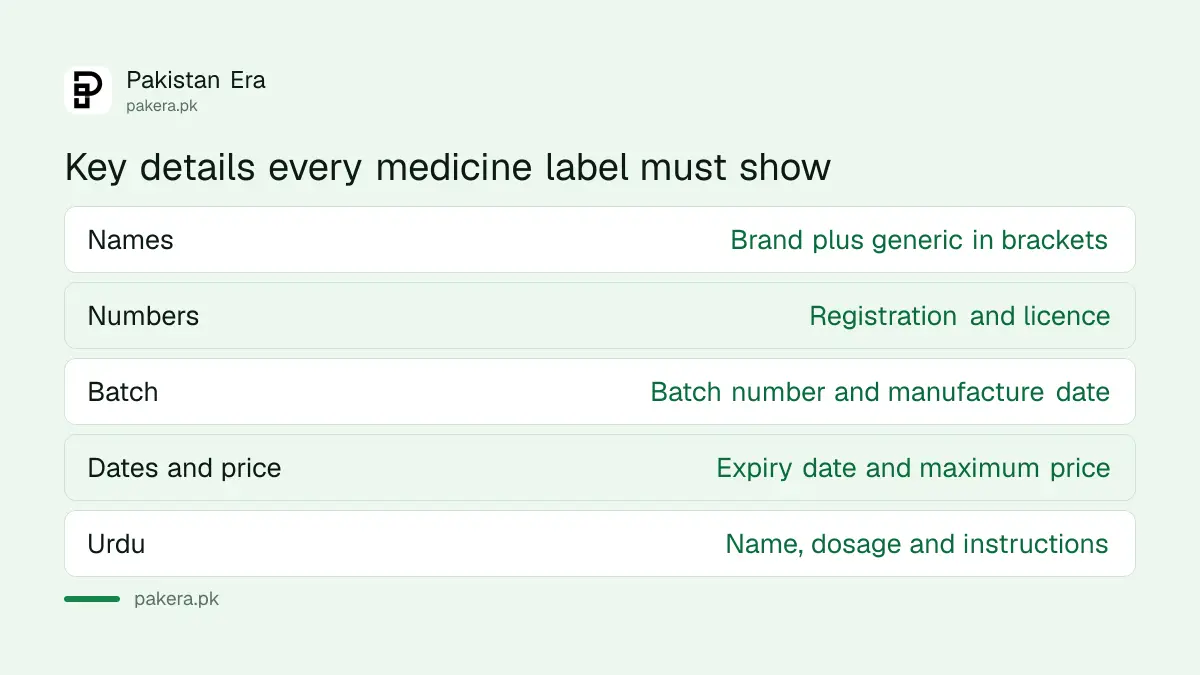
Rule 3 lists 11 details every medicine label must carry
Rule 3 says these details must appear in print or indelible ink, clearly, on the inner container and on the outer box. Most are plain facts: names, numbers and dates. If one is missing, ask the pharmacist before you pay.
| Detail on the label | What to look for |
|---|---|
| Registered name | The brand name DRAP registered |
| Generic name | In brackets right after the brand, at least as large |
| Strength | Amount of each active ingredient, per tablet or per ml |
| Maker | Name and main place of business |
| Manufacturing licence number | Often printed as DML No. |
| Registration number | Often printed as Reg. No. |
| Expiry date | Month and year |
| Urdu text | Name, dosage and instructions in Urdu |
| Batch number | Needed to match any DRAP recall |
| Manufacture date | When this batch was made |
| Maximum retail price | The most any shop may charge |
The generic name rule is one many people miss. If a brand name is printed, the generic name must follow it in brackets "with at least equal prominence". So a pack that shouts the brand and hides the medicine's real name in tiny type is not following the rule.
Strips and blisters can carry less, but the box cannot
A strip, blister, foil or an ampoule of 2 ml or less can leave the batch number, manufacture date and price to the outer box. The rule allows this. So keep the box until the strip is finished, because the batch is how you match a recall.
The same exception covers printed tubes of cream. In practice, a loose strip sold without its box gives you no batch number and no price. That is a good reason to ask for the box, or at least to note the batch the pharmacist reads from it.
You need that batch number for checking whether a medicine batch is recalled, and the registration number for checking that a medicine is registered with DRAP.
Five special wordings tell you who the pack was meant for
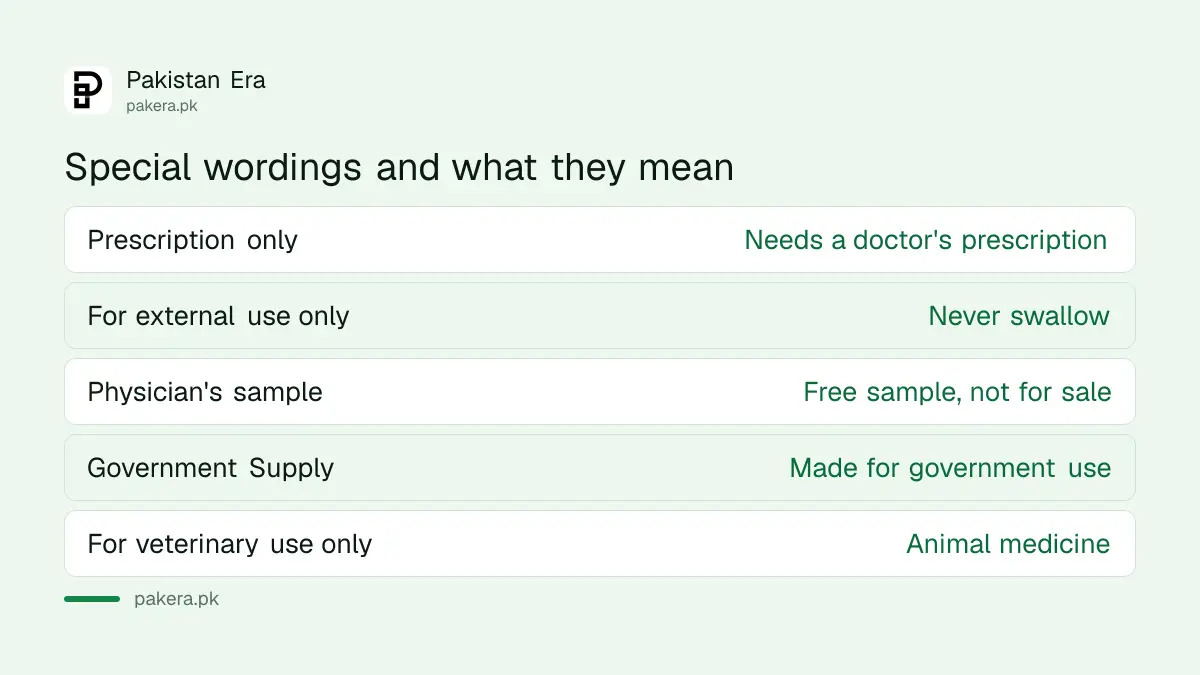
Rules 4 to 8 add printed warnings for special cases. A pack marked "Physician's sample: not for sale" or "Government Supply" should not be on sale at a private counter. Those words tell you the pack was meant for someone else.
| Words on the pack | What it means |
|---|---|
| To be sold on the prescription of a registered medical practitioner only | Contains a Schedule substance, needs a prescription |
| For external use only | Creams, lotions, antiseptics, never to swallow |
| Poison; for external use only | External product with a Schedule substance |
| Physician's sample: not for sale | Free sample for doctors |
| Government Supply | Made for a government hospital or agency |
| For veterinary use only | Animal medicine, preferably printed in red |
Schedule I lists the groups that need the prescription wording: stimulants of the nervous system, drugs that act on the womb, drugs that block hormone production, hormones and steroids taken by mouth or injection, narcotics and psychotropic drugs. A medicine for internal use with 3 per cent alcohol or more must also state its alcohol content.
Allopathic packs need a 2D barcode from 9 October 2026
Rule 3A, added by S.R.O. 963(I)/2026 on 9 June 2026, makes a GS1 barcode compulsory four months later. The barcode carries the product code, batch, expiry and a unique serial number. It applies to allopathic medicines, including biologicals, for people and animals.
It does not apply to alternative medicines, health and OTC non-drug products, nutraceuticals, medical devices, medical gases or radiopharmaceuticals. So a herbal syrup or a vitamin sold as a health product will not have this barcode, and that alone is not a sign of a fake. DRAP's notice on 2D barcodes on medicine packs explains the start date.
The rule also says the printed text under the barcode must match the details in Rule 3. If the batch or expiry in the human-readable line does not match the rest of the box, that is worth a question.
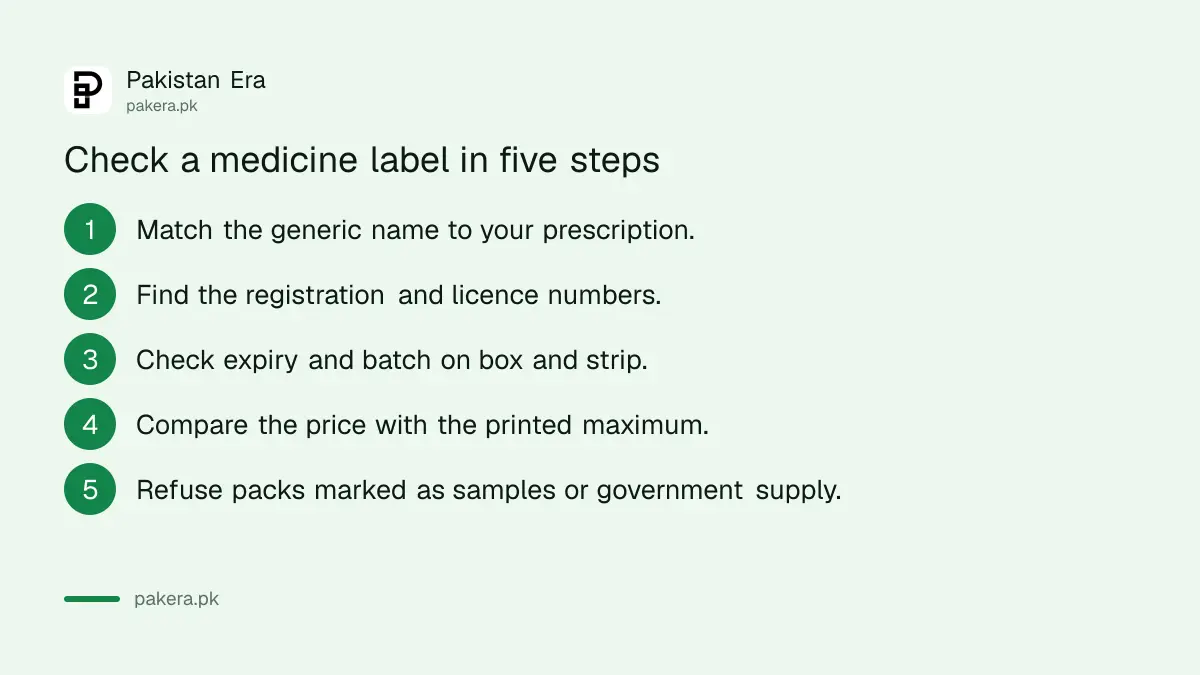
Check a medicine label at the counter in five steps
You do not need any tools to check a label. Hold the box, read it in good light and compare it with the list. The whole check takes about a minute, and a good pharmacist will not mind you doing it.
- Read the brand name and the generic name in brackets. Make sure the generic is the medicine your doctor wrote.
- Find the registration number and the manufacturing licence number.
- Check the expiry date and the batch number on the box and on the strip.
- Compare the price you are charged with the printed maximum retail price.
- Look for "Physician's sample" or "Government Supply". If you see either, do not buy it.
If the price is above the printed figure, the shop is charging more than the maximum. DRAP sets that maximum, so even talk of a new medicine price rise in 2026 does not let a shop charge above the box. If a pack looks wrong, you can report a fake medicine to DRAP.
Common questions
Which law sets medicine label rules in Pakistan?
The Drugs (Labelling and Packing) Rules, 1986, made under the Drugs Act, 1976. DRAP publishes a copy updated to September 2026.
Must a medicine label be in Urdu?
Yes, in part. Rule 3(h) requires the registered name, the dosage and the instructions in Urdu. Numbers in English are enough for the dosage.
Is a medicine without a 2D barcode fake?
Not always. The barcode rule covers allopathic medicines only, and stock made before 9 October 2026 may still be on shelves. Herbal and health products are excluded.
Can a pharmacy sell a physician's sample?
No. Rule 6 requires the words "Physician's sample: not for sale" on free samples meant for doctors. A sample on sale is a red flag.
What does "Government Supply" on a pack mean?
It means the pack was made for a government hospital or agency. Rule 7 requires that wording, so it should not appear at a private shop.
Why should I keep the medicine box?
Strips and blisters may leave the batch, manufacture date and price to the box. Without the box, you cannot match a DRAP recall.
How we verified this
What we checked, where we read it, and what we could not confirm.
Last checked 20 October 2026. We read the full text of the Drugs (Labelling and Packing) Rules, 1986, as amended till September 2026 on DRAP's website, including Rules 1 to 15 and Schedules I to III. The 9 October 2026 barcode date is our arithmetic from Rule 3A (four months after S.R.O. 963(I)/2026 of 9 June 2026) and matches DRAP's own notice. We did not check how many packs on sale follow these rules, and we did not test any medicine.
About the author
Public Services and Education Journalist
Fajr Riaz is a journalist and content writer at Pakistan Era, based in Lahore. She covers the questions people meet in everyday life in Pakistan: how a public service works, what a change in the rules means, and where to find a reliable answer.