Federal Constitutional Court Posts Adjournment Form: Counsel's Absence Is Not Sufficient Cause
The Federal Constitutional Court posted an adjournment form on 9 October 2026. Its Rules say counsel's absence is no cause. See the form and the costs risk.
Short answer: The Federal Constitutional Court has posted a standard Request of Adjournment form on its Notifications page, dated 9 October 2026. Under its 2026 Rules, a lawyer's absence, personal inconvenience or work in another court is not sufficient cause for an adjournment. The request must be in writing and give a real reason.
For years, many lawyers have treated "I am busy in another court" as a reason to ask for the next date. The Federal Constitutional Court's rulebook says in plain words that it is not. The new form is the paper that has to carry the reason instead.
We downloaded the form from the Court's Notifications page on 11 October 2026 and read it. We also read Order XXI and Order XXIX of the Federal Constitutional Court (Practice and Procedure) Rules, 2026, as printed in the Gazette of Pakistan, Extraordinary, dated 16 September 2026. We did not file an adjournment request ourselves.
The Court posted an adjournment form on 9 October 2026
The Notifications page of the Federal Constitutional Court lists "Adjournment Form" with the date 9 October 2026. It is a two-page document headed "Request of Adjournment on behalf of Petitioner/Respondent". The same website also has an online Case Adjournment page under its e-Services.
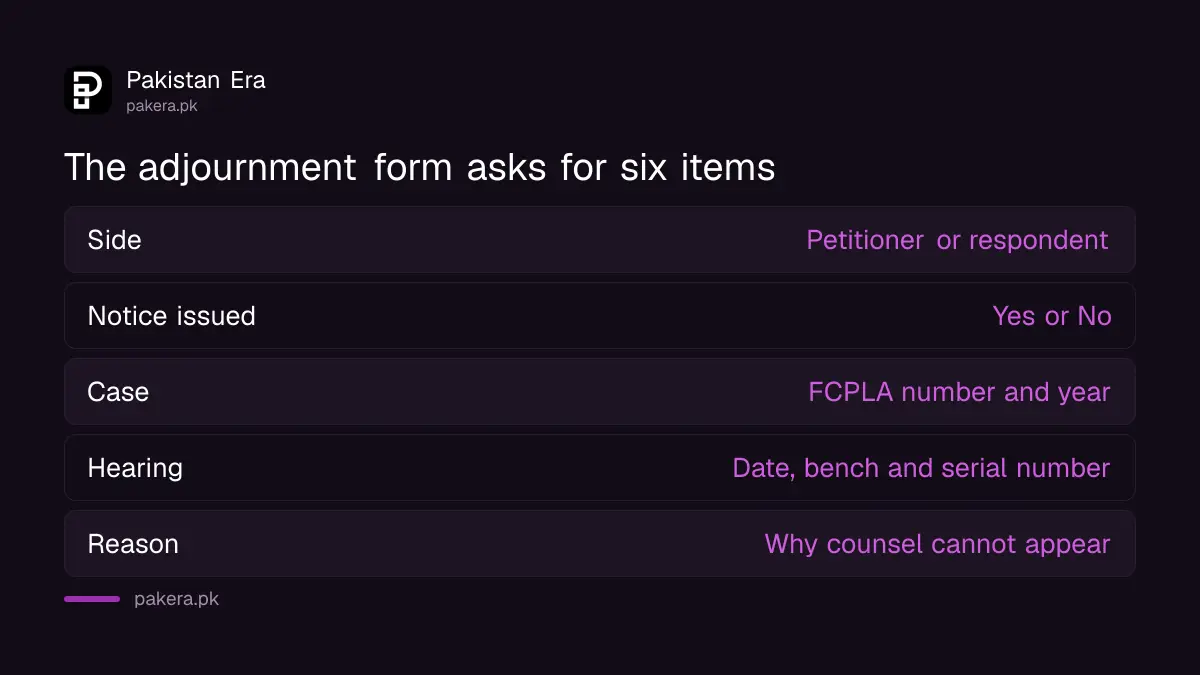
The form is for a case pending as an FCPLA, which is the Court's short form for a petition for leave to appeal. It asks for the applicant's side, whether notice has already been issued to the respondent by the bench, the case number, the hearing date, the regular bench number and the serial number on the cause list.
| Item on the form | What you fill in |
|---|---|
| Application on behalf of | Petitioner(s) or respondent(s) |
| Notice issued to respondent by the bench | Yes or No |
| Case number | FCPLA No. and year |
| Hearing | Date, Regular Bench number and serial number, at the principal seat in Islamabad |
| Reason | The cause that stops counsel from appearing on that date |
| Signed by | Advocate Supreme Court, counsel for the petitioner or respondent, with date |
The Rules say counsel's absence is not enough
Order XXI rule 2 says the absence, non-availability, personal inconvenience or professional engagement of counsel elsewhere shall not be sufficient cause for adjournment. An adjournment is an exception, not a matter of right, and the Court may refuse a request that is vague, casual or unnecessary.
The same rule says no adjournment shall be granted except on a written application filed by the Advocate-on-Record or by a party appearing in person. A request by letter, fax, email or any other mode "shall ordinarily" not be entertained. Where the Court has fixed a specific date, no adjournment shall ordinarily be granted on that date.
The Court may still grant an adjournment where a genuine emergency, an unavoidable circumstance or another sufficient cause is shown to its satisfaction.
The Advocate-on-Record must still assist the Court
Rule 2(3) of Order XXI says that if the engaged counsel cannot appear for any reason, the Advocate-on-Record remains under an obligation to assist the Court and to proceed with the matter, unless the Court directs otherwise. A missing lead lawyer therefore does not by itself stop a hearing.
An Advocate-on-Record is the lawyer whose name must be on the case in this Court. Our page on filing a Supreme Court case without a lawyer explains how the party-in-person route works in the apex court.
A weak request can bring costs or dismissal
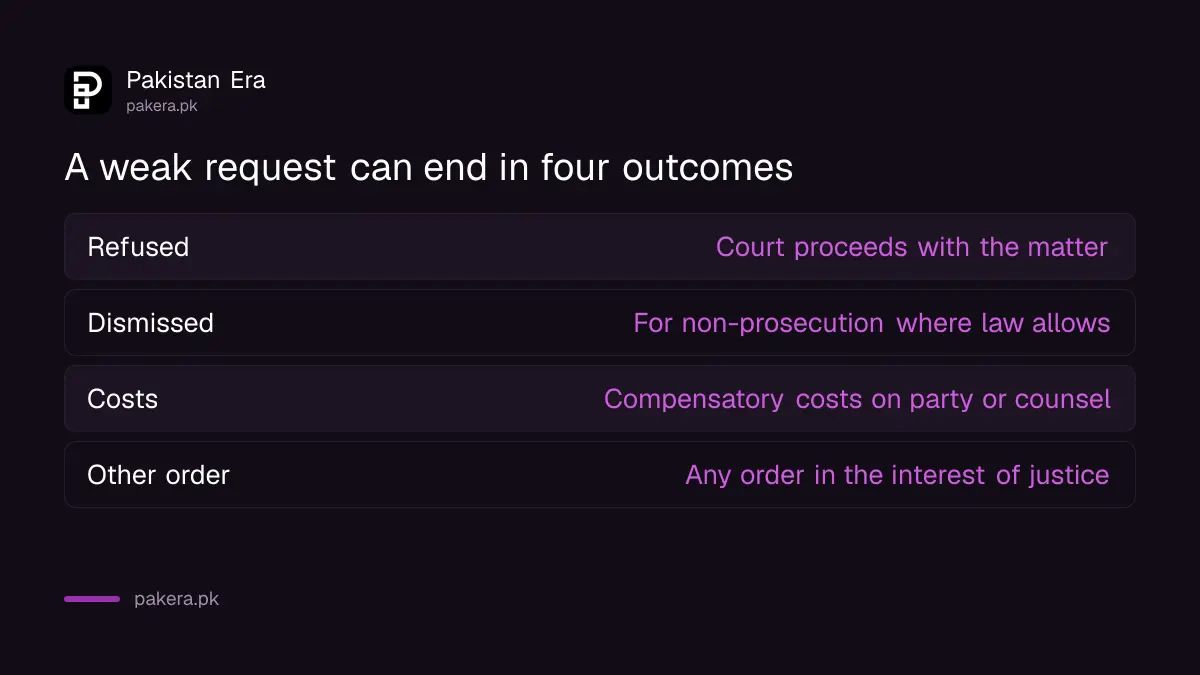
Order XXI rule 2(5) lets the Court refuse the adjournment and proceed, dismiss the matter for non-prosecution where law allows, impose compensatory costs on the party, counsel or Advocate-on-Record, or pass another order. Order XXIX Part A rule 3 repeats the power to impose compensatory costs for an adjournment sought without sufficient cause.
- The Court can refuse the adjournment and go on with the matter.
- It can dismiss the matter for non-prosecution, where the law permits.
- It can impose compensatory costs on the party, counsel or Advocate-on-Record.
- It can pass any other order needed for fair and quick disposal.
Order XXIX Part A rule 1(2) adds that, unless the Court directs otherwise, costs awarded shall not be less than Rs 25,000. That is the general costs rule, not a fixed price for adjournments, so the amount in a given case is for the Court.
If your problem is time rather than an absent lawyer, check the date first. Our page on checking the cause list of the Federal Constitutional Court shows where the bench number and serial number come from.
What is not yet clear
The form does not say how the Court will decide a request, or whether the online Case Adjournment page replaces the paper form. The Notifications page gives the date of the form but no covering order. We have not seen a practice direction on it. Ask the Registry before you rely on either route.
Common questions
Can a lawyer get an adjournment because he is busy in another court?
No. Order XXI rule 2(2) of the 2026 Rules says professional engagement of counsel elsewhere is not sufficient cause.
Can I ask for an adjournment by email or letter?
Ordinarily no. The Rules say a request by letter, fax, email or any mode other than a proper application shall ordinarily not be entertained.
Who must file the application?
The Advocate-on-Record, or the party appearing in person. The form itself is signed by an Advocate Supreme Court as counsel.
Is there an online way to apply?
The Court's website has a Case Adjournment page under e-Services, which asks for the case type, number, registry and year. We did not submit it.
What happens if the reason is weak?
The Court may refuse, dismiss for non-prosecution where allowed, or impose compensatory costs on the party, counsel or Advocate-on-Record.
How we verified this
What we checked, where we read it, and what we could not confirm.
Last checked on Sunday 11 October 2026. We read the Notifications page of the Federal Constitutional Court, the Request of Adjournment form posted on it, the Case Adjournment e-Services page, and the Federal Constitutional Court (Practice and Procedure) Rules, 2026. The date of the form is as listed on the Notifications page.
About the author

Public Services and Education Journalist
Fajr Riaz is a journalist and content writer at Pakistan Era, based in Lahore. She covers the questions people meet in everyday life in Pakistan: how a public service works, what a change in the rules means, and where to find a reliable answer.