Pakistan Federal Government New Hires From 1 July 2026: Ad Hoc Relief 2023 and 2024 Explained
New federal employees in Pakistan from 1 July 2026 get ad hoc relief 2023 and 2024 on the 2022 minimum pay, plus 7%. See the rates and a worked example.
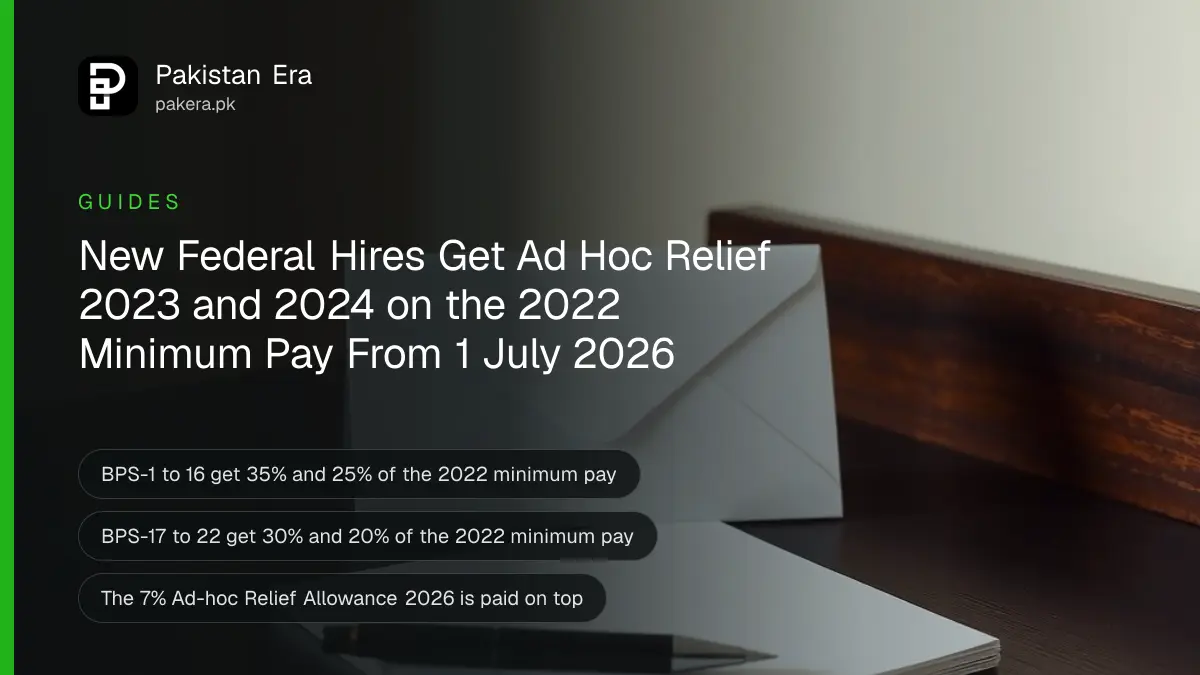
Federal civil employees who join from 1 July 2026 get Ad-hoc Relief Allowance 2023 and 2024 at fixed notional amounts, worked out on the minimum of the old 2022 pay scale. They also get the 7 percent Ad-hoc Relief Allowance 2026. Existing staff keep the older allowances frozen at their 30 June 2026 level.
The Finance Division explained this in an Office Memorandum dated 4 August 2026. People had asked how the 2023 and 2024 ad hoc allowances work now that the Revised Basic Pay Scales 2026 are in force. We read the memorandum on finance.gov.pk, along with the 21 July pay order and the 27 July order for autonomous bodies. This page explains what a new hire should expect on the first payslip.
New hires get two older allowances on a notional basis
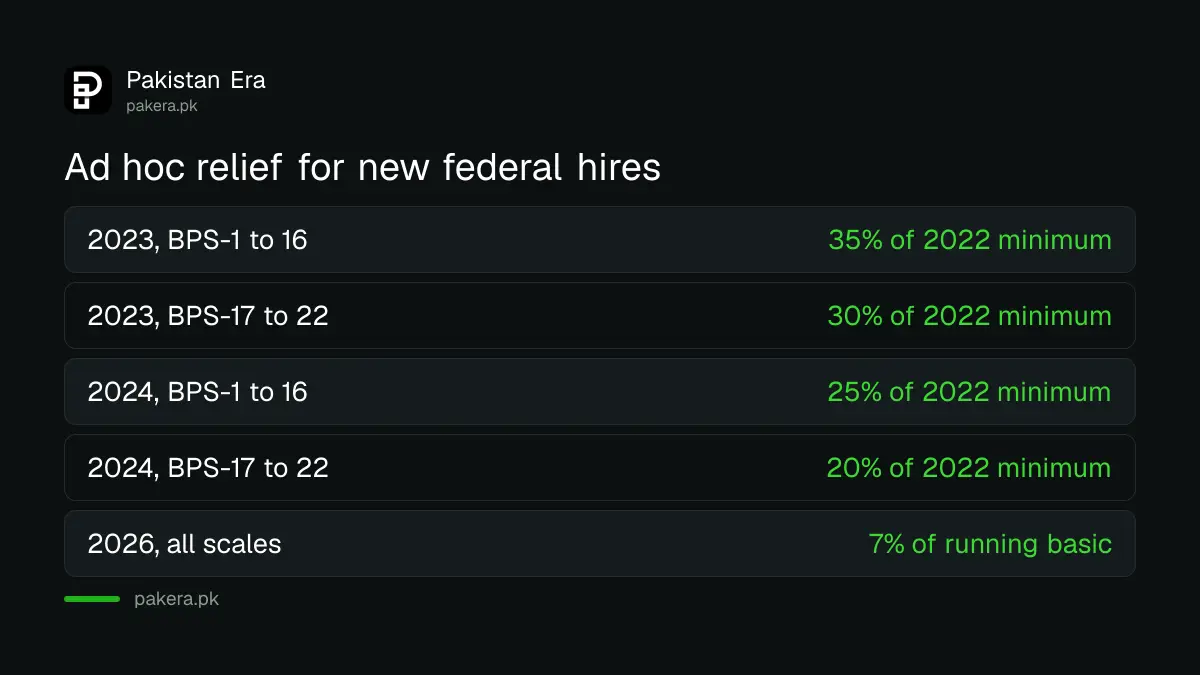
Ad-hoc Relief Allowance 2023 and 2024 are paid to new entrants at fixed percentages of the minimum of the relevant Basic Pay Scale 2022. The memorandum calls this a "notional basis". The amounts start on 1 July 2026, last till further orders, and stay frozen at the same level.
| Allowance | BPS-1 to 16 | BPS-17 to 22 |
|---|---|---|
| Ad-hoc Relief Allowance 2023 | 35% of the 2022 minimum | 30% of the 2022 minimum |
| Ad-hoc Relief Allowance 2024 | 25% of the 2022 minimum | 20% of the 2022 minimum |
"Relevant" means the minimum basic pay of your own scale in the 2022 table. The Revised Basic Pay Scales 2026 order prints both tables side by side. For example, the 2022 minimum was Rs 13,550 for BPS-1 and Rs 45,070 for BPS-17.
Existing staff keep both allowances frozen
The 4 August memorandum also answers the question existing staff asked. Ad-hoc Relief Allowance 2023 stays frozen at the level it had on 30 June 2023. Ad-hoc Relief Allowance 2024 stays frozen at its 30 June 2026 level. Neither grows when basic pay grows.
This follows paragraph 7 of the 21 July order. It froze all special pays and allowances that are a percentage of pay, including house rent allowance, at their 30 June 2026 level. A raise in basic pay therefore does not lift them automatically.
For a worker already in service, the main rises on payslips are the new basic pay scales and the new 7 percent allowance, both set out in the Revised Basic Pay Scales 2026.
A worked example for a BPS-1 and a BPS-17 new hire
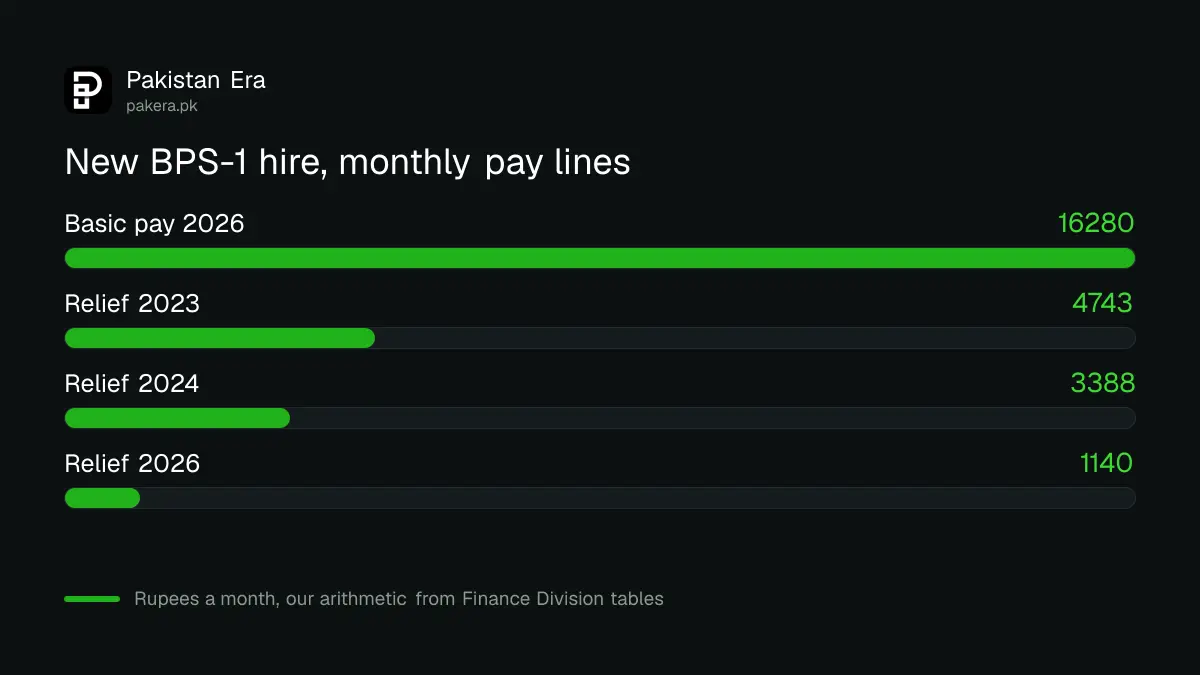
Here is what the memorandum's wording works out to for the lowest post in each group. This is our own arithmetic using the minimum pay figures in the Finance Division tables. We have not seen an actual payslip, and your office may apply the rule differently.
| Item a month | New BPS-1 hire | New BPS-17 hire |
|---|---|---|
| Basic pay, BPS-2026 minimum | Rs 16,280 | Rs 54,140 |
| Ad-hoc Relief Allowance 2023 | Rs 4,742.50 | Rs 13,521 |
| Ad-hoc Relief Allowance 2024 | Rs 3,387.50 | Rs 9,014 |
| Ad-hoc Relief Allowance 2026 at 7% of basic | Rs 1,139.60 | Rs 3,789.80 |
| Total of these four lines | Rs 25,549.60 | Rs 80,464.80 |
The totals leave out house rent, conveyance and every other allowance. They are a floor for these four lines only. The BPS-1 total is below Rs 40,700, and other allowances may or may not close the gap, so a new BPS-1 hire should also read about the Rs 40,700 Special Allowance, which tops up pay for anyone under that line.
Autonomous bodies follow a separate route for the 7 percent
Staff of autonomous and semi-autonomous bodies and corporations are treated differently. A Finance Division memorandum of 27 July 2026 says the 7 percent Ad-hoc Relief Allowance 2026 also applies to bodies that have adopted the Federal Government's pay scales "in totality".
Bodies that use different pay scales or allowances can grant the 7 percent only with the agreement of the Finance Division's Standing Committee, on a recommendation from their own Board of Directors or Governors. The grant must be tied to the body's financial position.
The order of approval is set. Cases for executive and supervisory staff go to the Finance Division first. Non-executive staff follow later on the same basis, once their Board approves. If you work at a corporation, ask your HR office which route your body is on.
Check your first payslip in four steps
New hires often get the wrong figure in the first month, because payroll teams are still learning the new tables. Use this order.
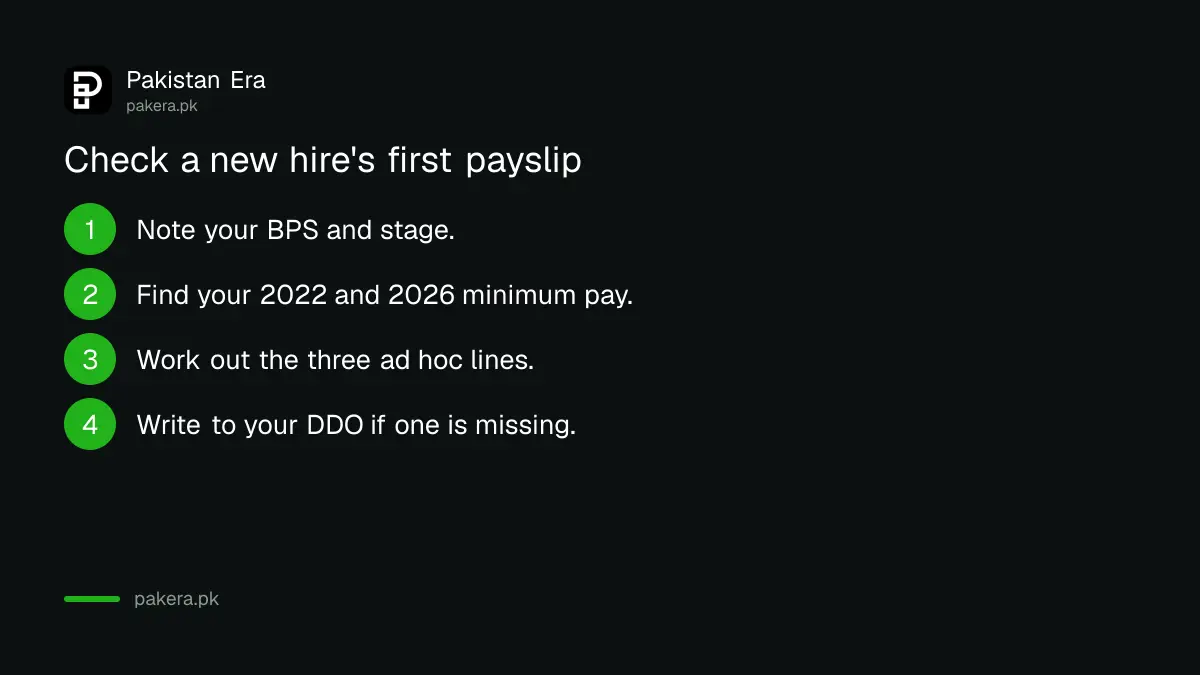
- Note your BPS and stage from the appointment letter.
- Look up your 2022 and 2026 minimum pay in the Finance Division pay scale tables.
- Work out the three ad hoc lines with the percentages above, and compare them with the payslip.
- If a line is missing, write to your DDO and quote Finance Division Office Memorandum No. F.1(2)IMP/2026-0004 dated 4 August 2026.
Common questions
What is Ad-hoc Relief Allowance 2023 for new entrants?
It is 35 percent of the 2022 minimum pay for BPS-1 to 16 and 30 percent for BPS-17 to 22, paid from 1 July 2026.
What is Ad-hoc Relief Allowance 2024 for new entrants?
It is 25 percent of the 2022 minimum pay for BPS-1 to 16 and 20 percent for BPS-17 to 22.
Do new employees also get the 7 percent allowance?
Yes. The 21 July memorandum grants 7 percent of running basic pay to civil employees from 1 July 2026, with no exclusion for new hires.
Will these allowances grow later?
No. The memorandum says they stand frozen at the same level.
Do corporation employees get the same rule?
Only if their body adopted the Federal Government's pay scales in full. Otherwise it needs Finance Division concurrence.
How we verified this
What we checked, where we read it, and what we could not confirm.
Last checked on 11 October 2026. We read three Finance Division Office Memoranda on finance.gov.pk: the clarification on revision of basic pay scales dated 4 August 2026, the Revised Basic Pay Scales 2026 order of 21 July 2026, and the memorandum for autonomous bodies dated 27 July 2026. The worked example is our own arithmetic. The memorandum does not give a sample payslip, and we could not confirm how any office has applied the "notional basis" wording in practice.
About the author

Public Services and Education Journalist
Fajr Riaz is a journalist and content writer at Pakistan Era, based in Lahore. She covers the questions people meet in everyday life in Pakistan: how a public service works, what a change in the rules means, and where to find a reliable answer.