How to File an FBR Tax Reference in the High Court in Pakistan: 60 Days, Rs 50,000 Fee
Lost at the Tax Tribunal? File a High Court reference on a question of law within 60 days. Fee is Rs 50,000, and a stay needs a 30 percent deposit. See steps.
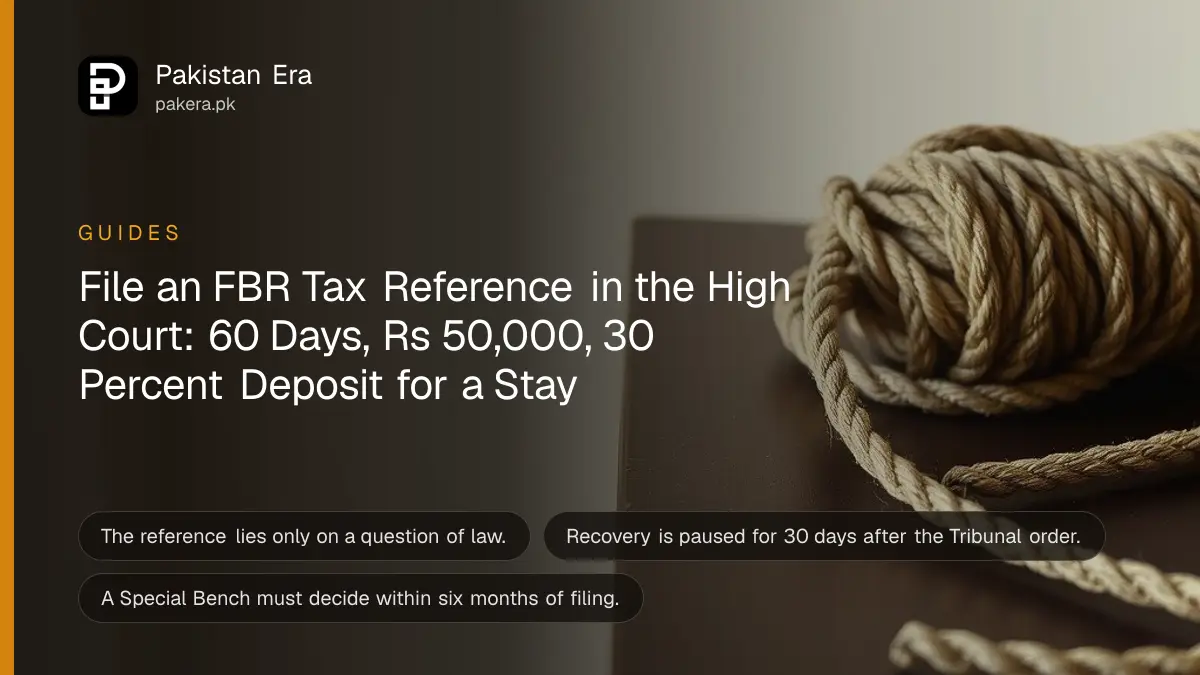
If the Appellate Tribunal Inland Revenue rules against you, a reference to the High Court on a question of law must be filed within 60 days of the Tribunal order. The fee is Rs 50,000, and the High Court can stay recovery only if you deposit at least 30 percent of the tax the Tribunal decided.
A reference is not a third appeal on the facts. The High Court looks only at a question of law that arises out of the Tribunal order, such as a wrong reading of a section. That is a narrower door than many taxpayers expect, and the money needed at the door is real.
We read section 133 and section 133A of the Income Tax Ordinance, 2001, as amended up to 30 June 2026, on FBR's Income Tax Ordinance page on 21 October 2026. The consolidated PDF shows older wording beside the new, so we used the footnotes to find what is in force. The step before this one is explained in the guide to the Appellate Tribunal Inland Revenue appeal.
The reference goes straight to the High Court within 60 days
Section 133(1) lets the aggrieved person, or the Commissioner, file a reference before the High Court within 60 days of communication of the Tribunal order. The reference is in the prescribed form, with a statement of the case, and it must state a question of law arising from the order.
The older route had the taxpayer ask the Tribunal to refer the question, with 90 days. The current text instead has you file in the High Court yourself. You must also file the complete record of the Tribunal within 15 days of filing the reference.
| Item | What section 133 says |
|---|---|
| Who files | The aggrieved person or the Commissioner |
| Time limit | 60 days from communication of the Tribunal order |
| What it must raise | A question of law only |
| Record of the Tribunal | Filed within 15 days of the reference |
| Fee, aggrieved person | Rs 50,000 |
| Late filing | Section 5 of the Limitation Act, 1908 applies |
The tax stays payable, with a 30 day pause before recovery
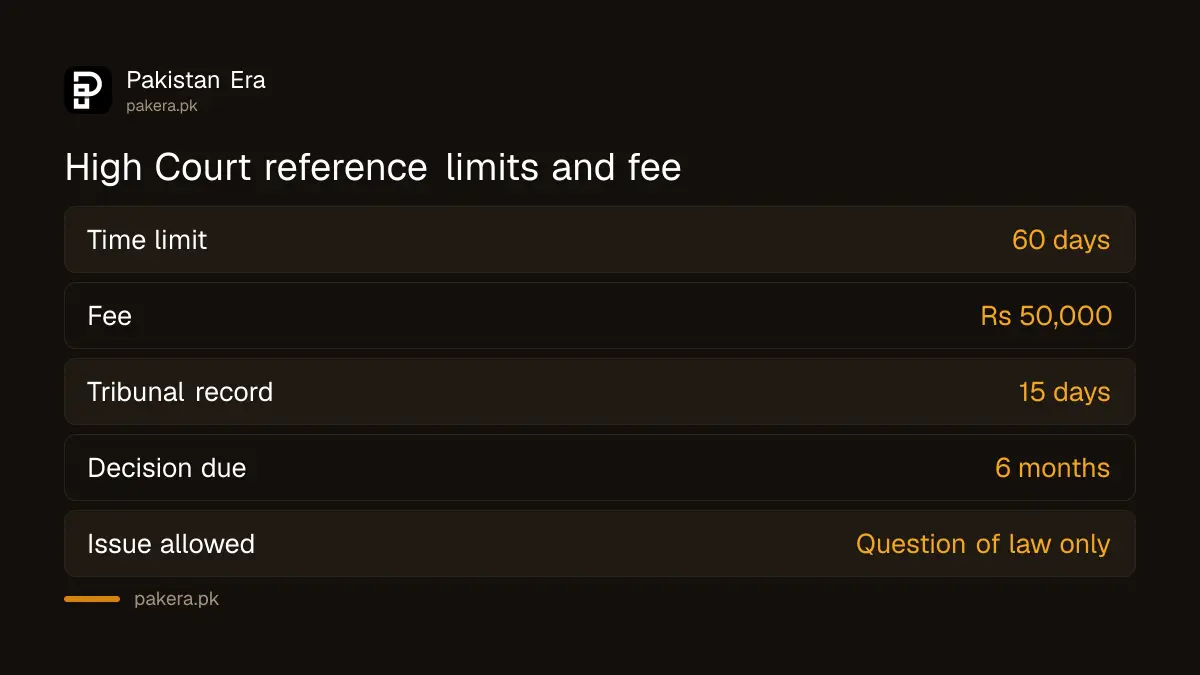
Section 133(9) says that even after you file, the tax is payable as the Tribunal ordered. But the Commissioner cannot recover it for 30 days from communication of the Tribunal order. That window is the time to apply for a stay.
Under sub-section (10), the High Court may stay recovery after hearing the Commissioner, subject to a deposit of not less than 30 percent of the tax the Tribunal determined. A stay ends after six months unless the reference is decided or the stay is withdrawn earlier. On a Rs 10 million Tribunal demand, the deposit would be at least Rs 3 million, our arithmetic from the 30 percent rule.
A Special Bench must decide the reference in six months
Section 133(4) and (5) say the Chief Justice constitutes Special Benches of not less than two judges, and the Special Bench shall decide a reference within six months of filing. The High Court must run a case management system to make that possible.
The Court decides the question of law, gives its reasons, and the Tribunal order stands modified accordingly. A copy of the judgment goes to the Tribunal. If the tax falls and a refund is due, the Commissioner has 30 days to ask the Court to hold the refund while he considers going to the Supreme Court.
The Commissioner needs approval from a case scrutiny committee
Section 133A, inserted by the Finance Act, 2026, says a Commissioner may file a reference, or an appeal to the Federal Constitutional Court or the Supreme Court, only after an independent committee approves. The committee has a retired senior judge, an advocate with at least 15 years of experience and a senior FBR officer. Its recommendations bind the Commissioner.
For taxpayers, this means the other side now faces a filter before it can push a case up. It does not change your own deadline.
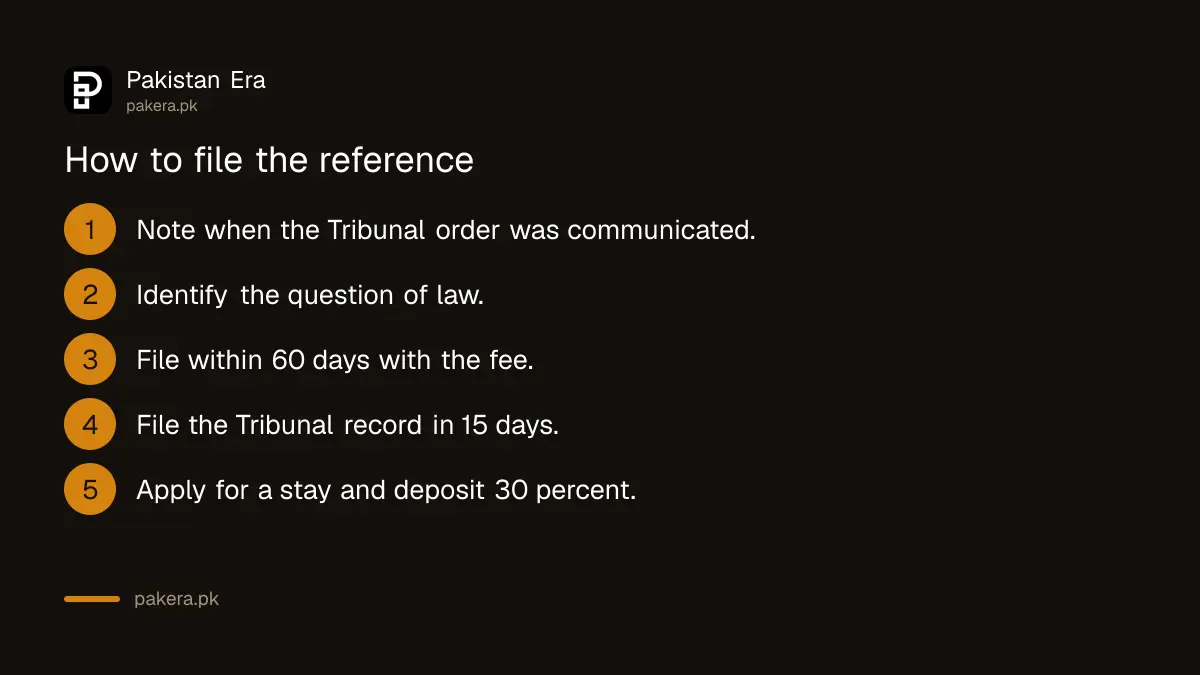
- Get the Tribunal order and note the date it was communicated.
- Identify the exact question of law. A pure factual dispute will not qualify.
- File the reference in the High Court within 60 days, with the Rs 50,000 fee.
- File the Tribunal record within 15 days of the reference.
- Apply for a stay and be ready to deposit 30 percent of the tax determined.
- Prepare for a Special Bench hearing within six months.
Before you reach this stage, check whether your dispute could have been settled through the committee route under alternative dispute resolution.
Common questions about an FBR High Court reference
How long do I have to file a High Court reference against a Tribunal order?
60 days from communication of the Appellate Tribunal order, under section 133(1) as amended up to 30 June 2026.
How much does the reference cost?
The fee is Rs 50,000 for the aggrieved person. The Commissioner pays nothing but needs a Chief Commissioner authorisation.
Can I argue the facts again in the High Court?
No. The reference lies only on a question of law arising out of the Tribunal order.
Do I have to pay while the reference is pending?
The tax is payable per the Tribunal order. Recovery is paused for 30 days, and a stay needs a deposit of at least 30 percent.
How long does the High Court take?
The law says a Special Bench shall decide within six months of filing.
What if I miss the 60 days?
Section 5 of the Limitation Act, 1908 applies, so the Court may excuse delay for sufficient cause. Do not count on it.
How we verified this
What we checked, where we read it, and what we could not confirm.
Last checked 21 October 2026. We read sections 131 to 133A of the Income Tax Ordinance, 2001, as consolidated up to 30 June 2026 on FBR's website. The PDF carries old and new wording together, so a mistake in reading the footnotes is possible. We did not read the High Court rules on how a reference is lodged, or any court fee notification. We did not file a reference. Confirm the deadline with a tax lawyer before relying on it.
About the author

Senior Writer, Public Services and Technology
Shahid joined us in 2024 as an author. He is a senior contributor to Pakistan's leading technology websites. He writes detailed articles, mostly covering his expertise in the latest tech, mobiles, apps, gadgets, and step-by-step guides. His ideology is to help people understand the latest trends and explain complex methods through very easy-to-understand guides.