Get Your First CNIC Free at 18 From NADRA, Even if Your Parents Are Not Registered
Your first CNIC is free from NADRA at normal speed. See the documents, the witness route if parents are not registered, and the birth certificate waiver.
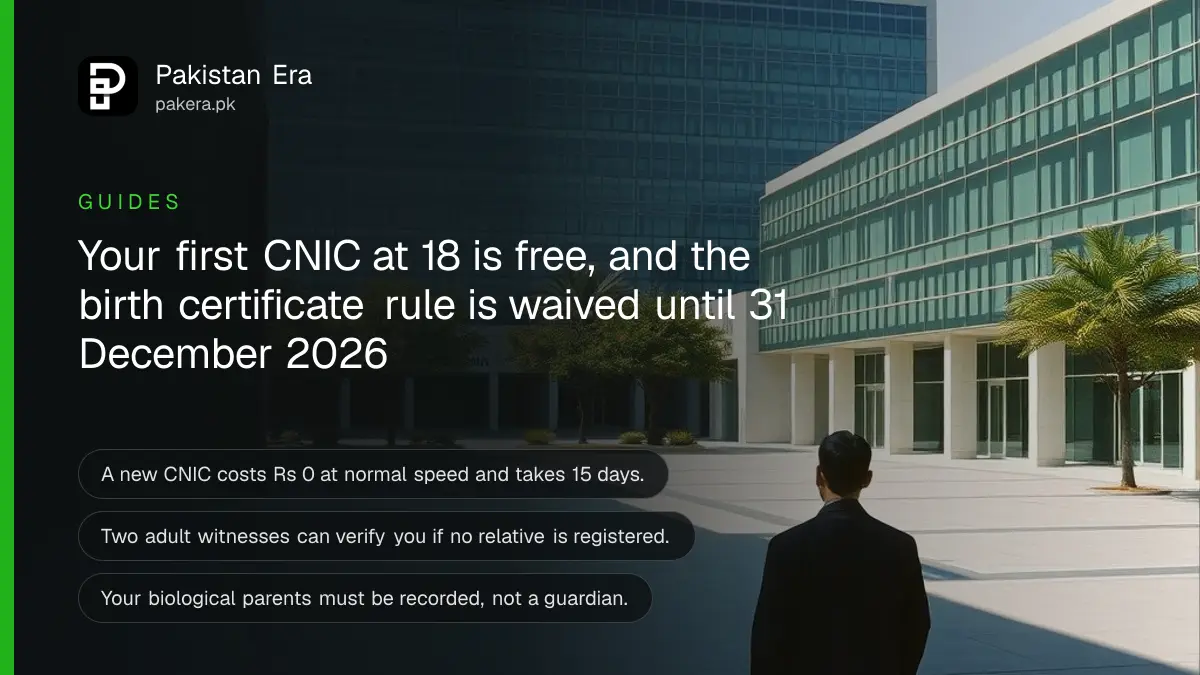
Your first CNIC at 18 is free from NADRA at normal speed, ready in 15 days. If your parents or brothers and sisters are not registered with NADRA, you can still apply. Two adult witnesses with ID cards verify you by fingerprint, and you sign Undertaking "B". NADRA has also waived the birth certificate rule until 31 December 2026, as long as family members give their ID numbers and fingerprints.
NADRA repeated this guidance on 7 October 2026 for people applying for the first time. Its message was simple: if no parent or sibling is on the NADRA record, sort out the witness and documents before you reach the counter.
A first CNIC costs nothing at normal speed
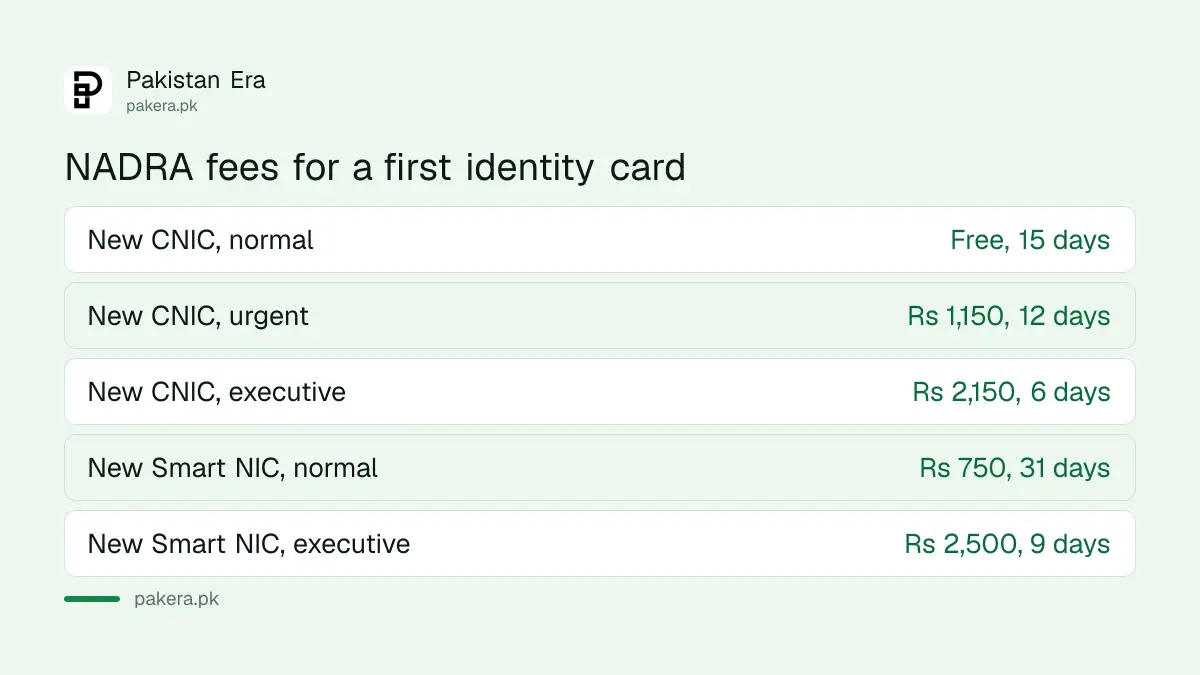
NADRA's fee table lists a new CNIC at Rs 0 on normal priority, with a 15 day timeline. You pay only if you want it faster or want the chip card. The fee is paid at the centre after your interview.
| Card | Normal | Urgent | Executive |
|---|---|---|---|
| New CNIC | Free, 15 days | Rs 1,150, 12 days | Rs 2,150, 6 days |
| New Smart NIC | Rs 750, 31 days | Rs 1,500, 23 days | Rs 2,500, 9 days |
Most first-time applicants need nothing more than the free card. Pay for urgent only if a job form, admission or exam has a close deadline. The Smart NIC has a microchip and costs more, but both cards prove the same identity.
Who can get a first CNIC
NADRA issues a CNIC to every Pakistani citizen who has turned 18. That includes someone never registered before and someone who already holds a Child Registration Certificate (B-Form) or juvenile card. The B-Form is the record NADRA makes for a child under 18.
A B-Form makes the first CNIC much easier, because NADRA already knows who your parents are. If you have one, check it is still valid in the CRC and juvenile card validity table. If you never had one, you can still apply directly for a CNIC at 18.
Documents NADRA asks for on a first CNIC
NADRA needs three things: proof of who your family is, a verified birth record, and someone to confirm your identity by fingerprint or signature. Each has a backup route if the usual one is missing.
| What NADRA needs | Usual route | If you do not have it |
|---|---|---|
| Family link | CNIC number of a parent or blood relative | Biometric witness who holds an ID card, plus Undertaking "B" |
| Birth record | Computerised birth certificate from the Union Council, Municipal Committee or Cantonment | Waived until 31 December 2026 if family give ID numbers and fingerprints |
| Identity check | Fingerprint check of a parent or blood relative at the centre | Form attested by an approved officer under Regulation 9 |
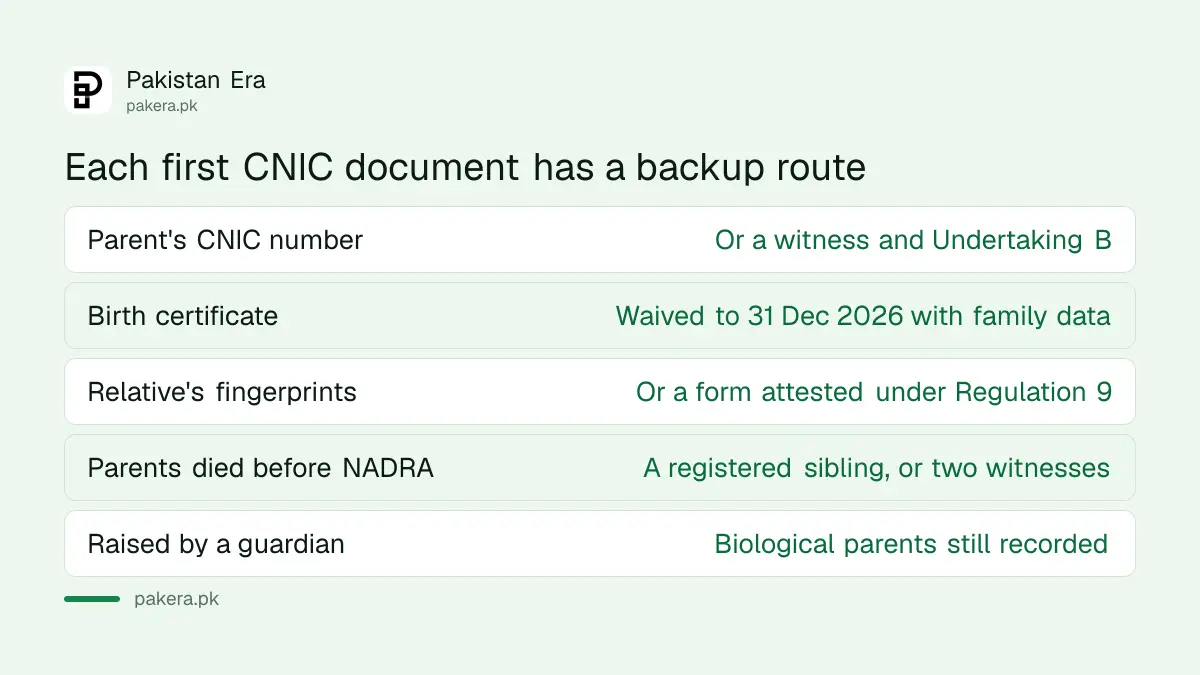
The birth certificate waiver is the part most people do not know. NADRA's own answer says a Union Council, Cantonment Board or CDA birth certificate is normally required. But it has exempted that rule until 31 December 2026, if family members give their identity card numbers and fingerprints. After that date, expect the birth certificate to be needed again. Getting one now is the safer plan, and the Union Council birth certificate process is short.
If your parents or siblings are not registered
You can still get a CNIC. NADRA's first choice is a registered brother or sister. If there is none, two adult witnesses with valid ID cards verify you by fingerprint, after which NADRA may check your details in the field.
NADRA sets an order for who can verify you. Blood relatives come first: father, mother, brother, sister. Next come immediate relatives: a guardian, a grandparent on either side, or a spouse. If none of them is registered, NADRA asks for witnesses who personally know you, preferably relatives, plus Undertaking "B" in its set format.
For parents who died before NADRA existed, NADRA's answer is clear. Identity is proved through any registered sibling. If no sibling exists, two people give biometric evidence, preferably close relatives, and the case goes through scrutiny and field verification. That takes longer than a normal application, so start early.
One rule catches people raised by an uncle or grandparent. NADRA says your real biological parents must be recorded on the card, even if a court recognised the guardianship or adoption. The guardian can verify you but cannot be listed as your parent.
How to apply at a NADRA centre, step by step
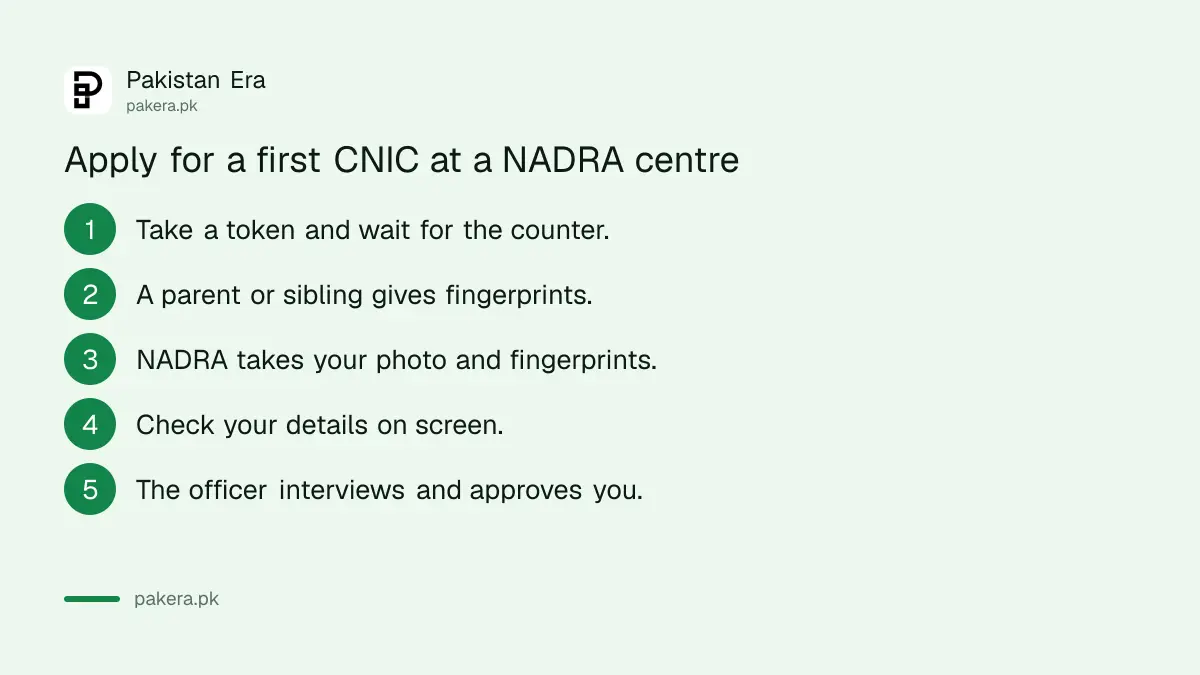
Take your documents and, if possible, one parent or sibling with their CNIC. Then follow the counter steps NADRA lists for a new card.
- Collect a token at the NADRA Registration Centre and wait for the one-window counter.
- A parent or sibling who came with you gives fingerprints. If none came, bring your witnesses or an attested form.
- NADRA takes your photograph and fingerprints.
- Staff enter your details. Read them carefully on screen before you agree.
- A parent, sibling or gazetted officer attests the form.
- The officer in charge interviews you and approves the application.
- Pay the fee if you chose urgent or executive. Normal is free.
- Collect the card when the processing time ends.
Booking a slot can save a long queue, and you can book a NADRA appointment on the Pak ID app. You can also start the form in Pak ID by choosing "New CNIC", but the photo and fingerprints still need a centre visit in most cases. The online CNIC application covers the app route.
Who can attest your form under Regulation 9
If no relative can give fingerprints, an approved person can attest the paper form instead. They must know you personally and must write their name, stamp and ID number under their signature.
NADRA's list includes members of the Senate, National or Provincial Assembly, a local body or Zakat committee; government officers in grade 16 and above; commissioned officers of the armed forces; officers of government banks and corporations; and the village lambardar for people living in his village. A NADRA officer in grade 16 or above can also attest.
Do not pay anyone to attest. Attestation is free, and an attester who does not actually know you puts your application at risk. If you live far from a centre, NADRA says you can ask for its Mobile Registration Van to visit your area. Questions go to NADRA's 24 hour helpline, 1777.
Common questions
Is the first CNIC free in Pakistan?
Yes. NADRA charges Rs 0 for a new CNIC on normal priority, ready in 15 days. Urgent costs Rs 1,150 and executive Rs 2,150.
Can I get a CNIC if my parents do not have one?
Yes. A registered sibling can verify you. If there is none, two adult ID holders give fingerprints as witnesses and you sign Undertaking "B".
Do I need a birth certificate for my first CNIC?
Normally yes, but NADRA has waived it until 31 December 2026 if family members give their ID numbers and fingerprints.
Who can be a witness for a CNIC?
An adult who holds a valid CNIC or NICOP and knows you personally. NADRA prefers relatives from your father's or mother's side.
Can my guardian be listed as my parent?
No. NADRA records the biological parents, even where a court has approved the guardianship or adoption.
Can I apply for my first CNIC on the Pak ID app?
You can start it there by choosing "New CNIC". A centre visit for photo and fingerprints is usually still needed.
How we verified this
What we checked, where we read it, and what we could not confirm.
Last checked 9 October 2026. Eligibility, the document list, the counter steps and NADRA's answers on missing birth records, deceased parents and guardians come from NADRA's CNIC page. Fees and timelines come from NADRA's fee structure. The list of who can verify or attest a form comes from NADRA's Regulation 9 attestation sheet, linked from the CNIC page. The 7 October guidance for first-time applicants was carried in NADRA statements; we did not find it as a press release on NADRA's website.
About the author

Public Services and Education Journalist
Fajr Riaz is a journalist and content writer at Pakistan Era, based in Lahore. She covers the questions people meet in everyday life in Pakistan: how a public service works, what a change in the rules means, and where to find a reliable answer.