Pakistan Opens Its First Wheeling Auction: 400 MW of Grid Access for Large Power Buyers
Pakistan issued the RFP for its first wheeling auction: 400 MW now, 800 MW over five years. See who can bid, the five stages and what it means for bills.
Pakistan has issued the request for proposals for its first wheeling auction, offering 400 MW of grid access to buyers and sellers of electricity. The Power Division says a total of 800 MW will be auctioned over five years. Factories using more than one megawatt are the first to benefit. Households are not part of this round.
The Power Division announced the request for proposals (RFP) in a news item posted in late September 2026. The Independent System and Market Operator (ISMO) runs the auction and holds the RFP on its website. We read both pages. We did not read the RFP itself, so the closing date and bid rules below are not confirmed.
Wheeling means using the grid to move power for a fee
Wheeling is the use of the power network to carry electricity from a seller to a buyer. The buyer pays a charge to use the wires. Pakistan has so far had a single buyer for almost all power. The wheeling auction is the first step to let sellers and large buyers deal with each other directly.
ISMO's published FAQ says the market works on a "copper plate" principle. The wheeling charge is the same across the country, and a buyer pays it to the electricity company it is physically connected to.
The auction offers 400 MW now and 800 MW over five years
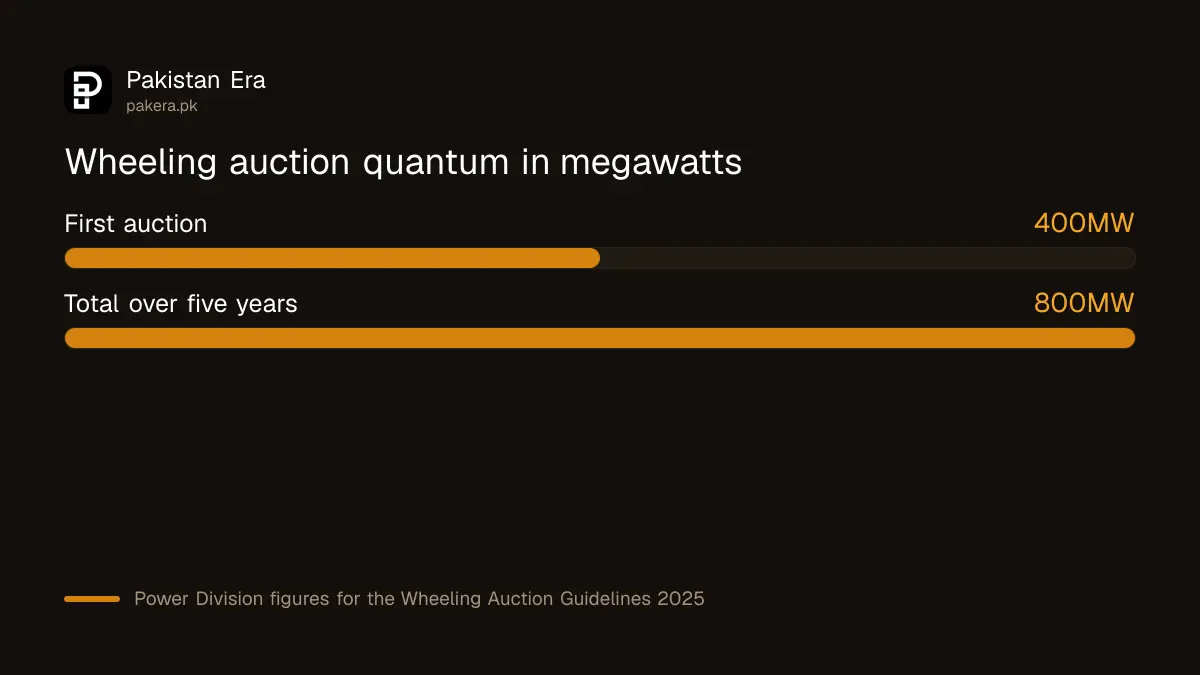
The Power Division says the Wheeling Auction Guidelines 2025 set a total of 800 MW to be auctioned over the next five years, with 400 MW offered in the first auction. The auction sits under the Competitive Trading Bilateral Contract Market, or CTBCM, the new wholesale market design.
| Item | What the Power Division and ISMO say |
|---|---|
| Total to be auctioned | 800 MW over the next five years |
| First auction | 400 MW |
| Who runs it | ISMO, on a dedicated auction platform |
| Who benefits first | Consumers using more than 1 MW |
| Where the documents are | ISMO's website, queries to auction@ismo.gov.pk |
| Effect on regulated consumers' tariff | "Minimal to negligible", per ISMO's FAQ |
The process has five stages from documents to award
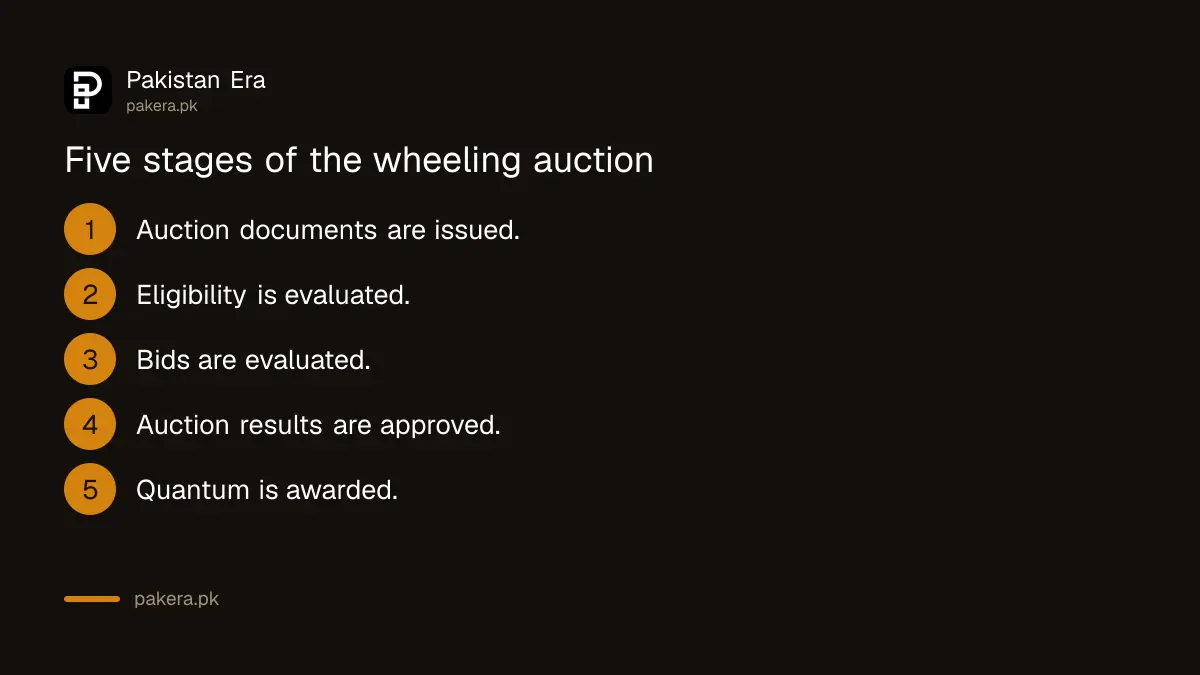
The Power Division lists a five-step process. A bidder goes from the auction documents to an award of a set quantity of grid access. Each stage is run through the platform, and ISMO says it will publish guidance material and explainer videos.
- Issuance of auction documents.
- Evaluation of eligibility.
- Evaluation of bids.
- Approval of auction results.
- Award of quantum.
Quantum means the amount of capacity a bidder wins, measured in megawatts.
The Power Division says the RFP sets out the eligibility rules, the proposal formats, the auction procedure and the complete timeline. A bidder must read it in full and send a complete proposal before the stated deadline. ISMO has also invited every eligible participant to take part.
Bidders must show they have a real buyer
ISMO's FAQ says bidders must show grid interconnection studies and memorandums of understanding (MoUs) with bulk power consumers. Both are described as preliminary checks, not binding contracts. The aim, it says, is to confirm a bidder has done basic groundwork.
Three other points in the FAQ matter to a bidder:
- The buyer named at the time of bidding stays fixed at first. It may be changed only later, under market rules.
- ISMO may cap how much one party can win. It gives 25% to 50% of the total as an example, and says the exact limit comes at the RFP stage.
- A winner that keeps leaving its quantum unused can lose it, after notice, unless it gives a valid reason.
What this means for ordinary households
For a home, nothing changes now. The minister is quoted by the Power Division as saying the benefit will gradually extend to general consumers in the coming years. No date or rule for households has been announced.
Factories that want cheaper power can already look at buying electricity from a private supplier above 1 MW. The grid charge they would pay is set out in NEPRA's single grid charge for open-market buyers. The wider reform plan is described in the plan to split the wires from electricity supply.
ISMO says the 800 MW should have little effect on the basket tariff of regulated consumers, using a national generation plan as its basis. That is ISMO's own estimate. We could not test it.
Common questions
What is a wheeling auction?
It is an auction of the right to use the national grid to move electricity between a seller and a large buyer, for a wheeling charge.
How much power is in the first auction?
400 MW. The guidelines set a total of 800 MW over five years.
Can a household bid?
No. The Power Division says consumers using more than 1 MW benefit first. A wider benefit for general consumers is only described as coming in later years.
Who runs the auction?
The Independent System and Market Operator, ISMO, through a dedicated auction platform.
Where can bidders ask questions?
By email to auction@ismo.gov.pk, according to the Power Division. The RFP is on ISMO's website.
Will my electricity bill go down?
Not from this round. ISMO says the effect on regulated consumers is expected to be minimal to negligible.
How we verified this
What we checked, where we read it, and what we could not confirm.
We read the Power Division's news item on the first wheeling auction and the FAQ on ISMO's website on 12 October 2026. We did not read the RFP, so the bid deadline, fees and per-party limit for this round are not confirmed here.
About the author

Tax, Bills and Technology Writer
Ali Akhtar is a young and curious voice here at Pakistan Era. He is currently pursuing his A-Levels and has a growing interest in Pakistan’s changing industrial landscape and educational trends. Ali likes to write in a way that helps him explain and explore the world around him. His writing reflects the perspective of the new generation navigating the evolving trends of Pakistan where technology, youth innovation, and shifting opportunities are reshaping the country’s future.