Pakistan Power Sector Reform: Finance Panel Weighs Splitting the Wires From Electricity Supply
The Finance Minister's power sector panel met on 7 October 2026 and discussed splitting network from supply. No tariff change was announced. See what it means.
Short answer: On 7 October 2026 the Finance Minister chaired the second meeting of a Steering Committee on the Power Sector Regulatory Regime. It discussed separating the wires business from the electricity supply business of distribution companies. No decision, tariff change or date was announced. Your bill does not change because of this meeting.
We read the Finance Division's statement on the meeting ourselves. It is a discussion record, so this page explains what the ideas mean and what they do not. The first meeting of the committee is not covered in the statement we read.
The committee reviewed reform options, it did not decide a change
The Steering Committee on Power Sector Regulatory Regime met at the Finance Division on 7 October 2026 under Finance Minister Muhammad Aurangzeb. It reviewed progress and reform options for a framework that brings efficiency, investment, competition and more private participation. The statement lists no approved measure.
The Power Minister, the Minister of State for Finance, the Prime Minister's adviser on privatisation, Finance Division officials and representatives of public-sector bodies attended. Nothing in the statement is a notification, a cabinet decision or a change to a tariff.
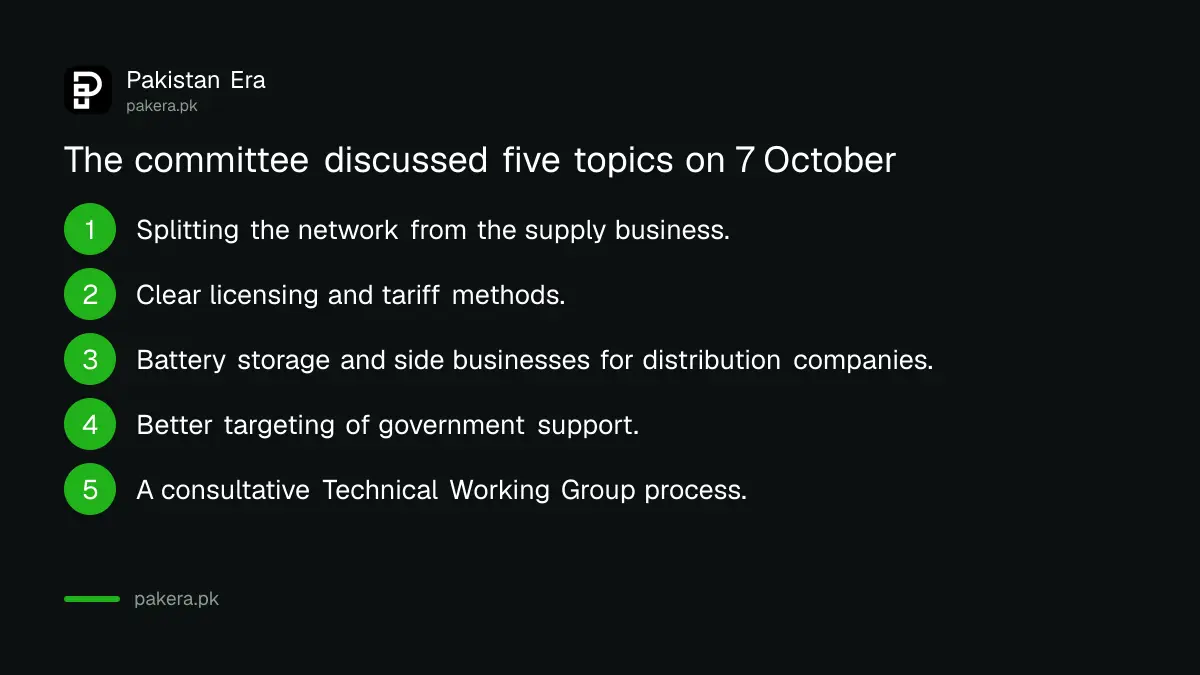
Splitting network from supply is the main idea on the table
The committee discussed more separation between the network function and the supply function. Distribution network operators would focus on running and maintaining the wires. Competitive supply businesses would sell electricity to customers within a regulatory framework. Today one distribution company does both.
The aim stated is better incentives for efficiency and service quality, and more room for competition. In plain terms, you could one day choose who sells you electricity while the same wires still carry it. That is an idea under discussion, not a plan with a date.
A related step for open-market buyers is set out in our explainer on grid charges for open-market electricity and our guide on buying electricity from a private supplier.
Batteries, solar and electric vehicles shape the discussion
The statement says the power sector is changing because of fast solar growth and new demand patterns. It names battery energy storage systems, distributed generation, storage and electric vehicles as technologies the regulatory framework must allow for, while keeping the system reliable.
Distribution companies might run extra businesses, such as storage or related infrastructure, through separate entities. The minister said any such business must sit under clear rules, with safeguards, and that benefits from using public infrastructure should be shared with consumers. If you have rooftop solar, read how net metering rules in 2026 already apply.
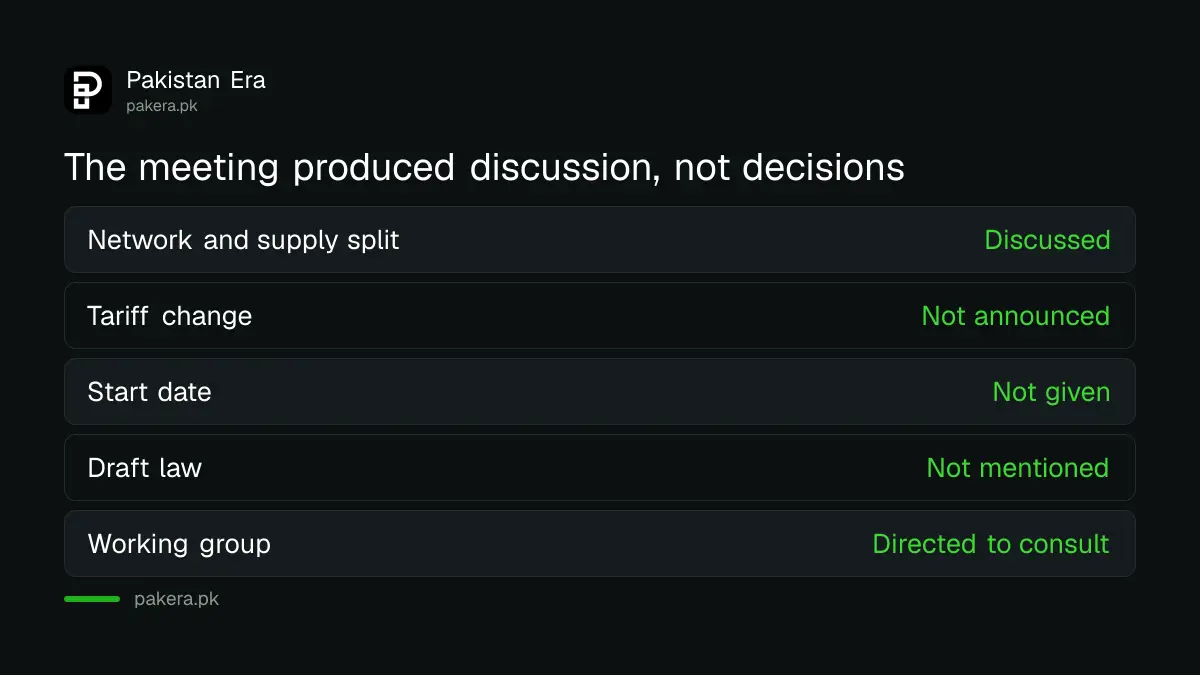
| Topic in the statement | What was said | Decision? |
|---|---|---|
| Network and supply split | Greater separation discussed | No |
| Licensing and tariff method | Need for clearer, predictable rules | No |
| Battery storage and side businesses | Allowed within a clear framework, benefits shared | No |
| Subsidy targeting | Improve how support is aimed | No |
| Technical Working Group | Directed to run a consultative process | Directed |
Subsidies and tariff methods are named but not detailed
The statement says the committee discussed better targeting of government support and tariff methods that protect consumers while supporting investment. It gives no figure, scheme or date. The only direction is for the Technical Working Group to work through stakeholders and bring practical recommendations.
The government's subsidy plans are covered separately. Our note on targeted electricity subsidy through BISP sets out what has been announced so far. Do not mix the two: this committee is about market structure and regulation, not about who gets a subsidy this month.
What readers can do while the talks continue
For now, nothing about your connection, tariff or bill changes. The practical value is knowing the direction so you do not fall for claims that bills are being cut or that you can switch supplier next month. Follow the real, dated steps instead.
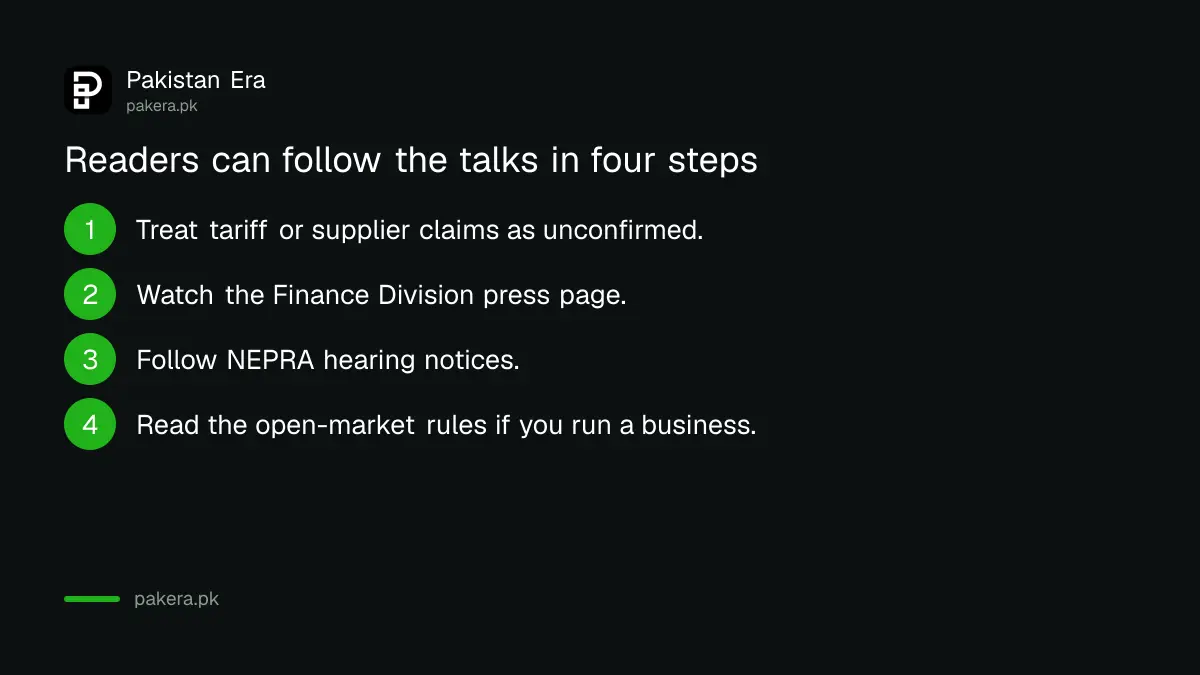
- Treat any message claiming a new electricity tariff or supplier switch as unconfirmed until NEPRA or your distribution company publishes it.
- Check the Finance Division press release page for later meetings of this committee.
- Watch NEPRA hearing notices and send comments through the process in how to take part in a NEPRA hearing.
- If you run a business, read the existing rules for open-market buyers before you act on any claim about supplier choice.
Common questions
What did the power sector steering committee decide?
The statement records no decision. It reviewed reform options and directed a Technical Working Group to run a consultative process and bring recommendations.
Will I be able to choose my electricity supplier?
That is one idea under discussion, with no date. The statement speaks of greater separation of network and supply, not of a start date for household choice.
Will electricity prices change because of this meeting?
No. The statement gives no tariff change. It speaks of tariff methods and a transparent regulatory regime as topics for further work.
Who attended the meeting?
The Finance Minister chaired it. The Power Minister, the Minister of State for Finance, the Prime Minister's privatisation adviser and officials attended.
Is this the same as the NEPRA grid charges decision?
No. The grid charges decision is a NEPRA tariff step for open-market buyers. This committee looks at the wider market structure and regulation.
How we verified this
What we checked, where we read it, and what we could not confirm.
Last checked on 11 October 2026. We read the Finance Division's press release of 7 October 2026 (PR No. 652) on the second meeting of the Steering Committee on Power Sector Regulatory Regime. Every point attributed to the committee comes from that release. The plain-language reading of the network and supply split is ours. The statement gives no timeline, no draft law, no tariff figure and no list of Technical Working Group members.
About the author

Global Affairs & Political Economy Writer
Muhammad Hatim is a book lover who started writing because he enjoys it. At Pakistan Era he writes about international relations, geopolitics and the global economy, with a particular interest in South Asia and the forces behind current events.