How to Fix Clothes That Turned Pink or Blue in the Wash in Pakistan: Dye Transfer in 6 Steps
Fix colour bleeding and dye transfer in Pakistan: keep the clothes wet, re-wash with liquid detergent, soak whites in oxygen bleach, and test new dark suits.

If colour has run onto other clothes in the wash, do not dry them. Re-wash the stained clothes straight away with liquid detergent, then soak whites in oxygen bleach made to the pack's directions. Pure white cotton can take a colour remover. Dye that has been dried in by sun, heater or iron is much harder to shift.
It happens most in winter. A new maroon khaddar suit, a red sweater or a dark blue school jumper goes into the machine with whites, and a load of shirts and vests comes out pink or blue. The fix is quick, but only if you act before anything dries.
This applies to dye transfer (colour from one garment landing on another in the wash), and to the blotchy patches that appear when a wet dark garment is left lying on a light one.

Keep the stained clothes wet and re-wash at once
The first hour matters most. Loose dye sits on the surface of the fibre while the cloth is wet, and drying fixes it in. Pull the dyed clothes out, keep them wet, and wash them again straight away, away from the garment that bled.
The Texas A&M AgriLife Extension stain guide gives this exact order for dye stains from garments: re-wash the items as quickly as possible, do not dry them, apply liquid detergent and work it into the area, and repeat. It then suggests washing with non-chlorine bleach, or, for white or colourfast fabric, chlorine bleach or a commercial colour remover used by its directions.
How to fix pink or blue clothes after the wash in 6 steps
Separate, re-wash, then soak. Most fresh dye transfer on whites lifts with one or two rounds. Keep the garment that bled out of every step, and check each item in daylight before it dries.
- Take out the culprit. Find the garment that bled and set it aside to wash alone.
- Keep the rest wet. Do not hang or spin dry the stained clothes.
- Rub in liquid detergent. Work it into the coloured patches with your fingers.
- Re-wash in cool water. Run a short wash with detergent and no other clothes.
- Soak whites in oxygen bleach. Make up oxygen bleach to the pack's directions and soak white and light items, usually for a few hours.
- Check, then dry. If colour remains, repeat the soak. Dry only when the colour is gone.
Colour catcher sheets absorb loose dye from the water during a wash. They help when re-washing, and they are a good habit when you must mix a new dark garment with lighter ones.
Choose the fix by the fabric that took the colour
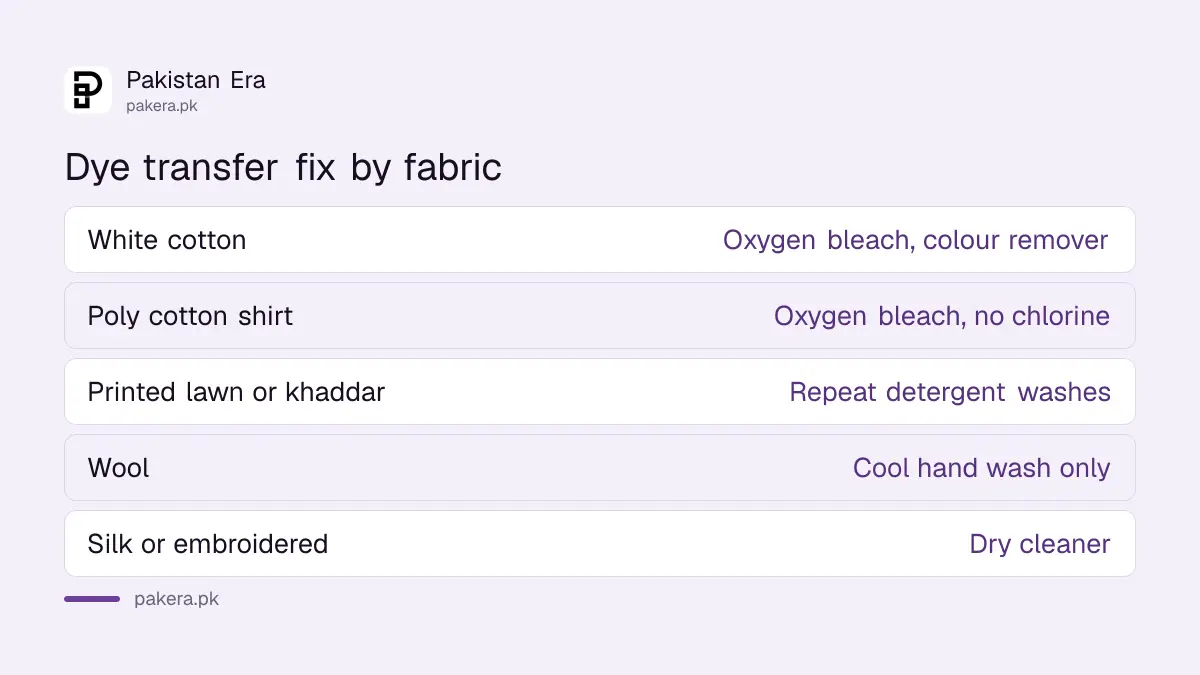
White cotton can take strong treatments. Coloured, printed and embroidered clothes cannot, because any bleach or remover will lift their own dye too. For those, stick to repeated detergent washes and oxygen bleach tested on a hidden seam.
| Fabric that took the dye | Safe fix | Avoid |
|---|---|---|
| White cotton vest, shirt, sheet | Re-wash, oxygen bleach soak; colour remover if needed | Drying before treating |
| White poly cotton school shirt | Re-wash, oxygen bleach soak | Chlorine bleach, which yellows polyester |
| Printed lawn or khaddar suit | Repeated detergent washes, test oxygen bleach first | Colour remover, chlorine |
| Wool sweater or shawl | Cool hand wash with wool detergent | Any bleach, hot water |
| Silk, chiffon, embroidered wear | A dry cleaner | Home bleaches and soaking |
The bleach signs on a care label decide what is allowed. An empty triangle allows any bleach, a triangle with two lines allows only oxygen bleach, and a crossed out triangle means no bleach. Every sign is set out in the laundry care label symbols chart.
Check a new garment for colour bleeding before the first wash
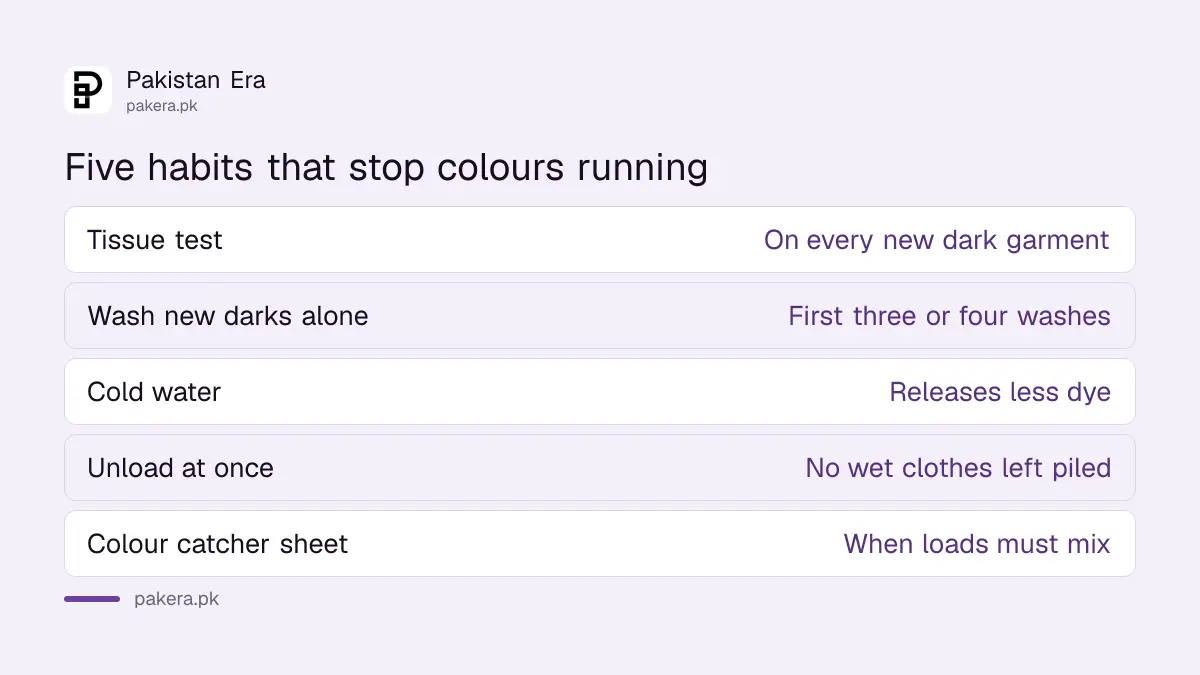
Do a 2 minute colour test on any new dark or bright garment. Wet a hidden part, such as the inside hem, and press a white tissue or cloth on it. If colour comes off on the white, wash that garment alone, in cold water, for the first few washes.
Deep reds, maroons, navy and black dyes run the most. New winter khaddar and karandi suits in these shades are a common culprit, along with dark denim and new school sweaters. The rules for washing khaddar and karandi without fading include the same tissue test and protect the suit's own colour too.
- Wash new dark clothes separately for the first three or four washes.
- Use cold water. Warm water releases more dye.
- Turn dark clothes inside out.
- Do not soak a bright garment with others, even for a few minutes.
Many detergents now include a colour bleed inhibitor, as the Texas A&M guide notes, which reduces the problem but does not stop a badly dyed garment from running.
Wet clothes left lying together also transfer dye
Dye can move without a wash. A wet dark kameez left on top of a white shalwar in a laundry basket, or clothes left in the machine overnight, can print patches of colour onto each other. Unload the machine as soon as it finishes and hang clothes apart.
Winter makes this more likely, because clothes dry slowly and get piled on chairs near heaters. Hang them with space between, and use the steps for drying clothes indoors in winter so nothing sits damp against something lighter.
Common questions
Can I fix clothes that turned pink after drying?
Sometimes. Re-wash with liquid detergent and soak in oxygen bleach for several hours. Dye set by heat may only fade, not disappear.
Does salt stop colours from running?
Salt is a common home trick for new clothes, but it does not reliably fix dye. Washing dark clothes alone in cold water works better.
Can I use chlorine bleach to remove dye transfer?
Only on pure white cotton that the label says can be bleached. Chlorine yellows polyester and strips colour from prints.
What is a colour catcher sheet?
A sheet you add to the drum that absorbs loose dye from the water, so less of it lands on other clothes.
How do I know if a new suit will bleed?
Wet a hidden part and press a white tissue on it. Colour on the tissue means it will bleed, so wash it alone in cold water.
Why did my white clothes turn grey, not pink?
Grey usually comes from washing whites with dark clothes over many washes, or using too little detergent. Wash whites separately and soak them in oxygen bleach.
How we verified this
What we checked and where we read it.
We checked the Texas A&M AgriLife Extension Quick Stain Removal Guide for washable fabrics (publication L-5199) on 15 November 2026 for its dye stain entry: re-wash quickly, do not dry, liquid detergent, then non-chlorine bleach or, on white or colourfast fabric, chlorine bleach or a colour remover, and its note on colour bleed inhibitors in detergents. Bleach label signs follow the international care symbols used on garments in Pakistan.
About the author

Lifestyle & Clothing Writer
Mahnoor Siddiqui is a lifestyle and clothing writer at Pakistan Era, joining the new lifestyle desk in November 2026.