Free Lawyer in Sindh and Balochistan: DLEC Legal Aid Up to Rs 40,000, How to Apply
Get a free lawyer in Sindh or Balochistan from the District Legal Empowerment Committee: up to Rs 40,000 a case, plain paper application, CNIC copy only.
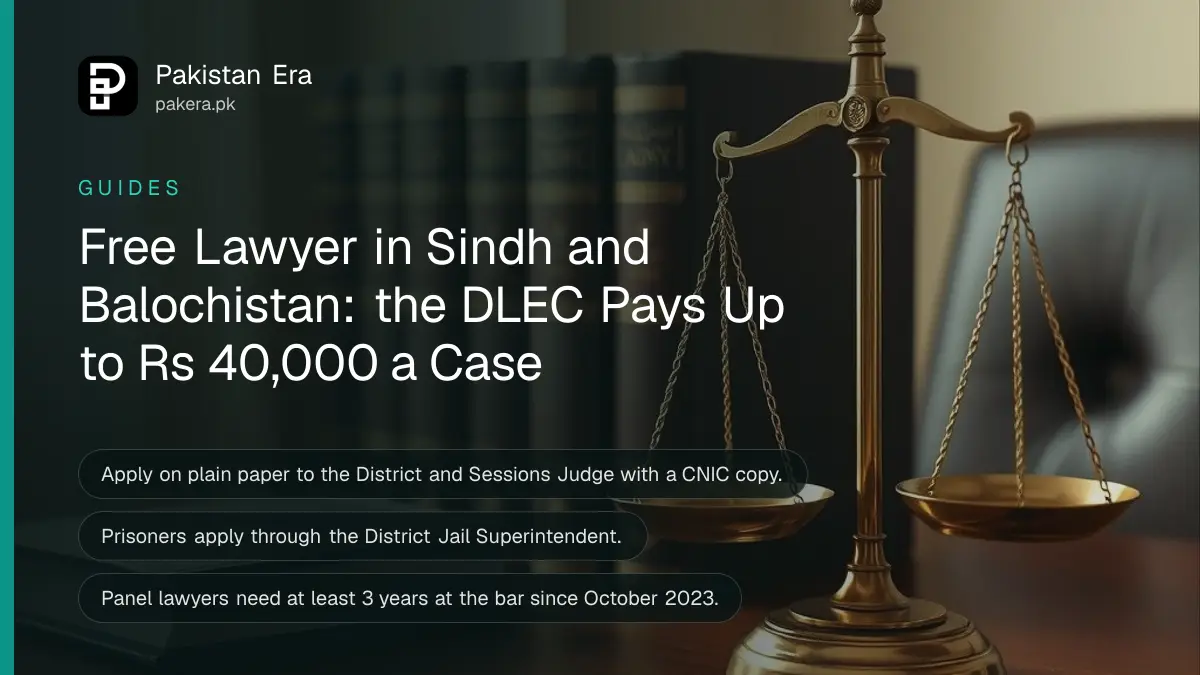
To get a free lawyer in Sindh or Balochistan, write an application on plain paper to the District and Sessions Judge of your district, who chairs the District Legal Empowerment Committee (DLEC), and attach a copy of your CNIC. The committee can pay your lawyer up to Rs 40,000 a case, plus court fee and copying costs.
The scheme runs under one set of national rules, the District Legal Empowerment Committees (Constitution and Functions) Rules, 2011, which the Sindh High Court publishes on its website. The Balochistan High Court lists the same Free Legal Aid (DLEC) service under its Public Desk. Below is what the committee pays for, who qualifies, how to apply from home or from jail, and what to do if the lawyer it gives you does not turn up.
The DLEC pays five kinds of court costs
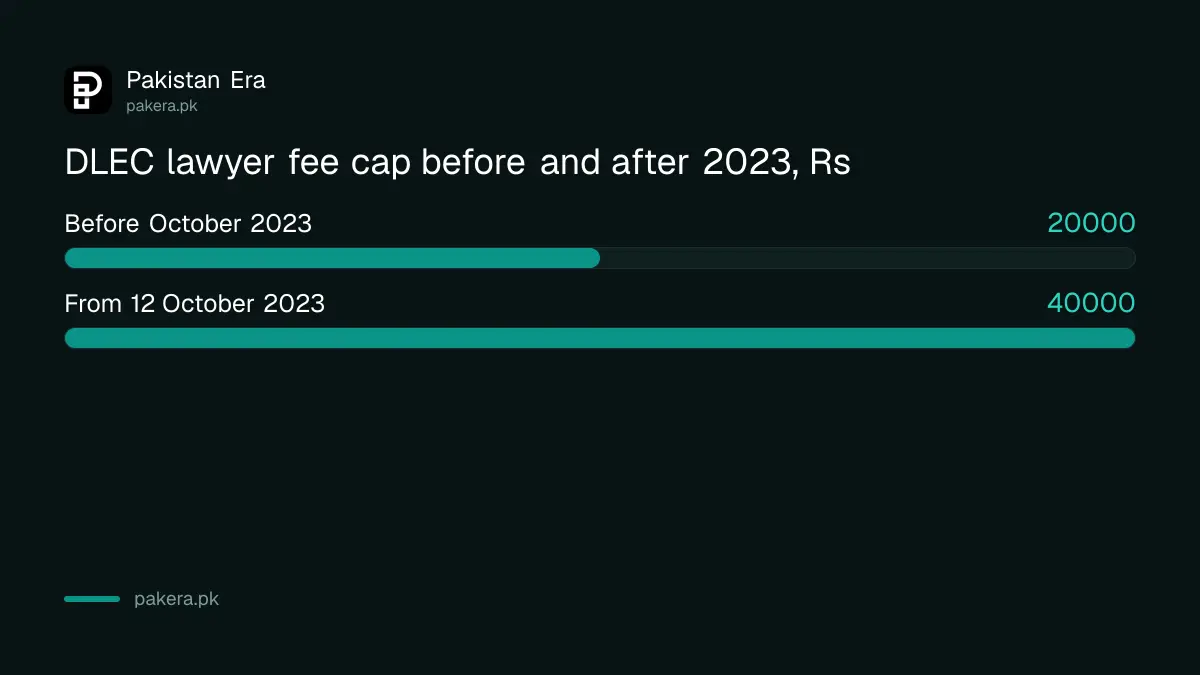
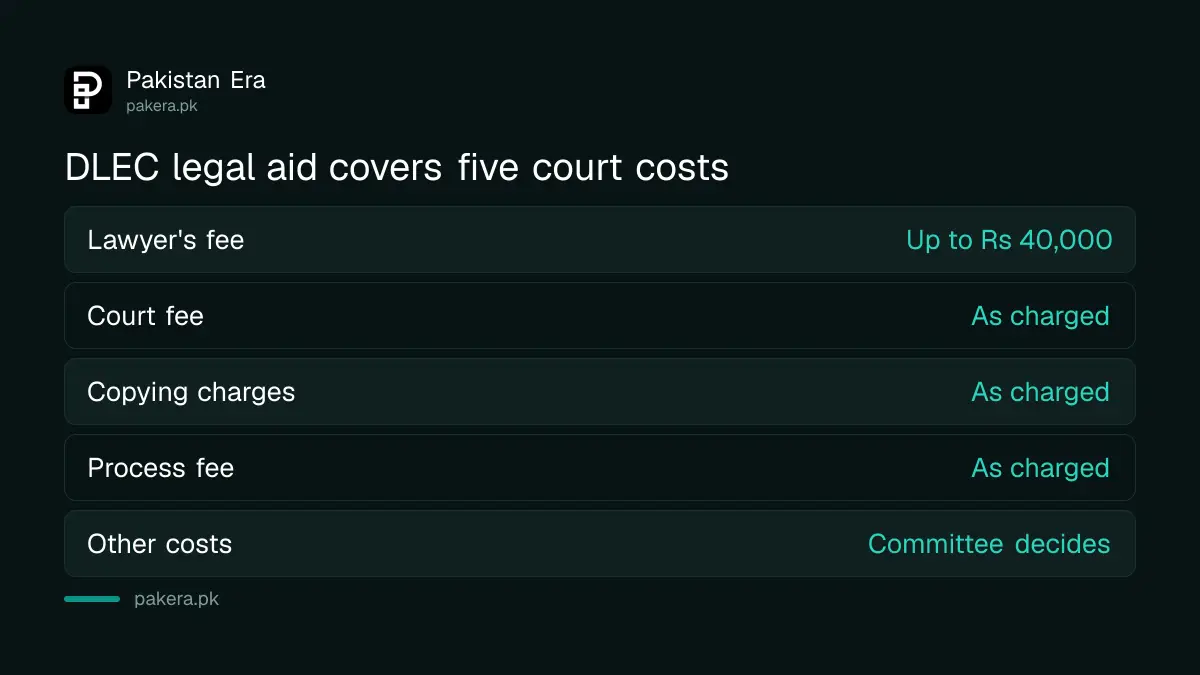
Rule 5 of the DLEC Rules lets the committee pay the lawyer's fee, the court fee, copying charges for certified copies, the process fee for summons, and any other cost it thinks fit in a particular case. The lawyer's fee cannot be more than Rs 40,000 in any case.
That ceiling was Rs 20,000 until a Law and Justice Commission notification dated 12 October 2023 doubled it. The same notification cut the experience a panel lawyer needs from five years at the bar to three.
| Cost the committee can pay | Limit in the rules |
|---|---|
| Lawyer's fee or honorarium | Up to Rs 40,000 a case |
| Court fee | As charged |
| Copying charges | As charged |
| Process fee | As charged |
| Any other cost | At the committee's discretion |
You qualify if you cannot afford to defend your rights in court
The rules call an eligible person a "deserving litigant": someone involved in a case who cannot get legal help to protect genuine rights because of limited money. Criminal, civil and family cases are all covered. There is no fixed income limit in the rules we read.
One exclusion matters. You cannot get DLEC aid in a case where an advocate, public prosecutor or government pleader has already been appointed for you under another law. If a state counsel is already on your file, the committee will not add a second lawyer.
The Law and Justice Commission's own Urdu leaflet on free legal aid says the same: any person who cannot defend legal rights for lack of money is entitled, in criminal, civil and family cases alike.
Apply on plain paper to the District and Sessions Judge
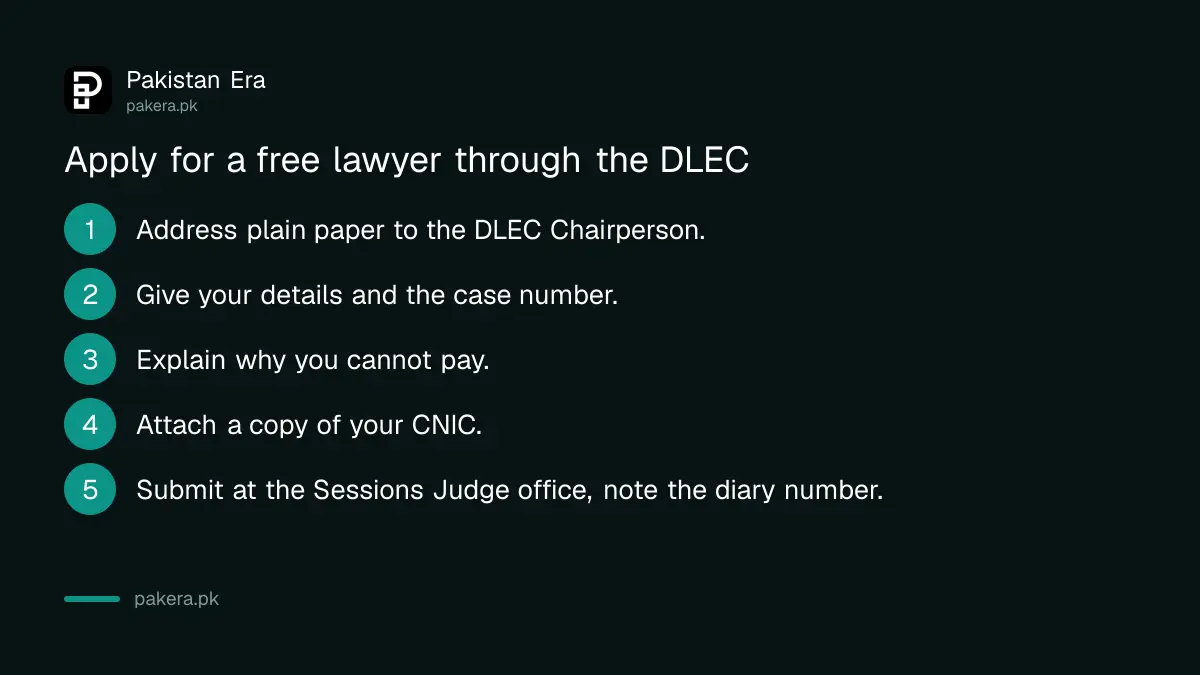
Rule 7 says the application can be on plain paper, addressed to the chairperson, who is the District and Sessions Judge. It must ask for help with the costs listed in Rule 5 and come with a CNIC or another identity document. The office gives it a diary number.
- Write a short application addressed to the Chairperson, District Legal Empowerment Committee, at your district court.
- Give your name, father's name, address and phone number, then the court, case number and what the case is about.
- Say why you cannot pay: your income, your dependants, and any debt or job loss.
- Name the help you need: a lawyer, court fee, copies or process fee.
- Attach a copy of your CNIC and any order sheet or summons you have.
- Hand it in at the District and Sessions Judge's office and note the diary number you are given.
The chairperson may send the file to someone to check your finances. The full committee then decides in its meeting, which the rules require at least once a month, with special meetings for urgent cases.
Prisoners apply through the jail superintendent
A person in jail, whether under trial or convicted, can apply through the Superintendent of the District Jail. The superintendent checks that the prisoner is deserving and forwards the application. A court hearing the case can also refer a litigant to the committee on its own.
The jail superintendent is a member of the committee, along with the Deputy Commissioner, the President of the District Bar Association and one civil society member. The District and Sessions Judge chairs it, and half the members, including the chair, make a quorum.
For a child who has been arrested, the law gives separate, faster rights to a lawyer; those are explained for a child under arrest in Pakistan.
The committee picks the lawyer and can replace a poor one
The committee keeps a panel list made with the District Bar Association President, notified for two years. A panel lawyer needs at least three years at the bar. The lawyer is paid in two parts: one when the case is assigned, and the rest after the outcome is checked.
If the lawyer does not appear or does poor work, tell the committee in writing. Rule 8 lets it replace the lawyer and strike the name from the list, and it reviews every panel lawyer once a year. A refusal is final, but you can apply again if your money position gets worse.
Other free lawyer routes if the DLEC is slow
The DLEC is not the only door. The Supreme Court's 1818 helpline links callers to bar councils, as set out for the 1818 free legal aid call centre. Islamabad has its own Legal Aid and Justice Authority, and Punjab and Khyber Pakhtunkhwa have provincial schemes too.
In Khyber Pakhtunkhwa, the DLEC sits beside a provincial agency; the free lawyer route in Khyber Pakhtunkhwa compares the two. We did not find a separate provincial legal aid law on the Balochistan Code list we searched, and we did not search Sindh's law portal for one.
Common questions
Is there a form for DLEC legal aid?
No set form is required. Rule 7 allows plain paper, though a committee can prescribe its own format. Ask at the District and Sessions Judge's office whether yours has one.
How long does a DLEC decision take?
The committee must meet at least once a month, so expect up to a month in a normal case. It can hold a special meeting for an urgent case, such as a bail matter.
Can a woman apply for help in a family case?
Yes. Family cases are covered, and the leaflet names criminal, civil and family cases together. Maintenance, custody and dissolution suits all fall in family courts.
Do I have to repay the money?
The rules we read do not ask a litigant to repay legal aid. Payments go from the committee's fund to the lawyer by crossed cheque.
How many committees are there?
The Law and Justice Commission's leaflet says 129 committees were set up across Pakistan's districts. The leaflet carries no date, so the current count may differ.
Who do I contact if the district office does not help?
The Law and Justice Commission of Pakistan lists 051-9209412 and ljcp@ljcp.gov.pk on its leaflet. In Balochistan, the High Court's Public Desk carries the Free Legal Aid (DLEC) page.
How we verified this
What we checked, where we read it, and what we could not confirm.
We read the scanned DLEC Rules, 2011 with the October 2023 amendments, and the Law and Justice Commission's Urdu awareness leaflet, both on the Sindh High Court DLEC page, on 27 October 2026. We also read the Balochistan High Court's Public Desk and Downloads pages, which list Free Legal Aid (DLEC) and the amended rules. We did not apply ourselves, so we cannot say how fast a district office answers in practice.
About the author

Tax, Bills and Technology Writer
Ali Akhtar is a young and curious voice here at Pakistan Era. He is currently pursuing his A-Levels and has a growing interest in Pakistan’s changing industrial landscape and educational trends. Ali likes to write in a way that helps him explain and explore the world around him. His writing reflects the perspective of the new generation navigating the evolving trends of Pakistan where technology, youth innovation, and shifting opportunities are reshaping the country’s future.