Gas Main Not in Your Street in Sindh or Balochistan: OGRA's 25 Metre Rule, a 45 Day Reply and How SSGC Extends the Pipeline
No gas main in your street? OGRA's 25 metre rule, the 45 day reply gas companies owe you, and how to get SSGC to extend the pipeline in Sindh or Balochistan.
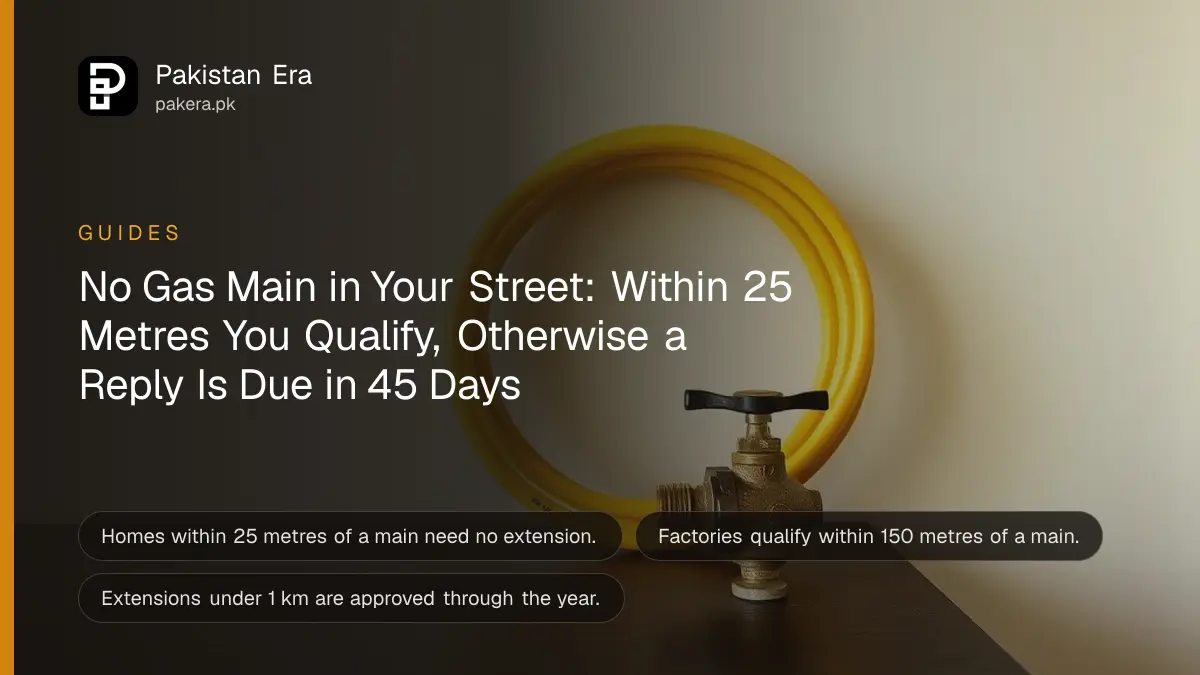
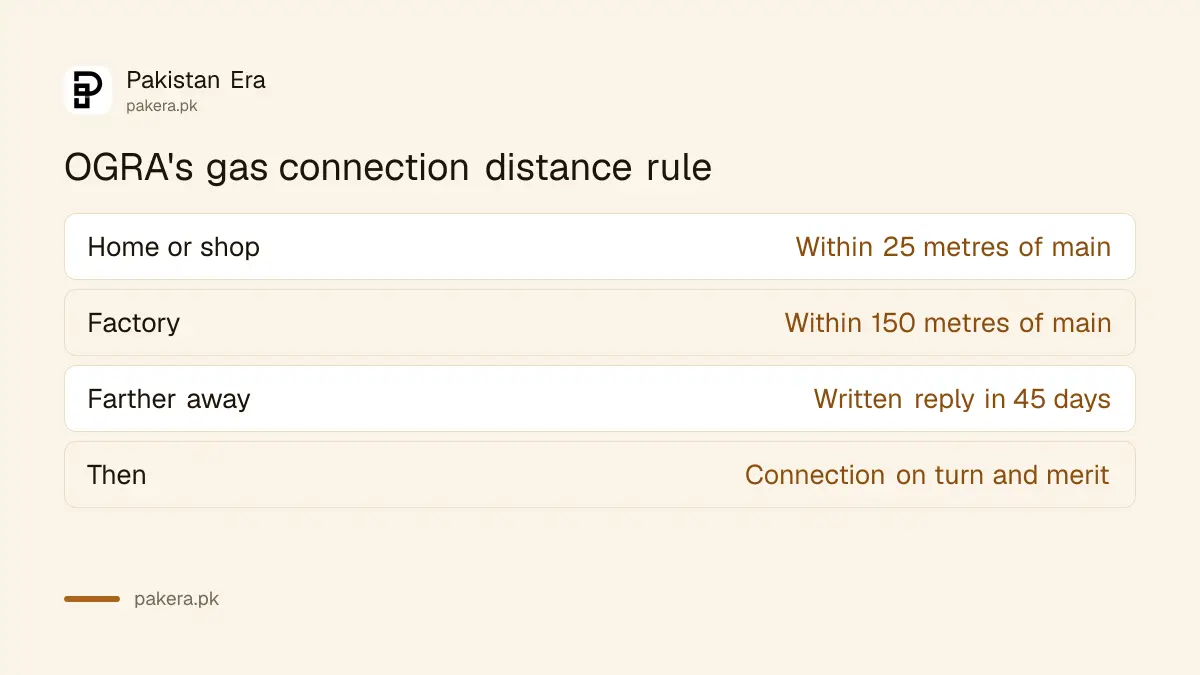
Under OGRA's service standards, a house or shop within 25 metres of an existing gas main, where no extension or reinforcement is needed, should get its connection on turn and merit; a factory qualifies within 150 metres. If your premises are farther, the gas company must tell you within 45 days either that it cannot supply you, or by when it can. In Sindh and Balochistan, SSGC then extends mains through yearly targets, or on residents' request and funding.
New colonies on the edge of Karachi, Hyderabad and Quetta often have the gas main ending a few plots short. Families apply, wait, and hear nothing. The 25 metre line and the 45 day reply are the two rules that turn that silence into an answer you can hold the company to.
The 25 metre rule decides whether you are a simple case
OGRA's standards tell gas companies to respond promptly to every request for service and issue proposal letters when the application's turn comes, if a connection is technically feasible, fair to other applicants nearby, and the premises lie within 25 metres of the main, measured perpendicularly.
| Premises | Distance from existing main | Condition |
|---|---|---|
| Home or shop | Within 25 metres, perpendicular | No main extension or reinforcement needed |
| Factory | Within 150 metres, perpendicular | No main extension or reinforcement needed |
| Beyond these distances | Any | Company replies within 45 days |
Perpendicular means the shortest straight line from your plot to the pipe, not the length of the winding street. Measure it yourself with a tape from the nearest gas service or marker. If you are inside 25 metres, your application is an ordinary one and the delay is a queue, not a missing pipe.
Beyond 25 metres, the company must answer within 45 days
If your premises are outside the distance limit, OGRA's standards require the company to inform you within 45 days of your request, either that it is unable to provide the service, or the time frame in which it can. A written answer is your right, not a favour.
Keep the date of your application and the receipt. If 45 days pass with nothing in writing, that is a breach of a published service standard. Raise it first with the company, then with OGRA. The routes are in SNGPL and SSGC gas complaints, and the OGRA side in tracking an OGRA complaint.
The standards also say the company is obliged to connect an owner or occupier on turn and merit, once the connection charges and gas supply deposit are paid and any road cutting permission is in place. Road cutting permission comes from the local authority, and it often explains a delay after payment.
SSGC extends mains through yearly targets
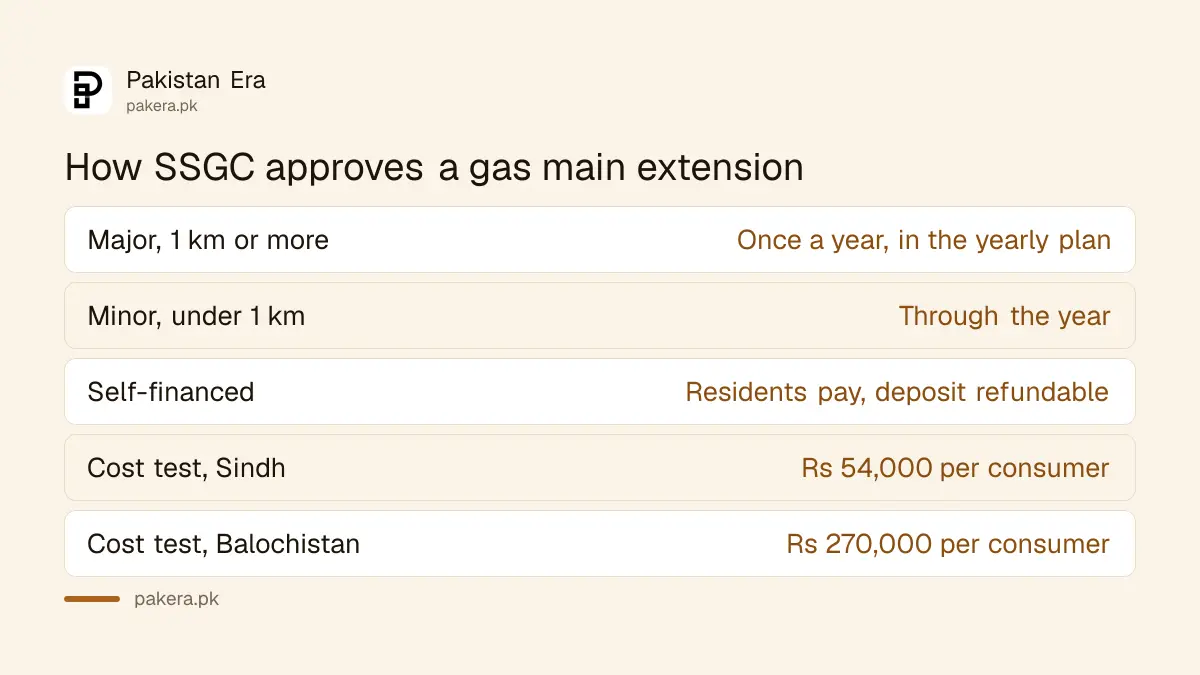
SSGC sets physical targets every year for laying new mains, approved by its board in the annual budget. A main extension of one kilometre or more is a major one, approved once a year in the Annual Development Plan. Shorter, minor extensions are processed throughout the year within an approved limit.
For a street at the edge of an existing network, you are usually asking for a minor extension. That is good news, because it does not have to wait for the yearly plan. Where gas mains already run in a town, SSGC's manual says the company continues to extend its network from its own resources in phases.
| Extension | Length | How it is approved |
|---|---|---|
| Major | 1 km or more | Once a year, in the Annual Development Plan |
| Minor | Less than 1 km | Through the year, within an approved limit |
| Self-financed | Any | At residents' request and cost |
Ask for a main extension in six steps
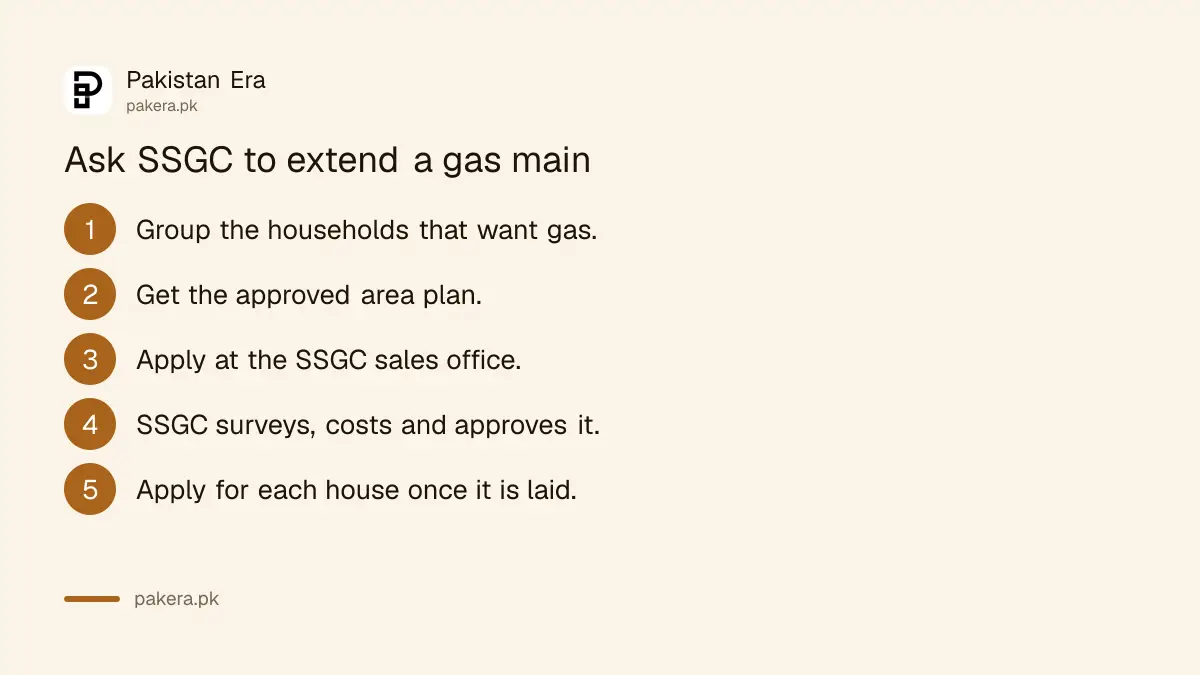
Residents, an organisation or a government body can ask SSGC to extend a main. SSGC opens a file, gets the approved area plan from the civic authority, has its planning department mark the route and pipe size, prepares a cost and feasibility estimate, and seeks management approval.
- Gather the households on your street that want gas, and agree one application with a contact person.
- Get a copy of the approved layout plan of your area from the civic authority or society, since SSGC needs it.
- Submit the request to SSGC's sales office with the plan and the list of houses.
- SSGC's planning team surveys and marks the diameter and length of main needed.
- SSGC prepares a feasibility and cost estimate, then seeks management approval and issues a work order.
- After the main is laid, apply for individual connections through registered contractors.
When a new area opens, SSGC sends a circular to registered contractors to start booking connections there, and gives residents a printed brochure on how to apply. Individual applications then follow the normal process, which today runs through SSGC's RLNG domestic connection.
Cost decides feasibility, and residents can fund the gap
SSGC treats an extension as feasible if it meets the federal government's capital cost criteria per consumer. Its manual lists Rs 54,000 per consumer for Sindh and Rs 270,000 for Balochistan, subject to change. A costlier scheme goes ahead only if someone funds the difference.
That someone can be the federal government, a parliamentarian or the residents themselves. SSGC's manual also allows extensions to new colonies financed by plot or house owners at their request. That money is treated as a special deposit that earns mark-up credited to the customer's bill account each year, and is refundable on permanent disconnection.
So a street with 20 houses and a 300 metre gap is a much easier case than five houses at the end of a long road. Grouping neighbours lowers the cost per consumer, which is the number SSGC tests. Low pressure in an area already on gas is handled differently: SSGC plans reinforcement with bigger pipes, and checking for a published notice is the first step.
Common questions
How far from the gas main can I get a connection?
Within 25 metres, measured perpendicularly, for a home or shop, where no main extension is needed. A factory qualifies within 150 metres.
What if my house is farther than 25 metres?
The gas company must tell you within 45 days whether it can supply you and, if so, by when.
Can residents pay for a gas main extension?
Yes. SSGC's manual allows self-financed extensions to new colonies. The amount is held as a special deposit earning mark-up and is refundable on permanent disconnection.
What is a minor main extension?
An SSGC extension shorter than one kilometre. These are processed throughout the year, unlike major ones approved once a year.
Why is my connection delayed after paying?
OGRA's standard makes the connection subject to road cutting permission where needed, which comes from the local authority.
Who can ask SSGC to extend a main?
Residents, an organisation or a government body can apply, with the approved area plan.
How we verified this
What we checked and where we read it.
We checked these rules on 15 November 2026. The 25 metre and 150 metre distances, the 45 day reply and the turn and merit obligation are item 7 of OGRA's performance and service standards (Gazette of Pakistan, 19 March 2019), printed in the SSGC Consumer Service Manual. The same manual's Section V sets out major and minor mains extensions, the capital cost per consumer criteria for Sindh and Balochistan, self-financed extensions, the procedure for extension, modification and relocation of mains, and the circular and brochure issued when a new area opens. OGRA's complaint route is on its lodge complaints page. SSGC's site lists new domestic applications as RLNG connections.
About the author

Tax, Bills and Technology Writer
Ali Akhtar is a young and curious voice here at Pakistan Era. He is currently pursuing his A-Levels and has a growing interest in Pakistan’s changing industrial landscape and educational trends. Ali likes to write in a way that helps him explain and explore the world around him. His writing reflects the perspective of the new generation navigating the evolving trends of Pakistan where technology, youth innovation, and shifting opportunities are reshaping the country’s future.