Government Polytechnic Institutes in Karachi: All 24 STEVTA DAE Institutes by District
All 24 government polytechnic, monotechnic and technology colleges in Karachi teaching DAE under STEVTA, by district, with technologies, fees and how to choose.
Karachi has 24 government institutes that teach the three-year DAE under Sindh TEVTA (STEVTA), spread across all seven city districts: two Government Colleges of Technology, at SITE and at Karimabad for girls, 11 Government Polytechnic Institutes, the Government Pakistani Swedish Institute of Technology in Landhi, and 10 Government Monotechnic Institutes. Five are for girls.
DAE is the Diploma of Associate Engineering, which Pakistan treats as equal to Intermediate Pre-Engineering. A regular morning seat costs Rs 4,300 in the first year under STEVTA's 2026-27 prospectus. The full list below comes from the prospectus's district-wise table of institutes, which we went through on 15 November 2026.
Admission is institute by institute, so the institute you name on the form is the one that decides your seat. That makes the choice of institute the first real decision.
Government DAE institutes in Karachi, district by district
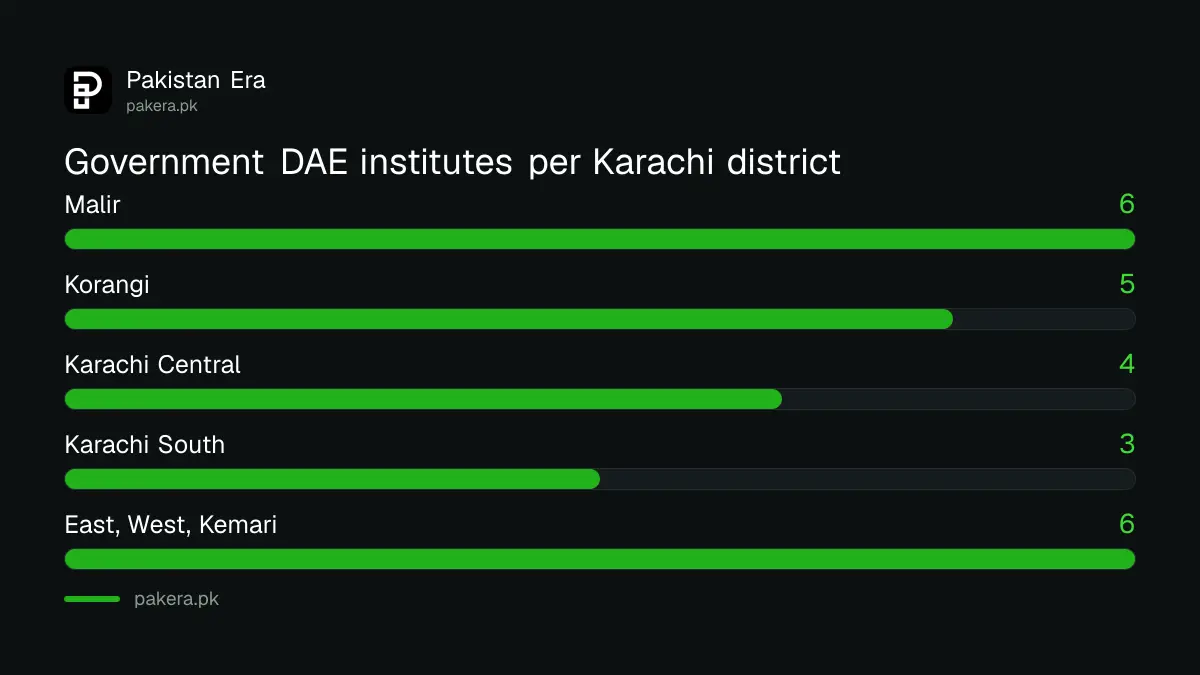
Korangi and Malir have the most institutes, with five and six each. Karachi Central has four, South three, and East, West and Kemari two each. Two of the monotechnics in East and South run from a nearby polytechnic's campus, which the prospectus marks with an "at" sign.
| District | Institute |
|---|---|
| Karachi Central | Government College of Technology (Girls), Karimabad |
| Karachi Central | Government Polytechnic Institute, Block N, North Nazimabad |
| Karachi Central | Government Monotechnic Institute, Federal B Area |
| Karachi Central | Government Monotechnic Institute, Sector 5-J, New Karachi |
| Karachi East | Government Polytechnic Institute, Sachal Baloch Goth |
| Karachi East | Government Monotechnic Institute, Gulistan-e-Jauhar (at GPI Sachal Baloch Goth) |
| Karachi South | Government Polytechnic Institute, Lyari |
| Karachi South | Government Polytechnic Institute (Girls), Lyari |
| Karachi South | Government Monotechnic Institute, Singo Line (at GPI Lyari) |
| Karachi West | Government Monotechnic Institute, Sector 7-C, Orangi Town |
| Karachi West | Government Monotechnic Institute, Sector 11 1/2, Orangi Town |
| Kemari | Government College of Technology, SITE |
| Kemari | Government Monotechnic Institute, Baldia Town |
| Korangi | Government Pakistani Swedish Institute of Technology, Landhi |
| Korangi | Government Polytechnic Institute, Sector 37-K, Landhi |
| Korangi | Government Polytechnic Institute, Sector 51-A, Korangi |
| Korangi | Government Polytechnic Institute (Girls), Sector 35-A, Korangi |
| Korangi | Government Polytechnic Institute (Girls), Sector 37-K, Landhi |
| Malir | Government Jamia Millia Polytechnic Institute, Malir |
| Malir | Government Polytechnic Institute, Asu Goth |
| Malir | Government Polytechnic Institute (Girls), Saudabad, Malir |
| Malir | Government Monotechnic Institute, Memon Goth |
| Malir | Government Monotechnic Institute, Razzakabad |
| Malir | Government Monotechnic Institute, Saudabad, Malir |
Polytechnics, monotechnics and colleges of technology all teach DAE
All three teach DAE. A Government College of Technology (GCT) is the senior type and also runs the four-year Bachelor of Engineering Technology. A polytechnic usually offers several technologies, and a monotechnic fewer. The Pakistani Swedish Institute of Technology in Landhi also teaches DAE under its own name.
- GCT: DAE plus the four-year B.Tech, under STEVTA's programme list.
- GPI (Government Polytechnic Institute): DAE in several technologies, and NVC vocational courses.
- GMI (Government Monotechnic Institute): DAE in a smaller set of technologies.
Do not pick by type alone. The technology you want, the shift and the distance from home matter more than the label on the gate.
DAE technologies taught in Karachi
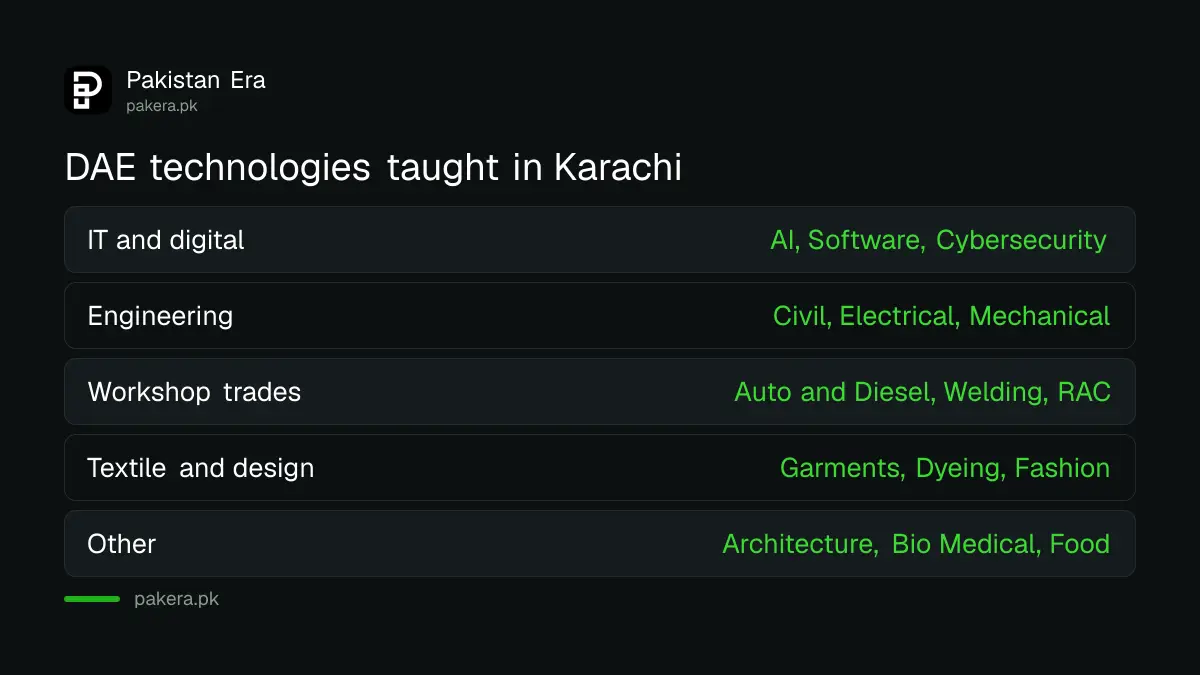
Karachi's institutes between them offer more than 25 DAE technologies. Newer ones such as Artificial Intelligence, Cybersecurity and Networks, Software and Internet of Things sit alongside Civil, Electrical, Mechanical and Electronics.
| Group | Technologies listed for Karachi |
|---|---|
| IT and digital | Artificial Intelligence, Software, Cybersecurity and Networks, Internet of Things, Telecommunication |
| Engineering | Civil, Electrical, Mechanical, Electronics, Mechatronics, Power, Chemical, Instrumentation and Process Control |
| Trades and workshop | Auto and Diesel, Refrigeration and Air Conditioning, Machinist, Welding, Wood Working and Furniture Design |
| Textile and design | Garments, Textile Dyeing and Printing, Textile Spinning, Textile Weaving, Textile and Fashion Design, Dress Designing and Making |
| Other | Architecture, Bio Medical, Food Technology, Food Preservation, Printing and Graphic Art, Secretarial |
Some technologies at some institutes run only on self-finance evening seats, which cost Rs 15,000 in the first year against Rs 4,300 for a regular morning seat. Check the shift and seat type before you set your heart on a technology.
How to choose a Karachi institute and apply
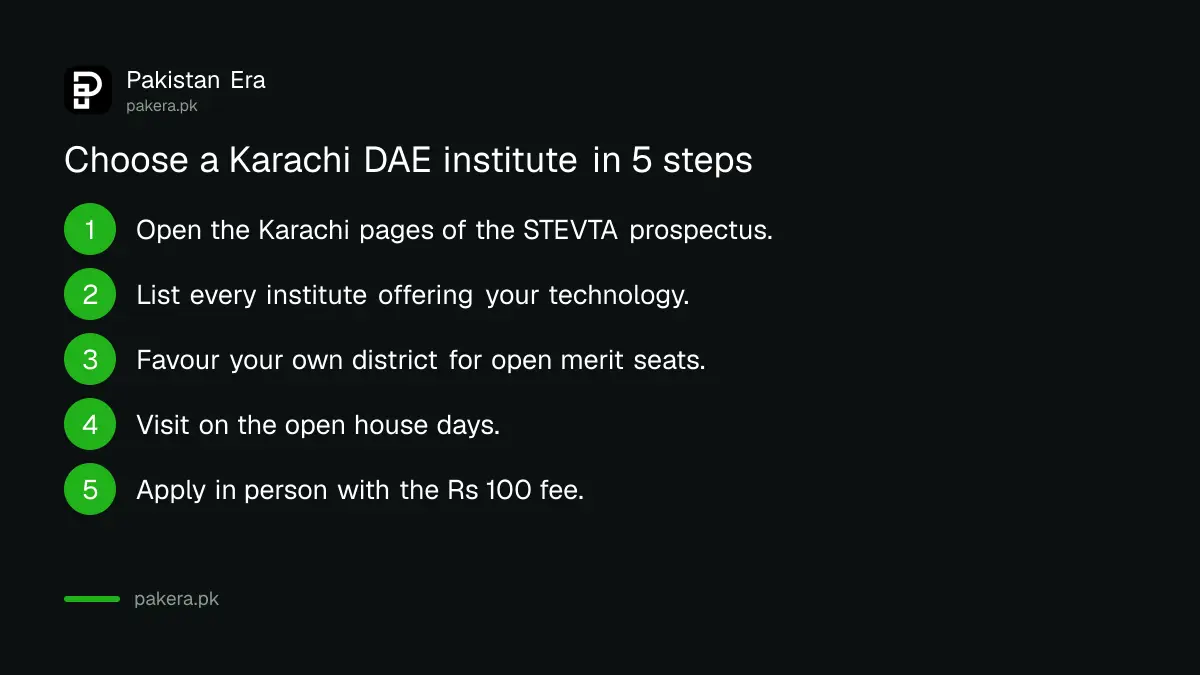
Pick the technology first, then find the institutes that offer it in the prospectus table, then rank them by shift and travel time. You apply in person at the institute with a Rs 100 processing fee, and 60 per cent of regular seats go to candidates from that institute's own district.
- Download the STEVTA prospectus for the year and open the Karachi pages of the district-wise institute table.
- Write down every institute that offers your technology, with its morning and evening seat numbers.
- Favour an institute in your own district, because 60 per cent of regular seats are open merit for that district.
- Visit during the open house days the prospectus announces, and ask about labs and transport.
- Submit the form at your chosen institute with the Rs 100 fee and attested documents before the last date.
The 2026-27 round closed on 31 August 2026. The 2026-27 advertisement came out on 21 June 2026, so the next one should come around June 2027. Girls can apply to the five girls' institutes, and STEVTA's policy also lets women take admission on merit at institutes that used to be for men only.
For how DAE compares with trade courses and NAVTTC courses, see technical education routes in Pakistan. Students with a disability apply for reserved seats with a disability assessment certificate from the DEPD in Karachi and a NADRA Special CNIC.
Common questions
How many government polytechnics are in Karachi?
STEVTA's 2026-27 prospectus lists 11 Government Polytechnic Institutes in Karachi, plus the Pakistani Swedish Institute of Technology, 10 monotechnics and two colleges of technology that also teach DAE.
Which government polytechnics in Karachi are for girls?
GCT (Girls) Karimabad, GPI (Girls) Lyari, GPI (Girls) 35-A Korangi, GPI (Girls) 37-K Landhi and GPI (Girls) Saudabad, Malir.
Where can I study DAE in Artificial Intelligence in Karachi?
Several Karachi polytechnics and monotechnics list Artificial Intelligence as a DAE technology. Ask the institute which shifts offer it.
What is the DAE fee at a Karachi government polytechnic?
Rs 4,300 for the first year on a regular morning seat in 2026-27, and Rs 15,000 on a self-finance evening seat.
Is the GCT SITE Karachi a government college?
Yes. The Government College of Technology, SITE, is a STEVTA institute in Kemari district.
How we verified this
What we checked and where we read it.
Last checked 15 November 2026. Institute names, districts and technologies come from the district-wise institute table in the STEVTA Prospectus for Academic Session 2026-2027, on the STEVTA Admissions page. Programme types come from the same prospectus, and the 31 August 2026 extension from the STEVTA Notifications page. The prospectus PDF lays out its technology and seat columns out of line with the institute names, so we list the technologies for Karachi as a whole rather than per institute. Use the printed prospectus or ask the institute for its own list.
About the author
Public Services and Education Journalist
Fajr Riaz is a journalist and content writer at Pakistan Era, based in Lahore. She covers the questions people meet in everyday life in Pakistan: how a public service works, what a change in the rules means, and where to find a reliable answer.